
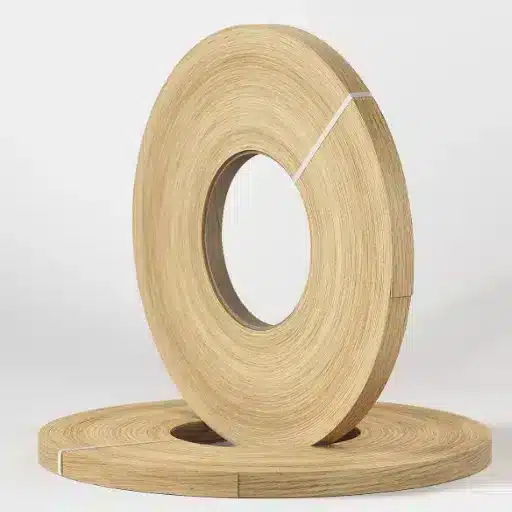
Veneer Edge Banding: The Complete Guide to Sustainable Wood Finishes
A day before her final walk-through, Maria Chen saw the part; the executive conference table was made of seamless facade oaks on its panels, but the covering of the exposed plywood edges on the return panels seemed to cheapen the room totally. In two days, the client, who happened to be a Fortune 500 officer in sustainability, was supposed to tour the space. She had done all specifications for sustainably sourced wood throughout the project. But now, I needed a finish that would match the aesthetic, would resist daily wear, and would be consistent with the building’s LEED certification. She used veneer edge banding. As a result, the transition was flawless. Raw edges were covered up with thin strips of real oak. The grain continued from the surface to the edge. The client never knew how close the project came to skirting off that fine line.
Have you ever walked into a finished project and thought, “Something seems just slightly beyond?” Could be that the edges of your panels are the culprit. Most guides to edge banding handle veneer as a technical afterthought. They tell you how to put it on, but they tend to ignore the questions that really count. Where does the wood come from? Does it match your sustainability goals? Is a commercial use something you can depend on to last under?
By the time you’ve reached the end of this, you’ll know how to choose the right type of edge banding for your project, how to apply it with confidence, and where to source it from a source you can trust. Thickness options, common application techniques, common mistakes, and the comparison of sustainably sourced veneer to its synthetic alternatives-these are some of the major subjects that are going to be widely covered. And we will also show it to you: how the right choice of edge banding can be a decisive factor in actually getting green building certifications. If you need to source some FSC-certified timber quickly for such a green building, consult our range of sustainable wood sourcing standards.
What Is Veneer Edge Banding?
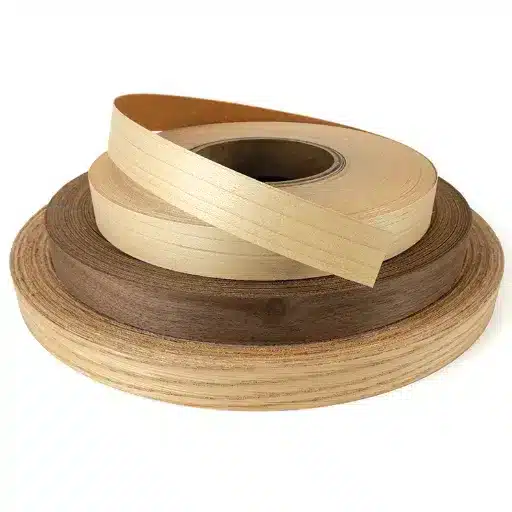
Veneer Edge Banding refers to the thin strips of wood veneer that are glued onto the unfinished edges of plywood, MDF, or chipboard. Invented to close the composite core of the boards, they even give an optical illusion of a solid piece of wood. In most cases, the strips have a paper or fiber backing and can come with a layer of adhesive activated by heat for easy fixation.
The process goes further with logs thinned from certified forest lands. The logs are either heated or watered, and when the fibers are tender, rotary lathe or plane slicing machines help cut them into fractions of millimeter-thick sheets. The slices are then dried in a continuous process and backed either with a reinforced seamless tape or a membrane. The completed product is delivered wound in a reel of natural wood flexible strip to your workshop, awaiting fixation on the edge of the panel.
This is significant as panel edges remain open and are found wherever there are man-made structures. In built environments, panels are used for aesthetics and structural efficiency in the manufacture of cabinetry, shelving, furniture, and millwork. Exposed borders reveal unattractive edges, such as the multiply structure of plywood or rough particle board edges, and create a break in the aesthetic flow within the framework. Veneer Edge Banding keeps the aesthetics intact as it enhances the look of thickness of the panel, which is actually the surface material that is extended to the edge only, thus conserving cost and the environment in the process.
It can serve as a short strip at the ends of home kitchen cabinets as well as in expensive interior designs. Designers point it out for use in fixing up reception areas and even wall cladding. Carpenters employ it to make desks and chests. In contrast, Seeks the solution from joiners for built-in casework that demands cost balanced with function. Cut and fix the edge to make it appear like a wooden piece, durable and compliant with the environmental promises of the structure being built.
Types of Veneer Edge Banding

Not all veneer edge banding is created equal. The type you choose affects appearance, durability, application method, and environmental credentials. Understanding the options helps you match the product to the project.
Natural Wood Veneer
Natural Wood Veneer is derived from the core of the log without any polishing. It retains the original grain pattern, color reappearance, and other traits of the tree it is derived from. The major species are pine, ash, mahogany, sycamore, and poplar. It is considered the best preference when authenticity is the ultimate goal. It is because natural wood production comprises variation, which is impossible to control. No two rolls are ever the same in patterns of the grain may vary across different boards. Engineered types of veneers are commonly used for these types of projects.
Engineered and Reconstituted Veneer
Engineered veneer is another name for reconstituted veneer. The process involves combining softer woods, such as Poplar or Ayous, into a colour, then laminating them into a block. A controlled, uniform grain pattern is then created when this block is sliced into a veneer. The advantage of this process is that it enables manufacturers to reproduce rare or exotic species without cutting down rare trees. It also does away with the variances that come with natural timber. Large projects in which every panel must match benefit engineer veneer more because it offers a level of predictability that is not to be found naturally, edge banding.
UV Prefinished Veneer
A UV finish is applied to the veneer before shipping it to your shop. This ensures that every sheet comes with a very clear and evenly dispersible ultraviolet-cured coating. This significantly reduces the time taken to apply stain, seal, and topcoat after installation. It is also scratch-resistant and strongly resistant. It gives a great consistency of finish. But, it will keep you from cu stom-stain ing the edge to any specified color. This is best used if the surface of the veneer pane is pre-finished and the match is predetermined.
Pre-Glued vs. Non-Glued
Fused or pre-finished edge tapes feature the glues that are activated by heat at the back. Using a regular clothing iron or heat gun allows the melting of this sprayed glue to obtain bonding between the tape and the varnished panel’s edge. It is the most feasible option for small shops and for DIY purposes. An additional gluing process must be performed for unglued veneer. The most common can be contact cement, PVA wood glue, or a hot-melt adhesive, including a tape edge banding machine. In a fast-moving production environment, non-gluing products are critical for higher speed, higher bonding strength, and improved resistance to moisture.
Backing Options
Paper backing is the general practice for most pre-glued veneers. It provides strength during its application and enables the veneer to deal with slight imperfections in a panel edge layout. Fleece backing, on the other hand, extends the adjustability feature, and it is most suitable for applications on curved or contoured edges. Non-backed veneers would be less noticeable in edge bandings, but they can even correspond to special applications. Maximum pliability or thinnest in its nature will describe specific purposes where unbacked veneer could be most successful.
| Type | Best For | Key Advantage | Consideration |
|---|---|---|---|
| Natural wood veneer | Custom finishes, authentic grain | Can be stained and finished to match any surface | Natural variation between batches |
| Engineered veneer | Large commercial projects, consistency | Uniform grain, replicates exotic species without endangering harvesting | Less authentic under close inspection |
| UV prefinished | High-volume production, speed | No post-installation finishing needed | Limited custom color matching |
| Pre-glued | Small shops, DIY, quick repairs | Iron-on application, no separate adhesive needed | Bond strength is lower than that of industrial adhesives |
| Non-glued | Production shops, heavy-use environments | Stronger bond with PUR or EVA adhesives | Requires an edge banding machine or manual gluing |
Thickness Guide: Choosing the Right Veneer Edge Banding
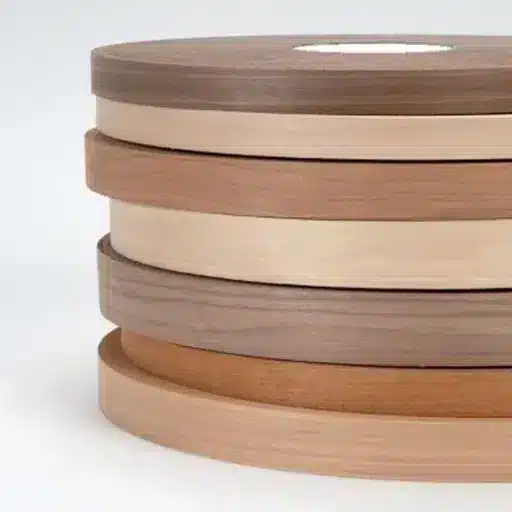
Thickness defines the volume of actual material to work with after application. It refers to durability, sandability, and the final profile of the edge.
Normal veneer edgeband is 0.4 mm to 0.5 mm thick. This is the most commonly seen description in building cabinetry and furniture. And it is thin enough to cover a panel edge and thick enough to endure a bit of sanding and finishing. For most interior applications, this amount is the optimum balance of performance and costs.
The thicker ones extend from 1 mm to 2 mm. Sometimes they are considered representatives of the thick ones, heavy-duty, or extraordinary ones. This enhances sanding with heavier performance, edge profile routing, and greater resistance to impact. Thick veneer is usually specified for commercial furniture fixtures, retail fixtures, or any high-use setting where edges will receive some sharp treatment. Its shortcoming is that it lacks flexibility. Thick veneer has a hard time extending over some of the minor bows or defects on a substrate edge.
Considering the thickness of the veneer, thin veneers should generally be 0.2mm-0.3mm. It can be used when it is essential to pack as narrowly as possible; while it can be good to be placed on delicate furniture, tight-radius curves, and projects where the edges must remain as slim as possible, it allows little or no margin for sanding or rework. One error when trimming, and you are through to the substrate.
When it comes to selecting the thickness of veneer, paying attention to the final use is essential. A domestic residential cabinet, which remains in climate-controlled conditions, may see good service from standard 0.5mm veneer. The thickness of a hotel reception desk or restaurant bar front can be anywhere between 1mm and 2mm. On curved architectural elements or in those intricate furniture details, a thinner veneer could provide the flexibility you may require therein. Always ask for samples and try on scraps before fielding a full production run.
How to Apply Veneer Edge Banding: Step-by-Step
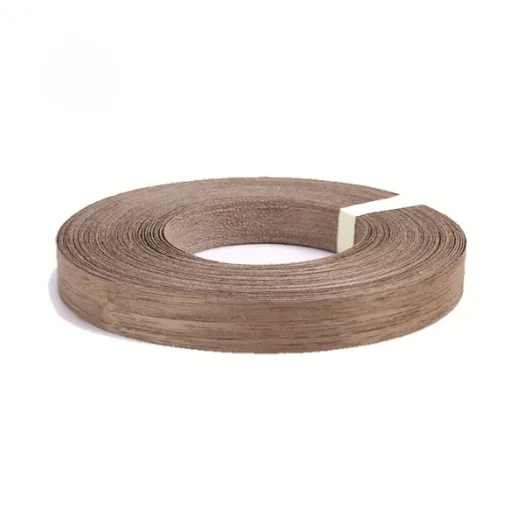
Application quality makes the difference between an invisible edge and an obvious patch. The method you choose depends on your tools, volume, and tolerance for perfection.
DIY Iron-On Method
Pre-glued veneer edging was designed primarily for processing. The cotton setting on an iron (about 390 degrees Fahrenheit) is necessary to activate the adhesive. The veneer strip should be cut to be just slightly longer than the panel edge and attached with the glue side toward the raw panel edge. Apply firm and even pressure to the area using the iron, moving at a slow pace along its length. The majority of adhesives require 15-20 seconds per inch for full activation.
After bonding, let the edge cool for a minute. Then trim the overhang. Ends work best by a sharp chisel. Lay the flat against the panel face and tap against the back so that it cuts cleanly. For top and bottom overhangs, use an edge trimmer tool to cut flush at one go. If you don’t own such a tool, any sharp utility knife or sandpaper block could also do the trick if you have the patience for it. Finally, blend the veneer into the panel surface by lightly drawing 220-grit paper along this edge.
Professional Edge Banding Machine Method
Production shops rely on automatic edge banders for speed and consistency. These machines feed the panel through a sequence of stations. The first station applies hot-melt adhesive to the panel edge. The second presses the veneer banding firmly into place. Subsequent stations trim the overhang, scrape the edge flush, and buff the surface.
The adhesive choice matters significantly. EVA hot melt is the most common. It bonds quickly, is easy to clean, and can be reheated if adjustments are needed. PUR hot melt offers superior bond strength, faster curing, and better moisture resistance. Once PUR cures, it cannot be reheated. This makes it ideal for kitchen and bathroom applications where humidity fluctuates. The trade-off is that PUR requires more precise application because mistakes are harder to fix.
Effective Surface Preparation Practices
Messy preparation of the surface is considered to be the most potent enemy. Panel edge should be clean, dry, and flat. Place the veneer on the panel edge only after all the bumps and squeezed-out glue have been sanded smooth. Dust and debris are a hindrance to complete adhesion due to incomplete contact with the adhesive. A light swipe with a clean cloth from time to time will remove most loose particles.
This is an important detail in most guides rarely tackled. Do not do a sealing of the edge of the panel with shellac, varnish, or any other coating before applying the edge banding of the veneer. Even pre-glued veneer that uses heat-activated adhesive ingredients needs a coarse porous surface for effective bonding. Any edge sealed is repellent to the adhesive and promises to peel away in a week. Keep the edge raw and dry-sand it for maximum adhesion.
Trimming and Finishing
Even with perfect application, trimming separates amateur results from professional ones. End trimming should leave the veneer perfectly flush with the panel ends. A sharp chisel guided by the panel face gives the cleanest result. For the long edges, an edge trimmer with dual blades cuts both the top and bottom overhang simultaneously. After trimming, sand the edge lightly with fine-grit paper. Round the corners slightly to prevent chipping. If the veneer is unfinished, apply your chosen stain and topcoat to match the panel surface.
Veneer Edge Banding vs. Synthetic Materials: A Sustainability Comparison
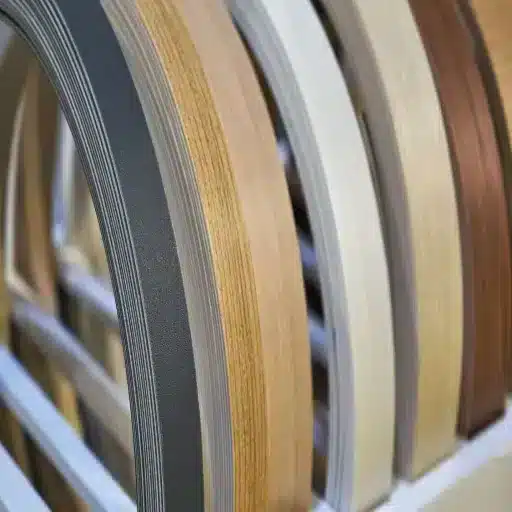
There are basically three materials that come into play when edge finishes are being discussed. Wood veneer, PVC, and ABS every material stand on their own merits. Consumption of these materials is determined by their performance requirement, environmental concerns, and disposal mechanisms.
Veneer Edge Banding is a product of only one category. When managed under a license that promotes beneficial cutting of trees, carbon storage, and species richness. It also poses no problem at the end of its useful life as it is biodegradable, and wood is a natural material. There is no problem where plastic takes hundreds of years to rot, more so under landfill conditions. Yet, it is sensitive to moisture. In damp locations, wood draws in moisture and bulges and ultimately breaks away. It also has to be applied with more caution during the installation process.
In terms of market share by volume, PVC edge banding is the most popular. The banding has the advantage of being water and impact-proof for external strain, plus it requires little or no maintenance. That is why it is a convenient and reliable choice for furniture like kitchen cabinets, laboratory, and commercial furniture that are always at risk of damage. The only problem is that this is not eco-friendly. PVC is made up of petroleum and chlorine. It is not compostable. While recycling would be an option, the chemical configuration makes recycling an unachievable, almost impossible proposition. Incineration generates dioxins. Therefore, when it comes to projects with green and sustainable goals, there is no way to deal with PVC without a negative compromise.
The ABS resin band has an intermediate position between the above-mentioned examples. In contrast to PVC, which is a plastic made from petroleum, this one lacks gas content, especially chlorine. That is why it is believed to be more recyclable, which means that it is less dangerous for the environment once it has served its time. It is sturdier and more moisture resistant, and even though it is not exactly like PVC, these characteristics could also apply to this one. It’s common in the market to find people trying to promote a bit of environmentally friendly synthetic resin, namely, ABS. It can be said that when compared to veneered PVC, it is better. However, this too is a product of fossil fuels and, therefore, cannot be degraded or decomposed by the environment.
James Okonkwo faced a similar situation while deciding on finishes for a residential project of 200 units in Lagos. Actually, the use of PVC edge banding was prescribed throughout. However, the project was targeted at achieving green building certification, and the environmental consultant raised PVC as a working material and its impacts. James opted for a Veneer Edge Banding made out of FSC oak for all domestic funeral water work cabinets and ABS for wet units such as kitchen and bathrooms. The green rating of the building was granted. The developer managed to reduce the costs of materials used in dry zones. Additionally, the oak veneer contributed to the decor of the room in a manner that PVC could not.
| Factor | Wood Veneer | PVC | ABS |
|---|---|---|---|
| Source | Renewable, biological | Petroleum, chlorine-based | Petroleum-based |
| Moisture resistance | Poor, swells in humidity | Excellent, fully waterproof | Very good |
| Impact resistance | Moderate | High | High |
| Biodegradable | Yes | No | No |
| Recyclability | Low, organic waste | Complex, limited infrastructure | Better than PVC |
| VOC emissions | Very low if unfinished | Modern low-VOC available | Low |
| Custom finishing | Stainable and finishable | Limited color options | Limited color options |
| Best application | Dry interiors, premium aesthetics | Wet areas, high-traffic commercial | Balanced performance needs |
The decision framework is straightforward. Choose sustainably sourced wood veneer edge banding for dry, climate-controlled interiors where aesthetics and environmental credentials matter most. Choose PVC only when moisture, chemical exposure, or extreme durability is non-negotiable. Choose ABS when you need synthetic performance with a slightly lower environmental burden. For projects pursuing LEED, BREEAM, or WELL certification, the documentation advantage of certified wood veneer often makes it the only viable choice.
Sustainable Sourcing: What to Look For
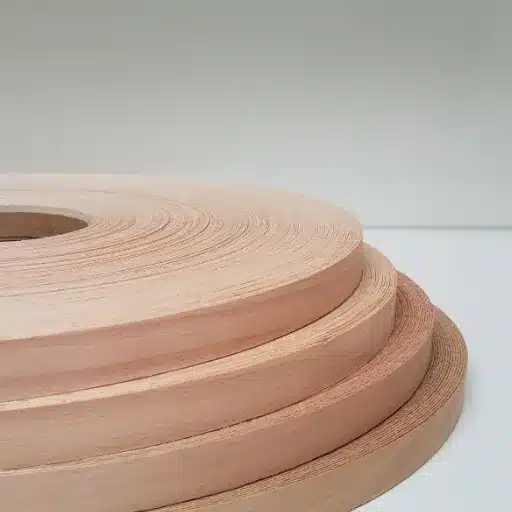
Wood veneer does not always have homogeneous environmental credentials. What differentiates them is the country they came from, the technology, and the means of transport used while processing timber.
The Forest Stewardship Council (FSC) introduces the most recognised system of responsible forest management.. The principles of such management are anchored within the environmental and socio‐economic limits. Outside protection of biodiversity and respect for the rights of the Indigenous people, clear-cutting of tree cover is never permitted beyond the level of regrowth. Veneer Edge Banding, which is specifically FSC certified, is one of the chain of custody features available as it traces all the materials to such forests.
A certification through the Programme for the Endorsement of Forest Certification (PEFC) is another option that has similar outcomes. It takes into consideration the local laws and traditions, advocating for forest management on a country scale. European and Asian suppliers are mostly PEFC certified. Both schemes – the FSC and PEFC – deliver reliable guarantees. In many cases, this is dictated by the presence of one system in the region or by the customer’s wishes.
Proving real claims is the chain-of-custody declaration, rather than simply labeling or any other soft language. A declaration letter from a supplier does not cut it. There must be a traceability document that relates the material approved in the forest to the final product, e.g., a roll. This is essentially known as a chain-of-custody certificate from the accredited certification body. Ask your supplier to present this document to you before declaring the material as certified in the project.
With respect to the use of adhesives or backing sheets, these are key factors to take into consideration. Some of the backing or pre-glue seals in place in some of the Veneer Edge Banding might also have adhesive with formaldehyde ingredients. Now solutions are emerging with non-toxic glue and low-VOC in-built glue or backing sheet options. Such indoor air quality considerations are necessary for projects requiring WELL certification or design in which inhabitants who are susceptible to fineness should be present.
The veneer edge banding from VitalWood Global is obtained solely from forests that are certified as FSC and PEFC sources. Chain-of-custody dossiers are offered on each unit order. Where pre-glued veneer edge banding is concerned, low-emissions adhesives are applied. We think of transparency not as a bonus merchandise. We understand that it is the threshold.
Choosing Veneer Edge Banding for Green Building Projects

Green building certification standards are a way to reward the use of those materials that reduce environmental toxicity while also improving occupant health and wellness. Veneer edging helps contribute to several credit categories, correctly documented and sourced.
Materials have been interpreted under the Building Product Disclosure and Optimization credits in LEED Version 4.1. FSC-certified wood products directly add to the Responsible Sourcing of Raw Materials credit. The point is documentation. You will have to provide receipts, chain-of-custody certificates, and product data that confirm the veneer has the FSC standards. The percentage of certified wood against total wood products on the project will determine the points that are given.
Credits are given by BREEAM for responsibly sourced materials according to the Mat 03 category. The operation of FSC and PEFC certifications is acknowledged. The proportion of certified timber by value across the project is the criterion by which the matter is adjudged. It is against this backdrop that specifying certified veneer edge banding for all visible wood edges increases overall proportion rather than costs.
The main objective of the WELL Building Standard is to improve the indoor quality of the setting. Materials within the concept were supposed to have low VOCs and be free of formaldehyde. These should be supported by coating veneer-edge banding with water-based finishes and bonding with adhesives made in nontoxic materials. Veneer, by virtue of the fact that it is natural and minimally processed, typically outperforms all synthetically made alternatives in VOC testing.
The selection of species may also come into play. For example, some certification systems might include awards for certified wood use of rapidly renewable species, reclaimed wood, and regional materials. Bamboo, as an example, is a grass plant with a short growth cycle. Reclaimed timber veneer uses wood that has been repurposed from a demolished building. Reduced transportation and LEED Regional Materials contribution to Regional Sourcing might be added benefits.
Common Mistakes and How to Avoid Them
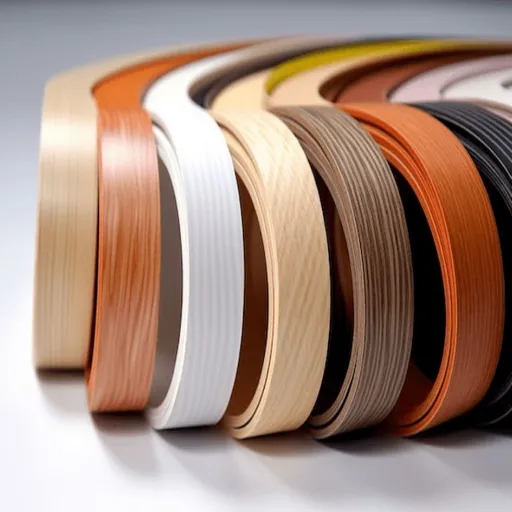
Even the well-perfected craftsman tends to make mistakes in laying veneer edging. Most of these errors are avoidable by attending to specifics.
The failure is attributed to poor preparation of the surface as one of the most common reasons. Dust, oil, and even old finish on the edge of the panel can prevent the bond between the adhesive and the substrate. Level the edge through sanding and wiping clean before applying. Then, a quick pass with 120-grit sandpaper will create enough bump on the surface to form a bite for the glue.
Incorrect temperature and pressure when edging during application usually make the bonds too weak or scorch the veneer. Most irons are within the right range when set on cotton; variations exist, however. Test scrap first. If the glue does not stick during a slow pass, increase the temperature slightly. If the veneer becomes dark and smells burned, your iron is too hot. Verify the temperature in the glue pot and the settings of the pressure rollers against the manufacturer’s required applications.
When you don’t burnish the edge, you have lumps that poke out and snag clothes, collecting dirt. Trim the ends first, and then the top and bottom edges. Flush trimming gives a craftsman look; the teeniest of overhangs may be seen with raking light.
One of the most common visual lapses of people hinges on mismatching finishes between the panel surface and the edge banding. For example, just because your panel is dark walnut and your veneer is a natural oak, there will be no way that it won’t call attention to itself-every perfect edging will have it remain conspicuously there. You should order unfinished veneer and stain it to match or specify that the veneer is already prefabricated and now in the factory, and matched to your panel.
Ignorance of the realities of moisture and environment would result in utter disaster. Woods expand and contract. Veneer may bubble up or lift from the edges where it comes in contact with very high humidity fronts. Or, in case of extreme dryness, shrink back to expose its substrate. Get the veneer or the panel acclimatized to the installation environment at least 48 hours before applying anything. No reason why it should be done in a high-variability moisture-controlled space before the HVAC is up and running.
Custom Veneer Edge Banding for Architects and Designers
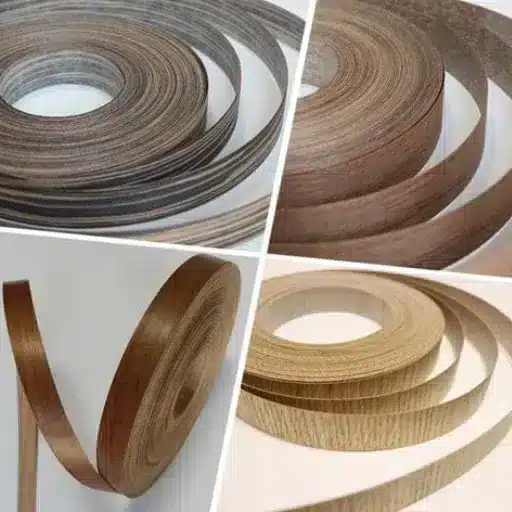
Standard rolls work for standard projects. But when the design calls for something specific, custom veneer edge banding bridges the gap between concept and reality.
Species matching is the most common custom request. A project might specify quarter-sawn white oak for the panels, and the architect wants the edges to match exactly. We can source veneer from the same log or production batch as the panel material. This ensures grain continuity and color consistency across every surface.
Custom widths accommodate non-standard panel thicknesses. While 22mm and 25mm are common cabinet thicknesses, architectural millwork often uses 30mm, 40mm, or even thicker panels. Ordering veneer edge banding in the exact width eliminates waste and reduces trimming time on site.
Crafted veneer affords yet another means by which one might personalize. Due to the fact the grain pattern is generated and not inherent, it renders possible consistent productions in lengths and quantities that were impossible with natural timber. For example, if there is a big commercial rollout involving 20 locations, then it is every reception desk that must look the same.
Through bulk and wholesale ordering, the customers can avail themselves of ordering possibilities that support their volume needs from contractors and furniture makers. Scheduled deliveries will keep production lines active without having unwanted inventory in the warehouse. Moreover, dedicated account management delivers continuity throughout recurring orders.
For the boutique hotel designed in Barcelona by Elena Vasquez, European walnut headboards and desks were specified in all of the guest rooms. The biggest problem consisted of finding a match for the veneer edge bands used for the specific hand-chosen panels sourced from a small Italian mill. The only choices available turned out to be too red or too pale. A custom unilateral run of engineered walnut veneer edge banding was developed to match the custom panel samples that were handed. In 87 matching rooms that opened to design features in Architectural Digest, there was an edge that blended perfectly into the surface. Elena has always specified custom-matched veneer in every project since then.
Conclusion
The veneer edge banding is the finishing detail that completes the illusion of a solid wood-crafted project while still maintaining the efficiency and stability that modern panel products have to offer. It also becomes the voice that delivers the values behind the whole project, which is sourced responsibly.
To summarize, it should be as easy as determining what sort of veneer would suit your requirements, both from a performance and aesthetically pleasing aspect, as well as selecting the most likely thickness that could sustain the operational environment. Surface preparation should be well performed, without sealing the edges before mounting. Source your paper from a supplier who has a chain of custody of certification documentation. The appearance and sustainability should therefore be matched to let real wood veneer edge banding do the work on behalf of synthetic alternatives.
The global market for edge banding is anticipated to grow constantly through 2033, but growth is not just enough. The idea is to construct the spaces that look exceptional, work reliably, and leave the least light footprint, and for the choice panel edge, you can make such opportunities.
Ready to specify sustainably sourced veneer edge banding for your next project? Contact our team to request samples, discuss custom matching, or receive chain-of-custody documentation for your green building certification.