

Wood Veneer Panels: The Complete Guide to Selection, Installation, and Sustainable Sourcing
Wood veneer panels are thin slices of real hardwood bonded to engineered cores like MDF or plywood, giving you the authentic look and warmth of solid wood at a fraction of the cost and environmental impact. The most sustainable method to introduce natural wood to indoor environments creates 45 times more usable space from wood timber than solid planks.
Most guides will not provide this information to their readers. The difference between a veneer panel that lasts 25 years and one that starts peeling in 18 months rarely comes down to the wood species on the surface. The panel performance depends on substrate selection and adhesive quality, edge banding, and the ability of the seller to provide certified forest origins.
The creation of this guide serves our specific purpose. The guide will teach you how to select appropriate wood veneer panels and install them properly, and confirm that your materials meet sustainability requirements. Our presentation will include information about panel types and construction methods, substrate selection, sustainability certification processes and best installation practices, and cost projections for 2026 and current design trends that are influencing the industry.
Key Takeaways
- Wood veneer panels use 95% of raw material and yield 45x more surface area than solid wood, making them one of the most sustainable wood products available.
- Substrate selection matters more than species choice: MDF for decorative walls, plywood for structural applications, and fire-retardant cores for commercial code compliance.
- FSC and PEFC certification with documented chain of custody is the only reliable way to verify sustainable sourcing claims.
- Professional installation with proper adhesive, pressing parameters, and edge banding can extend panel life from 10 years to 25+ years.
- Standard wood veneer panels cost 10–25 per sq ft in 2026; premium species and acoustic panels range from 40–40–100+ per sq ft.
What Are Wood Veneer Panels?

Wood veneer panels are composite products made by bonding a thin layer of real hardwood to a stable engineered core. The face veneer has a thickness range that extends from 0.5mm to 3.0mm. Different cutting techniques produce various grain patterns from log slicing. The process involves applying a thin wood slice to a substrate core, which results in a panel that resembles solid wood while achieving superior performance in actual usage.
The construction process requires attention to detail but maintains a simple approach. A typical panel has four layers: the decorative face veneer, an adhesive bonding layer, the structural substrate core, and a balancing backer veneer that prevents warping. The engineered layers of the panel system work together to create a dimensionally stable panel that maintains its shape through changing humidity levels, which cause solid wood materials to expand and contract and develop cracks.
This construction method holds great importance for sustainability reasons. One cubic meter of responsibly harvested timber, sliced to a standard 0.6mm thickness, produces approximately 900 square meters of veneer surface. The same cubic meter of solid timber might yield 20 square meters of plank surface. The efficiency improvement constitutes a substantial enhancement. The 45-fold material yield growth enables veneer manufacturing to achieve up to 95% utilization rates, which stands in contrast to solid wood milling practices that generate higher waste percentages.
Only about 3% of felled trees are suitable for veneer production. From that elite group, only 15% of trees produce wood that meets the standards for premium commercial applications. The global production of veneer accounts for less than 0.5% of all timber harvested from forests. Choosing wood veneer panels allows you to select an eco-friendly option that uses top-quality timber from the best resources on Earth.
Want to understand the full range of veneer options beyond panels? Our guide to wood veneer fundamentals covers sheets, cuts, and species in detail.
Types of Wood Veneer Panels
By Veneer Type
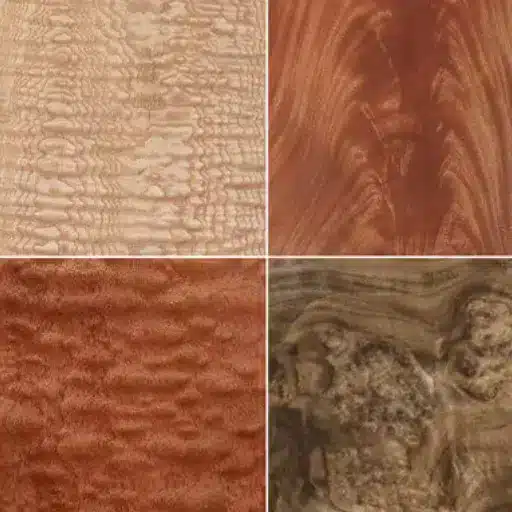
Natural veneer is produced through the direct slicing of hardwood logs. Every sheet exhibits individual characteristics because it displays the actual tree growth patterns and color differences that exist in the original tree. The most commonly used panel face materials include oak, walnut, maple, cherry, and teak wood species. The authentic appearance of natural veneer makes it valuable to designers who need actual wooden material for their work.
Engineered veneer, which people also refer to as reconstituted veneer, gets created by stacking renewable fast-growing tree species and applying dyes before reconstructing them into log shapes, which woodworkers cut to produce a uniform wood grain design. The product provides sustainable benefits through its use of fast-growing timber resources, which exist in large quantities, while it simulates the visual appearance of endangered wood species. For large commercial projects requiring visual consistency across thousands of square feet, engineered veneer is often the only practical choice.
Dyed veneer uses natural or engineered veneer as its base material, which undergoes color infusion through pressure-dyeing methods. This opens design possibilities that natural wood cannot offer: charcoal greys, deep blues, vivid greens, and perfectly uniform tones. Designers at contemporary hospitality and retail spaces use dyed veneer because it provides wood texture without revealing the natural wood color.
Paper-backed and phenolic-backed veneer backing systems create an additional backing layer, which uses either paper material or resin-impregnated phenolic film to cover the back side of the veneer. The backing system provides bendable properties together with protection against fractures, which makes these veneers suitable for use in applications that require surface movement and need protection in areas with high foot traffic.
By Core Substrate
The core serves as the primary structural element for the panel because selecting an improper core will result in immediate damage to the veneer installation.
MDF core panels use medium-density fiberboard as the substrate. MDF provides an ideal bonding surface because it maintains exceptional flatness, smoothness, and uniformity. It is the standard choice for wall paneling, cabinetry, and furniture. MDF offers three specialized formulations, including moisture-resistant, which is designed for kitchen and bathroom use, fire-retardant material, which meets commercial code requirements, and bendable material, which enables curved installations.
Plywood or veneer core panels use alternating layers of wood veneer cross-banded at 90-degree angles. This construction provides superior structural strength, screw-holding ability, and resistance to warping compared to MDF. For applications where the panel will bear load, receive hardware, or face structural stress, plywood core is the correct specification.
Particleboard core panels use wood chips and resin bonded under heat and pressure. The most cost-effective solution for vertical uses, which include wardrobe interiors and low-traffic paneling, suits their purpose. However, particleboard is heavier and more susceptible to moisture damage than MDF or plywood, so it should never be used in humid environments or for horizontal load-bearing surfaces.
Specialty cores include fire-retardant panels rated for Class A commercial applications, moisture-resistant cores for marine or bathroom environments, and ultra-lightweight cores for ceiling installations where weight is a critical factor.
By Cut Method
The slicing method used for a log results in specific grain patterns that appear on the completed panel surface.
Rotary cut peels the log in a continuous sheet around its circumference, producing a broad, wild grain pattern which plywood manufacturers use for their faces and less formal applications. It is the most economical cutting method and yields the highest material efficiency.
Plain sliced, also called flat cut, slices the log parallel to a line through its center. This technique creates the common cathedral grain pattern, which displays a central figure that opens like a book. The most popular veneer option for furniture and architectural paneling is plain sliced veneer because it provides the traditional wood look, which most people connect with premium hardwood.
Quarter cut slices the log perpendicular to the growth rings, producing a straight, linear grain with distinctive flake patterns in species like oak. The design element for modern and contemporary spaces, which emphasizes clean lines and simple elegance, has made this material popular.
Rift cut slices the log at a slight angle to the quarter, producing a remarkably straight, consistent grain with minimal flake. The mid-century modern furniture style uses rift-cut oak as its main material, while designers continue to choose it for luxurious commercial spaces.
Burl veneer comes from the gnarled growths that form on tree trunks and branches. The unique characteristics of burl sheets make each one different from others because their swirling patterns create eye-like designs, which woodworkers consider some of the most valuable and expensive decorative materials.
Curious about how these veneers are actually manufactured? Our article on wood veneer production walks through the slicing, drying, and pressing process from log to finished sheet.
How to Choose the Right Wood Veneer Panel for Your Project
For Residential Interiors
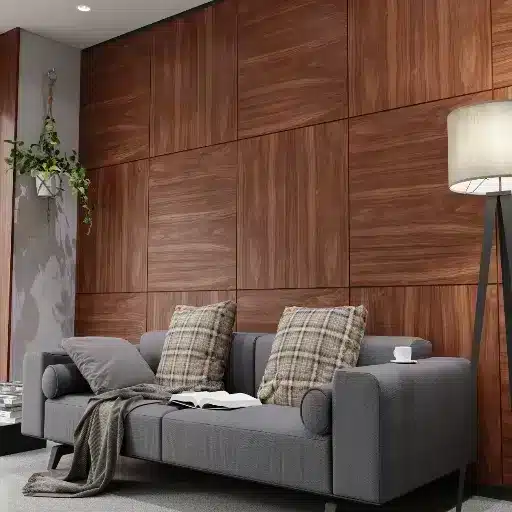
Wood veneer wall panels in living rooms and bedrooms produce warm, textured surfaces that do not require the weight and expense of solid wood materials. The standard specification requires MDF-core panels that contain plain-sliced walnut or oak for vertical accent walls. The installation produces a visual impact when the MDF substrate maintains flatness and the veneer face shows real wood beauty for a cost between $13 and $22 per square foot.
Kitchen cabinets and wardrobes need materials that resist moisture damage. Standard MDF will swell and delaminate when exposed to steam, splashes, and humidity cycles. The specification should include moisture-resistant MDF or plywood cores that use water-resistant adhesive systems. Polyurethane coatings provide superior moisture protection for kitchen applications compared to nitrocellulose lacquers, which use nitrocellulose as their base.
Mini-Story: Sarah’s Hotel Lobby
Interior designer Sarah Chen from Chicago selected wood wall panels as her main design element for the hotel lobby because she wanted to create a cozy atmosphere in the space, which contained concrete and glass architectural elements. She initially specified solid walnut planks at $45 per square foot. The designer found that FSC-certified walnut veneer panels on MDF cores provided the same visual appearance as solid wood at $18 per square foot while reducing wall framing load by 60% and enabling the project to achieve LEED MRc3 certification. The installation time required only four days because the solid wood needed two weeks for installation. The client achieved $34000 in material savings while reviewers of the completed lobby space identified the wood feature wall as the hotel’s main design element.
For Commercial Spaces
Building interiors need durable panels that can handle heavy foot traffic, undergo frequent cleaning, and meet all building code requirements. Commercial installations require fire-retardant MDF or plywood cores, which have Class A surface burning characteristics as their basic material requirement. The building code requirements for your location must be checked before you make equipment selections.
Engineered veneer panels provide hospitality projects, hotels, and restaurants with the consistent performance required for their operations. A single large hotel might need 5,000 square feet of matching walnut paneling, which will be installed throughout its guest rooms and corridors, and elevators. The natural veneer material fails to provide that specific level of consistent appearance. Engineered veneer provides that particular level of consistent appearance.
Retail spaces need materials that can withstand damage and most building damage and building repairs. The high-traffic stores require panels that can endure impacts from shopping carts and display fixtures, and continuous foot traffic. The best solution for impact protection and surface restoration exists in phenolic-backed veneers, which use plywood cores as their base material.
Wood Veneer Panels vs. Alternatives: An Honest Comparison
Veneer Panels vs. Solid Wood Panels
Solid wood panels consist of complete wooden boards that builders connect by matching their edges. The objects possess aesthetic value and substantial weight, but their cost remains high. The cost of a solid walnut panel ranges from 80 to 150 per square foot. The walnut veneer panel, which uses MDF material, produces the same visual effect as the solid wood panel for 15 to 30 per square foot.
The comparison involves more than just examining the expense. The wood material exhibits expansion and contraction behavior, which depends on changing humidity levels. When solid wood panels experience temperature changes between 30% and 60% relative humidity in a climate-controlled office, they will move enough to create joint cracks, surface warping, and fastener loosening problems. The engineered core of veneer panels maintains operational stability, which solid wood lacks. The core material provides dimensional stability, which solid wood fails to accomplish.
Solid wood performs better than other materials because it allows deeper refinishing work. A 20mm solid walnut panel can be sanded and refinished dozens of times over a century of use. A 0.6mm veneer face can be lightly sanded once or twice before you risk sanding through to the substrate. The trade-off exists because most interior spaces require veneer panels since they maintain stability while reducing costs, which limits their ability to refinish.
Veneer Panels vs. Laminate
High-pressure laminate (HPL) consists of a paper layer that undergoes printing, followed by resin saturation, and then it bonds with a substrate through an extreme heat and pressure process. The product delivers three essential qualities, which experts define as durable, consistent, and inexpensive. The product exists as a different substance from wood.
The difference becomes important because specifications fail to show its actual effects. Laminate surfaces do not allow for any repair work. The panel needs replacement because any laminate surface damage requires immediate panel replacement. A chipped veneer panel can be filled, touched up, and refinished. The aging process of laminate material differs from that of other materials. Wood veneer develops a patina through a ten-year period, which enhances its visual appeal. The laminate material develops specific patterns of wear, which cause it to appear old.
From an environmental perspective, the comparison favors veneer even more strongly. Most laminates use thermosetting resins, which become unrecyclable when their life cycle ends. FSC-certified wood veneer panels with 100% better environmental performance than standard wood materials.
Veneer Panels vs. Paintable MDF Panels
Paintable MDF panels skip the veneer process to deliver an unpainted smooth surface, which requires no additional preparation for paint application. The solution works best when the design needs a single color application, the budget serves as the main limit, and the project needs to be temporarily installed.
Veneer provides depth and warmth and tactile authenticity, which paintable MDF cannot match because it lacks real wood grain. The psychological and aesthetic benefits of natural wood surfaces have been established through research because biophilic design principles now shape interior architectural design. The functional purpose of paintable MDF makes it a practical choice for use. Wood veneer panels serve as a selection for design purposes.
Sustainability and Ethical Sourcing
FSC and PEFC Certification
The only certification system provides reliable wood tracking for people who want to know their wood origins. The Forest Stewardship Council (FSC) and the Programme for the Endorsement of Forest Certification (PEFC) together create the most widely accepted standards for responsible forestry, which exist throughout the world.
FSC certification verifies that forest management operations meet environmental requirements and social standards through its sustainable harvest levels and biodiversity protection measures, indigenous rights protection, and deforestation prohibition requirements. More than 230 million hectares of forest around the globe achieved FSC certification by the year 2023.
Forest certification needs to extend beyond its current requirements. The Chain of Custody (CoC) certification system establishes a tracking system that monitors certified forest materials through all processing, manufacturing, and distribution stages. The FSC CoC certification from a panel supplier enables you to identify the specific certified forest that supplied the wood used in your panels. The absence of CoC documentation prevents you from obtaining any proof that can confirm the authenticity of sustainability claims.
VitalWood Global delivers a complete chain of custody records together with each order, which has FSC certification. The system provides you with the certificate number and the certified supplier’s license code and the product claim that enables you to demonstrate FSC content for your project reporting.
Material Efficiency
The sustainability case for wood veneer panels is not just about certified forests. The case demonstrates that we can achieve equivalent results by using reduced wood sources.
One cubic meter of timber produces approximately 900 square meters of 0.6mm veneer. The same cubic meter produces around 20 square meters of solid plank. The veneer production process uses only 2.2 percent of harvested timber because it requires 45 times more timber than solid wood usage.
Veneer manufacturing achieves a raw material utilization rate that reaches 95 percent. The sawdust and offcuts which result from veneer slicing continue their journey through the production process to become particleboard, MDF, and energy recovery products. Solid wood milling operations produce higher waste rates because the operation generates saw kerfs, planer shavings and offcuts, which cannot be reclaimed at equivalent levels.
Sustainably sourced veneer panels used in interior design applications produce 40 percent less waste when compared to traditional solid wood products. The mill produces less waste, which leads to reduced logging pressure on forests.
Carbon Impact
Forests that receive responsible management practices function as carbon dioxide storage areas. Trees utilize carbon dioxide from the air during their entire growth process while they create wood fibers that contain stored carbon. Sustainable timber harvesting from certified forests requires the forest to undergo either planting of new trees or natural forest regeneration, which sustains the forest’s ability to absorb carbon dioxide.
The wood material stored in the panel remains preserved throughout the product’s entire lifespan. A wood veneer panel installed in a commercial interior in 2026 will hold that sequestered carbon for 20 to 25 years or more.
The manufacturing processes hold significant importance. Veneer processors that have invested in renewable energy sources, solar, wind, or hydroelectric power, have reduced greenhouse gas emissions from their facilities by up to 30% compared to conventional energy mixes. Energy-saving manufacturing technologies have delivered additional reductions of up to 15% in facility energy use.
The leading processors currently obtain about 89% of their wood supply from European forests while they obtain 10% from North American forests, which helps decrease transportation emissions by using local supply chains.
Learn more about how we verify every step of our supply chain in our guide to sustainable wood sourcing.
Installation Best Practices
Surface Preparation
The surface that will support your veneer panel needs to be flat, clean, and stable. The veneer face will display visible defects when surface height differences exceed 1/16 inch across a distance of 4 feet. The surface needs to be sanded to remove high areas and filled with material to cover low areas before adhesive application.
The humidity and temperature conditions during the installation process hold greater significance than most installers understand. The panels and installation area require 72 hours of climate control, which maintains 40% to 60% relative humidity and 65 to 75 degrees Fahrenheit temperature before installation. The installation of veneer panels needs to occur after the space completes its drywall mud and concrete drying process.
Adhesive Selection
A high-quality PVA wood glue that manufacturers make for veneering works as a suitable adhesive solution for most interior needs. Urea-formaldehyde resin and cross-linked PVA solutions provide better moisture protection for use in commercial spaces and areas with high humidity.
The specification of formaldehyde-free adhesive systems should happen when organizations need to maintain good indoor air quality. These water-based adhesives comply with stringent emission regulations and promote healthier indoor spaces. The majority of LEED projects now mandate E1 or higher formaldehyde emission standards for all composite wood materials used in the project.
Pressing and Clamping
The pressing process requires simultaneous application of pressure across the complete surface area of veneer panels. Vacuum presses serve as the ideal solution for custom shops and high-end installations because they provide consistent pressure distribution across all types of complex shapes and curved surfaces.
The cold press method, which uses cauls and clamps, operates effectively for flat panel installations when you achieve 15 to 25 psi of pressure that spreads evenly throughout the panel. Hot pressing processes, which use temperatures between 200 and 250 degrees Fahrenheit, enable faster curing times while enhancing bond strength. However, this method needs special equipment and precise temperature management to prevent veneer face damage through scorching.
The duration of pressing depends on three factors, which include the type of adhesive used, the temperature conditions, and the thickness of the panel. PVA adhesives require 30 to 60 minutes of pressure at room temperature to achieve adhesion. Urea-formaldehyde resins may require 2 to 4 hours. The adhesive manufacturer’s specifications must be followed precisely.
Edge Banding
The process of edge banding serves as the final touch that distinguishes between professional work and amateur work. The outer sides of a veneered panel display its fundamental structure, which consists of MDF, plywood, and particleboard materials. The panel requires edge banding because its current state lacks complete finishing, and its core material needs protection against moisture.
Wood edge banding uses a thin strip of matching veneer with a pre-applied hot-melt adhesive. The product provides an aesthetic solution that achieves a complete visual match with the panel face after sanding and finishing work.
PVC and ABS edge banding are synthetic options that offer superior moisture resistance and durability. The materials serve as the preferred option for kitchen cabinets and bathrooms, and commercial settings that come into contact with cleaning chemicals and experience moisture exposure.
The economical option for utility applications and hidden surfaces, melamine edge banding, matches melamine-laminated surfaces.
Planning a large installation? Request a quote for FSC-certified wood veneer panels with custom edge banding, cut-to-size service, and bulk pricing for commercial projects.
Care, Maintenance, and Repair
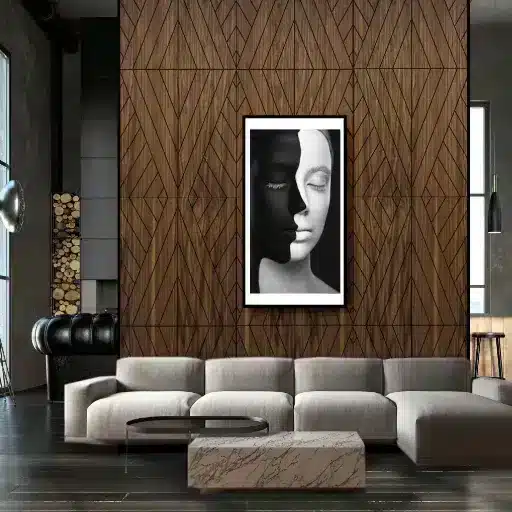
Daily Cleaning
The soft, dry microfiber cloth needs to be used to dust the veneer panel surfaces multiple times every day. Dusting creates abrasive materials that develop micro-scratches that damage the finish over time. The cleaning process requires a damp cloth, which should use a mild pH-neutral cleaner for better results. The ammonia-based products, silicone sprays, and wax-based furniture polishes must be avoided because they create finish problems. The products create a finish build-up, which results in a hazy residue.
UV Protection
Wood surfaces will experience fading due to direct sunlight exposure, which affects all types of wood, including veneer. Windows that face south and west pose the greatest danger for skin protection. The construction process needs to include low-E glass as a requirement, and existing windows should use UV-filtering window film installation. The installation of motorized shades that operate during peak sun hours should be considered for important installations.
Re-Coating Timelines
The typical lifespan of factory-applied finishes on veneer panels lasts between 5 and 7 years under standard residential usage. The commercial environment requires re-coating every 3 to 4 years because it needs more frequent cleaning. The coating needs replacement when the surface loses its shine, the scratches become permanent, and the surface remains dull after cleaning.
Repairing Damage
Touch-up markers, fill sticks, and colored waxes provide solutions for repairing small chips and scratches when they match the veneer species. The professional refinisher uses his skills to create an invisible patch through the application of a feathering technique.
The critical factor is veneer thickness. A 0.6mm veneer face can be lightly sanded once, maybe twice, before you risk sanding through to the substrate. A 2.0mm constructional veneer allows multiple sanding and refinishing processes. The thicker veneer face provides a return on investment through its capacity to be repaired when selecting panels for high-traffic and long-life uses.
Mini-Story: Marcus’s Failed Panel Installation
Marcus Ortiz, a general contractor in Phoenix, installed walnut veneer panels in a client’s master bedroom in July. After six months, the veneer developed bubbling and delaminated at its edges. The client was furious. Marcus made a demand for panel replacement from the supplier because he believed that defective panels had been sent to him.
The supplier’s technical rep visited the site and found the real problem within ten minutes. Marcus installed the panels before the house was completed and the construction work. The building’s drywall remained wet, which created interior humidity levels that exceeded 70 percent. He used a generic construction adhesive instead of a PVA adhesive that matches the standards for veneering work. He had used edge banding to cover the panels because he thought “the trim would cover it anyway.” The panels had absorbed moisture through the exposed edges, the adhesive had failed under humidity stress, and the lack of edge sealing allowed the MDF core to swell.
The installation of the replacement system, which used proper adhesive and complete edge banding after full acclimation, has achieved perfect operation for three years. Marcus now starts every veneer installation with a 72-hour acclimation period and a written specification sheet. The lesson cost him $4,200 in callbacks, but it made him a better contractor.
Cost Guide: What to Expect in 2026
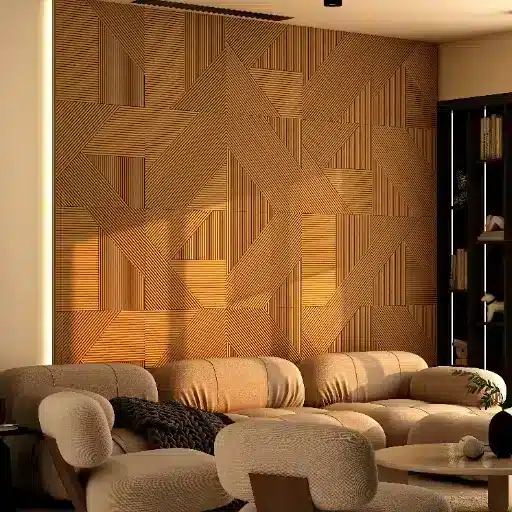
Wood veneer panel pricing in 2026 spans a wide range depending on species, thickness, core type, certification, and order volume.
Standard domestic species like oak, maple, and birch on MDF cores typically range from 10to10to25 per square foot. These are the workhorses of residential and light commercial interiors. They deliver excellent value and are readily available from most suppliers.
Premium species like walnut, cherry, and mahogany range from 30 to 60 per square foot. These panels command higher prices because the raw veneer itself is more expensive and the grading standards are more selective.
Exotic and burl veneers can reach 40 to 100 or more per square foot. These are statement materials for signature walls, executive offices, and luxury hospitality projects where the wood itself is the design feature.
Acoustic wood veneer panels with integrated felt backing and slat construction range from 35 to 75 per square foot. The premium reflects the added acoustic engineering and the precision manufacturing required for consistent slat spacing.
Installation labor typically adds 20% to 40% to material costs for straightforward vertical installations. Complex layouts, curved surfaces, or installations requiring specialized scaffolding will push labor costs higher.
Certification premiums for FSC or PEFC-certified panels are usually modest, in the range of 5% to 15% above non-certified equivalents. For most commercial projects, that premium is more than offset by the LEED credits and client sustainability requirements it enables.
Mini-Story: Elena’s LEED Verification
Elena Voss, Seattle-based sustainability consultant, was checking on the architect’s credentials for a 2,400-square-foot wall paneling made of imported walnut veneer, asking whether MR credits for certification allowed him to use it for the LEED Gold office enterprise. For this, she requested the general contractor to supply her with the FSC certificate. What she got in return was merely a one-page letter from his authorized distributor.
The correspondence looks authentic, but Elena knew that LEED requires chain of custody proof and not just assurance from a supplier. Directly contacting the distributor, Elena asked for the FSC license code, the individual certificate number, and how much credit the product claims to get. The distributor could not provide all this information. Basically, it transpired that the products were, to the best of general knowledge, called “FSC-controlled wood” and made with a comparatively lower quality. So it doesn’t qualify for the LEED credit.
Elena eventually altered this specification by choosing a fully FSC Chain of Custody certified supplier. She provided the original FSC certificate for this particular license code, FSC-C004999, and gave the FSC Mix 70% product claim. In this paperwork or documentation, Elena earned an additional point for that specific MRc3 and added the following clause to her standard specification template: “All certified wood claims have to be substantiated by valid FSC or PEFC Chain of Custody certificate numbers. Letters of assurance without certificate numbers cannot be accepted.”
2026 Trends in Wood Veneer Panel Design
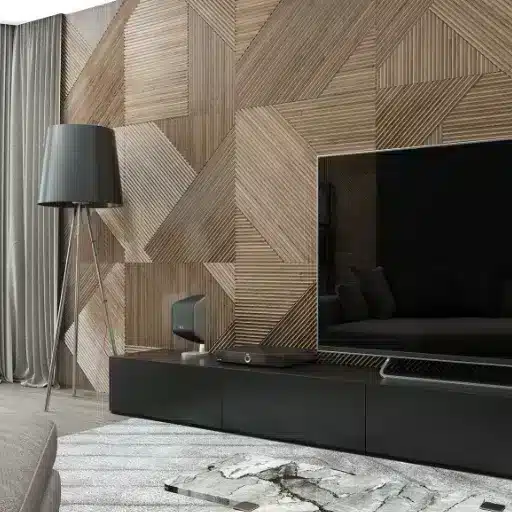
The industry of these wood veneer paneling is transcending the conventional plane surfaces of wall installations to attain something new. Here are the trends defining specification decisions in 2026.
Fluted and slat panels are setting the trend in commercial as well as high-end residential interiors. They make rhythmic shadows across flat walls and will be made from vertical wood slats on MDF or plywood cores. Acoustic felt backing turns them into a double-functioning panel; they give the anonymous effect and absorb sound.
Smoked and Fumed Finish-smoked and fumed finishes undergo a chemical treatment in which ammonia vapor causes tannin in the wood to create a dark effect rather than staining or dyeing the veneer. The color permeates the wood fiber, and, being acid-catalyzed, will not scratch off. Smoked oak operates as a proper, diversified, minimal luxurious finish designed for something.
Biophilic design has stirred an increased demand for wood surfaces that sparked demand in formerly synthetic-material spaces. Architects kept on specifying wooden veneer panels for ceilings, column wraps, and elevator interiors, which rendered otherwise sterile forms with some natural texture.
Acoustic returns for panel specifications in open floor plans, corporate canteens, or meeting rooms are more and more comprised. The best of the acoustic is committed to an NRC rating of 0.85 and above, which means it absorbs 85% of all the sound energy that comes in contact with it.
Digital-printed and custom-patterned veneers in the latest state-of-the-art technology of laminated engineering. The technology enables using a high-definition digital printer on veneer substrates to embed custom images, emblems, or patterns on genuine woods. This is opening doors upon doors for commercial branding and custom artistic applications that were not achievable under traditional veneer methods.
Frequently Asked Questions
How long do wood veneer panels last?
A wood veneer panel typically lasts for over 15-25 years if installed properly in a climate-controlled space. One installed in a high-traffic environment may start to show signs of wear and tear after 10-15 years. And, the wide face (2mm+) of the veneer can be refinished multiple times, greatly extending its service life.
Can wood veneer panels be resurfaced?
Resurfacing is possible depending on the thickness of the veneer face. Standard 0.6mm veneer faces can be gently sanded and coated once or twice more, whereas the thicker 1.5mm to 3.0mm constructional veneer can be sanded off and redressed again according to requirements. Therefore, one needs to plan to know the thickness of the veneer before sanding. Once the thin veneer face is sanded through, it is irreversible.
Are wood veneer panels waterproof?
Natural wood veneer is not usually waterproof, yet paneling mounted upon moisture-resistant backing and banded along the edges with polyurethane finish, of acceptable quality, could resist regular humidity and an occasional splash. However, under no condition should they be put under water or in steam-soaked environments without a separately specified marine-grade concept.
What is the best core for veneer panels?
It is in these applications for which Medium Density Fiberboard (MDF) is most likely to be most successful: decorative walls and furniture, where one can find the finest, smoothest, flattest surfaces. Load-bearing surfaces and similar applications will best use plywood or veneer core. In kitchens and baths, the essential quality of a core is its moisture-resistant properties.
How do I know if my veneer panels are sustainably sourced?
Request FSC or PEFC Chain of Custody certificate numbers from your supplier. Verify those certificates on the FSC or PEFC public database. A legitimate certificate will show the supplier’s license code, the certificate scope, and the expiration date. Letters of assurance without certificate numbers are not proof of certification.
What is the difference between veneer grades?
Grade A is nearly flawless and suitable for fully visible premium surfaces. Grade B allows small sound knots and minor color variation, appropriate for most visible applications. Grade C permits larger knots and more variation, used for painted or low-visibility surfaces. Grade D is a utility grade for structural or hidden applications.
Are wood panel walls still in style for 2026?
Yes, wood paneling is a futuristic trend in 2026 interior designing; it is part of a new generation of wall settings, but has now shifted away from old, dark, and heavy installations. The trends nowadays include light and natural tones, vertical slats, acoustic integration, and principles connected to nature.
Do wood wall panels improve acoustics?
Flat wooden veneer panels usually have minimal absorption. Acoustic slat wood-based panels with integrated felt backing are specially engineered for sound control. These usually achieve very high NRC ratings of 0.85 or formulated above, making them highly effective in controlling echo and reverberation in an office, restaurant, or home theater.
Conclusion
Wood veneer panels are among the most intelligent options in modern interior architecture. They offer the warmth and character of real hardwood. They also afford dimensional stability, which traditional wood does not. They are also much cheaper than solid wood. They are capable of being sustainably sourced, as the amount of wood used in the product is lower than in solid wood constructions.
But in all these instances, benefits aplenty as they are, start only when you get the right panel, carry out proper installation, and check if the supposed green credentials on the spec sheet figure are actually certified. The sub-frame is relevant. The glue is relevant. The finish is relevant. This includes the chain of custody certificate.
At VitalWood Global, we supply FSC-certified wood veneer panels with full traceability documentation, expert consultation on substrate and specification selection, and custom cutting and edge banding services for projects of any scale. Whether you are designing a single feature wall or specifying 50,000 square feet of paneling for a commercial development, we can help you get it right.
Request a Custom Quote for Your Project
Every panel tells a story. Make sure yours starts in a certified forest and ends in a space that will still look beautiful 25 years from now.
Ready to explore more wood product options? Learn about our full range of sustainable wood products or read our guide to choosing the right wood veneer manufacturer for your project needs.