

Acoustic Wood Veneer Panels: The Specifier’s Guide to Sound, Sustainability, and Design
Acoustic wood veneer panels are distinctive architecturally-oriented materials laminated with real wood surfaces for the purpose of transforming vegeta and are mainly used for the Games Hall, regarded as conquering fabric. It may be used on any animal-surfaced foundation that is engraved, slat-free, or grooved with some sound protection, such as pet felt lining or mineral wool. These product systems also produce low cri sound intercepting efficiency (NRC 0.50 to 0.95) along with the aesthetic influence of leali wood.
Hard surfaces look beautiful in renderings. In real rooms, they create reflection, reverberation, and noise complaints that arrive the day a project opens. Open offices echo. Restaurants get loud enough to read lips. Classrooms force teachers to raise their voices until the third graders in the back row stop trying to listen.
If you have spent time and effort designing a grand wood feature wall only to find out later that the room is “too noisy,” you need this guide. After this guide, you will take away knowledge and the ability to specify acoustic wood veneer panels that address sound troubles straight up, meet fire and emissions code, are designed according to green building principles, and are representative of the as-built design.
Key Takeaways
- Acoustic wood veneer panels combine a real wood veneer face with a perforated, grooved, slatted, or micro-perforated substrate to absorb sound. Typical NRC ratings range from 0.50 to 0.95 depending on cavity depth and backing.
- The five panel types that dominate the market are perforated, grooved, slatted, micro-perforated, and diffusing. Each suits different visual styles and frequency bands.
- For commercial projects you should specify acoustic target first (NRC range or RT60), then choose the panel system, then layer in wood species, grain match, finish, and substrate.
- Fire ratings (ASTM E84 Class A, Euroclass B-s1, d0) and formaldehyde-free cores (CARB P2, TSCA Title VI) are achievable on virtually every system. Always confirm in writing before purchase.
- Premium acoustic wood veneer panels run roughly $18-$60 per square foot installed, but FSC-certified veneer faces, recycled-PET backing, and 15-25 year service life make them a long-term value vs. fabric or foam panels.
What Are Acoustic Wood Veneer Panels?

Acoustic wood veneer panels are double-duty surfaces designed for both appearance and noise management. The surface is a thin sheet, normally between 0.3mm and 0.6mm thick, made of wood obtained from quality logs, which are further adhered to a base layer. Within the base, apertures and strands allow sounds to penetrate the hard surface and reach the panel. At the back of this substrate is either a felt backing material or an air cavity that converts the sound energy into low levels of heat. At no point does the wave bounce off the walls to become a nuisance again.
Light and strong enough, contrary to wooden panels, acoustic veneer systems appear to be an even more economical material-wise. One of the veneer logs under 0,4 meter veneer mounting will give approximately 900 square meters of veneer, which is nearly 45 times the surface that has been supplied with panels made of solid timber.
Acoustic wood veneer panels significantly differ from fabric wrapped acoustic panels as this material provides a more luxurious and tougher, and long-lasting finish suitable for busy spaces and therefore ages more favorably. Moreover, those patterns can also be part of biophilic design – a technique aimed at incorporating the natural forms within the structure of a building in order to aid the wellness of the occupants.
If you are new to veneer construction, our complete guide to wood veneer panels explains the layered build of veneer products and how they compare to solid wood and laminate.
How Acoustic Wood Veneer Panels Work
Sound is energy moving through space in the air. The room reflects most of the energy that hits a solid surface. It is why a glass and concrete lobby seems unbearable, while a library filled with furniture feels peaceful. Acoustic wood veneer panels interrupt the reflection in three different ways.
Helmholtz Resonators (Perforated Panels)
When a panel is perforated with countless small holes, each hole imitates the function of a resonator. Sound waves are constrained inside the hole, get captured by the cavity of the air behind, and dissipate their energy by friction against the cavity walls and the felt backing. It is tuned to particular frequencies through an absorption effect, though, by shifting the diameter and spacing of the perforation.
Slatted and Grooved Mechanics.
Slotted or tongued and grooved panels simply replace the openings with linear gaps. The point is the same. Sound goes out between the slats or into the groove. It strikes the PET felt backing and is immediately absorbed before being reflected out. This makes it a very successful absorption system for mid- and high-frequencies, both of which are the areas where human speech and music fall, actually.
Diaphragmatic Absorption
Solid veneer panels are furred over an air cavity, flexing slightly under low-frequency sound waves. The bass energy is absorbed by that flex. These are bass frequencies of sound energy left over from perforated panels, and that is why this unique system has its purpose. By balancing perforated or slatted panels with a few diaphragmatic panels, the full absorption of all frequencies is ensured.
However, backing fiber is the subtlest of all, easily overlooked by specifiers. Without any felt lining at the back, perforated panels look more aesthetically decorative than acoustical. Perforated panels require 25mm of recycled PET felt on the backside. With a 50mm air cavity, it can give you NRC 0.85 or higher. Manufacturers should be your best bet as far as tested NRC results go.
Types of Acoustic Wood Veneer Panels
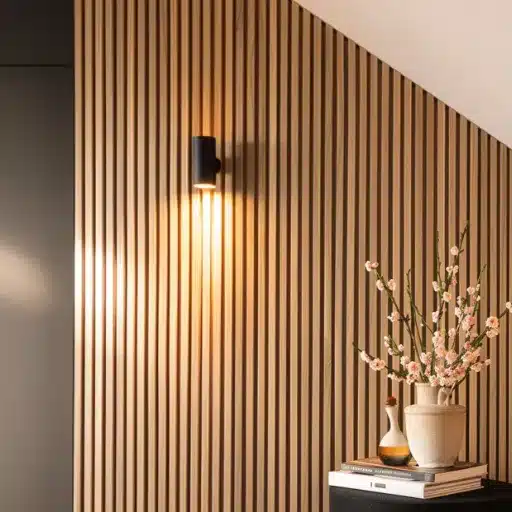
The market has five prominent panel families; each family follows a design brought forth by their visual signatures and acoustic profiles.
1. Perforated Wood Veneer Panels
Perforated panels are generally either MDF or plywood substrates full of round, square, or slot-shaped holes and then faced with veneer to follow the perforation pattern. Usual NRC values range from 0.60 to 0.90. Perforated panels make good ceilings, large feature walls, auditoriums, and lecture halls when broadband absorption is the stated aim for the designer.
2. Grooved Wood Veneer Panels
A grooved wood veneered panel has parallel kerf cuts cut into the panel member. The grooves are usually fine, e.g., 3 to 5 mm, and they are notched with visible discontinuities on the front face because the cuts do not pass the face entirely. The range of NRC values is typically from 0.50 to 0.85, making this product a cost-effective and flexible one for use in offices and boardrooms where designers do not want to leave visible holes in the product.
3. Slatted Wood Veneer Panels
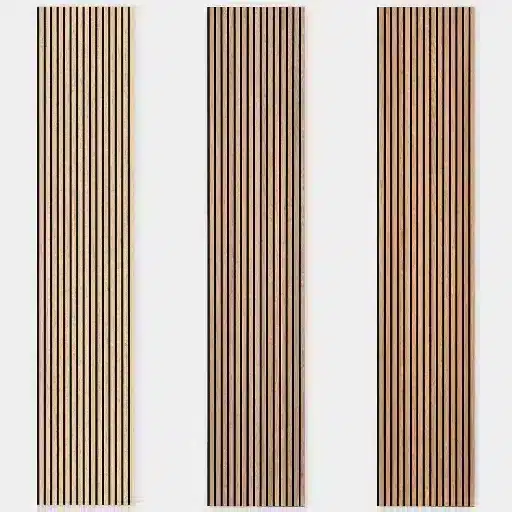
Slatted panels were leaders about trend in the last five years. Basically, there are wood slats glued on a back fabric made of PET felt with a size module of 600 mm and 1200 mm. The slats could be square or rectangular, or with a reeded or fluted profile. NRC of the standard values is rated from 0.65 to 0.85. Slatted panels appear warm, biophilic, and immediately identifiable, and appear in a variety of venues from cafes to residential interiors.
4. Micro-Perforated Wood Veneer Panels
The holes in micro-perforated panels are nearly invisible and are, therefore, less than one millimeter in diameter when seen from one meter. NRC values diverge by showing elevated frequencies that reach around 0.55-0.75. These panels are excellent for historical projects, chief executive offices, or any place where the design brief allows no visible perforation on any continuous wood surface.
5. Diffusing Wood Veneer Panels
Diffusion panels do not absorb sound; they scatter it. It could be a faceted or QRD (quadratic residue diffuser) for breaking up reflections, thus reducing flutter echoes because these shouldn’t necessarily come back. You see these types of materials widely applied in professional recording studios, in performance spaces, and high-end home theaters, where controlling reflections without having “dead” sound characteristics is also demanded by the room.
| Panel Type | Typical NRC | Frequency Bias | Best Use | Visual Style |
|---|---|---|---|---|
| Perforated | 0.60-0.90 | Broadband | Ceilings, auditoriums | Pattern-forward |
| Grooved | 0.50-0.85 | Mid-high | Walls, offices | Linear, subtle |
| Slatted | 0.65-0.85 | Mid-high | Feature walls, biophilic spaces | Warm, linear |
| Micro-perforated | 0.55-0.75 | High | Heritage, premium offices | Nearly invisible |
| Diffusing | N/A (scatters) | Broadband | Studios, performance | Sculptural |
Want help matching a panel type to your project’s acoustic target? Talk to a VitalWood Global specification advisor and we will recommend a system based on your room volume, surface area, and design goals.
Specifying Acoustic Wood Veneer Panels
When David Okafor, an acoustic consultant working on a 14,000 square foot fintech headquarters in Austin, opened the bids for the project’s acoustic treatment, the prices ranged from $96,000 to $310,000. The cheap bid used basic perforated MDF with no felt backing. The expensive bid was a full custom slatted system in book-matched walnut. The right answer turned out to be a middle option: perforated panels for the ceiling, slatted feature walls for the cafe, and matching wood diffusers for the boardroom. Total cost: $182,000, and the acoustic test after move-in showed RT60 values within 5 percent of the design target.
David’s project illustrates the right specification sequence. Acoustic target first, panel type second, aesthetic third. Here is how to work through each layer.
Wood Species and Grain Selection
The veneer face determines how the panel reads in the room. White oak, maple, holly, cherry, and walnut are probably the most frequently used species in design work as they offer cost, availability, and good temper. In particular, white oak has seen an increase in its usage among architects, with a 28% increase in the annual rate of oak veneer in the years 2023 and 2025.
Unique and exotic species such as teak, sapele, wenge, and zebrawood are used for highly dramatic visual “statements” in feature walls and special spaces. Those areas that are practically inaccessible for solid, thick forms undergo significant changes when cheaply veneer reaches one or more other species.
The engineered forms or combination recessed veneers are popular in projects that need a consistent grain for large numbers of surfaces and the demand for these timber species that are nearly unavailable with sustainable production. One of the most useful properties of engineered veneers is it is crafted from dyed, pressed, and quickly grown fibers that can well imitate the rare varieties of woods in their appearance without taking the risks of the supply chain issues.
Matching grain options include book-matching (mirror image), interacting matching (running bond), and random matching (a more fluid look). A lengthy, four-way wall may blend the pattern of the grain through vertical joints.
Acoustic Performance Targets
Match the panel system with the end-use requirement of every room. For the most part, the following benchmarks are readily accepted starting points:
- Open offices and call centers: NRC 0.65-0.85 across 20-30 percent of the wall and ceiling.
- Conference rooms and boardrooms: NRC 0.70-0.90 across the back of the wall and ceiling.
- Restaurants and hospitality: An NRC of 0.70 or higher on the ceiling, with selective wall coverage to reduce conversation overlap.
- Classrooms: The unoccupied reverberation time of up to 0.6 seconds, in ANSI/ASA S12.60, is limited to 10,000 cubic feet areas and must typically achieve from 15-20 percent acoustic coverage.
- Recording studios and broadcast: A holistic absorption (NRC 0.85+) and diffusion at first reflection points.
Substrate, Backing, and Performance Ratings
The specified material is always available between substrate, MDF, fire-retardant MDF, plywood, mineral fiber core, and honeycomb. The corresponding backing material includes recycled PET felt, mineral wool, or open cavity, and the pertinent performance ratings that are needed for your jurisdiction.
The criteria for commercial projects in the United States are ASTM E84 Class A firespreading capability and CARB P2/TSCA Title VI compliance with the formaldehyde legislation. For a European project, the criteria might be given as Euroclass B-s1, d0. There will be extra specific requirements, such as antimicrobial coatings or impact resistance, when it comes to healthcare- or education-related work.
Acoustic Wood Veneer Panels by Application
Different project types need different acoustic strategies. Here is how acoustic wood veneer panels deploy across the most common environments.
Open Offices and Coworking
Open offices fail acoustically when speech privacy drops below acceptable levels. The fix is rarely one big wall of panels. It is usually a combination of slatted or perforated ceiling treatment to absorb broadband reverberation, plus targeted wall panels at workstation clusters to reduce direct reflections between desks.
Conference Rooms and Boardrooms
Conference rooms benefit from full-coverage rear walls plus an absorbent ceiling. Premium projects often combine book-matched veneer perforated panels with diffusing panels on the wall opposite the video display, which controls flutter echo without making the room sound dead.
Restaurants and Hospitality
Restaurant noise is consistently cited as a top guest complaint. A Zagat survey found 24 percent of diners list noise as their top dining frustration, second only to service. Slatted wood veneer panels on lobby ceilings and rear walls, combined with perforated wood at booth seating, lift acoustic comfort without sacrificing the warm aesthetic operators want.
When the design team at a boutique restaurant group in Portland refurbished a 4,800 square foot location, they replaced exposed concrete ceilings with FSC-certified slatted walnut panels on PET felt. Post-occupancy noise measurements showed a 6-decibel drop in ambient noise during peak service. Guest review scores mentioning “noise” dropped from 19 percent of reviews to 3 percent within four months.
Education and Healthcare
ANSI/ASA S12.60 limits that are set for reverberation conditions must be achieved in schools. Wood veneer panels make these objectives achievable, while the warmth of these in comparison to fabric and acoustic ceiling tile is incomparable. The reduction of stress perceived by a patient is always between 10 and 30 percent. This research was compiled by The Center for Health Design.
Recording Studios and Performance Spaces
Studios layer absorption and diffusion. Acoustic wood veneer panels can take both roles. Perforated panels on the rear wall absorb low- and mid-frequency content. Diffusing panels at first reflection points scatter mid-highs. The combination produces the controlled, neutral environment producers want, with a finish that looks at home in a control room.
Sustainability and Green Building Credits
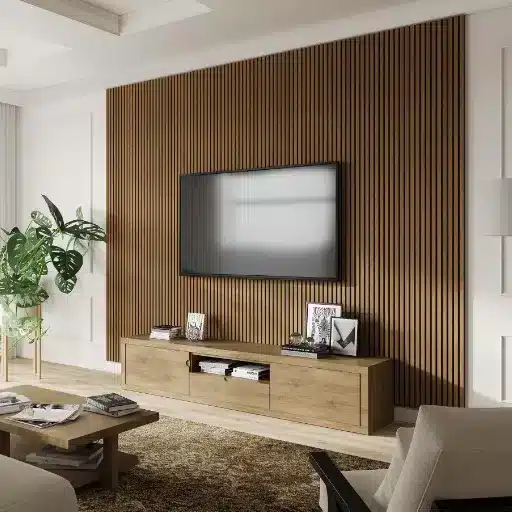
Acoustic wood veneer panels are one of the few architectural materials that can score points in every major green building rating system: LEED, WELL, BREEAM, and Living Building Challenge.
Certified Wood Sourcing
Look for FSC-certified veneer faces with full chain of custody documentation. FSC is one of the most recognized certifiers, and there are more than 230 million hectares of certified forests worldwide. The parallel certification, PEFC, can also be seen frequently within European supply chains.
The VitalWood Global system incorporates a real-time documentary certification that it supplies acoustic veneered panels, which have the LEED Materials and Resources credit.
Low-Impact Substrates and Adhesives
Specify CARB P2 / TSCA Title VI compliant cores and water-based, formaldehyde-free adhesives. A lot of our acoustic backings are now produced in recycled PET, and so would take the equivalent of 60 or more bottles per square meter of backings.
WELL Building Standard Sound Credits
The WELL Building Standard v2 Sound concept assigns up to 12 points across reverberation time, sound masking, and acoustic privacy. Acoustic wood veneer panels directly address the reverberation and privacy credits and indirectly support the well-being and stress reduction credits in the Mind concept.
Lifecycle and Circularity
Acoustic wood veneer panels mean a 15 – 25-year lifespan, once refinishing is done on them periodically, whereas fabric-wrapped panels would last 7 to 10 years. At the end of life, the wood face can be separated from the substrate for recycling, and many manufacturers provide take-back programs for large commercial orders.
How Much Do Acoustic Wood Veneer Panels Cost?
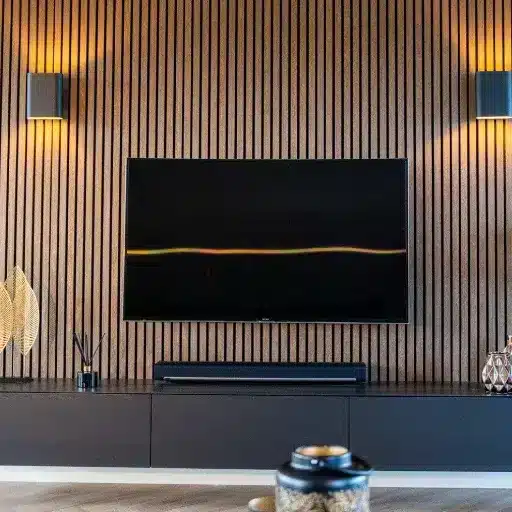
Pricing varies based on species rarity, customization complexity, performance ratings, and project size. The 2026 market ranges look roughly like this:
- Entry-level slatted wood veneer panels (engineered species, standard PET backing): $10-$18 per square foot, material only.
- Mid-range perforated or grooved veneer panels (domestic species, fire-rated core): $18-$35 per square foot.
- Premium architectural systems (exotic or book-matched species, custom CNC, high-density backing): $35-$80+ per square foot.
- Installation labor adds $5-$15 per square foot, depending on substrate condition, access, and mounting system.
For total project budgeting, plan on 1.1 0 to 1.1 4 times the panel cost for trim and waste, plus 1.05 to 1.10 times for fastening hardware and adhesives. Custom species or unusual dimensions can add a 20 to 30 percent premium over standard sizes.
If the fabric-wrapped acoustic panels are of premium wood veneer, then most typically, the square-foot focal cost can vary from 1.5 to 2.5. Besides that, longevity-of-life benefits add an aesthetic durability. Contributions to green building credits are added over a 20year ownership horizon and usually exceed the extra costs with owners.
How to Order Acoustic Wood Veneer Panels
Here is the specification workflow that consistently produces the best outcomes for B2B specifiers.
Step 1: Define your acoustic target. Determine room volume, surface area, and target NRC or RT60. Make this information available in writing from the consultant.
Step 2: Choose the panel system. Align the concept of aesthetics with acoustic profile-Differentiated as being slatted for biophilic warmth, perforated for broadband ceiling absorption, micro-perforated for heritage interiors, and diffusing for studios.
Step 3: Select species, grain pattern, and finish. Order samples for the quality tests of the A-grade material and review in actual room lighting; permit in writing before production.
Step 4: Confirm substrate, backing, and performance ratings. Get it in writing that the results of ASTM E84 are in compliance with CARB P2 and that those of the FSC chain of custody have also been provided. Avoid accepting any marketing fluff.
Step 5: Confirm lead time and logistics. Standard lead times are generally from 7 to 10 working days for all veneer-only components, 4 to 6 weeks for fully fabricated panels, and 6 to 10 weeks for fully custom systems with secondary finishing. Additionally, an international leg adds 2 to 4 weeks, depending on the country of origin.
2026 Trends in Acoustic Wood Veneer Panels
Several visual and technical trends are reshaping the category right now.
- Fumed and smoked finishes on white oak and walnut slats are crowding every high-end hospitality and luxury residential interior.
- Installed as feature walls, reeded and fluted slat profiles are replacing every flat slat design out there.
- Micro-perforation for ceilings is substitutive to the traditionally recognized use of exposed mineral fiber tiles in high-end commercial interior designing.
- New integrated lighting systems harness acoustic panels paired with linear LED channels for ceiling and feature wall installation.
- Combining biophilic affinity enables acoustic wooden panels in living walls, and in some cases, natural daylighting strategies.
- Noise busters and open spaces are realized using modular acoustic baffles in slat or perforated formats that offer flexibility for reconfigurable treatment.
Frequently Asked Questions
Do acoustic wood veneer panels really absorb sound?
Yes, correctly installed, a perforated or slatted veneer face will not absorb sound itself. Sound absorption takes place within the felt back and the air cavity behind the visible surface. The typical ASTM C423 lab tests regularly produce NRC in the range of 0.65 to 0.95 for properly specified systems.
What NRC rating do I need for my space?
A reasonable threshold from which to begin might be NRC from about 0.65 to about 0.85, for offices and meeting rooms, NRC from 0.70 or greater in restaurants or bar dining rooms, and higher NRC 0.85 or greater for spaces used typically by broadcasting or music, or when used for work in a room designated as a studio. Schools and health are covered by ANSI/ASA S12.60 and specific local regulations.
Are acoustic wood veneer panels fire-rated?
Most commercial acoustic wooden veneer panels receive ASTM84 Class A flame spread ratings in the US or Euroclass B-s1, d0 in Europe. Always check manually whether this assessment applies to your purchased unit, including the backing and substrate, not just the veneer face.
Can I get acoustic wood veneer panels with FSC certification?
Yes. Most reputable manufacturers provide FSC-certified veneer faces with full chain of custody supporting documentation for green-building projects. It is standard issue and not available as an upcharge, although lead times may be slightly longer for project-specific certification.
How are acoustic wood veneer panels installed?
The most popular methods of installation are through direct mount with construction adhesive and mechanical fasteners, or using Z-clip systems for more installation flexibility for acoustic wood veneer ceiling panels. Other methods would be by using concealed spline ceiling grid systems. Slatted panels with PET backing can usually be adherently attached to gypsum boards with adhesive and finishing nails.
What is the difference between acoustic wood veneer panels and solid wood acoustic panels?
Veneer panels, an engineered substrate, receive a thin layer of real wood; in contrast, full-thickness solid wood is milled for the latter. Veneer panels are lighter, dimensionally more stable, cheaper, and better on raw material usage. Solid wood panels have slightly higher density (and likely better low-frequency absorption) but are costlier and weigh considerably more.
Conclusion
Acoustic wood veneer panels serve dual purposes: they offer significant noise reduction that meets regulatory standards, and they add the cozy texture of wood to the interiors. To specify properly, one must begin by identifying the noise abatement goal, and then the relevant panel system that can achieve the said goal, as well as the design ethos, and only then add the various wood types, and their finishes, against specific cores or supports and relevant certifications.
The right method means using only one system to provide speech confidentiality in office spaces, enhance patron satisfaction in dining spaces, achieve acceptable sound levels in learning spaces, and achieve credit in all the major environmental building rating systems. The improper method provides a very attractive wall that has no bearing on the noise or a noise-inserted hand panel that becomes boring and out of place within a period of five years or so.
Specify the acoustic target first. Request faces that have the FSC, with cores of the second grade of CARB Protocols, and be presented with the documented specificierungstests of the given ratings. Take samples and make a written confirmation. Once these conditions are met, acoustic wood veneer panels rank among the top materials an architectural specifier can rely on.
Ready to specify acoustic wood veneer panels for your next project? Request a sample kit and project quote from VitalWood Global. We will send species samples, independent NRC test reports, FSC documentation, and a fixed-fee quote tailored to your scope and timeline.