
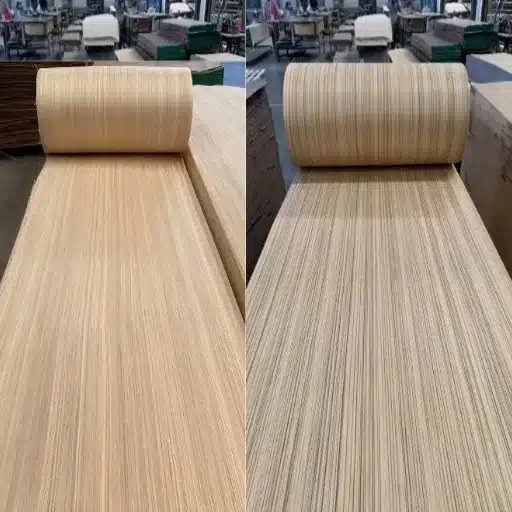
Wood Veneer Manufacturer vs Supplier: The Complete Guide to Choosing the Right Partner
A wood veneer manufacturer transforms raw logs into finished veneer sheets through every phase of production, while a wood veneer supplier sources finished veneer from multiple manufacturers and adds value through curation, custom matching, and logistics. The choice between them depends on your project volume, customization needs, and certification requirements. The global wood veneer market now exceeds $16 billion, yet buyers still struggle with this fundamental distinction, and choosing the wrong partner can derail timelines, inflate costs, and compromise the quality of your finished project.
You have probably seen the terms used interchangeably on B2B directories, trade show banners, and company websites. One listing claims to be a “manufacturer,” another a “supplier,” and many bill themselves as both. That overlap creates real confusion.
A cabinetmaker in Ohio searching for consistent walnut veneer for a 200-unit residential project has very different needs than an architect in London specifying FSC-certified oak for a LEED-targeted commercial lobby. The wrong choice means mismatched grain, delayed shipments, or certification gaps that threaten your project’s environmental credentials.
In this guide, we will break down exactly what each partner does, how they differ in quality control, pricing, and lead times, and most importantly, how to decide which one is right for your specific project. We will also cover red flags to watch for, cost considerations that go beyond the unit price, and a practical decision framework you can use today.
Key Takeaways
- A manufacturer owns production facilities and controls every phase from log to finished sheet, offering direct quality control but typically requiring higher minimum order quantities.
- A supplier aggregates veneer from multiple manufacturers, providing broader selection, flexible order sizes, and value-added services like custom matching and local stocking.
- Choose a manufacturer for large commercial volumes (5,000+ sq ft), custom species, or projects requiring direct certification oversight (FSC, PEFC, LEED).
- Choose a supplier for mid-size projects, variety from a single source, or when you need faster fulfillment from local inventory.
- The cheapest quote rarely delivers the best value, project delays and replacement costs from poor quality quickly erase any initial savings.
What Is a Wood Veneer Manufacturer?
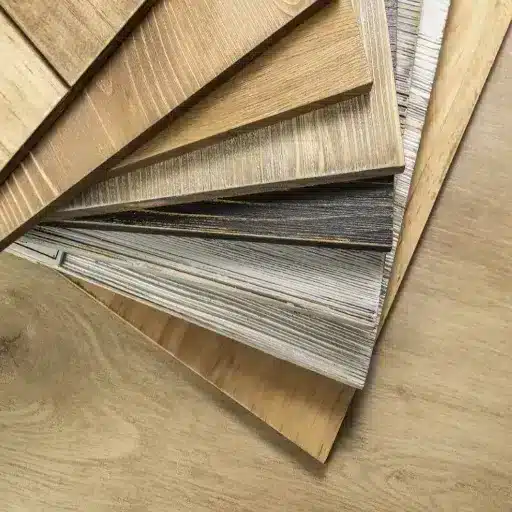
A wood veneer manufacturer owns production facilities and controls the entire transformation process from raw log to finished veneer sheet. This includes log selection, conditioning through steaming or soaking, slicing or peeling (using rotary, flat, quarter, or rift cuts), drying to precise moisture levels, grading by visual quality, splicing and matching (book-match, slip-match, or flitch-match), and finally bonding the veneer to backing substrates such as paper, fleece, or phenolic materials.
The Production Process
The manufacturing process is capital-intensive and technically demanding. It begins with log procurement, where manufacturers select species based on grain pattern, color consistency, and defect levels. Logs are then conditioned, typically through controlled steaming or soaking, to soften the wood fibers before slicing. The slicing method determines the grain appearance: rotary cutting produces broad, sweeping patterns; flat slicing creates the distinctive “cathedral” grain associated with premium decorative veneer; quarter slicing yields straight, parallel grain lines; and rift cutting minimizes the wild grain figure found in species like oak.
After slicing, sheets enter continuous dryers where moisture content is reduced to between 6% and 12%. This range is critical, veneer that is too dry becomes brittle and prone to cracking, while excess moisture invites warping and adhesive failure downstream. Grading follows, using industry-standard scales from AA (premium, virtually flawless) through D (structural or hidden-use grade). Advanced manufacturers now employ automated optical grading and AI-powered defect detection, which can reduce defective product rates by up to 30% compared to manual inspection alone.
Core Capabilities
The defining advantage of a manufacturer is direct, end-to-end quality control. They can adjust slicing parameters in real time, modify drying schedules for specific species, and enforce consistent batch standards across multi-phase projects. For architects and builders, this matters enormously.
When Elena Castellanos, a Miami-based interior designer, specified rift-cut white oak for a 12-story residential tower, she needed every floor’s elevator lobby panels to match precisely. Working directly with the manufacturer allowed her team to specify the exact flitch sequence and ensure consistent color across all 8,000 square feet. They also received batch-matched reserve material for future maintenance. A supplier could have sourced similar oak, but coordinating consistent flitch sequencing across multiple mills would have been nearly impossible.
Manufacturers also hold certifications directly. Forest Stewardship Council (FSC) Chain of Custody, Programme for the Endorsement of Forest Certification (PEFC), ISO 9001 quality management, and CARB Phase 2 / EPA TSCA Title VI formaldehyde compliance are all administered at the manufacturing level. For LEED projects requiring MRc3, MRc4, or EQc2 credit documentation, having direct access to the certificate holder simplifies compliance and reduces audit risk.
Typical MOQs and Lead Times
Manufacturers generally require higher minimum order quantities, often starting at 500 square feet for standard species and climbing to 5,000 square feet or more for custom cuts or exotic species. Standard production lead times range from 2 to 8 weeks, depending on species availability, custom matching requirements, and current order volume. Rush orders are sometimes possible at a premium, but the production reality of conditioning, slicing, drying, and finishing cannot be compressed beyond certain physical limits.
What Is a Wood Veneer Supplier?
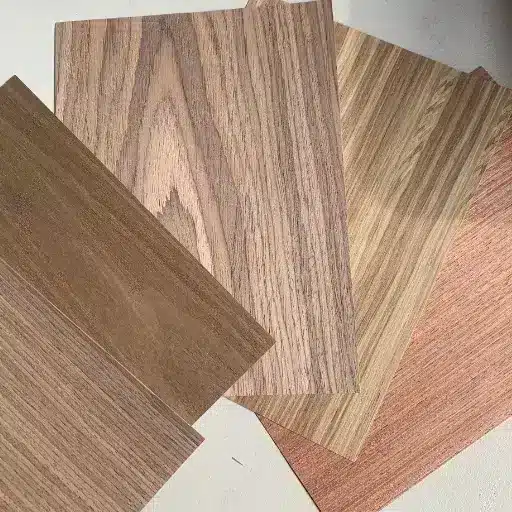
A wood veneer supplier does not own the production line. Instead, they source finished veneer from multiple manufacturers, often across different regions or countries, and add value through curation, inventory management, custom matching, and logistics coordination. Think of them as a specialized aggregator that bridges the gap between mills and end users.
The Sourcing Model
Suppliers maintain relationships with dozens, sometimes hundreds, of manufacturing partners. This network allows them to offer a curated catalog spanning domestic species like oak, maple, and walnut alongside exotic options such as teak, sapele, and ebony without carrying the capital burden of owning mills for every species. When a buyer requests a species the supplier does not stock, they source it through their partner network rather than turning the order away.
The trade-off is less direct control over production variables. A supplier relies on their manufacturing partners to maintain quality standards, moisture content, and grading consistency. Reputable suppliers mitigate this risk by auditing partner mills, performing incoming inspection, and building long-term relationships with a vetted core group of manufacturers. Still, the control is indirect, and batch-to-batch consistency depends heavily on the supplier’s quality management practices.
Core Capabilities
Suppliers excel at breadth and flexibility. They typically offer lower or more flexible minimum order quantities, sometimes as low as 50 to 100 square feet, making them accessible to smaller shops, prototype builders, and residential projects. They also maintain local inventory, which can reduce delivery times from weeks to days for stocked items.
Value-added services are where suppliers differentiate themselves. Custom panel assembly, book-matching across multiple sheets, local edge-banding, protective wrapping for delicate veneer, and consolidated shipping all fall within a capable supplier’s service range. For buyers who need variety without managing relationships with five or six individual mills, a supplier acts as a single point of contact.
Where Suppliers Add Value
Consider the experience of James Whitfield, a furniture maker in Portland, Oregon. He landed a contract for 40 custom conference tables across three corporate offices. Each table required a different species: walnut for the executive suite, white oak for the general conference rooms, and reconstituted teak for the lobby accents.
Ordering directly from three separate manufacturers would have meant three sets of MOQs, three lead times to track, and three invoices to reconcile. Instead, James worked with a regional supplier who sourced all three species, performed the custom matching in-house, and delivered the consolidated order in a single shipment. His administrative overhead dropped dramatically. The supplier’s custom matching service ensured visual consistency across each table run. Suppliers are also the preferred source for residential projects requiring wood veneer panels for kitchen cabinets and built-ins, where variety and local stock matter more than direct mill control.
Wood Veneer Manufacturer vs Supplier: Side-by-Side Comparison
The best way to understand the practical differences is to compare them directly. The table below also includes distributors, a third category often conflated with suppliers, to clarify where each fits in the supply chain.
| Factor | Manufacturer | Supplier | Distributor |
|---|---|---|---|
| Production Control | Direct, owns mills and equipment | Indirect, relies on partner mills | None, resells existing inventory |
| Quality Assurance | In-house QA at every production phase | Incoming inspection and partner audits | Limited to inventory inspection |
| Customization | High, custom species, cuts, and matching | Moderate, curation and coordination | Low, stock items only |
| Product Range | Narrow, limited to own production line | Broad, aggregates multiple manufacturers | Moderate, stocked SKUs only |
| MOQ | Higher, typically 500 to 5,000+ sq ft | Flexible, often 50 to 500 sq ft | Lowest, may sell by the sheet |
| Pricing | Factory-direct, volume discounts at scale | Moderate markup, offset by flexibility | Lowest for standard stocked items |
| Lead Time | 2 to 8 weeks for production | Faster if stocked locally, otherwise similar | Fastest, off-the-shelf |
| Certifications | Holds FSC, PEFC, ISO directly | May hold chain-of-custody; relies on partners | Minimal documentation |
| Best For | Large commercial, custom, certified projects | Variety, mid-size, flexible orders | Quick-turn, commodity-grade needs |
The Overlap: Hybrid Models
In practice, the lines often blur. Many companies, particularly on global B2B platforms, operate as “Manufacturer/Factory & Trading Company.” They produce certain veneer lines in-house while sourcing others to offer a fuller catalog. The Decorative Hardwoods Association (DHA) officially categorizes its members using codes like (M) for Manufacturer, (S) for Supplier, and (D) for Distributor, but acknowledges that many members qualify for multiple categories.
Hybrid models can offer the best of both worlds: direct manufacturing control for core products combined with supplier flexibility for complementary species. When evaluating a hybrid company, ask which products they manufacture directly and which they source. That distinction determines where your project falls on the control-versus-flexibility spectrum.
When to Choose a Wood Veneer Manufacturer
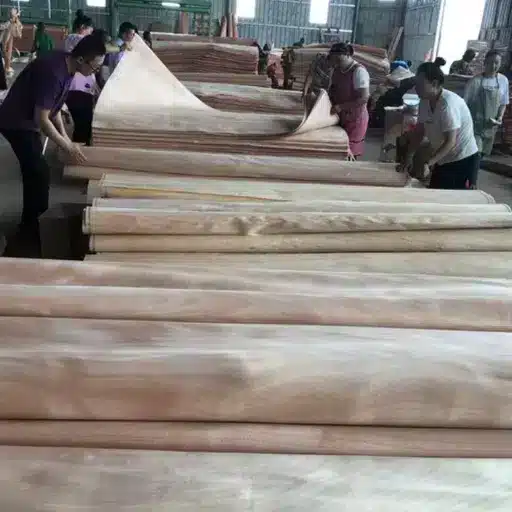
Selecting a manufacturer makes the most sense when your project demands direct control over production variables, large volumes, or specific certifications. Here are the scenarios where a manufacturer is the clear choice.
Large Commercial Volumes
Manufacturers prioritize and price large orders competitively. For projects requiring 5,000 square feet or more, factory-direct pricing typically includes volume discounts of 15% to 25% at the 500 to 2,000 square foot tier, and 30% to 40% at 5,000+ square feet. More importantly, large volumes justify the manufacturer’s attention for batch consistency and custom matching across the entire order.
Custom Species and Grain Matching
When your specification calls for an unusual species, a specific cut method, or precise grain sequencing (such as continuous flitch matching across multiple panels), a manufacturer can adjust production parameters to meet those requirements. Suppliers can coordinate custom matching, but they are constrained by what their partner mills are willing and able to produce.
Direct Certification Oversight
For projects pursuing LEED certification, WELL standards, or corporate ESG reporting, having direct access to the FSC or PEFC certificate holder simplifies documentation. Manufacturers can provide Chain of Custody documentation for every shipment, often with certificate numbers you can verify independently on the certifying body’s website.
When to Choose a Wood Veneer Supplier
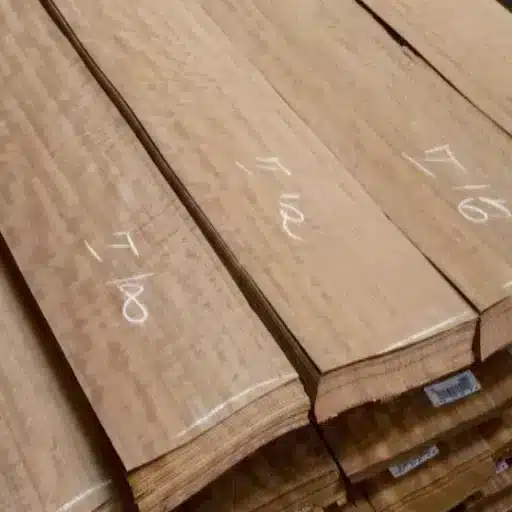
A supplier is the better fit when flexibility, variety, or speed matters more than direct production control.
Need Variety Without Managing Multiple Mills
If your project requires three or more species, different cut methods, or mixed grades, coordinating with individual manufacturers becomes administratively burdensome. A supplier consolidates those relationships into a single purchase order, a single point of contact, and a single delivery.
Lower Volumes or Prototype Phases
Not every project justifies truckload quantities. Residential interior designers, custom furniture makers, and prototype builders often need 100 to 500 square feet of several species. A supplier’s flexible MOQs make these smaller orders economically viable without the waste of over-ordering to meet a manufacturer’s minimum.
Local Stocking and Faster Fulfillment
Suppliers who maintain regional warehouses can deliver stocked items in days rather than weeks. For renovation projects with tight deadlines, or when a job site needs replacement material urgently, that speed can be the difference between staying on schedule and paying crew overtime.
Not sure how to evaluate potential partners? Our complete guide to choosing a wood veneer manufacturer includes a 10-question checklist you can use with any candidate, whether they are a manufacturer or a supplier.
Certifications, Sustainability, and Accountability
Certifications are where the manufacturer-supplier distinction becomes operationally significant. Understanding who holds which credentials and who can provide documentation protects your project from compliance gaps.
Who Holds What?
Manufacturers typically hold the primary certifications directly. FSC Chain of Custody and PEFC certification are issued to the entity that processes the raw material, which means the mill that slices and dries the veneer. ISO 9001 (quality management) and ISO 14001 (environmental management) are also organization-level certifications tied to the manufacturer’s facilities and procedures.
Suppliers may hold their own FSC Chain of Custody certification, which allows them to trade certified material under their own documentation. However, many suppliers operate under their manufacturer’s certification, providing “supplier certificates” that trace back to the original mill. Either approach is valid, but you should verify that the documentation chain is unbroken and that certificate numbers are current.
Sustainability Implications
One cubic meter of log can yield up to 1,000 to 2,000 square meters of veneer surface, roughly 40 times more usable material than traditional solid lumber. This inherent efficiency makes veneer one of the most sustainable ways to use hardwood. However, the environmental benefit depends entirely on responsible sourcing.
Manufacturers with direct forest management relationships can often provide the clearest provenance documentation. Suppliers, by aggregating from multiple mills, can offer access to a broader range of certified sustainable options, including reconstituted (engineered) veneer manufactured from fast-growing renewable species. Reconstituted veneer typically produces 18% to 35% lower CO2 emissions than harvesting old-growth exotic hardwoods and costs 30% to 50% less than equivalent natural species.
Cost, Pricing, and Value Analysis
Unit price is only one component of total cost. Our guide to wood veneer manufacturer pricing breaks down factory-direct rates, volume tiers, and hidden fees that shape the total investment. A comprehensive value analysis also considers timeline risk and quality consistency.
Pricing Tiers
Manufacturer pricing is factory-direct. For standard commercial orders in the 500 to 2,000 square foot range, expect volume discounts of 15% to 25%. At 5,000+ square feet, discounts of 30% to 40% are common. Supplier pricing includes a markup to cover curation, inventory carrying costs, and value-added services, but this is often offset by lower effective costs on smaller orders where manufacturer MOQs would force over-purchasing.
Hidden Costs to Factor
Emergency sourcing carries an average premium of 15% when delayed shipments force rush orders. Replacement logistics, including the cost of removing and reinstalling mismatched veneer panels, can exceed the original material cost on high-end installations. Storage costs for excess inventory bought to meet manufacturer MOQs add up, particularly for moisture-sensitive species requiring climate-controlled warehousing.
Total Cost of Ownership
The cheapest quote rarely delivers the best value. A manufacturer offering walnut veneer at 20% below the next bid may be using lower-grade logs, shortened drying cycles, or less rigorous grading. The result is higher defect rates, color inconsistency, and replacement costs that quickly erase the initial savings. Similarly, a distributor offering rock-bottom prices on standard stock may provide no custom capability, no batch-matching support, and minimal after-sales service.
Red Flags: How to Spot the Wrong Partner
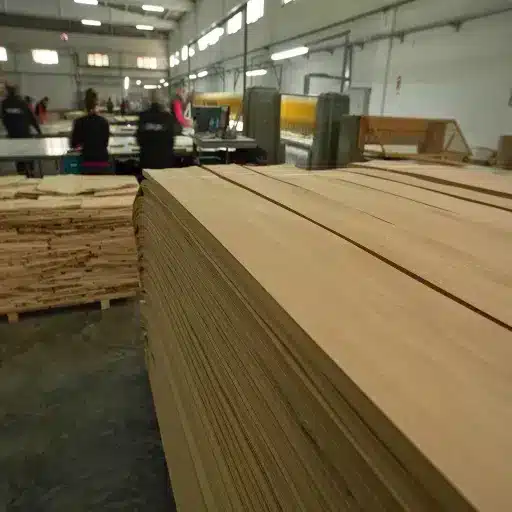
Whether you are evaluating a manufacturer or a supplier, certain warning signs should prompt immediate caution.
Manufacturer Red Flags
- Vague certification claims: “Sustainably sourced” without a certificate number is marketing, not proof. Always request the certificate number and verify it independently.
- Inability to provide batch samples: If a manufacturer cannot send production samples from the exact batch you will receive, quality inconsistency is a real risk.
- Chronically unpredictable lead times: Repeated delays suggest poor production planning, overcommitment, or reliance on subcontractors.
- Prices that seem too good to be true: They usually are. Low prices often signal lower-grade logs, shortened drying times, skipped quality checks, or certification gaps.
Supplier Red Flags
- No transparency about manufacturing partners: A supplier who will not disclose which mills they source from may be hiding quality inconsistencies or working with uncertified producers.
- Inconsistent quality across orders: If the oak you ordered in March looks different from the oak you ordered in June, and the supplier blames “natural variation,” their quality control is inadequate.
- Poor communication before the sale: Slow or evasive responses during the courtship phase predict even worse support when problems arise after delivery.
- Cannot provide chain-of-custody documentation: For certified projects, this is a non-negotiable requirement. A supplier who cannot produce it is not a viable partner.
Decision Framework: Which Partner Is Right for Your Project?
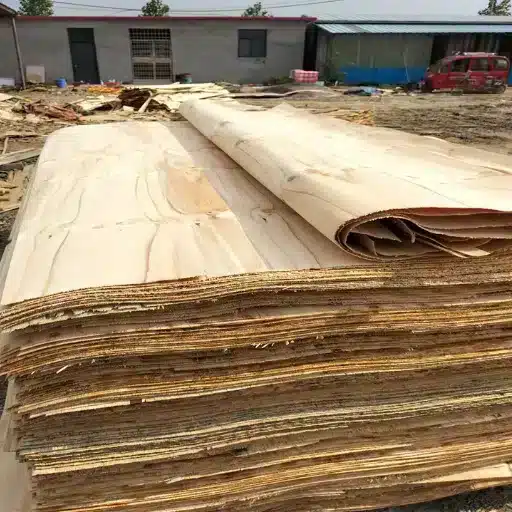
Use this three-factor test to guide your decision quickly.
Factor 1: Volume and Frequency
For one-time or infrequent orders under 500 square feet, a supplier or distributor is usually more practical. For recurring orders over 1,000 square feet, or single projects over 5,000 square feet, a manufacturer relationship becomes economically and logistically advantageous.
Factor 2: Customization Needs
Standard stock species in common grades require minimal production oversight. Custom species, specific cut methods, grain sequencing, or unusual backing types all benefit from direct manufacturer involvement.
Factor 3: Compliance Requirements
Projects requiring FSC, PEFC, LEED, or corporate ESG documentation should prioritize partners who hold certifications directly or can provide an unbroken chain-of-custody paperwork. When certification is required, ask: “Can you provide the certificate number, and can I verify it on the certifier’s website?” Any hesitation is a red flag.
Scenario Examples
Scenario A: A hospitality developer needs 6,000 square feet of book-matched black walnut wall panels for a hotel lobby, with FSC certification required for LEED points. The recommendation is a direct manufacturer relationship to control grain sequencing, ensure batch consistency, and provide direct Chain of Custody documentation.
Scenario B: A residential interior designer needs 250 square feet of white oak, 150 square feet of maple, and 100 square feet of cherry for three separate rooms in a single home. The recommendation is a supplier who can source all three species, perform custom matching, and deliver from local stock within a week.
Scenario C: A commercial contractor needs 3,000 square feet of consistent rift-cut white oak for an office fit-out with a four-week deadline. The recommendation is a hybrid supplier with deep manufacturing ties and local inventory, combining production control with stocked availability.
Ready to find the right partner for your project? Contact the VitalWood Global team for personalized guidance on whether a manufacturer or supplier relationship fits your specific volume, timeline, and certification needs.
Conclusion
The wood veneer manufacturer vs supplier decision is not about finding the “better” partner in absolute terms. It is about finding the right partner for your specific project. Manufacturers deliver control, customization, and direct certification oversight. Suppliers deliver flexibility, breadth, and speed. Distributors fill the gap for quick-turn, standard-grade needs.
At VitalWood Global, we believe the best sourcing decision is an informed one. Whether you need factory-direct production for a large commercial specification or a curated selection from a trusted supplier network, understanding the difference empowers you to ask the right questions, evaluate candidates thoroughly, and protect your project from costly surprises.
The global wood veneer market is growing, with Asia Pacific holding 36% to 38% of market share, North America at roughly 28%, and Europe showing the fastest growth trajectory driven by strict sustainability standards. For a geographic breakdown of where veneer is produced, see our guide to global wood veneer manufacturing hubs. Wherever your project is located, and whatever its scale, the principles in this guide apply. Start with your volume, define your customization needs, confirm your compliance requirements, and let those three factors guide you to the partner who will help you build something exceptional.
Get a Quote Today and let our team help you match the right sourcing strategy to your project’s unique demands.