

Engineered Maple Vs. Solid Maple: 2026 Flooring Guide
Engineered maple and solid maple are both genuine hardwood floors, and neither is automatically better. The right choice for you depends on your subfloor, your climate, your budget, and how long you plan to live in the home. In 2026, engineered maple is the better default for most homes. Its cross-laminated core tames the seasonal movement that solid maple, one of the most moisture-sensitive domestic hardwoods, simply cannot. Solid maple still wins when you want decades of full sand-and-refinish cycles in a stable, climate-controlled space.
When Rachel priced a maple floor for her family’s new home, she assumed solid was the “real” wood and engineered was the compromise. Her installer corrected that in one sentence: the maple you walk on is real in both. What changes is the board underneath. Rachel’s finished floor looks exactly like solid maple, but the engineered version sits safely over her radiant-heated concrete slab, a location solid maple could never handle. That one difference reshaped her whole decision.
In this guide, you will learn how each floor is built, how they compare on stability, cost, lifespan, and refinishing, and exactly which one fits your home. You will also get the honest answers on maple’s quirks, because maple is not oak, and it does not behave like oak. Let us find the floor that fits your life.
Key Takeaways
- Engineered maple beats solid for concrete slabs, basements, radiant heat, kitchens, and humid climates because its cross-laminated core reduces seasonal movement by roughly 60% to 75%.
- Solid maple can be sanded and refinished about 5 to 8 times over a 50-to-100-plus-year life; engineered maple allows 0 to 3 sandings depending on wear layer (2 mm = about 1, 3 to 4 mm = 2 to 3, 6 mm+ approaches solid).
- Engineered maple typically costs 15% to 25% less upfront, around $3 to $9 per square foot versus $4 to $12 for solid, though solid can win on lifetime value if you actually refinish it.
- Both forms share maple’s quirks: the pale, smooth surface shows scratches and dust readily, dark stains go blotchy, and the wood yellows with UV exposure over time.
- Choose engineered for stability and flexibility; choose solid when maximum refinishing cycles and tradition matter more than where and how you can install it.
Quick Verdict
For most 2026 homes, pick engineered maple: it installs over concrete slabs, basements, and radiant heat that rule out solid, tolerates humid climates, and costs 15% to 25% less upfront. Pick solid maple only when you want the maximum number of full refinishes in a stable, climate-controlled, above-grade space.
What Is Engineered Maple Flooring?
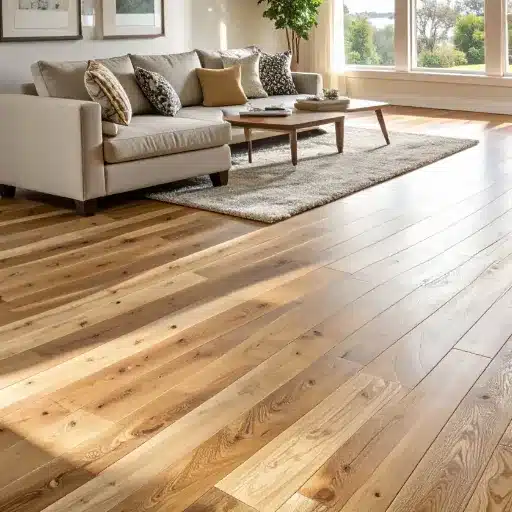
Engineered maple flooring is a real maple wear layer bonded to a cross-laminated core, usually plywood or high-density fiberboard (HDF). The maple veneer on top is genuine hard maple, and the layered core underneath is what makes the board dimensionally stable. The thickness of that top wear layer, not the total plank thickness, is the single most important spec on the sheet.
A well-built engineered maple board typically carries a 2 to 6 mm maple wear layer over a plywood core whose plies run in alternating directions. That cross-grain structure locks the board against the expansion and contraction that makes solid wood move. It is why engineered maple can go where solid cannot, and why most new installations in the United States now choose engineered formats. For the full species story, including grades, construction specs, and best rooms, our engineered maple flooring guide walks through everything in one place.
What Is Solid Maple Flooring?
Solid maple flooring is a single piece of milled hard maple, most commonly 3/4 inch thick with about 1/4 inch of sandable wood sitting above the tongue. There is no core beneath the surface. The board is maple all the way through, which is why it can be sanded and refinished far more times than a thin engineered wear layer. The density and shrinkage figures behind that trade-off are documented by the Maple Flooring Manufacturers Association.
That solid construction is also its limitation. Because the board is one continuous piece of wood, it expands and contracts freely with humidity. Maple moves more than oak, which means gaps in a dry winter and cupping in a humid summer if the room is not kept near 35% to 55% relative humidity. Solid maple is a beautiful, traditional floor for the right house, and a risky one for the wrong house.
Engineered Maple vs. Solid Maple: Side-by-Side Comparison
This table summarizes the differences that matter. Use it as your quick reference, then read the sections below for the details behind each row.
| Comparison | Engineered Maple | Solid Maple |
|---|---|---|
| Construction | Real maple wear layer over plywood or HDF core | One solid piece of maple, usually 3/4 inch |
| Maple surface | Genuine hard maple (Janka about 1,450) | Genuine hard maple (Janka about 1,450) |
| Dimensional stability | High; cross-lamination cuts movement 60% to 75% | Low; one of the most movement-prone hardwoods |
| Moisture resistance | Better; tolerates humidity swings and minor spills | Limited; needs 35% to 55% RH and climate control |
| Installation | Nail, glue, or float (click-lock) | Nail or staple down only |
| Slab, basement, radiant heat | Yes | No, generally not recommended |
| Material cost | $3 to $9 per square foot | $4 to $12 per square foot |
| Installed cost | $5.50 to $14 per square foot | $7 to $18 per square foot |
| Refinishing | 0 to 3 sandings depending on wear layer | About 5 to 8 sandings over its life |
| Lifespan | 20 to 40+ years by wear layer | 50 to 100+ years with refinishing |
| Resale nuance | Strong modern-market appeal | Perceived premium with traditional buyers |
| Sustainability | Uses less premium maple per plank | Uses more slow-growth hardwood per plank |
Stability and Moisture: Where Solid Maple Fails
Wood is hygroscopic. It absorbs moisture and swells, then releases it and shrinks. Every solid hardwood does this, but maple does it more than most, which makes solid maple one of the fussiest domestic floors you can install.
The practical result shows up as winter gaps between boards, when heating dries the air, and summer cupping, when humidity swells the boards against each other. Controlling the indoor environment to 35% to 55% relative humidity minimizes the problem, but it demands a climate-controlled home year-round. Basements, rooms over concrete slabs, and homes in humid coastal regions are where solid maple runs into real trouble.
Engineered maple solves the problem by construction. When each ply in the core runs perpendicular to its neighbor, the board cannot move as one piece. Manufacturers and installers commonly cite a 60% to 75% reduction in dimensional movement compared with solid wood of the same species, a figure echoed in Canfloor’s engineered maple pros and cons guide. That stability is what allows engineered maple over concrete slabs, in basements with a proper vapor barrier, and with radiant heat systems, none of which suit solid maple.
Neither floor is waterproof. Engineered maple forgives a spill or a humid week better than solid, but standing water will damage both. If your space is genuinely wet, a kitchen near a dishwasher or a bathroom, you want a truly waterproof product, not just an engineered one. For more on the species-neutral version of this comparison, our page on engineered hardwood vs. solid hardwood covers the general factors that apply to every species.
Wear Layers and Refinishing: How Many Times Can You Sand Maple?
Refinishing is the biggest long-term difference between the two, and it comes down to how much maple you have to sand.
Solid maple boards carry about a quarter inch of maple above the tongue, which typically supports 5 to 8 full sand-and-refinish cycles over a 50-to-100-plus-year life. That is the floor your grandchildren can still refinish. The catch is that hard maple is dense, so it burns easily under a sander and shows every sanding mark. Professionals finish maple at 120 grit, never coarser, to avoid a burned, scratchy surface.
Engineered maple’s refinishing future depends entirely on its wear layer:
| Engineered Wear Layer | Refinishing Potential | Typical Service Life |
|---|---|---|
| Under 2 mm | Zero sandings, screen-and-recoat only | 15 to 25 years |
| 2 to 3 mm | About 1 careful sanding | 25 to 40 years |
| 3 to 4 mm | 2 to 3 sandings | 40 to 70 years |
| 6 mm and up | Approaches solid maple | Nearly solid-like |
Here is where buyers get caught. A cheap engineered board with a 2 mm wear layer and an HDF core cannot be sanded at all. When the factory finish wears through, the floor is replaced, not refreshed. A premium board with a 4 to 6 mm sawn-face maple wear layer, by contrast, can be screened and recoated every 5 to 10 years and sanded a couple of times over its life. Dan learned this the hard way when he tried to refinish his budget engineered floor after eight years; his installer told him the wear layer was too thin to sand, and the only option was replacement. On both product types, the maple density and blotch risk mean you want a professional who knows maple. For the full workflow, including the 120-grit rule and screen-and-recoat steps, our guide to refinishing maple floors shows what is involved.
Engineered Maple vs. Solid Maple: Cost and Lifetime Value in 2026
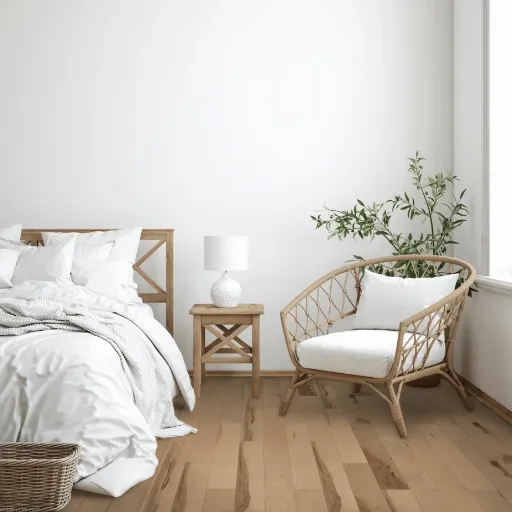
Upfront, engineered maple is usually the cheaper buy, often 15% to 25% less than solid, because it uses far less of the premium species. Typical 2026 material prices run about $3 to $9 per square foot for engineered maple and $4 to $12 for solid, with installed totals of $5.50 to $14 and $7 to $18 respectively. Solid installation also tends to cost more, since nail-down labor plus on-site sanding and finishing add up, while engineered maple can float over almost any subfloor.
The honest question is lifetime value, not sticker price. Over 50 years, a solid maple floor can be refinished several times and still be going, while a thin engineered floor may need full replacement. That reframing favors solid only if you actually refinish it. Many owners never do, which is why the cheaper engineered floor often proves the better real-world value for a typical 10-to-15-year homeowner. For full line-item pricing, grade tiers, and a realistic budget example, our maple flooring cost guide breaks down every dollar.
Maple Flooring Pros and Cons to Weigh
Before you decide, it helps to see maple’s honest strengths and weaknesses, because they apply to both engineered and solid forms.
The strengths. Hard maple is genuinely hard, about 1,450 on the Janka scale, harder than red oak at 1,290 and white oak at 1,360, so it resists dents from pets, kids, and dropped items. Its smooth, closed grain and creamy light color suit modern and minimalist interiors, reflect light, and make rooms feel larger. When you want a clean, uniform, contemporary look, maple delivers it better than almost any domestic species.
The honest weaknesses. That same smooth, pale surface shows scratches, scuffs, dust, and pet hair far more visibly than oak’s busy grain does. The tight grain also resists stain, so medium and dark finishes tend to come out blotchy unless applied by someone who knows the conditioning tricks. And maple warms and yellows over time as UV light hits it. None of these are deal-breakers, but they are real, and competitors often skip them. For the full balanced picture, our maple wood flooring pros and cons article expands on each point with the details you need before buying.
Does Maple Flooring Turn Yellow in Both Forms?
Yes, both engineered and solid maple yellow over time, and it is one of the most common surprises for new maple owners. Two forces drive the shift. First, the wood itself is naturally UV-photosensitive, so sunlight slowly warms its color from cream toward honey. Second, oil-based polyurethane finishes amber on their own, adding a yellow cast on top of the wood’s natural change.
The good news is that the finish you choose changes the outcome. Water-based polyurethane with UV inhibitors slows both the finish ambering and some of the wood’s reaction, keeping maple lighter for longer. Rugs, curtains, and window film also protect the floor from direct sun. If the warm patina bothers you, understand it before you buy, because you cannot fully stop it. For the deeper explanation and the products that keep maple light, read our article on does maple flooring turn yellow and how to manage the color shift.
Sustainability: Which Maple Floor Is Greener?
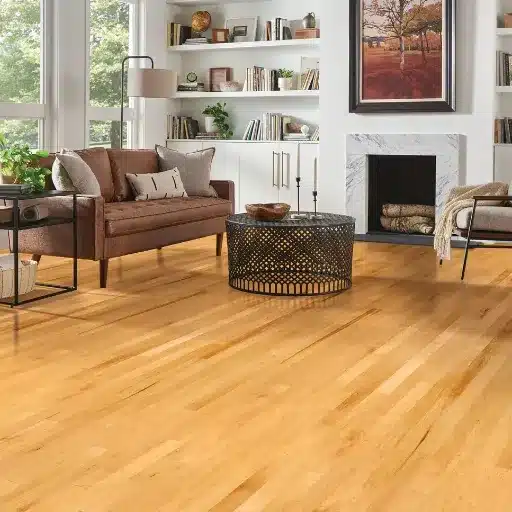
Maple is a fast-growing, abundant North American species, so it is one of the more sustainable domestic flooring choices in either form. The real sustainability difference between engineered and solid comes down to material efficiency.
An engineered maple plank uses a thin layer of the premium species over a core made from smaller, faster-growing or plantation-grown wood. That means one log stretches across far more floor area, which is a genuine efficiency win for a hardwood that takes decades to mature. A solid maple plank uses premium lumber top to bottom. Both floors store carbon for their service life, and both can be responsibly sourced, but engineered construction is the more resource-efficient use of the species.
What matters most is that your maple comes from a certified, responsibly managed forest. Look for FSC or PEFC certification on the sourcing, and for the indoor air quality side, check that the engineered board’s core and finish meet FloorScore or CARB/EPA TSCA Title VI formaldehyde limits. As a manufacturer of real maple veneer for engineered flooring, we see the material from log to finished plank, which is exactly why we are selective about the certified supply chains we buy from. When you choose VitalWood Global, you can trace the maple you walk on back to a responsibly managed forest.
How to Choose: Engineered Maple vs. Solid Maple
If you are still torn, work through this decision framework in order, and the answer will usually reveal itself.
- Start with the subfloor and grade. Concrete slab, basement, or radiant heat? That alone rules out solid maple and decides for you.
- Consider your climate and humidity. Wide seasonal swings, coastal air, or a home without year-round climate control point firmly to engineered.
- Decide how long you will stay. Planning to live there 20-plus years and refinish? Solid maple rewards you. Expect to move within 10 to 15 years? Engineered is the smarter spend.
- Check the wear layer, not the marketing. If you lean engineered, demand a genuine engineered maple wear layer of at least 3 mm, ideally 4 to 6 mm, unless you are fine never sanding it.
- Set a budget that includes installation. Engineered often wins on total installed cost because it floats and skips site finishing.
- Verify certifications and warranty. FSC or PEFC sourcing, FloorScore for indoor air, and a clear wear-layer warranty protect your purchase.
Choose engineered maple if you need a slab, basement, or radiant-heat install; live in a humid climate or a home without climate control; want lower upfront cost; or want the flexibility of a floating installation in a condo or over an existing floor.
Choose solid maple if you have a stable, climate-controlled, above-grade space; want the maximum number of full refinishes over many decades; value the traditional all-wood product; or are buying for a forever home where you will maintain it.
FAQ
Which is better, engineered or solid maple?
For most homes in 2026, engineered maple is the better buy. It installs over concrete slabs, basements, and radiant heat that rule out solid, it handles humid climates, and it costs 15% to 25% less upfront. Choose solid maple only when you want the maximum number of full refinishes in a stable, climate-controlled, above-grade space.
Is engineered maple flooring real wood?
Yes. Engineered maple has a genuine hard-maple wear layer bonded to a core. The surface you walk on is real maple, recognized by the National Wood Flooring Association as a real wood floor. Only the construction beneath the surface differs.
Which lasts longer, engineered or solid maple?
Solid maple can last 50 to 100+ years because it can be refinished many times. Engineered maple lasts 20 to 40+ years depending on its wear layer. In practice, most homeowners replace or move well before either wears out.
Can engineered maple be refinished like solid maple?
No, and the difference is the wear layer. Engineered maple allows 0 to 3 sandings depending on how thick its maple veneer is. Solid maple allows about 5 to 8. A 2 mm engineered board cannot be sanded at all, only screened and recoated.
Is engineered maple better for radiant heat or concrete slabs?
Yes. Its cross-laminated core resists the seasonal movement that makes solid maple risky over slabs and radiant heat. This is engineered maple’s clearest advantage.
Which shows scratches more, engineered or solid maple?
They show scratches equally, because the surface wood is the same hard maple. The pale, smooth grain reveals marks and dust more than oak does, regardless of which construction you choose.
Does maple flooring yellow in both forms?
Yes, both engineered and solid maple warm toward honey over time from UV exposure and finish ambering. Water-based UV-inhibited finishes slow the change.
Is solid maple worth the extra cost?
It is worth it only if you will actually refinish it over a long ownership period. For most homeowners, engineered maple delivers the same beauty for less money with better stability.
The Bottom Line: Engineered Maple vs. Solid Maple
If you take nothing else from this guide, remember this. Engineered maple and solid maple are both real maple, and both can be beautiful, durable floors. Choose engineered when stability, installation flexibility, and upfront value matter, which covers most modern homes, and choose solid when you want maximum refinishing cycles and the traditional full-wood product in a stable, dry, above-grade space.
Maple rewards buyers who know its quirks. Accept that the pale surface shows a little wear, protect it from UV if you want it to stay light, and confirm the wear layer or species grade before you sign. Do those things, and a maple floor, engineered or solid, will serve you beautifully for years.
When you are ready to compare real options, our team can help you spec the right board for your subfloor and climate, with certified, responsibly sourced maple every time. Contact VitalWood Global to request samples and a wholesale or project quote, and let us help you build a floor you will be proud to stand on.