

Burl Veneer: A Practical Guide for Designers, Buyers, and Woodworkers
Burl veneer has a way of stealing the spotlight without trying too hard. It brings that swirling, irregular grain people notice immediately, and once you’ve seen it up close, plain veneer can feel a little flat.
What Is Burl Veneer?
Burl veneer is a thin slice of wood taken from the knotted, irregular growth that forms on a tree, and that unusual grain is exactly why it gets so much attention. The surface rarely looks orderly. It has swirls, eyes, waves, and little bursts of pattern that can make a cabinet door or panel feel almost like a piece of natural art.
That visual noise is the appeal. Plain veneer reads clean and consistent; burl veneer feels alive, a little unpredictable, and a lot more expensive-looking. You might see a tight, marbled section with tiny oval “eyes” clustered across the sheet, then a softer, cloudier area right beside it. That contrast is part of the charm. Designers use it when they want a surface to do more than just cover a substrate. It becomes the feature, not the background.
The Basic Look and Why It Stands Out
The thing people notice first is movement. Burl veneer doesn’t run in straight lines or repeat itself neatly, so your eye keeps drifting across the sheet instead of settling in one place. That makes it especially good for statement furniture, decorative panels, and focal points where flat grain would feel too restrained.
It also has a kind of depth that’s hard to fake. Even in a small sample, maybe a 12-by-12-inch panel, the figure can look layered, almost three-dimensional under finish. Light hits the grain from different angles and throws out subtle shifts in tone. One moment it looks soft and smoky, the next it flashes a brighter knot cluster. That’s the whole game with burl veneer: it never sits still for long.
Still, the reason it stands out isn’t only visual drama. It also signals craftsmanship. Using burl veneer says someone cared enough to choose a material with character, then place it where people would actually notice. On a high-end dresser front, a conference table inlay, or a set of cabinet doors, that matters. The wood doesn’t just decorate the object. It gives it personality.
How Burl Forms in the First Place
Burl comes from abnormal growth, usually where a tree has been stressed, damaged, infected, or otherwise pushed off its normal growth pattern. Instead of growing in a regular, straight-grained way, the tree produces a dense mass of twisted bud tissue and dormant eyes. That’s what creates the swirling figure people want so badly in Burl Veneer.
The exact trigger can vary. A wound from storm damage, an insect attack, a fungal issue, or even a genetic quirk can start the process. Sometimes the burl grows low on the trunk. Sometimes it appears near a branch union. And sometimes it shows up in a spot that makes no obvious sense at all, which is part of why the material feels rare and a little mysterious.
What matters from a woodworking standpoint is how chaotic the grain becomes. Regular lumber has fibers that mostly travel in one direction. Burl grain does not. It twists, folds, reverses, and compresses into tight knots and pockets, which is why the veneer slices from it can look like a tiny landscape of curls and eyes. That irregularity is beautiful, but it also makes the material harder to cut and match cleanly.
So the finished sheet carries the story of that strange growth. Not in a romantic, vague way. You can actually see the stress built into the pattern. That’s what gives burl veneer its edge over ordinary decorative wood. It looks like the tree changed its mind halfway through growing, and the result is exactly the kind of visual tension designers keep coming back for.
Why People Choose It Over Plain Veneer
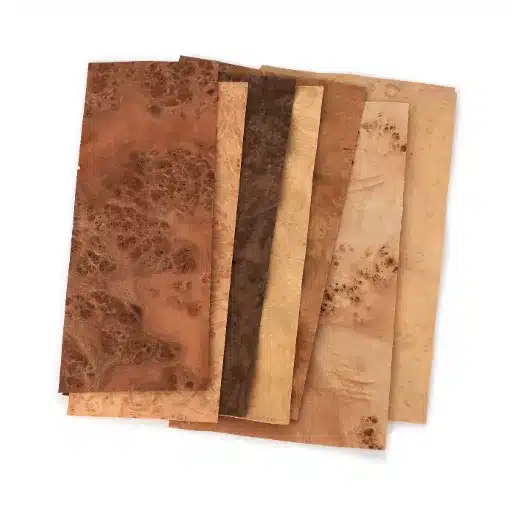
Burl veneer wins because it gives you drama without forcing the whole project into “look at me” territory. Plain veneer is clean, calm, and useful; burl brings motion, depth, and that slightly wild grain that makes a flat surface feel alive. Designers reach for it when they want a piece to read as custom, not just finished.
The appeal is practical as much as visual. A solid burl slab can be expensive, heavy, and awkward to work with, while burl veneer lets you get the same rich figure on a substrate that’s easier to build, easier to install, and a lot more manageable in larger runs. That balance matters when you’re covering a cabinet bank, a reception desk, or a pair of matching panels. You get the show without the structural headache.
Visual Drama Without Using a Solid Burl Slab
This is where burl veneer earns its keep. It gives you that swirling, marbled effect people usually associate with high-end furniture, but in a thinner, more efficient format. One drawer front can look like a slice of storm cloud. Another might lean softer, with a quilted feel that catches light in different ways as you move around it.
That flexibility is useful. You’re not locked into one giant block of costly wood, and you’re not carrying the weight or waste that comes with a solid burl piece. For interior projects, that’s often the smarter move. You can use it on a headboard, a credenza, or a wall feature and still get the same visual payoff. The surface does the talking; the construction stays sensible.
There’s also a little bit of psychology in it. People see burl and assume rarity, craft, and attention to detail. They’re not wrong. Even a modest application — say, a narrow band on a cabinet door — can shift how the whole piece is read.
Where It Makes the Biggest Difference
Burl veneer has the biggest impact anywhere a flat surface needs to feel special fast. Cabinet fronts are the obvious one. So are conference tables, vanity doors, and built-ins in rooms that need a strong focal point without extra ornament.
It also works well in places where light hits from different angles. The figure changes as you walk past it, which gives the material a kind of quiet movement. That’s why you’ll see it used in entry spaces, hospitality interiors, and statement furniture where the goal is to make a lasting first impression. A long hallway with burl-paneled doors, for example, feels very different from the same hallway in plain oak — warmer, richer, a bit more deliberate.
Still, it’s not only for luxury settings. Burl veneer can elevate smaller projects too: a desk inset, a drawer stack, a media unit, even a single accent panel in a room that otherwise stays restrained. That contrast is the trick. Use it where the eye naturally lands, and it does the heavy lifting for you.
5 Things to Check Before You Buy
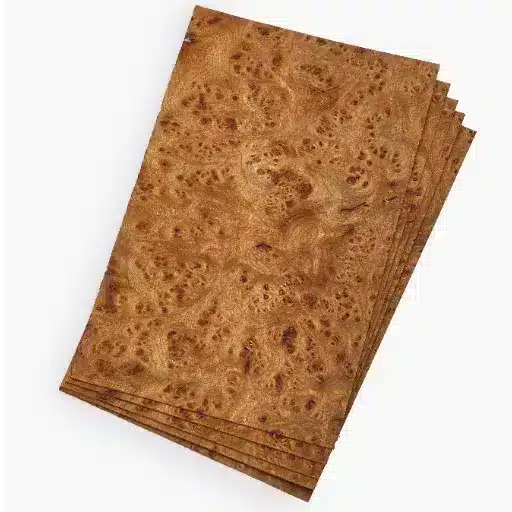
Burl veneer looks easy to buy until you’re standing in front of a sheet and realizing the pretty part is only one piece of the puzzle. The real difference shows up in the details you can miss in a quick glance.
Grain pattern and figure consistency
Look closely at how the figure moves across the sheet. Some Burl Veneer has tight, almost marble-like movement; other sheets open up into larger swirls that feel bolder and a little wilder. If you’re covering a small cabinet door, that dramatic look can be perfect. If you’re matching a long run of panels, too much variation can make the final result feel busy instead of refined.
Sheet size, thickness, and backing
Check the usable size, not just the advertised size. A sheet with a ragged edge or uneven trim can cost you a couple of inches that matter more than you’d think. Thickness and backing matter too, especially if the veneer needs to be pressed, handled often, or fitted over a stable substrate rather than a simple decorative panel.
Matching pieces for larger projects
If the project has multiple doors, drawers, or wall sections, ask how well the sheets match from one piece to the next. That’s where a lot of people get tripped up. Burl is naturally irregular, so matching is never perfect, but a good set should still feel related—like parts of the same sentence, not three different conversations.
Can You Finish and Install It Like Other Veneers?
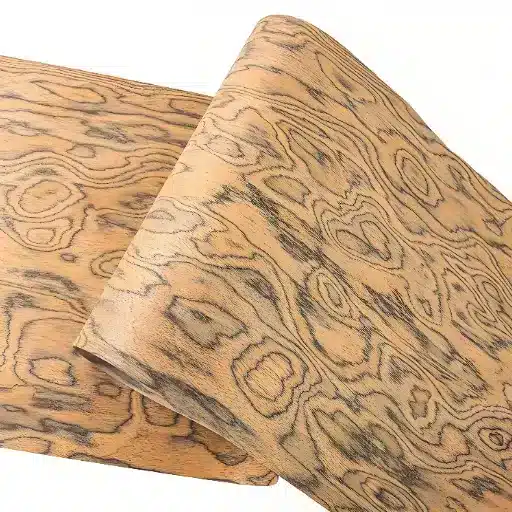
Yes, but burl veneer asks for a steadier hand than plain-grain sheets. The surface can be gorgeous and still be a little fussy, so the prep matters more than people expect.
Prep, glue-up, and substrate choice
Start with a flat, stable substrate. MDF is usually the safer bet for most furniture work because it stays predictable, and that predictability helps when the veneer figure is already doing plenty of visual work. Plywood can work too, but only if it’s truly flat and the face quality is good; a slight crown or warp will show up fast once the Burl Veneer goes on. Clean the surface, sand lightly, and remove every speck of dust. That tiny bit of care saves a lot of headache later.
For glue-up, even pressure is the whole game. Vacuum press, cauls, or a well-set cold press all work if the panel is supported evenly and the adhesive is spread consistently. With burl, you don’t want dry spots, because they tend to telegraph through the finish like a bruise under thin fabric. So keep the glue coat controlled, not heavy. Too much glue can bleed through open figure and leave you with stain-resistant patches that show up at the worst possible moment.
Finishing tips for a cleaner result
Finish Burl Veneer in thin, patient coats. The figure usually looks best when you build depth slowly rather than trying to flood it with heavy finish in one pass. A sanding sealer can help tame the surface just a bit, especially if the grain is wildly open or you’re working on a large decorative panel.
Test your finish on a scrap first. That sounds obvious, but burl can darken or shift character in ways that plain veneer won’t, and a clear coat that looks clean on one wood can go a little muddy on another. A satin finish often suits it well because it keeps the pattern visible without making it look plastic. You want the figure to breathe, not glare.
Choosing the Right Burl Veneer for Your Project
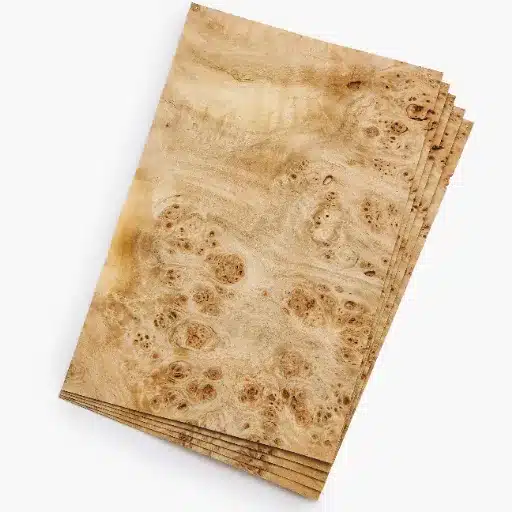
The right Burl Veneer usually comes down to two things: how much visual movement you want, and how much control the project needs. A bold, highly figured sheet can make a small panel feel expensive and alive; a quieter pattern is often better when the rest of the design already has a lot going on.
A quick buying checklist
Look at the figure first. If the swirl is too chaotic for the surface size, the panel can feel crowded instead of elegant. Check the sheet size next, because a beautiful pattern is useless if you can’t get the coverage you need without awkward seams.
Backing matters too. A paper-backed or flexible option may be easier for curved work, while a firmer backing is often a safer pick for flat furniture parts. Pay attention to color consistency from sheet to sheet, especially if you’re ordering more than one. Burl can vary wildly, and that’s part of the charm, but you still want the pieces to feel like they belong to the same family.
When to go decorative, when to go premium
If the veneer is going on a small accent door, a drawer front, or a feature panel, decorative grade can be plenty. It gives you the look without pushing the budget harder than it needs to go.
Go premium when the surface is large, highly visible, or part of a custom build where every seam will be noticed. That’s the kind of project where a more consistent Burl Veneer earns its keep. It’s a bit like choosing between a good wine glass and a chipped coffee mug: both do the job, but only one changes how the whole thing feels.
Frequently Asked Questions (FAQ)
-
What is burl veneer used for?
Burl veneer is used where you want a surface to feel more decorative, rich, and custom without using a solid burl slab. It’s common on cabinet doors, drawer fronts, wall panels, and statement furniture. A small walnut burl inset on a desk, for example, can change the whole look of a room without overwhelming it. Designers like it because it adds visual movement fast. -
Is burl veneer hard to work with?
It can be a little fussy, mostly because the grain is irregular and the sheet can be more fragile than plain veneer. You need a flat substrate, even glue pressure, and patience during finishing. If you’re pressing a 24-inch cabinet panel, for instance, tiny bumps or dry spots may show through. It’s not difficult, but it does reward careful handling. -
How do I choose the right burl veneer sheet?
Start with the figure and ask whether it fits the scale of your project. A highly swirled sheet works well for a single accent panel, while a calmer pattern is better for larger runs. Check sheet size, backing, and color variation too. If you’re matching four drawer fronts, you’ll want pieces that feel related, not randomly pulled. -
Can burl veneer be finished like other wood veneers?
Yes, but usually with a lighter touch. Thin coats, a clean substrate, and a test on scrap make a big difference. A satin finish often works nicely because it lets the figure show without looking too glossy. If you flood the surface, the open grain can catch the finish unevenly and look muddy. -
Why is burl veneer more expensive than regular veneer?
The figure is less common, the sheets are harder to cut consistently, and good-looking sections are often limited in size. That all pushes the price up. For a small vanity panel or a pair of cabinet doors, the cost may feel worthwhile because the visual payoff is immediate. You’re paying for rarity and appearance, not just coverage.
References
-
Wood Database. (n.d.). Burl Wood and Figured Grain Reference. https://www.wood-database.com/
- Click here to read more.