
Engineered Oak Flooring Kitchen: Species & Finish Guide
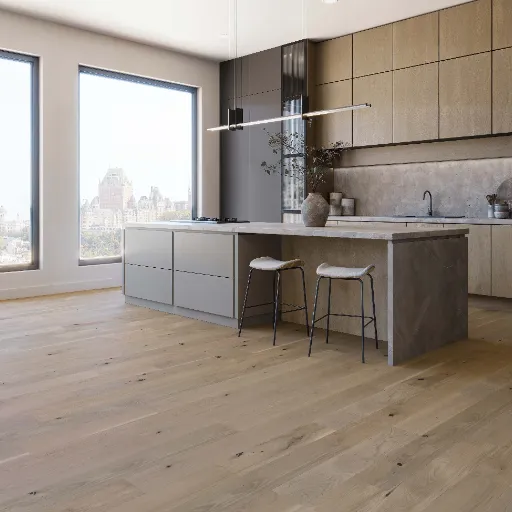
For an engineered oak flooring kitchen, three decisions do most of the work: white oak over red, a wear layer of 3-4 mm, and a matte factory finish. Get those right and the floor handles a working kitchen. Get them wrong and the same room will show every spill, dent, and dropped spoon.
Oak is the default species for a reason. It is hard enough for chair traffic, open enough to take a stain, and neutral enough to sit under almost any cabinet color. But “oak” covers several species with different color, grain, and water behavior, and a kitchen punishes the differences more than a bedroom does.
Oak kitchen flooring also has one design question that species comparisons ignore: what the floor looks like next to the cabinets. This guide covers both. For moisture, installation sequencing, and 2026 costs, start with the engineered wood flooring for kitchens guide. If the same kitchen needs veneered cabinet fronts or panel carcasses, send the specification and we will confirm what can be matched across the run.
Key Takeaways
- White oak is the kitchen default: 1,350 lbf Janka, a neutral tone, and pores plugged with tyloses that slow water movement.
- Red oak is usually cheaper but open-grained and more prone to water staining, which matters at a sink and dishwasher.
- Match the floor to the cabinets by undertone and value, not by species name. Two mid-tone oaks with different undertones is the most expensive common mistake.
- A matte factory finish hides wear better than gloss, but sheen does not add scratch resistance. The finish chemistry does.
Is Engineered Oak Good for a Kitchen?
Yes, engineered oak is a sound kitchen floor when the plank has a wear layer of about 3-4 mm, sealed edges, and a finish rated for residential traffic. The cross-laminated core moves less than solid oak when humidity swings, and the oak face can be refinished if it is thick enough.
It isn’t waterproof. Water that sits at the sink base, under the dishwasher, or behind the refrigerator can swell the core and lift the boards. That is why the kitchen specification is about the whole plank: face, core, edge, and finish.
One operating condition matters more than any other. The National Wood Flooring Association recommends keeping indoor relative humidity at 30-50% at 60-80 F year-round. Use the product’s own range when it differs; a kitchen that swings between a dry winter and a humid summer will move any wood floor.
What engineered construction changes, and what it does not
Engineered oak is a real oak face on a plywood or fiberboard core. The cross-lamination resists the seasonal movement that makes solid oak cup, gap, and crown. That stability is why engineered oak handles a kitchen better than solid oak of the same species.
What it does not change is the face. An oak face dents like oak. A thin wear layer can’t be sanded back to new. Construction improves stability; it doesn’t turn wood into tile.
White Oak vs Red Oak vs European Oak for a Kitchen Floor
The three oaks sold for flooring are not interchangeable in a kitchen. Hardness is close enough that appearance and water behavior usually decide. The table below uses values from The Wood Database, measured at 12% moisture content.
| Oak | Janka hardness (lbf) | Natural color | Grain | Water behavior | Price position | Best for |
|---|---|---|---|---|---|---|
| White oak | 1,350 lbf | Light tan to medium brown, neutral | Tight, straight | Pores plugged with tyloses; rated very durable | Premium | Kitchens, busy homes, resale |
| Red oak | 1,220 lbf | Pink to reddish brown, warm | Open, pronounced | Porous; stains and discolors when wet | Lower | Traditional rooms, budget builds |
| European oak | 1,120 lbf (English oak) | Olive to medium brown, wide variation | Varied, often longer planks | Good decay resistance; tannin-rich | Premium | Character grades, reactive finishes |
Two caveats on the numbers. Janka measures dent resistance, not water resistance. And “European oak” is a category, not one species: English oak (Quercus robur) and sessile oak (Quercus petraea) are both sold under it, and values vary by source and grade.
White oak: the kitchen default
White oak earns the default for two reasons. First, its heartwood pores are plugged with tyloses, the growth that makes white oak barrels watertight. The Wood Database rates it very durable and notes its use in boatbuilding and tight cooperage. Second, its color is neutral enough to sit under white, cream, green, navy, or walnut cabinets without fighting them.
The phrase “white oak flooring in kitchen” is often used as if white oak were a color. It isn’t.
White oak is a species group with a tan-to-brown heartwood. A floor sold as white oak may be natural, lightly stained, smoked, or gray-washed. Ask for the finish name and a physical sample.
White oak also takes stain evenly, which is why it dominates the current light-oak and warm-honey looks. Our engineered oak flooring guide covers the species and construction in more detail.
Red oak: cheaper, warmer, thirstier
Red oak is usually cheaper than white oak in comparable grades, and it is still the volume seller in traditional homes. Its open grain takes a stain well and shows a strong cathedral figure.
In a kitchen, the same open grain is a liability. The Wood Database rates red oak non-durable to perishable and warns that it discolors and stains in contact with water, particularly in the porous growth-ring areas. A spill that sits for an hour can leave a dark ring that sanding may not fully remove. At a sink or dishwasher, that is the wrong risk to take for a small saving.
Red oak also ambers under oil-based finishes, which pushes it toward yellow-orange. Next to honey oak cabinets, it can read as a near-match that misses.
European oak: character and reactive finishes
European oak is the design-market choice. The planks often run longer and wider, and the color variation is wider than American white oak.
European oak is also tannin-rich, which is why it responds so well to fuming and reactive stains. Those finishes change the wood’s color chemically rather than coating it, producing the smoked and aged looks that dominate high-end kitchen work. The trade-off is permanence: a reactive finish cannot be sanded back to a different color.
Hardness is lower than American white oak. English oak measures 1,120 lbf, roughly 17% softer than white oak. In a kitchen, that difference is small next to the finish and the water discipline, but it matters in a busy family room.
Matching an Oak Floor to Kitchen Cabinets
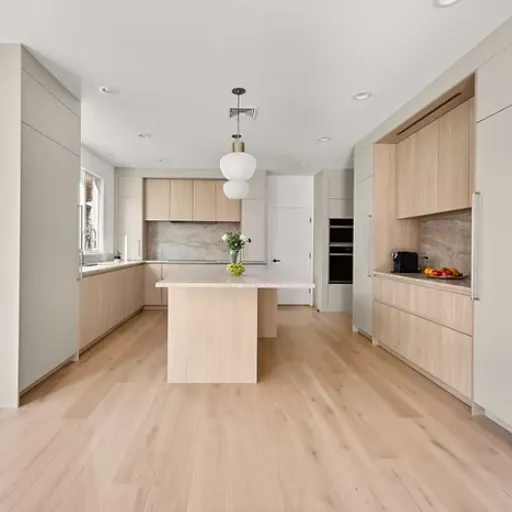
The most expensive common mistake in an oak kitchen is not the wrong species. It is two oaks that almost match. A honey oak cabinet and a red oak floor are both warm, both mid-tone, and both oak, but one reads yellow-orange and the other pink-red. The eye sees the mismatch before it can name it.
Choosing kitchen flooring with oak cabinets comes down to one of two rules. Match the value and undertone closely enough that the two read as one material, or contrast deliberately with a floor that is clearly lighter or darker. The middle ground is the one to avoid.
The two-oaks problem
If the cabinets are 1990s honey oak, don’t add a red oak floor. The two woods fight over the same warm middle. Choose a white oak floor two or more shades lighter, a darker smoked oak for contrast, or a different material entirely.
The same logic applies to natural oak cabinets in a new kitchen. An exact match is almost impossible because the cabinet door and the floor come from different boards, cuts, and finishes. Trying to match invites a visible seam between two surfaces that were never going to agree.
White, colored, and walnut cabinets
| Cabinet | Floor direction | Why |
|---|---|---|
| White or cream painted | Mid-tone natural white oak | Warms a cool room; a gray-washed floor can read cold and dated |
| Navy, green, clay, or other saturated color | Natural or lightly stained white oak | Oak is the neutral that lets the cabinet color lead |
| Natural oak | Two shades lighter or darker, or a different species | Avoids the near-match problem |
| Walnut | Lighter white oak | Contrast in value; do not match walnut with a walnut-look oak |
| Gray or greige painted | Warm white oak, not gray oak | Keeps the room from going flat |
Approve a board, not a photo
Order a sample large enough to show several planks, and view it against the actual cabinet door in the actual kitchen. Look at it in morning light, under the room’s LED downlights, and at night. A 3 in chip hides the color variation that appears across a 200 sq ft floor.
This is the same discipline used for veneer color matching on cabinet faces: approve the range, not the average. If the kitchen also needs new cabinet fronts, the wood veneer panels for kitchen cabinets guide covers how face veneer is matched across a run.
Choosing a Finish and Color That Survives a Kitchen
The finish decides how the floor handles grease, water, and cleaning. It also decides whether a scratch can be repaired in place or requires a full sand and recoat. Four families are worth knowing.
| Finish | Look | Water resistance | Repair | Maintenance | Best for |
|---|---|---|---|---|---|
| Factory ultraviolet (UV)-cured polyurethane | Clear film, low sheen available | Good | Screen and recoat; spot repair difficult | Damp mop with a manufacturer-approved cleaner | Most busy kitchens |
| Aluminum oxide | Clear film, very hard | Very good | Same as polyurethane | Damp mop | High traffic, rentals, heavy use |
| Hardwax oil | Natural, matte, open grain | Moderate; beads but needs refresh | Spot repairable with oil | Re-oil high-spill zones periodically | Design-led homes with upkeep |
| Reactive stain plus oil | Color in the wood, not on it | Moderate | Scratches show less; color variation is permanent | Oil maintenance | Character grades, smoked looks |
The practical split is maintenance tolerance. A sealed film finish tolerates a damp mop and asks little of the owner. An oiled floor looks better for longer if it is maintained, and worse than a film finish if it is neglected. Neither is more waterproof; both rely on wiping standing water promptly.
Matte, satin, or gloss
Sheen changes how much wear the floor shows, not how much wear it takes. Matte and satin scatter light and hide scratches, footprints, and dust. Gloss reflects the room and shows every mark, which is why it has fallen out of favor in kitchens.
A low-sheen finish is the safer choice for a working room. It doesn’t make the floor more durable. It makes the floor look better between cleanings.
Oil or lacquer for a working kitchen
Choose a sealed factory finish if nobody wants a maintenance schedule. Choose hardwax oil if the floor is a design feature and someone will re-oil the sink zone and the run in front of the range once a year or so.
Don’t choose oil for a rental property or a household that uses a steam mop. Steam and standing water damage an oiled floor fastest.
Texture: smooth, wire-brushed, hand-scraped
Wire-brushed oak has a light grain texture that hides scratches and scuffs. In a kitchen, the grooves also collect flour, crumbs, and grease, so it needs vacuuming rather than sweeping. Smooth oak is easier to clean and shows every mark. Hand-scraped oak is falling out of favor because the deeper ridges are harder to keep clean in a room with cooking residue.
Oak floor color trends for 2026
The direction in 2026 is warmer and lighter. Natural white oak, warm honey tones, and low-sheen finishes are the mainstream specification. Cool gray-washed oak, heavy whitewash, and high-gloss finishes are on the way out. The major flooring trend reports put white oak at the top; treat that as a direction, not a specification.
Three format choices are moving with the color shift:
- Wider planks. 7-10 in (180-255 mm) is the current high-end standard. Wide planks show fewer seams, but they move more across their width.
- Longer planks. Longer boards reduce butt joints and waste more in a small galley.
- Pattern. Herringbone and chevron are growing again. A herringbone engineered wood flooring kitchen layout adds labor and waste, so price it before committing a small room to it.
One caution on trend-led color. A smoked or strongly stained floor is a 10-year decision, and the next buyer may not share the taste. A natural mid-tone white oak is the safest resale choice. If the kitchen is a forever room, choose the color you want; if it is a five-year house, choose the neutral.
Specifying Engineered Oak for a Kitchen
An engineered oak flooring kitchen specification has nine lines. Each one is a question the seller should answer in writing.
- Wear layer. 3-4 mm supports refinishing. Under about 2 mm, treat the floor as wear-and-replace.
- Core. Plywood is more moisture-stable than high-density fiberboard (HDF). Ask for the core species and ply count.
- Edge seal. Sealed edges slow water at the joints. Unsealed edges are the weak point at a sink.
- Finish. Name the chemistry and the sheen. “Matte” is not a durability rating.
- Grade. Select, character, or rustic. Grade changes the look and the price, not the hardness.
- Plank width and length. Match the format to the room, not just the trend.
- Matching. If the floor runs continuously into another room, ask how the planks are sequenced.
- Subfloor moisture. Test before the first plank. A slab needs an on-site moisture test, not a visual check.
- Acclimation. Follow the manufacturer’s time and conditions. A kitchen that is still drying out is not ready.
The best engineered wood flooring for kitchen scorecard turns these lines into a weighted score you can use to compare two products that look identical in a showroom.
Three kitchen briefs
Example, not a customer case. Small galley, white shaker cabinets, 120 sq ft. White oak, 5 in (130 mm) plank, 3 mm wear layer, matte UV-cured finish, glue-down or floating according to the subfloor.
Example, not a customer case. 1990s oak-cabinet remodel, 200 sq ft. Keep the cabinets and avoid red oak. Use a white oak floor two or more shades lighter than the cabinet, with a matte finish. Approve the sample against the cabinet door before ordering.
Example, not a customer case. Open-plan kitchen and living area, 500 sq ft. White oak, 7-9 in (180-230 mm) plank, continuous layout, matte finish to cut glare, and expansion gaps at the long runs. This is the layout where an engineered wood flooring open plan kitchen decision usually turns on carrying the floor across two rooms rather than on the species.
FAQ About Engineered Oak Flooring for Kitchen
Is engineered oak good for a kitchen?
Yes, if the plank has a 3-4 mm wear layer, sealed edges, and a finish rated for residential traffic. Keep indoor humidity at 30-50%, wipe standing water promptly, and never use a steam mop. Engineered oak is more stable than solid oak, but it isn’t waterproof.
White oak or red oak for a kitchen?
White oak. Its pores are plugged with tyloses, so it absorbs water more slowly, and its neutral tone works with more cabinet colors. Red oak is cheaper and warmer, but its open grain stains more readily and it can clash with honey oak cabinets.
Should the floor match the kitchen cabinets?
Not exactly. Match the undertone and value, or contrast deliberately with a floor that is clearly lighter or darker. A near-match between two mid-tone oaks is the look that reads as a mistake.
What finish is best for an oak kitchen floor?
A factory-applied UV-cured polyurethane or aluminum oxide finish in matte or satin suits most kitchens. It wipes clean and needs no routine re-oiling. Hardwax oil is the better choice only when someone will maintain it and spot-repair the high-spill zones.
Can you refinish engineered oak?
It depends on the wear layer. A 3-4 mm face can usually be sanded and refinished; a 2 mm face has limited life; under about 2 mm, the floor is a wear-and-replace product.
Is laminate engineered oak the same thing?
No. Laminate is a printed image under a clear wear layer on an HDF core. Engineered oak has a real oak face over a plywood or fiberboard core. They can look similar in a photo and behave differently under water, sanding, and repair.
Conclusion
For an engineered oak flooring kitchen, the decision is narrower than the market suggests. White oak is the default for its water behavior and neutral tone. A 3-4 mm wear layer decides whether the floor can be refinished. A matte factory finish hides the wear that a working kitchen puts on any surface.
The cabinet pairing decides whether the room looks considered or almost right.
If the project also needs veneered cabinet fronts, panel carcasses, or edge banding, send your specification and request a sample of the oak face you are considering. Vital Wood Global supplies oak veneer, veneer panels, plywood, and edge banding, not finished flooring. We can confirm the face veneer, matching, and panel construction for the cabinetry; the floor itself comes from a flooring supplier.
For the room-level questions this guide deliberately leaves out, including moisture control, installation around cabinets, and cost, use the engineered wood flooring for kitchens guide as the next step.