
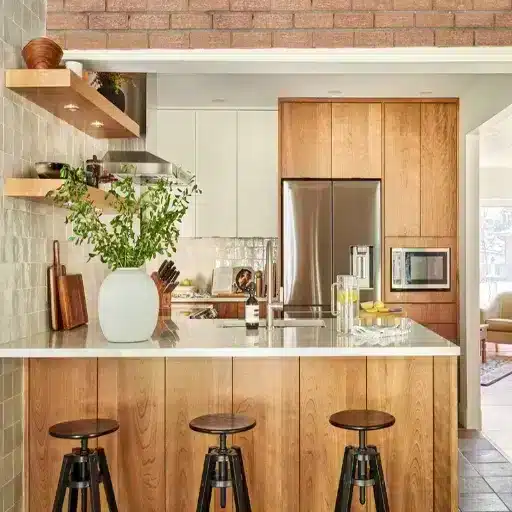
Wood Veneer Panels for Kitchen Cabinets and Built-Ins: A Complete Specifier’s Guide
Wood veneer panels for kitchen cabinets are cost-effective, mimic real wood, and come with warmth and aesthetics. In steam-filled kitchen environments, the wood veneer has improved dimensional stability. If it’s set to the proper species, quality edge banding, and waterproof core, veneer cabinetry goes a long way in extending the life to twenty-five to twenty-five years in residential usage, thus far surpassing repairability and total cost of ownership post- laminate and thermofoil alternatives industries.
Indeed, the largest sales of architectural wood veneer are captured within the size of the kitchen cabinetry. That is significantly more diverse because, in fact, the majority of people may not distinguish between a kitchen cabinetry set that gets them through twenty years in service from one that delaminates behind the dishwasher in year five. Online guidelines tend to blur the residential DIY refacing with commercial architectural specification, leaving designers and homeowners without specific advice for this kitchen application on the right substrate, edge banding, and species.
Should you find yourself in the market for purchasing, speccing or perhaps remodelling cabinetry in your kitchen, you will want to read on through the essentials herein. This all-encompassing text will help you choose the right substrate for moisture resistance while concerning the edging bands as first-class specification details and reflecting on species matching for high-use kitchens. Realistic price tags and the ever-expanding addition of project checklists are what most others refer to as sustainability credentials.
Key Takeaways
- Between 20 and 25 years with approved moisture-resistant substrates and quality edge banding, wood veneers last longer than laminates (10-15 years) or thermofoils (8-12 years) from wear and abuse.
- The type of substrate is more determinative in the kitchen than the species. From the MDF substrate, MR-MDF absorbs approx 40-60 percent less moisture than standard MDF, and plywood holds screws 25-40 percent stronger for doors and drawers used heavily for application.
- The most underestimated flaw of all is at the edge. 35-45 percent of all field failures in veneer cabinets begin at the edges, usually from water that infiltrates the surfaces, poor adhesion, or impact damage to corners.
- Veneer cabinets typically cost $8000-$30,000 for a full kitchen, while solid wood – with price tags from $15000 to $50000+ – and laminate – $5,000 to $15,000 – cost far less per square foot.
- FSC-certified veneer faces, CARB P2/TSCA Title VI cores compliant, and low-VOC adhesives offer available on every order will provide direct contribution toward LEED v4.1 and WELL v2 credits.
What Are Wood Veneer Panels for Cabinets?

A wood veneer cabinet door is a thin slice of real wood, usually 0.5-0.6 millimeters thick, bonded to a stable composite substrate and formulated into slab or five-piece doors, drawer fronts, end panels, and matching built-ins. The veneer face is not printed, embossed, or anything not real, but rather real timber poles were sawn or peeled from a log. That means a cabinet carries the warm tactile feel, grain, and variations in color pertaining to the tree from which it came.
Essentially, cabinet construction is divided into two classes. One class is the slab doors, which are single-veneer faces adhered flat to a substrate. It makes a smooth and unadulterated look and is popular in modern and Euro-style kitchens. Five-piece cabinets associate a veneered frame with a separate veneered panel at the center of the door, thus making a crest-raised panel or Shaker appearance of normal or transitionally styled cabinetry in a given kitchen design.
The area directly beneath the veneer facade is where the kitchen performance is won or lost. Standard MDF makes for a flat surface at the best cost, but it dramatically swells after the absorption of moisture into the edge grains. Moisture-resistant MDF is made moisture-proof with paraffin wax or resin, commonly provided with a premium of 10-20%. Plywood is unbeatable on screw-holding for hinges and hardware. In addition, it boasts natural moisture resistance in construction with crisscrossed fibers and, thus, costs 20-35% more than standard MDF. For commercial kitchens and multifamily housing, Class A or B-rated MDF or particleboard is also used.
For a complete overview of how the veneer panel family fits together, see our pillar guide to wood veneer panels.
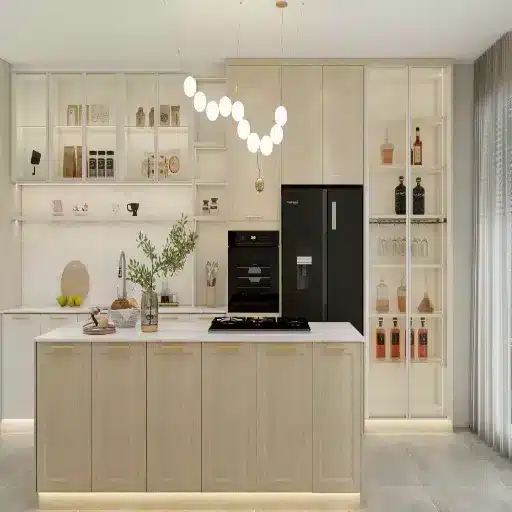
Pros and Cons of Wood Veneer Kitchen Cabinets
Advantages
Real wood aesthetics at a lower cost. It is costed 30% to 50% cheaper than solid wooden cabinets of the same style, but you get 85-95% of the look. Actually, it is due to material frugality. One of the logs of veneerable quality became 900 square meters of 0.6 millimeter veneer face; that is more than about 45 times the usable surface area that could be salvaged from the same log if it were solid planked.
Superior dimensional stability. Wood and humus develop in terms of shape due to aqueous factors. In a kitchen, it means the boiling of pots, the steam from the dishwasher exhausts, and seasonal fluctuations. A veneered panel moves much less wrt a stable substrate than one made of solid wood of the same dimensions, resulting in fewer crevices, superficial discrepancies, and tighter seams as time progresses.
Wide species selection. Because veneer uses so little wood per square foot, exotic species that would be prohibitively expensive in solid form, such as walnut, sapele, and anigre, become accessible. You can specify a kitchen in quartersawn white oak or book-matched American walnut without the budget of a solid wood equivalent.
Repairable. Chipped veneer can be patched, reglued, or touched up. Laminate and thermofoil cannot. That repairability extends service life and reduces lifetime replacement cost.
Sustainable. The 45-to-1 yield ratio means veneer places dramatically less pressure on forests than solid wood for the same visual result. Add FSC or PEFC certification, and the sustainability profile improves further.
Disadvantages
Thin-faced veneer. Standard veneer faces can be damaged if deep scratches, burns, or even very aggressive sanding at a 0.5-0.6 millimeter-thick veneer face. The rest of the layer is not decorative, so that can be seen as enticing damage.
Moisture sensitivity at edges. If standard MDF is penetrated by water at the edge, normal MDF can swell and delaminate the veneer face. Meanwhile, edge banding and substrate selection in kitchens are mandatory because untreated panels in rainy weather will develop problems.
Not all substrates tolerate steam. Only the core can make a good veneer face. Among the factors that qualify a veneer face into mediocrity is a cheap core together with a substandard grade of substrate or adhesive, which leads to bubbling, peeling, or breaking away within five to seven years.
Edge banding adds cost and a failure point. Any exposed edges of the substrate must be sealed. Edge banding comes out poorly in application, color mismatch, or its corners peel: the most common complaint with cabinets.
Choosing the Right Substrate and Core
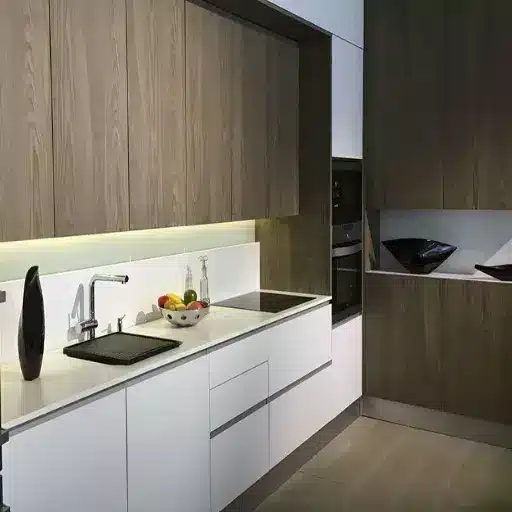
The substrate is the structural layer under the laminate face. It also has to function in the kitchens: it must resist humidity, support hardware, and maintain flatness over the decades. Here are the options.
Standard MDF
With the smoothest surface for veneering, the standard medium-density fiberboard provides the best and cheapest machines available. Excellent slab doors may be created with it. The only thing one would want to keep away from this board is moisture. Like a sponge, it quickly soaks up water if the edge banding fails or water sits on any horizontal surface. This swelling of the base causes disbonding or delamination of the veneer face. Standard MDF is not appropriate unless for some dry indoor uses, excluding those near sinks or dishwashers.
Moisture-Resistant MDF
MR-MDF shields itself with the use of paraffin wax or resin during manufacture against the absorption of moisture. Independent evaluations demonstrated that, under high humidity conditions, MR-MDF can save 40 to 60 percent of the moisture absorbed compared with standard MDF, making it the best substrate for domestic kitchen applications located within one meter of water sources. A premium bill is 10 to 20 percent compared to other types of MDF, and a small insurance policy for the most commonly known cabinet failure to happen.
Plywood
Birch or poplar cores are the only parts of the plywood that are not brittle, so they offer the best screw-holding property for hinges, drawer slides, and hardware. Plywood-screw holding property increases efficiency by 25-40% as compared to MDF core plywood, making plywood the preferred platform for heavier-use cabinet doors and drawers. It is durable and moisture-resistant, made through cross-laminated construction. And if you are looking for quality enhancements, these are the most beautiful cabinets you may ever see. You will have to pay 20-35% more per square foot for it than regular MDF, plywood being the best choice for high-use kitchen applications, commercial applications, and shelving applications that will be built into the wall.
Fire-Rated MDF or Particleboard
Commercial kitchens, restaurants, hotels, and multi-family housing often require Class B or Class A fire ratings. Fire-rated substrates use treated resins that slow combustion and meet building code requirements. The cost premium is 15 to 30 percent. For code-required spaces, this is not optional.
| Substrate | Moisture Resistance | Screw Holding | Fire Rating | Typical Cost Premium | Best For |
|---|---|---|---|---|---|
| Standard MDF | Low | Moderate | None | Base | Dry interiors, low-budget |
| MR-MDF | Moderate | Moderate | None | +10 to 20% | Residential kitchens |
| Plywood | High | High | Optional | +20 to 35% | High-use, commercial |
| Fire-rated MDF | Moderate | Moderate | Class A/B | +15 to 30% | Code-required spaces |
Lena Ortiz, a kitchen designer in Portland, learned about substrates the hard way. In 2023 she specified standard MDF-core veneer cabinets for a client’s beach-house renovation, prioritizing the smooth slab-door look and a tight budget. Within eighteen months, the cabinet end panel next to the dishwasher had swollen at the edge and the veneer face had begun to separate. The replacement cost, including removal, reorder, and reinstallation, exceeded the original 15 percent premium she would have paid for MR-MDF from the start. She now specifies MR-MDF or plywood for every kitchen within five miles of salt air or steam.
Edge Banding: The Critical Detail
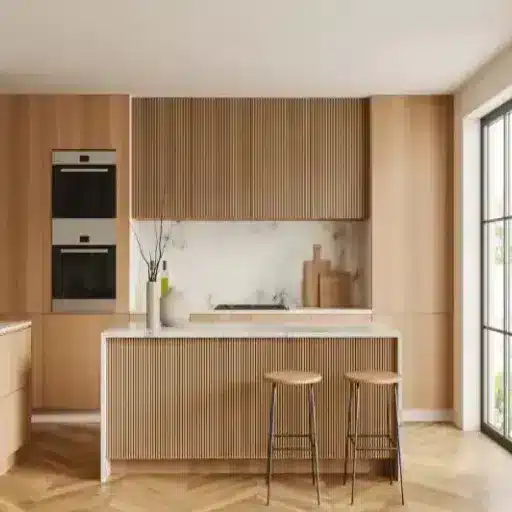
Edge banding is the finishing material applied to all exposed substrate edges of a cabinet door, drawer front, or panel. It is not a cosmetic afterthought. It is the primary moisture barrier that prevents steam and standing water from penetrating the core. Studies of cabinet warranty claims indicate that 35 to 45 percent of veneer cabinet field failures originate at the edge banding.
Edge Banding Materials
PVC is the most common choice. It is durable, color-matched to the veneer face, moisture-resistant, and applied quickly with hot-air or laser equipment. ABS offers similar performance with a greener end-of-life profile, no chlorine, fully recyclable. Wood veneer edge banding delivers a seamless real-wood edge but is less moisture-resistant than PVC or ABS and requires more care in application. Melamine edge banding is the budget option, pre-finished and heat-activated, but less impact-resistant at corners.
Application Methods
Hot-air edge banding is the industry standard. A heated air stream activates the adhesive on the back of the banding as it is pressed to the panel edge. Fast, reliable, and suitable for PVC and ABS. Laser edge banding uses a laser-activated adhesive layer that creates a zero-glue-line joint, essentially invisible and exceptionally durable. It is the premium choice for high-end residential and commercial work. Iron-on edge banding is the DIY method, heat-activated with a household iron, least durable, and not recommended for kitchen environments.
Matching Strategies
The best results come from ordering veneer faces and edge banding from the same flitch or dye lot. This ensures grain direction, color tone, and finish sheen match exactly. Custom staining can bridge small differences, but starting with pre-matched materials eliminates the guesswork.
Wood Species Selection for Kitchen Cabinets
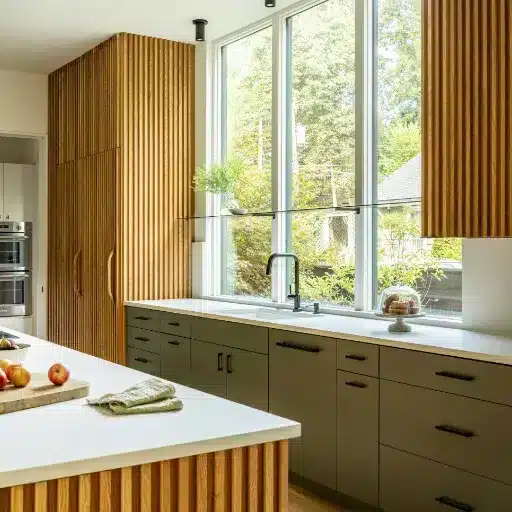
Not every beautiful wood species belongs in a kitchen. Heat, grease, steam, and frequent cleaning create demands that some species handle better than others.
Best Species for High-Use Kitchens
White oak imbibes moisture well, making it a hard, long-lasting, steam-tolerant type of wood, which leads to a very even way in the acceptance of stains, showing its open grain uniformly, even with tiny wounds. At the risk of making an extreme organizational change, I would like to declare that white oak is indeed the workhorse of today when it comes to kitchen design. Hard maple is in many ways even harder on the Janka scale, being better than oak when it comes to denting, and of a clear color that works well in Scandinavian and quite contemporary kitchens. Cherry behaves well under wear over time and is medium in hardness with that first-class appearance. Walnut behaves better by having that dark, dramatically sensuous impact and unpleasant wear marks. It is a good tough type with excellent shock resistance, a recognizable grain pattern, and a domestic choice of plenty of availability, thanks to its durability.
Species to Specify with Caution
Pine is too soft for the cabinet faces with the correct grain. It is easily scratched or dented and doesn’t keep up well with the daily rush in a typical kitchen. Mahogany’s color darkens unevenly after an unequal trauma caused by continuous heat from the ovens and cooktops. Other options like ebony, zebrawood, and makore are so magnificent that not many could resist taking them, but they are costly and best used for significant features or islands rather than for the entire kitchen.
Engineered and Reconstituted Veneers
Engineered veneers are usually produced from fast-growing fibers and stains and reconstituted blocks that look like rare species with standard grain, color, and supply. They tend to be highly resistant to natural veneer for high-use areas because no natural defects come with the process. The cost is about the same or a little less than that of equal natural species, and the sustainability profile is better in that no threatened species are harvested.
Wood Veneer Cabinets vs. Alternatives
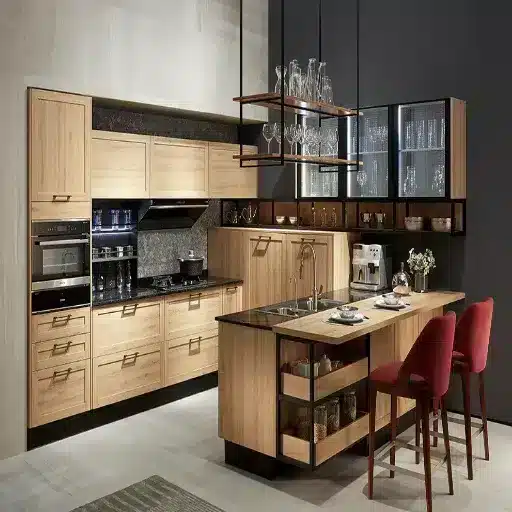
vs. Solid Wood Cabinets
Solid wood cabinetry usually sets you back between $15,000 and $50,000, plus for a full kitchen. Veneer brings the same appearance as some solid wood in the range of $8,000 to $30,000. Veneer has the extra advantage of superior dimensional stability due to the fact that the substrate resists the expansion and contraction that might warp solid wood doors. In 30–50 years, solid wood can be refinished more than once. Veneer may be refinished 1 or 2 times, depending upon face thickness, but sawn veneer at 2.0 or less millimeters actually encourages refinishability.
vs. Laminate and Melamine
Laminated kitchen cabinets are the most cost-effective, at $5,000 to $15,000 for a whole kitchen. Laminates are extremely moisture-resistant at surfaces, with easy-to-clean surfaces. They are not repairable, but you cannot patch chipped or burned surfaces on laminate. The advantage is the real wood aesthetics that veneer offers, on-site repairability, and a service life of 20 to 25 years compared to a service life of 10 to 15 years for laminate.
vs. Thermofoil
Thermofoil is a vinyl film heat-sealed to an MDF core, costing $4,000 to $12,000. It creates a seamless, easy-to-clean surface ideal for budget renovations. The drawback with heat, pet hairs, and pet dander should be something to consider when you’re opting for thermal foil; this may peel, bubble or delaminate near ovens, dishwashers, or toasters. Aside from that, it can’t be repaired. Veneer is even more tolerable and can be patched if damaged.
vs. Acrylic and High-Gloss
Acrylic cabinets cost about $10,000 to $25,000 and are reflected in a smooth, contemporary shine. They are easily cleanable but lack elements of heat or variations found in nature. They are textured into the organic warmth and color depth veneer binges that would never be simulated by acrylic.
| Material | Full Kitchen Cost | Service Life | Repairability | Moisture Tolerance | Sustainability |
|---|---|---|---|---|---|
| Laminate | $5,000 to $15,000 | 10 to 15 yrs | None | High | Low |
| Thermofoil | $4,000 to $12,000 | 8 to 12 yrs | None | Moderate | Low |
| Wood veneer | $8,000 to $30,000 | 20 to 25 yrs | Yes | Moderate* | High |
| Solid wood | $15,000 to $50,000+ | 30 to 50 yrs | Yes | Moderate | Moderate |
| Acrylic | $10,000 to $25,000 | 15 to 20 yrs | Limited | High | Low |
*With proper edge banding and MR substrate
Cost Guide: What to Budget for Veneer Cabinetry
Cabinet cost is driven by door construction, substrate, species, edge banding, grain matching, and certifications. Here are three realistic 2026 budgets.
Budget Kitchen Refresh
A 10 by 12 foot kitchen with slab doors, oak veneer, and standard MDF core.
- 20 doors + 8 drawer fronts: $2,800 to $4,000
- End panels and trim: $800 to $1,200
- Edge banding and hardware: $600 to $900
- Total materials: $4,200 to $6,100
Mid-Range Custom Kitchen
A 12-by-14-foot kitchen with five-piece doors, white oak, and plywood core.
- 28 doors + 12 drawer fronts: $6,500 to $9,500
- Matching island panels and built-in shelving: $2,000 to $3,500
- Premium PVC edge banding: $1,200 to $1,800
- Total materials: $9,700 to $14,800
Premium Architectural Kitchen
A 15 by 18 foot kitchen with book-matched walnut, MR-MDF, and custom built-ins.
- 36 doors + 16 drawer fronts: $12,000 to $18,000
- Built-in pantry, wine storage, feature wall: $5,000 to $8,000
- Laser edge banding + custom stain: $2,500 to $4,000
- Total materials: $19,500 to $30,000
For a deeper breakdown of what drives veneer pricing across all applications, see our wood veneer panels cost guide.
Planning a kitchen project and need a transparent quote? Contact VitalWood Global and we will itemize every line, from substrate to edge banding to certification documentation.
Cabinet Refacing with Veneer Panels vs. Full Replacement
Refacing cabinet boxes can mean applying a new layer, or Rigid Thermofoil. Refacing consists of replacing doors, drawer fronts, and hardware. It costs between 40 and 60 percent of a full replacement and creates 70 percent less debris. The refacing works when the existing boxes are structurally stable, the layout is acceptable, and the support is flat and dry. It is useless when water damage, fungus, structural change, such as moving or introducing a sink from the island needed.
Refacing takes 3 to 5 days, as opposed to 2 to 4 weeks for a full custom replacement. Everything is cleaned and sanded, new veneer or RRTF is applied, doors and drawer fronts are replaced, and fresh edge banding is placed on all exposed edges. In terms of sustainability, refacing keeps the embodied carbon in the case of the cabinet and creates a diversion from landfill.
James Park, while working as a contractor and renovating a 1980s kitchen in Minneapolis, recovered the contents of this kitchen instead of tearing them out when he worked in 2024. The original cabinets were solid plywood. They were square, and they were dry. He covered the frames with a new white oak veneer, installed five-piece shaker doors with soft-close hinges, and used a PVC edge banding that matched the veneer dye lot. The homeowner had to pay only 6200 and make it in just four days while most companies charged 14,000 for full replacement. He saved 18 cabinet boxes from ending up in the trash.
Matching Cabinets to Built-Ins and Feature Walls
The kitchen designs are the most cohesive, and the veneers of the cabinet have been extended beyond the scullery. Paneled refrigerator and wine storage niche, built-in pantry or beaver-board breakfast nook, are all considered part of the same design language, as long as this language includes veneer species, grain matching, and edge banding profile.
This project requires more forethought when using grain matching possibilities across the cabinet doors next to the wall panels. Source all veneers to be utilized for the kitchen or built-ins from the same flitch or production run. Ensure matching edge banding profiles and moldings. Coordinate countertop and backsplash tones with the warmth of the veneer. Using the same trim or detail continues along the transition where cabinet panels meet with wall panels to create a realized joint rather than an accidental gap.
For guidance on custom sizing, grain matching, and built-in integration, see our guide to custom wood veneer panels for architects and designers.
Sustainability and Certifications for Kitchen Veneer
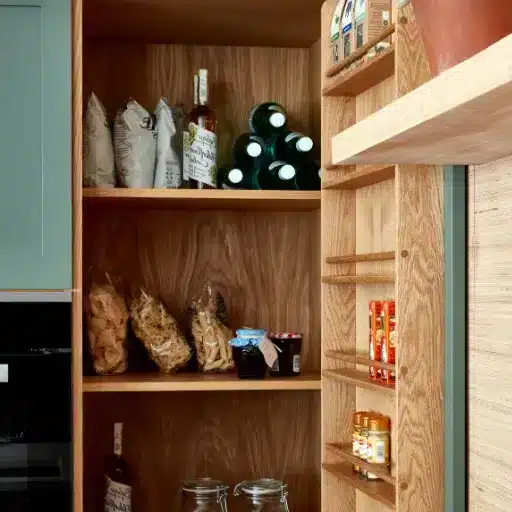
FSC and PEFC certified veneer faces are obtained in a chain-of-custody form. The additional cost typically runs between 5 and 15 percent within random, uncertified equivalents but is recoverable through LEED Materials and Resources credits and documented tenant demand for ethical interiors.
CARB P2/TSCA Title VI compliant cores ensure keeping formaldehyde emissions below 0.11 parts per million. This is already a legally binding requirement in California and is becoming increasingly more common as an industry specification, with additional prerequisites for well: EQ credit as seen in LEED and WELL v2 Indoor Air Quality requirements.
LEED v4.1 credits – MR for certified wood and EQ Low-Emitting Materials. Covers aligning WELL v2 with low VOC adhesives and finishes to improve indoor air quality in spaces where people are cooking, eating, and gathering daily.
The rare species problem is eliminated through engineered veneers. These are made of a rapidly growing fiber that wastes less than 5 percent of the total goods in comparison to the 15-25 percent loss through flitch processing. They can go cost-neutral or even cost-positive on the sustainability route.
Advantages at the end of life. As veneering comes from wood, real veneer is biodegradable. A cabinet can be com-poled or recycled at the end of its useful life because the veneer face and most substrates are also organic. Laminates and thermofoil are not biodegradable, but they can be landfill-destined.
At VitalWood Global, each kitchen veneer panel can specify an FSC-faced, formaldehyde-free core and low-VOC adhesives. A small premium is worth it-the long-term gain, for the project and for the planet, is massive.
Care and Maintenance
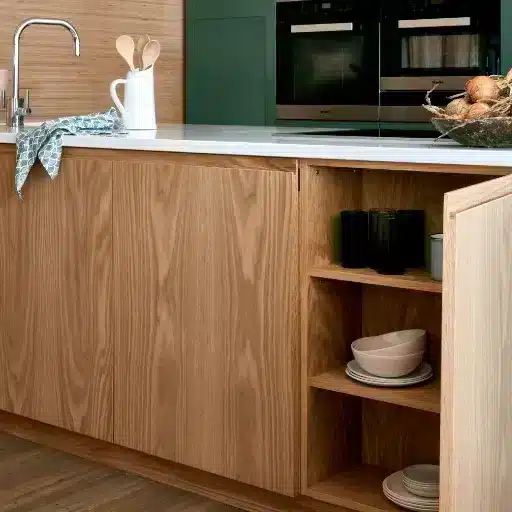
Daily Cleaning
Use a soft cloth with mild soap and water. Keep the area dry right after washing. Abrasive cleansers, overuse of water on edges or anywhere near the edge band, and also avoid ammonia. Wood is best cleaned by a microfiber cloth and a pH-neutral wood cleaner.
Steam and Heat Management
Where possible, plan to have 6 to 12 inches of space between cook stoves and the face of cabinets. Make sure to vent with cooking steam and grease. Clean the cabinet faces that are near cooktops once a week so as not to allow grease to build up and darken or stain the finish over time.
Humidity Control
Ideal indoor relative humidity is 35 to 50 percent year-round. Use a dehumidifier in humid climates. In dry winter climates, use a humidifier. Seasonal movement is possible through manufacturer specification allowances during the installation.
Repair
Tiny pieces need to be touched by markers or some wax filler sticks that are specifically matched to the tone of the particular species. Larger chips have to be addressed using veneer patch kits or by hiring a professional to reglue them. A bit lower-tech option is to use heat-activated adhesive strips for repainting edge banding for the household iron, while professional re-application will give more seamless results in this way.
Refinishing
Veneer cabinets can actually undergo light sanding and get refinished 1 to 2 times, depending on face thickness, as there are grinding veneers at 1.0 to 2.5 millimeters, which offer more refinishability against the conventional 0.5-0.6 millimeter faces. A collaborative effort should be made between the hidden area and the finishes compatible with the existing coating.
For a complete maintenance schedule and long-term care strategies, see our wood veneer panel maintenance guide.
For detailed installation guidance that protects your investment from day one, see our wood veneer panel installation guide.
Frequently Asked Questions
Are wood veneer kitchen cabinets durable?
Yes. With the correct specifications of wood veneer cabinets in the kitchen, this could potentially last for nearly up to 25 years in residential use. Of course, knowing the perfect core, humidity-resistant, and quality edge bandings for the kitchen environment are key essentials.
How long do wood veneer cabinets last?
Typically lasts 20-25 years in a house with proper, diligent care. This is in contrast to laminates, which last 10-15 years, and thermofoils, which last 8-12 years.
Are veneer cabinets cheaper than solid wood?
Yes. Normally, the cost of veneer cabinetry stands at 30%-50% much less than solid wood; however, taking into account that it brings up to 85-95% of the visual quality of it. A good measure for your entire kitchen in veneer prices from $8,000 to $30,000 high, speaking of solid wood at the low range of $15,000 and goes beyond $50,000.
Is it good for the veneer cabinets to get wet?
A veneer face might withstand occasional water encounters just fine, particularly if cleaning helps a lot with drying afterward. Moisture from the edge entering through the substrate is a whole different issue we need to take care of. That is why edge banding and waterproof substrates are essential in the kitchen.
What is the best wood veneer for kitchen cabinets?
The top ones are white oak, hard maple, cherry, walnut, and ash, as they all have the balance of hardness, moisture tolerance, ability to get stained, and the warmth that aesthetics tend to develop. Soft species like pine would not do for high-use faces.
Can you repair chipped veneer cabinets?
Yes. Fill small chips with touch-up markers or wax sticks, while larger damage can be patched with Harlequin Wood Repair Systems from veneer repair kits or by professional regluing. This repairability is one of the advantages of laminates and thermofoils.
What’s veneer cabinet refacing?
Refacing is applying new veneer or RTF and new doors, drawer fronts, and hardware to the existing cabinet boxes. It requires 40% to 60% of the full replacement cost, and can be carried out when existing boxes are structurally sound and dry.
Will humidity warp veneer cabinets?
Because the veneer is on a stable substrate, veneer cabinets are far less likely to warp when compared with solid timber cabinets. The engineered core both suppresses expansion and contraction, but also edge banding and maintains an indoor relative humidity level at the recommended 35 to 50 percent, working in conjunction to still further suppress movement.
Are wood veneer cabinets environmentally friendly?
Yes. Veneer yields roughly 45 times more usable surface area per log than solid wood. FSC and PEFC certification, engineered veneers, and the biodegradability of real wood all contribute to a strong sustainability profile.
Can you paint or stain veneer cabinets?
Yes, but with care. Veneer can be lightly sanded with compatible finishes and can also be stained or painted. The 0.5 to 0.6 standard thickness faces allow for 1-2 refinishing cycles. Sawn veneers of 1.0 to 2.5 mm enable more refinishing among faces.
How should you clean wood veneer kitchen cabinets?
Clean it with a soft, microfiber cloth using mild soap and water or a wood cleaner that is pH neutral. Wipe everything dry right after. Do not use abrasive pads, ammonia, or a lot of water down the edges.
What is the ideal substrate for covering cabinet veneer in the kitchen?
MR-MDF substrate is the best substrate for residential kitchens as resisting moisture. Although it is rather expensive, plywood is best for high-use kitchens as well as commercial use because it is better screwed and resisting moisture.
Conclusion: Specify for the Kitchen, Not Just the Showroom
Wood veneer panels for kitchen cabinets and built-in wardrobes are able to give a touch of warmth and naturalness of wood texture, with no cracks or deformations at high temperatures. The difference between a cabinet that lasts 25 years and one that fails in 5 is rarely the veneer face itself. It is not the veneer on the face. It is the proper substrate behind it and the correct edge binding technology to protect it.
Match the substrate to the moisture exposure. Seal the edges with a high-end binding application. Use the species which most commonly encountered in a kitchen. There are certifications that are available, so specify the ones that help with the sustainability of your project. In addition to that, it is worth considering the 20-year usage in which veneer wins for all cases against laminate and thermofoil.
If you are sourcing wood veneer panels for a kitchen project right now, VitalWood Global is built to give you a transparent, line-item specification with FSC-certified veneer faces, moisture-resistant cores, matched edge banding, and full certification documentation. Request a quote from VitalWood Global and we will help you select the right substrate, species, and finish for your kitchen, your timeline, and your budget. Sustainable wood, specified the right way the first time, is always the better investment.