

Wood Veneer Panel Grades: HPVA, AWI, and EN 635 Compared
There are three wood veneer panel grading systems: HPVA (American National Standard: AA, A, B, C, D, E, and SP face grades), AWI/AWS (Architectural Standard: Premium, Custom, and Economy grades), and EN 635 (European Standard: E, I, II, III, and IV grades). The “best” grade is the one that meets your visual requirements, fits your budget, and suits your sustainability needs, but not necessarily the most prestigious grade.
You receive two quotes for the same walnut veneer panel from the same manufacturer with similar dimensions and the same level of trustworthiness. One quote costs forty percent more. The only difference in the itemized list is the grade of the product. If you cannot justify that cost increase to your client, then you have no argument defending the specification. This is precisely the kind of scenario that this guide will help you handle with ease.
The confusion begins when you receive your quotes or your specifications contain veneer panels for the first time. You start reading the terms and conditions of your contract or the quote line items and notice words such as “face-back,” “Premium-Economy,” or “II-III.” You quickly realize that specifying veneer panels requires understanding grading systems that seem like an alien language until you read this guide.
This guide provides a comprehensive understanding of all the grading systems used in specifying veneer panels, decodes the notation associated with each grade, relates the grades to specific applications, and provides an example of a written veneer panel callout for various types of projects. From hotels to schools of architecture to backyards, you will walk away with a proper specification and an insight into sustainability.
Key Takeaways
- Three grading standards exist for most projects: HPVA (US standard), AWI/AWS (US architectural), and EN 635 (European). Select the standard that corresponds to the geographical location of the project, as well as the technical document set involved.
- The HPVA face grades are AA, A, B, C, D, E, and SP. The back grades are numerical (1, 2, 3, 4). A combination such as “A-2” describes both.
- AWI/AWS employs three levels: Premium, Custom, and Economy. The Custom Grade represents the primary choice for most interior commercial projects.
- Better grades command higher prices, typically 2.5 to 4 times a lower grade within the same species, and consume more raw materials per square foot.
- Grading is separate from certification; an A-grade panel could be FSC-certified, and a B-grade panel equally sustainable, if not more so.
Why Wood Veneer Panel Grades Matter

The veneer panel grade defines four aspects simultaneously: how the face appears, the permissible defects, price, and the probability of passing the submittal review. Setting a waste budget too high. Setting it too low will result in rejected mockups, change orders, and highly stressful Friday afternoon phone calls with the millwork shop.
Grades are established during veneering. The flitch is cut into veneers, which are evaluated based on published standards, and panels are put together from these veneers. At every step, additional requirements concerning defect size, repair limitations, color uniformity, and matching apply.
Also, it’s useful to understand what information isn’t covered by the grade. Grade is independent of species, independent of cut type (rotary, plain sliced, quarter sliced, rift), independent of the method of matching (book, slip, or sequence), and independent of certifications (FSC, PEFC, CARB). In other words, when ordering, you must indicate all these characteristics along with the grade. Otherwise, the delivered product may satisfy your requirements in every respect except one – its grade.
If you want a broader primer on how veneer panels are built before diving into grades, start with our complete guide to wood veneer panels, then circle back here for the grading detail.
The Three Grading Standards Specifiers Need to Know
In practice, you’ll work with one of three standards on any given project. The US market is dominated by ANSI/HPVA HP-1, the American National Standard for hardwood and decorative plywood, published by the Hardwood Plywood & Veneer Association. Architectural specifications for commercial millwork usually reference the Architectural Woodwork Standards (AWS), maintained by AWI and partner associations. Projects with European suppliers or European-leaning sustainability documents will reference EN 635 from the European Committee for Standardization.
Knowing which standard governs your project is half the battle. The other half is knowing how to translate between them when supply chains cross borders.
| Standard | Region | Best For |
|---|---|---|
| ANSI/HPVA HP-1 | United States | Hardwood plywood and panel manufacturing baseline |
| AWI / AWS | United States | Architectural and commercial millwork specification |
| EN 635 | Europe | European-manufactured panels and EU-aligned green building documentation |
Larger projects sometimes reference more than one. A multinational hospitality client may specify AWS Custom Grade for the US scope and EN 635 Class I for the European scope, with a target panel supplier expected to deliver both.
HPVA Wood Veneer Panel Grades (Face Grades)

The HPVA system is the most widely cited grading framework in North America. Face grades run from AA at the top to E at the bottom, with a Specialty (SP) category for custom requirements.
AA Grade: Premium Face
AA is essentially defect-free. Color is matched across leaves, repairs are not permitted on the face, and panels are typically book or slip matched. Use it sparingly, for executive offices, signature hospitality, or feature walls where the budget supports it.
A Grade: High-Quality Face
A grade allows very small pin knots and limited repairs. This is the most common premium specification for production work: commercial cabinetry, retail interiors, and premium residential.
B Grade: Sound, Smooth Face
B allows character marks: small knots, mineral streaks, and color variation. Repairs like boat patches and Dutchmen are permitted within limits. Designers who want a more organic look, or projects that need a premium feel on a tighter budget, often land here.
C Grade: Industrial Face
C accepts knots up to 3/4 inch, larger repairs, and more color and grain variation. It’s standard for paint-grade applications, cabinet interiors, and shelving.
D Grade: Lower Industrial Face
D allows open defects, knotholes, and aggressive repairs. Use it for utility work, hidden surfaces, or structural applications where appearance is irrelevant.
E Grade: Backing or Utility
E is sound but visually unrefined, suitable for back faces and unseen surfaces.
Specialty (SP) Grade
SP is whatever a project’s contract documents define. It exists for unusual architectural requirements that don’t map cleanly to the lettered grades.
A real-world example helps. Sarah, a senior interior architect on a boutique hotel project in Charleston, originally specified AA-grade rift-cut white oak for every public-area wall. After her millwork shop quoted the package, the line for veneer panels alone came in $38,000 over budget. We worked with her team to step the back-of-house corridors down to A-2 white oak with sequence matching, keep AA only for the lobby feature wall, and route the remaining savings into FSC-certified sourcing for the entire scope. Same designer, same intent, lower budget, stronger sustainability story.
If your project would benefit from a similar grade-by-grade walkthrough, request a sample set from our specification team. You’ll see the visual differences side by side before you commit a line on the drawings.
HPVA Back Grades (1, 2, 3, 4)
Face grades use letters. Back grades use numbers. The two are paired because most veneer panels have a hidden side that still needs to be specified.
- 1 Back: Solid, sound, visually similar to a B face. Use when the back may be partially visible or when cabinet doors swing open in daily use.
- 2 Back: Allowable repairs and more color variation. The most common background for general cabinetry.
- 3 Back: Industrial back with larger defects allowed. Acceptable when the back is fully hidden.
- 4 Back: Sound but unrefined. Use only for fully concealed surfaces.
Common factory-stocked combinations include AA-1, A-2, A-3, B-3, and B-4. Specifying the back grade matters because most millwork shops will accept whatever back shipments if your drawings are silent. That is rarely the back you actually want.
How to Read Face/Back Combination Notation
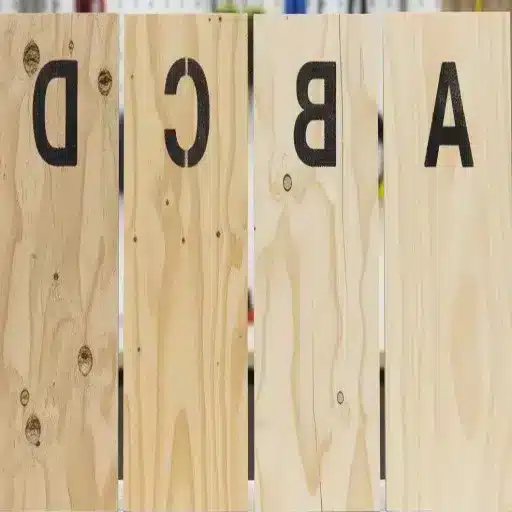
Combination notation looks intimidating until you learn to read it as two pieces of information stacked. Take “A-2 Walnut Veneer Panel” as an example. The letter A is the face grade. The number 2 is the back grade. The species is walnut. Cut, matching, core, and certification are specified separately.
Here’s another worked example. “AA-A 2-Ply” means an AA face, an A back, and a two-ply construction. You see this when both sides of a panel will be visible, like an open partition or a freestanding island.
A third common pattern is “A-3” for typical cabinet doors. You get an A grade on the visible face and an industrial 3 on the hidden back, which never sees daylight.
The most common confusion in our consults is between grades and matching. Book match, slip match, and sequence match are not grades. They are separate specifications that describe how the sliced veneer leaves are assembled across a panel. An A-grade panel can be book-matched, slip-matched, or randomly matched. You have to say which one you want.
AWI / AWS Veneer Grades
The Architectural Woodwork Standards organize the entire millwork package, not just the veneer face, into three quality tiers. Current editions reference Section 4 for veneered panels.
Premium Grade
Premium is the highest aesthetic and execution tier: sequence-matched, color-matched, mockup-approved. Lead times are longer. Costs are higher. Premium belongs in executive interiors, signature lobbies, performance halls, and anywhere the client signs off on every sample.
Custom Grade
Custom is the workhorse. Most commercial architectural projects in the US default to AWS Custom Grade. It defines matching, requires a quality veneer face (typically A grade), and assumes professional installation. Corporate offices, hospitality, retail, and healthcare interiors live here.
Economy Grade
Economy is functional and code-compliant with the lowest visual standards. Use it for back-of-house, utility spaces, and equipment rooms.
A short story illustrates the practical impact. Marcus runs procurement for a national chain of fitness studios. His architects had been specifying AWS Premium Grade veneer panels for every project, including supply closets and back-of-house corridors. We mapped his typical buildout to grade requirements and found that 78 percent of his veneered surfaces could move to Custom Grade with no visible impact, freeing roughly $22,000 per location for upgrades to FSC-certified sourcing and acoustic treatments. Specifying smarter beats specifying higher every time.
If you want to see how a similar audit could land on your project, our specification team reviews drawings and provides written grade recommendations, no obligation.
EN 635: European Veneer Grades
EN 635 is the European harmonized standard for plywood face quality. The series has multiple parts: EN 635-1 covers general terminology, EN 635-2 covers hardwood, EN 635-3 covers softwood, and EN 635-5 covers visual assessment.
EN 635 face grades are E (extra), I, II, III, and IV. Each side of a panel gets its own grade, so you’ll see notation like “I/II” or “II/III.” Grade E is the closest analog to HPVA AA, and Grade IV is roughly equivalent to HPVA D or E.
You’ll most often see EN 635 specified when projects use European-manufactured panels, when your client is pursuing European sustainability certifications, or when local European building documentation forms the contract baseline.
Cross-Standard Grade Equivalence Table
Treat equivalence as approximate. Defect measurement methods differ across the three standards, and a strict comparison sometimes breaks at the edges. The table below works as a starting point for translation, not a final substitute for reading the relevant standard.
| HPVA Face | AWI / AWS | EN 635 | Typical Application |
|---|---|---|---|
| AA | Premium | E / I | Signature interiors, feature walls, executive spaces |
| A | Custom (upper) | I | Commercial cabinetry, retail, and premium residential |
| B | Custom (lower) | II | Character-driven projects, budget premium |
| C | Economy | III | Paint grade, cabinet interiors, shelving |
| D / E | (not applicable) | IV | Hidden surfaces, utility, structural |
Use this table to translate a single drawing across regions, not to assume a one-for-one substitution at the supplier level. A European panel labeled “I/II” is in the ballpark of HPVA A-B, but the actual defect profile may differ from what your US millwork shop expects.
For more on how panel construction itself varies across regions and applications, see our reference on the main types of wood veneer panels you’ll encounter when specifying.
Watch: How Veneer Is Sliced and Graded
If you’d like to see the grading process in motion, this short overview from the Forest Stewardship Council walks through how veneer is harvested, sliced, and inspected before it ever reaches a panel manufacturer.
How to Specify a Veneer Panel Grade in Architectural Drawings

A complete specification answers nine questions. Skip one, and the panel that ships may surprise you.
- Species (e.g., White Oak)
- Method of cutting (e.g., rotary cut, straight cut, quartered cut)
- Face Grade & Back Grade (e.g., A-2)
- Matching type (e.g., book matched, slip matched, sequential matched, blueprint matched)
- Core substrate (e.g., MDF, ply, particle board, lightweight)
- Backer type (e.g., paper, phenolic, unbacked, 2-ply)
- Reference standard (e.g., ANSI/HPVA HP-1, AWS Ed X, EN 635-2)
- Mockup or sample approval requirement
A complete callout reads cleanly when assembled:
White Oak veneer panel, plain sliced, A-2 grade per ANSI/HPVA HP-1, book matched, balanced match, MDF core, paper-backed, FSC certified. Submit sample for approval before fabrication.
Drop that on a drawing and your millwork shop has zero room for assumption.
Cost, Sustainability, and Grade Decisions
The premium is significant. AA-grade veneer panel costs can be 2.5-4 times higher than C-grade within the same wood type. Why is that? Again – it’s about yield. More material goes into producing premium panels since they are cut from a narrower area of a flitch. That price will reflect on all invoices.
Sustainability works transversally here. Higher-grade panels can mean higher consumption of raw timber per square foot of usable surface. Combining low face grade and FSC certification could offer a smaller environmental footprint without compromising the design intent. Using engineered or reconstituted veneer with a low face grade will be a more sustainable choice for commercial projects covering thousands of square feet with a consistent appearance.
The connection has to be made – grade and certification are not necessarily interrelated. AA-graded panels could have a chain of custody certificate, and B-graded veneers can have one too. In case sustainable development is your project goal, be sure to order FSC certification. Otherwise, you will not get this information from face grade alone. If you are hesitating whether to choose veneer altogether, check out our wood veneer vs solid wood comparison.
As a sustainability consultant on a Living Building Challenge project in the Pacific Northwest, Anna was facing a challenging budget situation with just six weeks left until construction documentation would be finalized. We helped her team shift from AWS Premium to AWS Custom Grade on all interior partitions, leaving FSC certification, formaldehyde-free MDF cores and sequence-matched veneers in the lobby untouched. This package saved them $54,000 on total project costs without sacrificing WELL and Living Building Challenge documentation requirements.
Common Mistakes Specifiers Make With Veneer Panel Grades
The same handful of mistakes show up on nearly every grade consultation we run. Watch for these.
- Specifying AA when A would meet the design intent. AA is over-specified more often than any other grade. The visible difference often disappears once the panel is mounted and lit.
- Omitting the back grade entirely. Silent drawings mean whatever back ships is acceptable. That is rarely what you want.
- Confusing matching specifications with grades. Book match, slip match, and sequence match are additional specs, not built into the grade itself.
- Assuming a premium grade implies certification. It does not. FSC, PEFC, and CARB compliance are separate, and you have to ask.
- Specifying a grade that the species can’t reliably produce. Heavily character-grade species rarely deliver AA, and chasing that grade can stall procurement.
- Skipping mockups and sample approval. A sentence on the drawing requiring a sample submittal prevents most aesthetic disputes downstream.
The Right Grade Is Not the Highest
If you remember nothing else, remember this: the best wood veneer panel grade is the one that matches your project’s visual intent, budget, and sustainability goals. AA is rarely necessary outside of signature spaces. Custom Grade carries most commercial work. FSC certification belongs in every spec where the project documentation supports it, regardless of the face grade you choose.
Three actions move every veneer specification forward.
- Decide which standard governs your project (HPVA, AWI/AWS, or EN 635), then specify the face grade, back grade, matching, core, backing, certification, and sample approval as separate items.
- Walk one tier lower than your default and ask whether the design still works. Step back up only where the answer is clearly no.
- Request samples across two adjacent grades before you finalize the spec. A side-by-side comparison settles most internal debates in five minutes.
VitalWood Global supplies wood veneer panels across every grade and standard described in this guide, with FSC-certified sourcing available on request and a sample program built for specifiers. Request a grade-specific sample set, and our specification team will review your project drawings, recommend a grade-by-grade match, and ship samples to your studio or jobsite. The wood industry is moving toward smarter, more sustainable specifications. Your next project is a chance to lead it.