

Wood Veneer vs Solid Wood: A Complete Guide for Sustainable Projects
Wood Veneer vs. Solid Wood. The right choice depends on your purpose, budget, and sustainability goals. Both are real woods, but they differ in terms of cost, durability, and environmental impact.
They could be used on the same walnut tree, the entire lobby of a hotel done in wood veneers, while the same tree can craft a single conference table using solid wood. Choosing the two would also depend on whether the financial part comes into play, but, most especially, you must be creative in being able to create value from each log.
If you are either an architect, a builder, or an interior designer, given that you have clients who would ask that question about wood veneer, they think it is not “real wood”-solid wood always sells better. After reading through this guide, you will know when to choose solid wood or wood veneer, and how to source the two from an ethical chain of supply certified.
You’ll also learn why high-end European cabinetry relies on wood veneer for stability and how a single specification choice can reduce material waste by 40 times.
Key Takeaways
- A veneer represents an actual, thin, hardwood slice adhered to a strong substrate, a substance not merely made in imitation.
- Veneer is surpassingly dimensionally steady and grain-consistent as to those interior elements and their big surfaces’ applications, for example, wall surfaces and cabinetry.
- Solid wood, in terms of easily repairing, durability, and structural strength, is very well suited to high-traffic furnishings applications.
- With one log, an area of usable surface good for veneer use is probably around 40 times more than that commensurate to solid lumber.
- Certification of the FSC has more value than the actual format; parts may, in fact, show much less sustainable worth about the uncertified solid wood-based ones.
What Is Wood Veneer? (And What It Isn’t)

Wood veneer is a thin slice of real hardwood, typically 0.5mm to 2mm thick, that’s bonded to a stable substrate such as plywood, MDF, or particleboard. It is not laminated. It is not melamine. It is not printed plastic made to look like timber. Veneer is genuine wood, sliced or peeled from a log, with the same grain, color, and cellular structure as the solid lumber it came from.
The manufacturing process starts with a harvested log. A blade peels or slices a continuous sheet of wood from the circumference. This sheet is dried, graded, and then glued under heat and pressure to a substrate core. The result is a panel that looks like solid wood but resists warping, splitting, and expansion far better than a solid board of the same dimensions.
Veneer matching techniques add another layer of craft. Book-matching folds alternating veneer leaves like pages in a book, creating symmetrical grain patterns prized in luxury interiors. Slip-matching arranges consecutive leaves side by side for a more uniform, linear appearance. These techniques allow designers to control aesthetics across large installations in ways that solid wood simply cannot replicate. To understand the full range of panel constructions and substrates available, see our guide to the types of wood veneer panels.
Common Myths About Veneer
Misconception about Veneer is the fact that it still costs $1000 or more, as specifiers of material spend more as they do not need it every year. These are the facts behind the hype.
Myth: Veneer is fake wood.
Reality: Veneer is 100% real wood; it’s the wood’s thickness that is the difference. A walnut veneer panel is actually walnut on the surface, with a substrate beneath (comprising the backing of the veneer), providing that structural stability.
Myth: Veneer is always the cheap option.
Reality: Many premium architectural veneers can cost more per square foot than mid-range solid lumber. High-end European cabinetry nearly always indicates veneer over solid lumber because of dimensional stability and a similar grain pattern, not just to reduce costs.
Myth: Veneer doesn’t last.
Reality: A well-made veneer panel on a quality substrate can last 20 to 30 years in residential use and 15-plus years in commercial settings. The key factors are substrate quality, adhesive performance, and wood veneer panel grade, not the veneer itself.
When Elena Martinez, an interior designer in Chicago, specified book-matched walnut veneer panels for a 40-foot hotel lobby wall, her client initially pushed back. They wanted “real wood.” Elena explained that solid walnut boards of that length would have cost nearly four times as much, would have required visible seams every 8 to 10 feet, and would have risked warping within two Chicago winters. The veneer installation delivered a seamless, stable surface that still looks flawless three years later.
What Is Solid Wood?
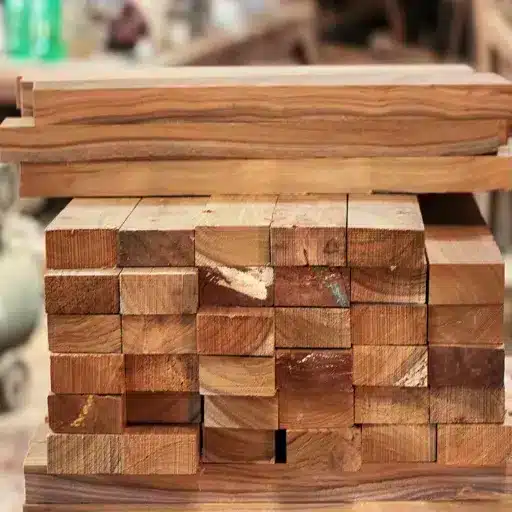
Solid wood is derived from lumber, which comes directly from the tree in its milled state. No substrate is sandwiched between two thin layers of veneer; these two layers are what you really get to see. It is what makes a solid piece become a board, plank, or the structural components of a house.
One thing to look out for when the lumber is milled is how it is cut from the tree. A quartered board, for example, will be cut to an angle such that the grain is 90 degrees to the face; this produces a very stable grain showing a very uniform expansion and contraction behaviour. The method in which a board is milled, considering the example of a flat-sawn board, is that it will be tangentially oriented to see the grain.
Rift-sawn is a compromise between those two and offers visual interest and great stability. Quarter-sawn is a unique cutting method to produce a straight-grain, stable board; this way, boards will have little expansion and contraction, so they can’t warp. The opposite would be flat sawing, where boards will have cathedral patterns across the face. For example, many people think of oak and pine when they think of cathedral patterns.
For some, natural characteristics in solid wood are highly desirable, while for others, they should be avoided. The life of a tree is evident in the grain variation, knots, mineral streaks, and color shifts in hideaways. These features are what make each item unique, but they are not the best for trying to create very wide-matched surfaces. A designer will likely spend months looking for boards that match well enough and will give a tight match. He or she will probably have to specify a dozen or so solid walnut boards to make a 12-person conference table.
The biggest problem when it comes to solid wood involves wood movement. Wood tends to shrink in dry air and expand in moist conditions. For instance, a solid oak tabletop might move 1/4 inch or more seasonally within a perfectly climate-controlled office. This is the reason for floating panels and expansion gaps in the fine furniture, as well as breadboard ends. Despite all of this, do things defying nature, and joints will crack, finishes will fail, and boards will cup or bow.
When Solid Wood Is Non-Negotiable
Solid wood continues to be the reigning specification choice in some applications. High-traffic furniture, such as dining tables, chairs, and beds, benefits from the repairability of solid wood. Therefore, a dented tabletop can be sanded and refinished up to a hundred times over a century. A veneered surface offers finite refinishing several layers deep before what lies beneath begins to show.
Structural elements themselves call for solid wood or engineered lumber specifically built to hold the load. Thin veneer panels are not structural members, no matter the substrate. High-traffic areas outdoors in wet or humid climates favor solid species of wood that have natural rot resistance, such as teak, white oak, or cedar. Although it would be properly sealed and maintained.
Almost always crafted to last for fifty or even more years, heirloom pieces are crafted from solid wood. This material can be repaired, refinished, and recycled even after generations. Real furniture maintains value at resale generally because of these characteristics.
Wood Veneer vs Solid Wood: Head-to-Head Comparison

The choice between wood veneer vs solid wood isn’t about finding a winner. It’s about matching material properties to project requirements. Here’s how they stack up across the factors that matter most to specifiers.
| Factor | Wood Veneer | Solid Wood | Best For |
|---|---|---|---|
| Cost | Lower per square foot | Higher per board foot | Large surfaces, tight budgets |
| Dimensional stability | High, minimal warping | Low, expands and contracts | Climate-varying environments |
| Weight | Lighter (substrate-dependent) | Heavier | Shipping, installation ease |
| Repairability | Limited, thin surface layer | Excellent, can be sanded repeatedly | High-traffic, long-term use |
| Lifespan | 15–30 years (quality-dependent) | 50–100+ years with care | Heirloom, resale-value pieces |
| Material efficiency | One log = 40x surface area | One log = limited boards | Sustainability-focused projects |
| Grain consistency | Highly repeatable, matchable | Unique, variable | Large visual installations |
| Structural strength | Substrate-dependent, non-structural | Load-bearing capable | Beams, frames, structural members |
Cost Comparison
Veneer wins on material cost for large surface applications. A sheet of walnut veneer on an MDF core costs a fraction of solid walnut boards covering the same area. Labor costs can also favor veneer, since large panels install faster and require less joinery.
However, the total cost of ownership shifts the math for long-life furniture. Solid wood dining tables last for decades with refinishing. Veneer furniture in the same role may need replacement after 15 to 20 years of heavy use. Specifiers should calculate lifecycle cost, not just upfront material price. For detailed per-species pricing, core options, and project budget frameworks, see our wood veneer panels cost guide.
Durability and Lifespan
If you define what is between them, veneer panels can be more resistant to warping, cupping, or cracking in larger dimensions compared to solid wood, so they are ideal for wall panels, cabinetry, and built-ins. Substrate compounds prevent wood movement, which is why solid boards are usually damaged over time.
It is better in terms of wear resistance and repairability. And it may be sanded down and refinished five to ten times from birth, while serious oak flooring allows this. Anyhow, it will last longer than an oak plywood floor’s top layer will allow, breaking down somewhere after one or two revests in commercial properties with much foot traffic, to build on when the notion of replacing floors becomes increasingly more common in earlier years.
The hard way to the hard-grained reality of the situation on the 2019 restaurant job in Portland was David Chen. To remain within budget parameters, he ordered oak veneer table toppers. Just about 18 months with workwear visible through the oak veneer within the heavy-trafficked bar area. A white oak host stand that he had structured together with it took twice the same ill-treatment, and after a light sand remained as new. For those surfaces that are hardly contacted, veneer is perfect, but for continual contact areas, solid wood is the only logical consideration.
Environmental Impact
This is where things get really doubly elliptic when it comes to a comparison of surface area. The size of one piece of log that forms the essence of the luxury wood is twenty times smaller than a finished or directly usable surface, as it makes a cutting billet. It is in this respect that the added usage per real-performance type gained from veneer becomes all the more unique, typical, and valuable in relation. And as such, it extends, in such rare or slow-growth species, the veneer availability of a variety that includes walnut, teak, and mahogany, without increasing growth volume.
Solid planks gobble far more timber per square foot of surface visible. A 1-inch plank uses 25 times more wood fiber than its 1mm veneered counterpart. For sustainable projects, this efficiency gap from scoring literally matters.
It also matters what the substrates are. MDF cores, stable as they are, necessitate alternative adhesives in some cases that might emit formaldehyde unless they are specifically marked as NAF or NAUF. The certification of the substrate must go hand in hand with that of the veneer for informing specifications.
Want to see how sustainably sourced veneer panels perform in real projects? Explore our complete guide to wood veneer panels for specification details, substrate options, and grain-matching techniques.
How to Tell the Difference
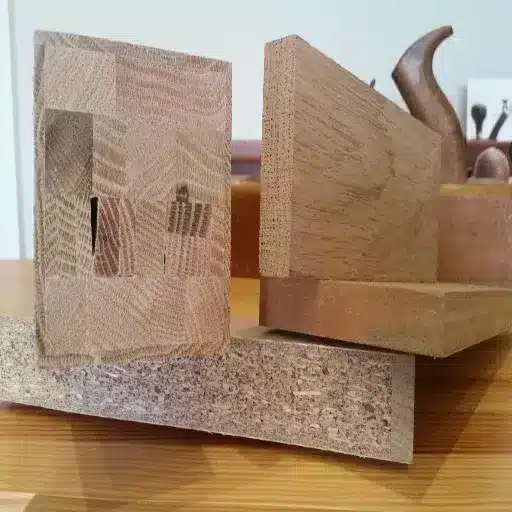
Whether you are evaluating a sample board, checking the work of a subcontractor, or answering a client’s question, the skill of being able to tell the difference between veneer and solid wood is something practical. Below is a five-step guide for visually inspecting samples.
- Check edges and corners for substrate exposure. Veneer panels will have multiple layers of material at the intersection between the substrate and the surface, and solid wood will show a continuous grain running through the edge.
- Look for repeating grain patterns. Veneer is limited in size, and in covering surfaces with sheet veneer, a manufacturer will have to use several of his sheets side by side. So, a discerning eye might realize that sections of the same grain will occur at least every 2 to 4 feet when it is zoomed out. This is never experienced with solid wood as it is unique in each instance.
- Inspect weight and density. MDF-core veneered panel feels completely different from solid wood in its density and the sound it makes when tapped. It is often quite uniform in weight. A tap feels hollow on solid wood, and it tends to make deeper echoing sounds.
- Check the bottom or back area of the objects. Furniture is therefore likely to use a different substance on the hidden surfaces. If the underside of a table top is painted, laminated, or clearly looks like a different species, the top surface is veneer.
- Pay attention to the joints and end grain. When it comes to joints of solid woods, you will see the end grain in miters (most often dovetails), mortise-and-tenon joints, and dowels. Veneer furniture usually connects parts mechanically or uses secret brackets where the end grain will not be visible.
The Water Drop Test
If you have doubts following a visual inspection-pick, lay down one drop of water on an unobtrusive part. Solid wood absorbs moisture a little more slowly, and the area-darkens wet as water penetrates the fibers. Some areas may bead up or may absorb very slowly in the veneer on a non-absorbent substrate, depending on the finish and core material. Not definitive, still a useful field test.
When Just Looking Good Isn’t Enough
Almost indistinguishable from real wood is some of the finest veneer work, without expensive and destructive testing. Thick “lumbercore” veneer is manufactured with a solid wood center encapsulated with timber veneer that matches it from front to rear when seen, as well as the superb solidity of an edge. If you want more accountability and transparency in the source, go for Chain of Custody documentation rather than visual inspection only, and this makes little significance more for the audit when it comes to a material format.
Best Applications: When to Choose Which
The right material choice depends on three factors: the size of the surface, the level of physical contact it will receive, and the importance of grain matching across the installation.
Specify Veneer Panels For:
- Large wall panels and cladding. It provides dimensional stability and removes the tendency of warping and seam separation seen in solid wood installations over 10 feet. The veneer matches from one piece to the next and will look absolutely perfect on a 30-foot surface.
- Cabinetry and built-ins. Drawers, doors, and casework are performed with flat, stable, nonexpansive, and uncontrollable sides compared to solid wood, which swells during a humid season. It is a veneer that has been used by European kitchen producers for centuries.
- Commercial hospitality projects. Everywhere in that large hotel, the restaurant, in the office lobby-everywhere-there should be identical space for each of those dozens of rooms. Unlike solid wood, veneer can offer color and grain repetitions in commercial hospitality.
- Curved or compound surfaces. Veneer can be curved around radiused forms that otherwise would be steam-bent or laminated in solid wood. Veneer is generally specified for use at reception desks, column wraps, and custom millwork.
- Acoustic and performance surfaces. Modern offices, hotels, and home theaters increasingly specify acoustic wood veneer panels that combine natural wood aesthetics with sound-absorbing performance. Solid wood cannot deliver the same NRC ratings without extensive perforation and engineering.
Specify Solid Wood For:
- High-traffic furniture. Dining and conference tables, chairs, and beds suffer from dents, scratches, and damage, finally asking for refinishing. Solid wood can bear such conditions; thus, veneer cannot.
- Outdoor or humid environments. Properly sealed solid teak, white oak, or cedar are more functional in terms of moisture than most veneered substrates; using corrosive products for extended humidity conditions may damage adhesive bonds on veneer panels.
- Heirloom or resale-value pieces. They are all solid wood varieties, save for antiques. Anything can be repaired, modified, and refinished henceforth.
- Structural elements. According to the distribution capacity of solid lumber or engineered lumber, the right material to achieve this load-bearing function is solid timber, whereas the veneer paneling does not actually offer structural support.
Hybrid Approaches
Smart specifications most of the time marry both materials. From notable contact points to the thoughtful arrangement of finishing materials over large expanses, framing defines the spatial shell’s structural, repairable membrane properties-support laden live-loads. This technique is seen in high-grade cabinets in which full-thickness solid wood doors, or face frames, enclose veneer side panels. It is practiced in furniture with solid legs and aprons supporting the veneered tabletop.
Not sure what all fits into your project? Consider this hybrid specification, solid wood/veneer panel, for durability and most visual congruence.
Sustainability: The Real Environmental Story
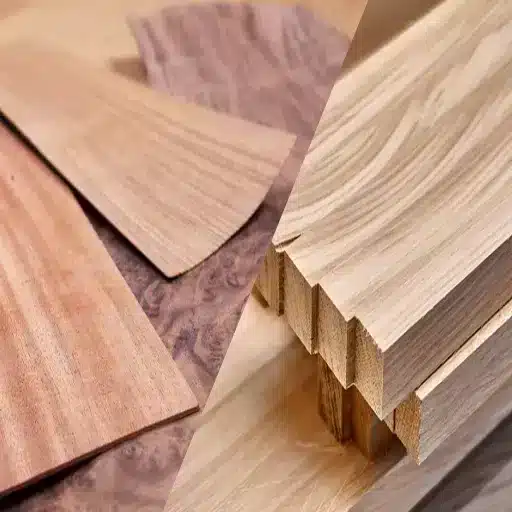
The wood veneer vs. solid wood sustainability argument often wags the wrong dog. The type of material is significantly less important compared to the integrity of sourcing. For example, having a piece of FSC-certified veneer over a certified plywood core can actually have a minor environmental impact compared to the shipment of uncertified solid lumber halfway around the world.
But this doesn’t mask the plain goodness of efficiency offered by veneer. You cannot just make very simple net yield math comparisons. That is to say, a 1mm veneer sheet of log produces about 40 times the face area relative to a 1-inch solid board of the same log. It actually, thus, preserves supply for wild species that occur in low supply limits for other efficient harvest designs.
Supporting or undermining all of this efficiency is a selection of the substrates. FSC-certified plywood cores support forest conservation while ensuring dimensional stability. Low-emission MDF reduces indoor air quality problems. Amongst wood certifications, suppliers should also be asked to provide Environmental Product Declarations (EPDs) and VOC emission data.
When made separately, the analysis of carbon footprints and the analysis of footprints of civilization will appear entirely different, about as different as a sugar glucose molecule from a chitin sugar molecule in an insect. Kiln drying is yet another specialized step in the veneer processing process, which comprises slicing machinery and adhesive curing, all very intensive energy applications. For solid wood, while it still has milling and drying, the milling process eliminates some of the metamorphosis. Transportation also brings its twists to an evening’s journey. The placement of lightweight veneer from a certified European mill suggests a lighter footprint than the transportation of perhaps scarce and solid lumber across a continent.
Beyond the material issue, the appropriateness or otherwise of any material in lowering carbon emissions fully depends on its supply chain. Soy-based polyols on the other hand, would be equally poised with the above material to provide the best value returned in terms of the environmental benefit while producing the most material content. Changing even more frequently from wood veneer to only half of such a rapidly renewable resource would possibly outscore the two.
Hence, longevity can be part of sustainability scoring in the right way. Eighty years of the life of a piece of solid wood furniture and three refinishings on it will pull it ahead of 30-year-old veneer-followed furniture replaced twice over the same period. The lifespan of the material must be coordinated with the real duration of the project. Do you think that retail display temporary math would be equal to challenging environmental strategies from those about a permanent institutional build?
VitalWood’s Sustainable Sourcing Commitment
We source all wood products from certified, sustainable forests available in VitalWood Global. Our team provides chain-of-custody documentation, which is detailed for every veneer panel and solid timber order. They can guide you through a substrate certification, certification options for FSC labeling, and regional sourcing strategies that align with LEED, BREEAM, or WELL certification goals.
Maria Alvarez, an architect in Austin, specified FSC-certified walnut veneer paneling for a LEED Gold office. It needed proof that the substrate was as good as the face veneer. Such a chain as this could scarcely be broken even if the documentation for it could be traced as far back as the mill where the plywood core was certified in Finland, as was the case with VitalWood. They furnished the chain-of-custody paperwork for her reviewer, and the project achieved all Materials and Resources credits she had aimed for in the appropriate category. The product was not only gorgeous but also able to count toward the certification of the structure.
Conclusion
Neither is veneer better than solid wood. It depends on what is being used, the budget, the expected lifecycle expectancy, and prioritizing sustainable expectations. For large installations, using the greatest in efficiency, stability, and grain-perfect consistency, with the relevant need being called the feature, veneer would certainly be the option of choice. Solid wood is best when imperfection, strength, and longevity are demanded for home furniture and highly used parts.
What really matters is the source that supplies you to the supply chain. The FSC-certified veneer is really more environmentally friendly by all means compared to any solid wood, which is not certified at all. Here at VitalWood Global, we think formats should be secondary, bringing sustainable practices to forests behind it.
If you’re putting together the materials for a project, above everything else, start with the requirements. Match what the application requires to the material. Wherever possible, choose certified and sustainably sourced wood that supports responsible forest management.
Ready to specify with confidence? Request a quote or sample from VitalWood Global today. Our team is here to guide you through material selection, certification documentation, and delivery logistics, wherever your project takes you.