

Wood Veneer Production: From Sustainable Forest to Finished Sheet (2026 Guide)
Wood veneer production is the process of transforming sustainably sourced logs into ultra-thin sheets of genuine hardwood through seven distinct phases: sourcing, preparation, slicing, drying, grading, splicing, and finishing. Modern facilities achieve up to 90% raw material utilization and generate roughly 40 times more usable surface area than solid wood milling, making veneer one of the most resource-efficient wood products available to architects and builders today.
A single cubic meter of timber can yield up to 2,000 square meters of veneer surface. That is not a marketing claim. It is simple physics, and it is why sustainable architecture firms increasingly specify veneer over solid lumber for large-scale commercial interiors.
If you have ever run your hand across a seamless walnut wall panel and wondered how one tree becomes thousands of flawless sheets, you are not alone. Most professionals understand what veneer is, but few know the precision, technology, and sustainability practices that separate premium wood veneer production from commodity manufacturing. That knowledge gap matters because the production methods your supplier uses directly affect grain consistency, dimensional stability, and whether your materials meet the sustainability standards required for green building certification.
In this guide, you will learn exactly how wood veneer production works from a certified forest to a finished sheet. We will walk through each of the seven phases, explain why sustainable sourcing is integrated at every step, and show how 2026 technology is raising quality standards while reducing environmental impact. By the end, you will understand enough to evaluate production quality like a seasoned specifier.
When Elena Vasquez, a project architect in Miami, toured her first veneer mill in North Carolina, she was stunned by what she saw. She had specified walnut veneer for a 12-story hospitality project, but she had never witnessed the actual production. Watching a 60-inch log rotate against a razor-sharp blade and emerge as paper-thin sheets changed her perspective entirely. “I understood veneer was efficient,” she told her team later, “but seeing 90% utilization in real time made me confident we had made the right specification.”
Key Takeaways
- Wood veneer production transforms certified logs into thin sheets through seven distinct phases: sourcing, preparation, slicing, drying, grading, splicing, and finishing.
- Modern rotary peeling achieves up to 90% raw material yield, while one cubic meter of log produces up to 2,000 square meters of usable veneer surface.
- Four primary slicing methods — rotary, flat, quarter, and rift — produce dramatically different grain patterns suited to different design applications.
- 2026 technology including AI-powered machine vision grading and CNC precision cutting is reducing defects by up to 30% while improving batch consistency.
- FSC-certified sourcing, low-VOC adhesives, and engineered veneer alternatives make modern wood veneer production one of the most resource-efficient wood manufacturing processes available.
What Is Wood Veneer and Why Does Production Matter?

Wood veneer is a thin slice of genuine hardwood, typically between 0.3 and 0.6 millimeters thick, that is bonded to a stable substrate such as plywood or medium-density fiberboard (MDF). It delivers the authentic appearance, grain, and warmth of solid wood while using a fraction of the raw material.
Natural veneer is sliced directly from the log. Engineered or reconstituted veneer is manufactured from fast-growing, renewable species and dyed to replicate rare exotic appearances. Backed veneer includes paper, fleece, or phenolic layers that add flexibility and durability for specific applications. Each type serves different project needs. Understanding the differences between natural and engineered veneer helps you specify the right material for your application.
The way that slice is produced matters enormously. A poorly steamed log will produce sheets that crack during drying. An imprecise blade angle will waste valuable timber. Inconsistent grading will leave you with panels that do not match across a large installation.
Understanding the production process helps you specify with confidence and ask the right questions of your supplier. For commercial specifiers, production quality is not an abstract concern. It directly impacts project timelines, warranty claims, and whether your materials meet the sustainability standards required for green building certification.
Curious about how to evaluate suppliers based on their production capabilities? Our guide to choosing a wood veneer manufacturer breaks down exactly what to look for in a production partner.
Phase 1 — Sustainable Sourcing and Log Selection

Every sheet of premium veneer begins in a certified forest. The sourcing decisions made at this stage determine not only the visual character of the finished product, but also its environmental credentials and long-term availability.
Responsible Harvesting in Certified Forests
FSC-certified forests follow strict guidelines for selective harvesting, biodiversity protection, and reforestation. When a logger removes a mature tree for veneer production, the surrounding ecosystem remains intact. Wildlife corridors are preserved, soil health is protected, and new trees are planted to replace what was harvested.
Chain of Custody (CoC) documentation tracks each log from the forest floor to the mill gate. This paper trail prevents illegal logging and gives architects the documentation they need for LEED Materials and Resources credits. According to industry research from Fortune Business Insights, over 60% of wood veneer manufacturers have adopted sustainable sourcing practices in the past three years.
PEFC certification offers an alternative framework with similar environmental safeguards. Both standards require independent third-party auditing, which means the claims are verifiable, not aspirational. Understanding these certification standards helps you evaluate whether a supplier’s credentials meet your project requirements.
The distinction between who produces veneer and who merely distributes it matters here. A true manufacturer controls sourcing decisions directly, while a supplier may rely on opaque subcontracting. Ensuring your Chain of Custody documentation is genuine starts with understanding who actually makes the product.
Log Selection Criteria
Not every tree becomes veneer. Sawmills reserve their highest-quality logs for slicing because the thin sheets reveal every defect. Straightness, diameter, and aesthetic characteristics matter here.
Species selection also plays a critical role. Exotic hardwoods like walnut, teak, and zebrawood deliver dramatic visual impact, but they come from slower-growing forests. Increasingly, manufacturers are turning to fast-growing sustainable alternatives like poplar, ayous, and eucalyptus for engineered veneer production. These species mature in 10 to 15 years rather than 50 to 100, reducing pressure on old-growth forests without sacrificing beauty.
When a procurement team at a major furniture manufacturer in Milan switched to FSC-certified poplar veneer for their core product line, they expected pushback from designers accustomed to exotic species. Instead, the consistent grain and lighter environmental footprint became selling points. Their carbon reporting improved, and they secured a long-term contract with a European retailer that required documented sustainable sourcing.
Phase 2 — Log Preparation and Conditioning

Once logs arrive at the mill, they undergo a careful preparation process that preserves quality and prepares the wood for precise slicing. Rushing this stage leads to cracked sheets, uneven grain, and wasted material.
Log Yard Storage and Moisture Control
Freshly felled logs contain high moisture content and are vulnerable to splitting. Mills store them in log yards where sprinklers constantly spray water across the stacks. This prevents end-checking and keeps the wood in optimal condition until processing begins.
Climate-controlled storage timelines vary by species. Hardwoods like oak and maple might wait two to four weeks. Softer species like ayous process faster. The key is maintaining consistent moisture so the wood fibers remain uniform when slicing begins.
Debarking, Flitching, and Squaring
The first mechanical step is debarking. A rotating drum or high-pressure water jet removes the outer bark to expose the clean wood beneath. Any remaining bark would create defects in the finished veneer.
Next comes flitching. Workers or automated systems cut the log into longitudinal sections called flitches, which determine the grain orientation of the final sheets. Flitching decisions are based on the desired cut: plain slicing requires a different flitch orientation than quarter slicing.
Squaring follows. The flitches are trimmed into rectangular blocks with precise right angles. This squared shape is essential for proper mounting on slicing machinery. Uneven blocks produce inconsistent thickness and irregular grain patterns.
Steaming and Cooking
This is one of the most critical stages in wood veneer production. The squared flitches are submerged in vats of boiling water or placed in steam chambers for a carefully controlled period.
Steaming softens the lignin that binds wood fibers together. Without this step, the blade would tear rather than slice, producing rough, unusable sheets. Timing must be exact. Too much steaming darkens the wood and alters its natural color, while too little leaves the log rigid and prone to splintering.
Species-specific recipes govern temperature and duration. Oak typically steams for 24 to 72 hours at temperatures between 60 and 80 degrees Celsius. Maple requires gentler handling to preserve its pale tone. These recipes represent decades of accumulated craft knowledge, and modern mills document them with digital precision.
Phase 3 — Slicing and Peeling Methods in Wood Veneer Production
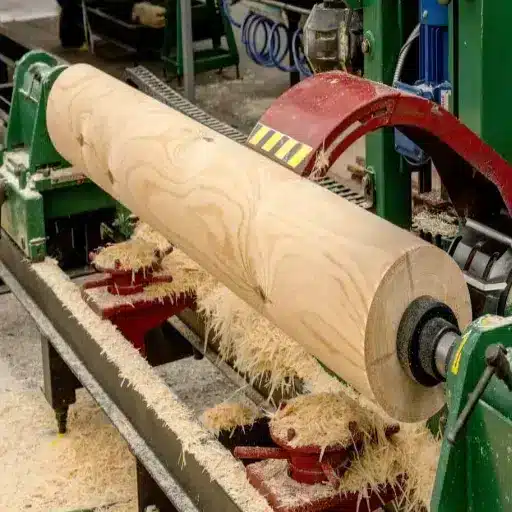
The slicing method determines the grain pattern, visual character, and yield of the finished veneer. This is where the artistry of production meets the precision of engineering.
Four primary methods dominate modern wood veneer production. Each produces a distinctly different aesthetic and is suited to specific applications.
| Slicing Method | Yield | Grain Pattern | Best Applications |
|---|---|---|---|
| Rotary Peeling | ~90% | Broad, swirling, varied | Plywood cores, commercial panels |
| Flat Slicing | ~70-80% | Cathedral or crown figure | High-end furniture, architectural panels |
| Quarter Slicing | ~70% | Tight, straight, parallel lines | Modern minimalist designs, formal environments |
| Rift Cut | ~65% | Consistent straight grain, minimal fleck | Luxury contemporary interiors, large surfaces |
Rotary Peeling
In rotary peeling, the steamed flitch is mounted on a lathe and rotated against a stationary blade. The blade peels a continuous sheet from the log, similar to unrolling a paper towel from a roll.
This method achieves the highest yield, approaching 90% of the log’s usable volume. The resulting grain is broad and somewhat unpredictable, with swirling patterns that can be dramatic or inconsistent depending on the species. Rotary peeled veneer is commonly used for plywood faces and large commercial installations where cost efficiency matters more than visual uniformity.
Flat Slicing
Flat slicing, also called plain slicing, is the most popular method for premium architectural and furniture applications. The log is sliced parallel to its center, creating the classic cathedral grain pattern with straighter grain at the edges.
The visual effect is unmistakably similar to solid wood, which is why designers favor it for high-end cabinetry and wall panels. Yield ranges from 70 to 80 percent, making it less efficient than rotary peeling but more visually refined.
Quarter Slicing
For quarter-sliced veneer, the log is quartered and sliced perpendicular to the growth rings. The result is tight, straight, parallel lines with minimal variation. In oak, this cut can reveal distinctive medullary ray fleck patterns that add visual interest.
Quarter slicing is prized for modern, minimalist designs where consistency and formality are paramount. It is also the preferred method when matching across large surfaces, because the grain remains predictable from sheet to sheet.
Rift Cut
Rift cutting slices the log at a slight angle to the quartered position, typically 15 degrees off the radial line. This produces extremely consistent straight grain with minimal flecking or cathedral patterns.
Luxury contemporary interiors frequently specify rift cut veneer for its visual uniformity. When a designer needs a 40-foot wall of seamless oak with no variation in grain character, rift cut is the production method that delivers.
Understanding these cutting methods is essential when specifying custom work. Manufacturers with advanced capabilities can produce specific cuts and matching patterns tailored to your project’s visual requirements.
Phase 4 — Drying and Moisture Stabilization
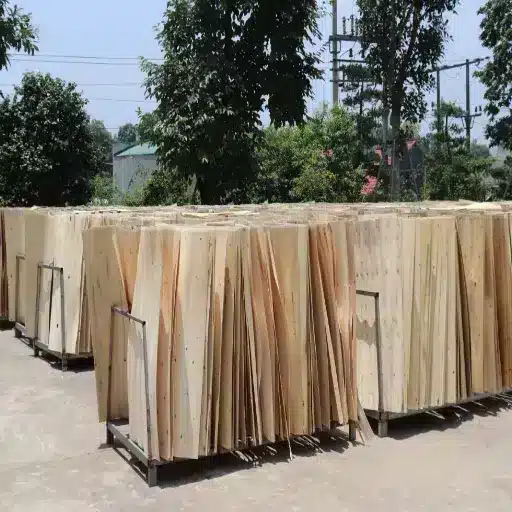
Freshly sliced veneer is soaking wet and must be dried immediately to prevent mold, warping, and dimensional instability. Modern drying systems are engineered for speed, consistency, and energy efficiency.
Sheets are fed individually through large belt dryers or kiln dryers that circulate heated air across both surfaces. Target moisture content ranges from 6 to 12 percent, depending on the final application and climate zone where the product will be installed.
The stacking order established during slicing is carefully preserved through drying. This ensures that adjacent sheets, which came from adjacent slices of the same log, can be matched later for consistent color and grain. Losing this sequence would make book-matching and slip-matching nearly impossible.
Modern facilities have adopted energy-efficient dryers with heat recovery systems that reduce energy consumption by up to 30%. Some mills are now implementing low-emission infrared drying and biomass-powered kilns that further reduce carbon footprints. This is not just an environmental win. Lower energy costs translate to more competitive pricing without compromising quality.
Efficient drying and logistics are critical links in the broader supply chain. Proper moisture control during this phase ensures the veneer remains stable from factory to final installation.
Phase 5 — Grading, Clipping, and Quality Control
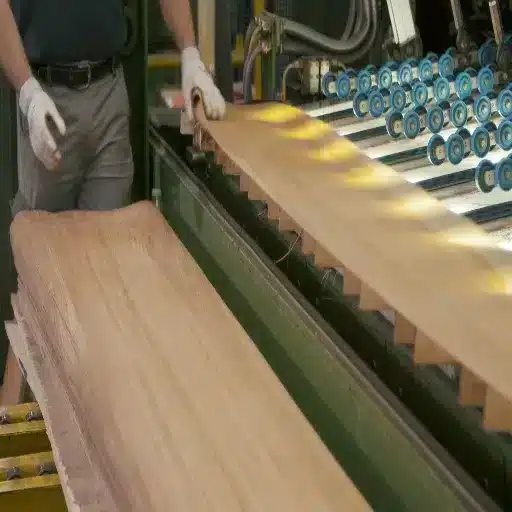
After drying, every sheet undergoes rigorous inspection. This phase separates premium material from seconds and determines how each sheet will be used.
Visual Grading Standards
Veneer is graded on a letter system that most manufacturers follow:
- AA Grade: Nearly perfect. Minimal defects, excellent color consistency, and uniform grain. Reserved for the most visible surfaces in luxury applications.
- A Grade: High quality with minor imperfections that are acceptable in most commercial installations.
- B Grade: More pronounced defects such as knots, mineral streaks, or color variation. Suitable for painted applications or areas where appearance is less critical.
- C Grade: Heavy defects. Often used for structural plywood faces or applications where the veneer will be completely hidden.
Grading is both an art and a science. Experienced inspectors can spot subtle color shifts that machines might miss, while automated systems detect pinhole defects invisible to the human eye.
Automated Optical Grading
2026 technology is transforming this phase. Machine vision systems equipped with high-resolution cameras and artificial intelligence scan each sheet in fractions of a second. They detect surface defects, measure color uniformity, and flag thickness variations with precision down to 0.1 millimeters.
Automated optical grading can reduce defective products by up to 30% compared to manual inspection alone. Robotic handling systems gently transport delicate sheets between stations, reducing the damage that human handling can cause. For commercial specifiers, this means better batch consistency and fewer rejected panels on the jobsite.
Understanding grading standards helps you specify the right quality level for each application. Our detailed guide to wood veneer quality control standards explains how to read grade stamps and set acceptance criteria for your projects.
Clipping and Trimming
After grading, sheets move to clipping lines where guillotine operators trim away defects and standardize dimensions. A sheet with a small knot near one edge might be clipped to a smaller standard size rather than downgraded entirely.
This optimization maximizes usable material. Even offcuts and trimmings find purpose in particleboard, bioenergy production, or other secondary applications. Nothing goes to waste in a well-run veneer mill.
Phase 6 — Splicing, Matching, and Assembly
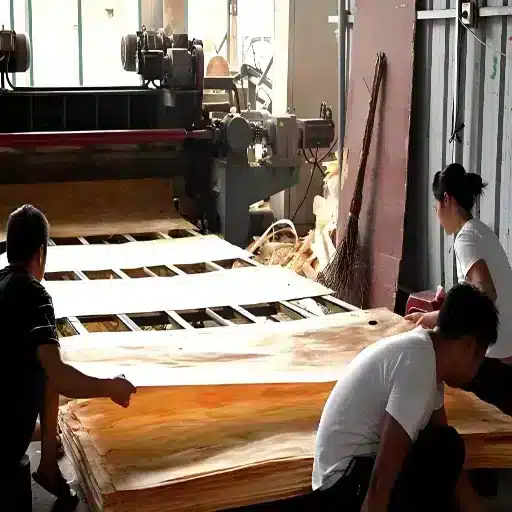
Individual veneer leaves are rarely large enough to cover a standard 4-by-8-foot panel on their own. Splicing joins multiple leaves edge-to-edge to create the full panel size required for commercial applications.
Knife-cutting machines create true parallel edges on each leaf. Then, splicing machines apply adhesive and press the edges together under heat and pressure. The result is a seamless panel that appears to be a single continuous sheet.
Matching techniques determine how the visual pattern flows across the panel:
- Bookmatching: Alternating sheets are flipped like pages in a book, creating symmetrical mirror images. This is the classic choice for dramatic wall panels and reception desks.
- Slip-matching: Sheets are laid side by side in sequence without flipping. This produces a more uniform, repetitive grain that works well for large contemporary surfaces.
- Random matching: Sheets are assembled without intentional sequence. This creates a natural, varied appearance suitable for rustic or casual designs.
The precision achieved during earlier production phases directly impacts how well these matching techniques work. Inconsistent thickness, uneven moisture content, or poor clipping will create visible seams that no amount of matching can hide.
For projects requiring bespoke visual layouts, manufacturers with custom capabilities offer advanced matching and splicing options beyond standard production.
Phase 7 — Backing, Bonding, and Finishing
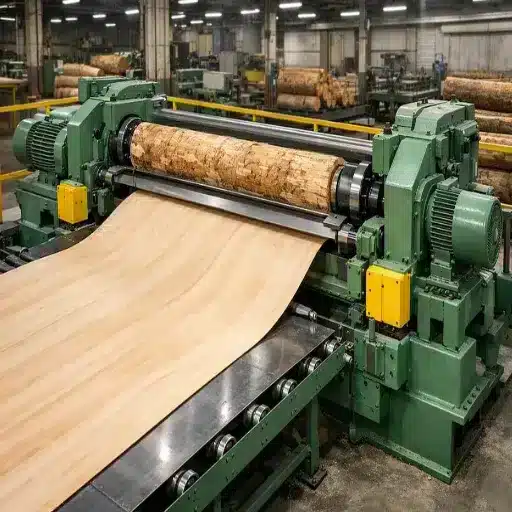
The final production phase transforms raw veneer leaves into finished products ready for installation.
Substrate Bonding
Raw veneer is delicate. It cracks easily, warps with humidity changes, and lacks the structural strength needed for most applications. Bonding it to a stable substrate solves these problems.
Common substrates include FSC-certified plywood, recycled-content MDF, and agricultural waste composite panels. The choice depends on the application. Plywood-backed veneer offers structural strength for cabinetry. MDF-backed panels provide a smooth, uniform surface ideal for painted or lacquered finishes.
Adhesive selection matters for both performance and environmental credentials. Traditional urea-formaldehyde adhesives have given way to water-based, low-VOC, and soy-based alternatives. These options eliminate formaldehyde emissions, improve indoor air quality, and meet the stringent requirements of LEED, BREEAM, and WELL certifications.
Backing Options
Depending on the application, manufacturers may add specialized backings to the veneer:
- Paper-backed: A thin paper layer adds flexibility and prevents cracking during handling. Standard for most furniture and millwork.
- Fleece-backed: A textile backing provides extra durability and is common for curved or formed applications.
- Phenolic-backed: A rigid resin backing adds substantial thickness and impact resistance. Used for high-traffic commercial surfaces.
- PSA peel-and-stick: A pressure-sensitive adhesive backing allows for easy application without additional glue.
Understanding how these finishing choices affect project cost helps with budgeting. Substrate type, backing material, and protective finish all influence the final price per square meter.
Protective Finishing
The final step applies protective coatings that preserve the veneer’s beauty while enhancing its durability. Options range from traditional solvent-free varnishes and natural oils to modern UV-cured finishes that harden instantly under ultraviolet light.
Low-VOC and formaldehyde-free finishes are increasingly specified for projects where indoor air quality is a priority. Water-based adhesives and UV curing are now standard in many 2026 production lines, reflecting broader industry shifts toward greener finishing chemistry.
2026 Technology Transforming Veneer Production
The veneer industry has always balanced craft knowledge with mechanical precision. In 2026, that balance is shifting decisively toward intelligent automation. Several emerging technologies are reshaping how veneer is produced, graded, and finished.
CNC Precision Cutting
Computer numerical control (CNC) systems now govern slicing machinery with tolerances measured in hundredths of a millimeter. These systems adjust blade angles, feed rates, and pressure in real time based on wood density sensors and pre-programmed species profiles.
The result is optimized material recovery and more consistent sheet thickness. For specifiers, CNC precision means tighter tolerances on custom orders and less variation between production batches.
AI-Powered Machine Vision Grading
Artificial intelligence has moved from experimental to standard in many premium mills. Machine vision systems trained on millions of sheet images can classify defects, measure color uniformity, and predict structural issues faster and more consistently than human inspectors.
These systems operate 24/7 without fatigue, reducing the defect rate by up to 30% while maintaining throughput. Robotic arms handle delicate sheets between stations, minimizing the physical damage that can occur during manual transfer.
Digital Printing on Veneer
One of the most exciting 2026 developments is high-resolution digital printing directly onto veneer substrates. This technology allows manufacturers to create custom designs, intricate patterns, and realistic replicas of endangered exotic species without harvesting restricted timber.
For designers, digital printing opens creative possibilities that were previously impossible or ethically problematic. A project can feature the visual richness of rosewood or mahogany while using sustainably sourced poplar as the base material.
Bio-Based Surfaces
New partnerships between veneer producers and biomaterial innovators are producing hybrid surfaces that blend natural wood with engineered bio-based layers. Products like Woodflow-skin combine thin natural veneer faces with cellulose-based backing materials derived from agricultural waste.
These bio-based surfaces maintain the authentic warmth and grain of real wood while pushing sustainability performance beyond what traditional construction can achieve. They are particularly relevant for architects pursuing aggressive carbon reduction targets.
Smart Energy Management
Modern mills are integrating solar arrays, biomass kilns, and smart energy management systems that optimize power consumption across production cycles. Heat recovery from drying operations feeds back into steam generation. Excess sawdust powers on-site biomass boilers.
These closed-loop energy systems reduce operational carbon footprints while lowering production costs. The savings can be reinvested in further technology upgrades, creating a virtuous cycle of improvement.
Sustainability at Every Stage of Wood Veneer Production

Sustainability in wood veneer production is not a single decision. It is a series of choices made at every phase, from forest to finished product.
Resource Efficiency: The 40x Advantage
The most compelling sustainability argument for veneer is simple math. One cubic meter of log produces up to 2,000 square meters of usable veneer surface. The same volume processed into solid lumber yields roughly 50 square meters of finished surface.
That is a 40-to-1 efficiency ratio. For architects and designers working on large commercial projects, this means achieving the visual impact of solid wood across thousands of square feet while consuming a fraction of the timber.
Waste Reduction and Circular Economy
Modern veneer mills operate with minimal waste. Sawdust from debarking and trimming becomes particleboard or bioenergy. Steam condensate is collected and reused. Even bark finds applications in landscaping mulch or soil amendments.
Automation and machine learning are pushing waste reduction further. Advanced cutting algorithms optimize flitching patterns to maximize yield. Predictive maintenance keeps machinery running at peak efficiency. Industry data suggests these technologies can reduce production waste by up to 20% compared to conventional methods.
Certification and Transparency
FSC Chain of Custody documentation is not just a certificate hanging on the wall. It is a verified record that follows each batch of veneer from the certified forest through every production phase to the final customer.
When you specify FSC-certified veneer, you can trace the material back to its source. That transparency matters for green building certifications, corporate sustainability reporting, and client conversations about environmental responsibility.
Understanding how to verify these claims is essential. Independent third-party audits and documented Chain of Custody records are the only reliable ways to confirm that sustainability claims are genuine.
Engineered Veneer: The Future of Sustainable Production
Engineered or reconstituted veneer represents the fastest-growing segment of the market, with growth rates of 12 to 15% annually. These products are manufactured from fast-growing, renewable species like poplar and ayous.
The process dyes and reassembles wood fibers to replicate the appearance of rare exotic species. The result is visually consistent, highly sustainable, and produces 18 to 35% lower carbon emissions than harvesting old-growth exotic hardwoods. For large-scale commercial projects where consistency across hundreds of panels is essential, engineered veneer offers both environmental and practical advantages.
To understand when engineered veneer makes sense for your project, review our reconstituted vs natural veneer comparison.
How Production Choices Impact Your Project
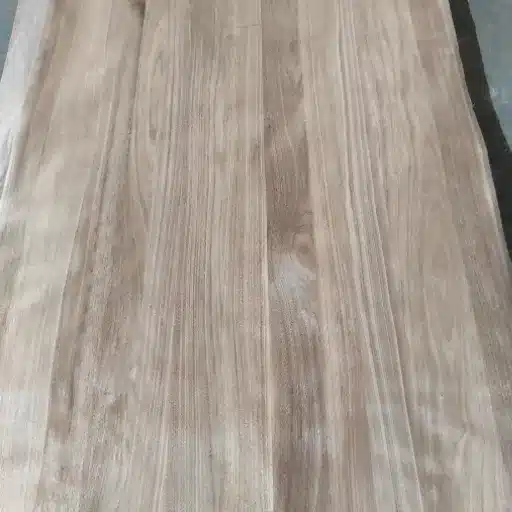
Understanding wood veneer production is not an academic curiosity. It directly affects specification decisions, project outcomes, and long-term performance.
Moisture content at the time of manufacturing determines how the material will behave in your local climate. Veneer dried to 6% moisture content and installed in a humid coastal environment will absorb moisture and potentially swell. Specifying the right moisture range for your application prevents callbacks and warranty issues.
Cut selection drives visual continuity. A rotary-cut walnut feature wall will look dramatically different from a quarter-sliced installation of the same species. Understanding these differences before specifying prevents costly surprises during installation.
Adhesive and finish choices directly impact green building credits. Low-VOC bonding and formaldehyde-free substrates contribute to LEED Indoor Environmental Quality credits. FSC-certified sourcing supports Materials and Resources credits. The production decisions your supplier makes can either simplify or complicate your certification process.
Batch consistency matters for phased construction. When a project spans six months and requires additional veneer panels for the final phase, you need confidence that the new material will match what was installed in month one. Automated grading, documented production parameters, and responsible inventory management are what make that possible.
When a design-build firm in Seattle specified rift-cut white oak veneer for a corporate headquarters, they did not anticipate a nine-month construction delay. When installation finally resumed, they needed 200 additional panels. Because their supplier maintained detailed production records and retained matching flitches from the original run, the new panels were visually indistinguishable from the first batch. The client never knew there had been a gap.
Want to ensure your next project benefits from production expertise? Contact VitalWood Global to discuss specifications, request samples, and explore how our FSC-certified production lines can support your timeline.
Frequently Asked Questions About Wood Veneer Production
How thick is the wood veneer cut during production?
Standard decorative veneer ranges from 0.3 to 0.6 millimeters thick, roughly 1/64 to 1/40 of an inch. Some specialty thick veneers reach 1 to 3 millimeters for applications requiring extra durability or the ability to sand and refinish.
Is wood veneer made from real wood?
Yes. Wood veneer is genuine hardwood sliced or peeled from logs. It is not a synthetic or printed imitation, though 2026 digital printing technology can add custom patterns to real wood surfaces. The key difference from solid wood is efficiency: veneer uses a thin slice of the log bonded to an engineered substrate, while solid wood uses the entire cross-section.
How long does the wood veneer production process take?
From log arrival to finished sheet, the production cycle typically spans 2 to 4 weeks, depending on species, drying requirements, and finishing complexity. Steaming alone can take 24 to 72 hours. Drying adds another 24 to 48 hours. The remaining time is allocated to grading, splicing, and finishing.
What is the most sustainable type of wood veneer?
Engineered or reconstituted veneer is generally the most sustainable option because it uses fast-growing, renewable species and produces lower carbon emissions than harvesting slow-growing exotic hardwoods. However, FSC-certified natural veneer from responsibly managed forests is also highly sustainable, especially when sourced with verified Chain of Custody documentation.
Can veneer production waste be recycled?
Yes. Nearly all waste from modern wood veneer production is recycled or repurposed. Sawdust and wood chips become particleboard or biofuel. Bark is used for mulch or soil amendments. Steam condensate is collected and reused. Well-run facilities approach zero waste to landfill.
What is the difference between rotary cut and flat cut veneer?
Rotary cut veneer is peeled in a continuous sheet from a rotating log, producing broad, swirling grain patterns with the highest yield (~90%). Flat cut veneer is sliced parallel to the log’s center, creating the classic cathedral grain pattern that most closely resembles solid wood. Rotary cut is more economical; flat cut is more visually refined.
Conclusion
Wood veneer production is one of the most resource-efficient manufacturing processes in the building materials industry. From selective harvesting in certified forests to AI-powered optical grading and low-VOC finishing, every phase has been refined to maximize quality while minimizing environmental impact.
The seven phases we have covered — sourcing, preparation, slicing, drying, grading, splicing, and finishing — represent both centuries of craft knowledge and the cutting edge of sustainable manufacturing. The 2026 technologies transforming this industry, from CNC precision to digital printing and bio-based surfaces, are making veneer more versatile, consistent, and environmentally responsible than ever before.
For architects, builders, and designers, understanding this process means specifying with confidence, asking better questions of suppliers, and delivering projects that perform beautifully while respecting the forests they came from.
The next time you specify veneer for a feature wall, a reception desk, or a complete interior, remember what happens before the material reaches your site. The choices made during wood veneer production will shape the aesthetics, durability, and sustainability story of your project for decades.
Ready to source sustainably produced wood veneer for your next project? Contact VitalWood Global today to discuss your specifications, request samples, and explore our FSC-certified production lines. We will work with you from selection to delivery to ensure every sheet meets your exacting standards.