

How to Vet a Wood Veneer Manufacturer: Factory Audits and Red Flags
A wood veneer factory audit is a structured evaluation of a manufacturer’s facilities, documentation, and quality control systems to verify their capabilities, certifications, and reliability before placing a production order. It covers five phases: pre-audit documentation review, production floor observation, quality control protocol verification, sample testing, and post-audit compliance checks. For architects, builders, and procurement professionals, this process is the difference between a successful project and a costly supply chain failure.
Maria Chen learned this the hard way. As a procurement manager for a boutique hospitality design firm in Chicago, she sourced walnut veneer from a new supplier for a 200-room hotel project. The first shipment looked perfect. The second? Completely different color tones, grain patterns that wouldn’t match the original panels, and moisture content that caused warping within weeks. The replacement order pushed the project timeline back six weeks and added $45,000 in unexpected costs.
If she had conducted a proper wood veneer factory audit before placing that production order, she would have spotted the warning signs in minutes. This guide shows you exactly how to do it.
You will learn a complete five-phase audit framework that covers documentation review, production floor observation, quality control verification, sample testing protocols, and post-audit actions. You will also discover the 10 red flags that should disqualify a supplier immediately, plus what the new EU Deforestation Regulation means for your vetting process in 2025 and 2026.
Key Takeaways
- A wood veneer factory audit follows five phases: documentation review, floor observation, QC verification, sample testing, and post-audit compliance checks.
- Five deal-breaker red flags include 100% prepayment demands, refusal of factory access, expired FSC/PEFC certificates, missing QC records, and broken chain-of-custody documentation.
- The EU Deforestation Regulation (EUDR) makes geolocation data and Due Diligence Statements mandatory for all wood veneer entering the EU market starting December 30, 2025.
- Always verify certification numbers on official certifier portals, not just supplier-provided PDFs.
- Batch-specific samples from the exact production run, tested for moisture, adhesion, and species authenticity, are your best defense against substitution and quality drift.
Why a Factory Audit Is Non-Negotiable for Veneer Procurement

Veneer is not like other building materials. It is thin, moisture-sensitive, and visually critical. A defect in a steel beam can be calculated around. A defect in a walnut wall panel is there for everyone to see, every day, for years.
Unlike solid lumber, veneer defects are not fixable on-site. You cannot sand out a delamination. You cannot patch a color mismatch across 3,000 square feet of book-matched panels.
Batch inconsistency is the number one cause of veneer project overruns. When phase two of your project starts six months after phase one, you need the new sheets to match the old ones exactly. The best manufacturers achieve this through documented grading standards, reference samples, and batch tracking. The worst? They hope you will not notice the difference.
Certifications can be forged, expired, or misrepresented. Any supplier can email you a PDF with an FSC logo. Only direct verification protects you from greenwashing. Check the certificate number on the official Forest Stewardship Council portal.
This matters now more than ever. Starting December 30, 2025, the EU Deforestation Regulation (EUDR) makes supply chain documentation legally mandatory for every wood veneer shipment entering Europe. Auditing your supplier’s compliance before you order is no longer a best practice. It is a legal necessity.
If you are just beginning your search for a manufacturing partner, our complete guide to choosing a wood veneer manufacturer covers the broader selection framework. This article dives deep into the audit process itself.
Phase 1: Pre-Audit Documentation Review

Before you set foot in a factory or join a video call, review the paperwork. A manufacturer with solid documentation is usually a manufacturer with solid processes. One who stalls, provides incomplete records, or sends certificates you cannot verify is signaling a problem.
Certification Verification Checklist
Start with the certifications that matter most for your market and project type.
Request these certifications and verify each one independently:
- FSC or PEFC Chain of Custody: Non-negotiable for certified projects. Get the certificate number. Verify it on the certifier’s online portal. Do not accept a PDF at face value. Certificates expire, get withdrawn, or cover only specific product groups. Check that the scope includes your exact species and product form. The official FSC Chain of Custody evaluation standards explain exactly what auditors verify.
- ISO 9001 (Quality Management) and ISO 14001 (Environmental Management): These indicate systematic process control. Ask for the accreditation body and validity dates.
- Formaldehyde compliance: Requirements vary by market.
- United States: Demand CARB Phase 2 or EPA TSCA Title VI documentation.
- Europe/Asia: Request E0 or ENF classification.
These are health and regulatory standards, not marketing claims.
- Business license and export eligibility: Confirm the company is legally registered and authorized to export. Trading companies often pose as manufacturers. A valid license with manufacturing in its scope code is your first filter.
- Third-party audit reports: SGS, Bureau Veritas, or TUV reports dated within the last 12 months add credibility. Ask for the full report, not just a summary page. The Decorative Hardwoods Association maintains industry standards and a member directory that can help you identify reputable auditors and manufacturers.
Technical and Commercial Documents
Request specification sheets for your target species, cut, and backing type. These should include thickness tolerance, moisture content range, adhesive type, and intended application. A manufacturer who cannot provide a technical data sheet for their own product is not a manufacturer you want to trust.
Demand the warranty and replacement policy in writing. What happens if the veneer delaminates? Who pays for replacement shipping? What is the claims window? Vague verbal promises become very quiet when problems arise.
If possible, request QC records from the last six months. Batch-level moisture readings, thickness checks, and grading logs tell you whether quality control is a documented process or an afterthought.
For protected species like ebony or rosewood, verify CITES permits. Without them, your shipment risks seizure at customs, and you risk legal liability.
Understanding the production process before you audit helps you ask better questions on the factory floor. Review the facility’s capabilities from log intake through finishing before your visit.
Phase 2: Production Floor Observation
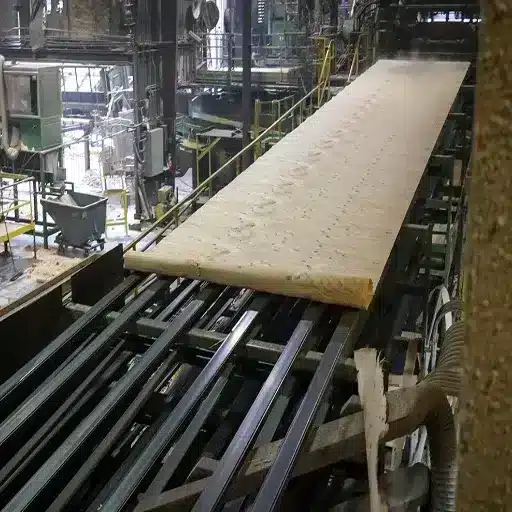
This is where the real audit happens. Whether you visit in person or conduct a live video walkthrough, observe the factory floor with a critical eye. Take photographs. Ask questions. Request to see records in real time.
Raw Material Yard
Start where the wood starts. Logs should be stored under continuous water spray or in a climate-controlled cover to prevent checking and degradation. Look for clear species segregation and labeling. If oak logs are sitting next to walnut with no physical separation or marking, you are looking at a substitution risk.
Conditioning and Slicing
Logs are steamed or soaked before slicing to soften the wood and prepare it for clean cuts. Ask to see the steaming logs. Are cooking times documented by species? Different species require different preparation. A factory that treats walnut and maple identically does not understand its materials.
At the slicing line, look for the blade maintenance schedule. It should be posted and current. Examine freshly cut sheets. Torn grain, rough surfaces, or knife marks indicate dull blades or improper knife angles. These defects do not improve downstream.
Drying and Grading
Drying is where most veneer quality problems begin. Moisture content must be reduced to 6-12% for interior applications. Ask to see the kiln charts. Are readings taken per batch, or just spot-checked? Per-batch monitoring is the standard you want. Spot-checking is a gamble.
At the grading station, look for a documented standard with photographic reference boards. Graders should work under consistent lighting, ideally in a light booth that eliminates color distortion. Ask how graders are trained and whether their work is periodically cross-checked.
Backing, Pressing, and Finishing
If you are purchasing backed veneer, ask about the adhesive system. Phenolic, melamine, PVA, and urea-formaldehyde each have different performance characteristics. The type should be documented per batch, not guessed.
Press parameters, temperature, pressure, and dwell time should be logged. Ask to see the records. Edge sealing should be consistent across all finished sheets. Missing or partial edge sealing invites moisture ingress, delamination, and warping.
Storage and Shipping
Finished veneer should be stored in a climate-controlled warehouse, ideally 18-22 degrees Celsius with 45-55% relative humidity. FSC-certified and non-certified stock must be physically segregated or clearly marked to prevent mixing.
Packaging standards matter enormously for a thin veneer. Look for moisture-barrier wrapping, edge protectors, and corner protection. Sheets tossed loose into a shipping container will arrive damaged, guaranteed.
When David Torres, a sustainable architecture firm principal in Austin, toured his first veneer mill in Southeast Asia, he brought a checklist and a camera. “I photographed the drying kiln logs, the grading station lighting, and the storage area humidity readout,” he recalled. “When I compared those photos against what the supplier had described in their brochure, I found three discrepancies. We negotiated corrections before placing the order, and the project was delivered on time with zero defects.”
Phase 3: Quality Control and Testing Protocols
A factory without documented QC is a factory without repeatable quality. During your audit, ask to see the evidence.
Batch-level QC records should be available for review. These should include thickness measurements, moisture content readings, glue bond strength tests, and surface quality inspections. The best factories maintain these records digitally with timestamps and operator signatures.
Thickness tolerance is a quick way to assess precision. For high-end decorative veneer, target plus or minus 0.1 millimeter. For standard grades, plus or minus 0.2 millimeters is acceptable. Wild variation suggests poor mill calibration or inconsistent process control.
Bond and peel test evidence is critical for backed veneer. Ask for EN 314 boil test results or equivalent. This test exposes glued veneer to boiling water and measures whether the bond holds. A supplier who cannot provide bond test data is asking you to be their quality laboratory.
Formaldehyde emission test reports should match the compliance standard your project requires. In the United States, this means CARB P2 or EPA TSCA Title VI. In Europe, E0 or ENF classification. Do not accept test reports older than 12 months.
Daily QC logs, signed by shift supervisors, demonstrate that quality control is an ongoing operational discipline, not a one-time audit performance. Ask to see logs from the current week. A factory that cannot produce them quickly may be generating them after the fact.
For a deeper dive into QC standards and testing protocols, see our guide to wood veneer quality control.
Phase 4: Sample Verification

Never rely on trade show samples or catalog photos. Demand production samples from the exact batch or flitch you will receive. This is your last line of defense before committing to a full order.
Verify grain, color, and figure match against your specification and any master standard you have established. Hold the sample at the angle and distance it will be viewed in the final installation. Lighting changes everything.
Test flexibility by bending the sample to the radius required for your application. Some veneers crack under tight curves. Better to discover this with a sample than with a full production run.
Test backing adhesion using your intended substrate and adhesive system. What bonds perfectly in the factory may not bond to your shop’s process.
Check moisture content with a calibrated meter at the time of receipt. Do not trust the factory’s reading alone. Meters drift, and a 2% difference can mean the difference between stable panels and warped ones.
For high-value species like ebony or burl, conduct a species authenticity test. True ebony sinks in water. Authentic species retain their shape and density when burned. These simple checks protect you against costly substitution fraud.
10 Red Flags That Should Disqualify a Supplier
Even experienced specifiers can miss warning signs. Use this framework to separate manageable concerns from deal-breakers.
Deal-Breakers: Walk Away Immediately
1. Demands 100% prepayment with no alternatives
Standard practice is 30% deposit, 70% against the bill of lading copy, or payment via letter of credit. A supplier who insists on full prepayment with no escrow or trade assurance option is either desperate for cash or planning to disappear.
2. Refuses a factory visit or live video walkthrough
This is the single biggest red flag. A legitimate manufacturer welcomes scrutiny. One who hides behind excuses, “we are renovating,” “visitors are not allowed,” or “just watch this pre-recorded video,” is almost certainly concealing poor conditions or operating as a trading company with no real facility.
3. Expired or unverifiable FSC/PEFC certificates
Greenwashing is common in the veneer trade. Certificates expire, get withdrawn, or cover different product scopes. If the certificate number does not validate on the official portal, you are not buying certified wood. You are buying a story.
4. No batch-level QC records
Without documented quality control, there is no traceability. When defects appear, and they will, you have no basis for a claim and no way to prevent recurrence.
5. Cannot provide Chain of Custody for every shipment
For LEED projects, FSC-certified builds, or EUDR compliance, chain-of-custody documentation is mandatory. A supplier who breaks this chain breaks your project’s certification.
Serious Caution Flags: Proceed with Extreme Care
6. Inconsistent veneer grading across sample panels
This indicates either no documented grading standard or poor process control. Either way, your shipment will be a lottery.
7. No edge sealing on finished sheets
Unsealed edges absorb moisture, leading to delamination and warping. This is basic veneer handling. Its absence signals negligence.
8. High moisture content above 12% or no drying records
Veneer above 12% moisture content will move, warp, and fail to bond properly. A factory that does not monitor or record drying is not manufacturing. They are guessing.
9. Logs stored improperly
Logs left exposed to sun and wind degrade before processing begins. You are paying premium prices for material that was already damaged.
10. Vague species declarations on invoices
Every invoice should list the common and scientific names of the species. “Exotic hardwood” is not a species. It is a warning.
| Category | Deal-Breaker | Caution Flag |
|---|---|---|
| Financial | 100% prepayment demanded | Unusual payment routing requests |
| Transparency | Refuses any factory or virtual access | Only provides pre-recorded video |
| Documentation | Fake or expired certificates | Missing one secondary certification |
| Quality | No QC records at all | Single minor defect in the sample batch |
| Legal | CITES species with no permit | Sourcing from a mid-tier CPI country without extra documentation |
Understanding how these red flags affect your budget is just as important as spotting them. A supplier with no QC records, expired certificates, or moisture problems will cost far more in replacements and delays than a higher-priced but properly audited partner.
Phase 5: Post-Audit Actions

The audit does not end when you leave the factory or hang up the video call. What you do next determines whether the audit actually protects your project.
Commission independent sample testing through a third-party laboratory. Test for moisture content, formaldehyde emission, and adhesion strength. Laboratory results are objective evidence that holds up in disputes.
Verify all certificate numbers on official scheme websites. FSC, PEFC, ISO, and CARB all maintain public verification databases. Spend 15 minutes now to avoid a $45,000 problem later.
Conduct reference checks with at least three provided client contacts. Ask about on-time delivery, defect rates, communication responsiveness, and how the supplier handled problems. A reference who pauses too long before answering is telling you something. Reputable distributors like Mundy Veneer publish their due diligence standards as proof of their vetting rigor. Use their framework as a benchmark when evaluating your own suppliers.
Review shipping documentation templates before placing the order. Confirm that packing lists, commercial invoices, certificates of origin, and fumigation certificates, if required, match your customs and project documentation needs.
Establish a pre-shipment inspection clause for your first two or three orders. An independent inspector verifies quality, quantity, and packaging before the container leaves the factory. This costs a few hundred dollars and can save tens of thousands.
Finally, set up a feedback loop. Share inspection results with the manufacturer. Track defect trends over time. The best suppliers improve because their buyers hold them accountable.
EUDR and 2025-2026 Compliance Considerations
The regulatory landscape for wood veneer imports changed fundamentally on December 30, 2025. That is when the EU Deforestation Regulation (EUDR) became enforceable for large and medium-sized companies. Small and micro-enterprises have until June 30, 2026.
Wood veneer falls explicitly under HS Code 4412. There are no exemptions by end-use. The same documentation requirements apply whether your veneer becomes furniture, wall panels, or architectural millwork.
To legally place wood veneer on the EU market, importers must now prove:
- Deforestation-free origin: Timber harvested from land not deforested after December 31, 2020.
- Legal harvesting compliance: All relevant laws of the country of origin followed.
- Precise geolocation data: GPS polygon coordinates for every forest plot.
- Scientific species name: Common names are not sufficient.
A Due Diligence Statement (DDS) must be submitted through the EU TRACES NT system before customs clearance. Without a valid DDS reference number, customs authorities will refuse entry.
FSC and PEFC certification provide a head start on traceability. But they are not automatically sufficient for EUDR compliance. The regulation demands specific geolocation data and risk assessments that go beyond current voluntary certification schemes. Your supplier must provide GPS coordinates of harvest plots and documented supply chain mapping back to the forest.
Penalties for non-compliance are severe:
- Fines up to 4% of annual EU turnover
- Confiscation of products
- Temporary exclusion from public procurement
- Shipment delays that cascade into project timeline failures
If your projects serve the European market, EUDR readiness should be a central element of your factory audit checklist. For a full certification and compliance deep-dive, see our guide to sustainable wood veneer sourcing.
Conclusion
A wood veneer factory audit is your best insurance against the three problems that destroy projects: cost overruns, timeline delays, and compliance failures.
Documentation review catches misrepresentation before it becomes a contract. Production floor observation reveals whether a supplier’s promises match their practices. Sample verification protects you from the batch-to-batch inconsistency that ruins large installations.
The 10 red flags in this guide are not abstract warnings. They are the specific patterns we have seen lead to failed shipments, disputed invoices, and compromised projects. Use the deal-breaker versus caution framework to make fast decisions when time is short.
For EU-facing projects, EUDR compliance is no longer optional. The December 2025 enforcement deadline means every wood veneer shipment now requires geolocation data, supply chain mapping, and a submitted Due Diligence Statement. Audit your suppliers for EUDR readiness now, or audit your project delays later.
The cheapest quote is rarely the best value. A supplier who welcomes your audit, maintains transparent records, and invests in quality control is a partner who will save you money over the life of your project.
One who resists scrutiny, hides behind excuses, or produces certificates that do not verify is a risk you cannot afford.
Ready to see what a transparent, audit-ready manufacturing process looks like? Contact VitalWood Global to schedule a virtual factory tour, request our complete certification documentation, or discuss your project’s specific quality and compliance requirements.