
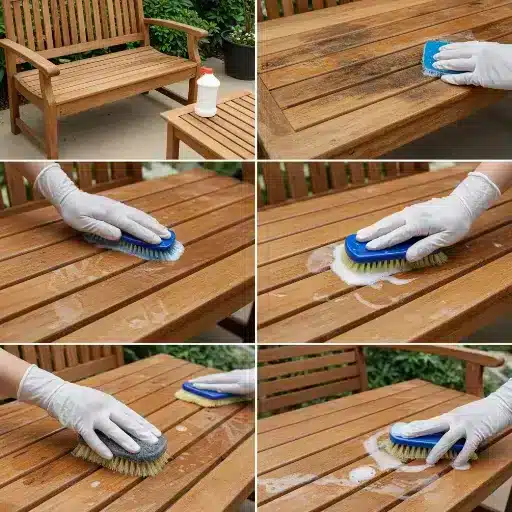
How To Clean Teak Wood: Outdoor Furniture Care For Every Stage
How to clean teak wood the right way is simple: scrub with mild soap and water and a soft-bristle brush, working with the grain, then rinse thoroughly and let the wood dry completely. That gentle routine protects the natural oils that make teak so durable. For deep cleaning and restoring grayed wood, a dedicated teak cleaner with oxalic acid does the heavy lifting.
Daniel learned the hard way that teak is not like other wood. He had just paid a premium for a teak dining set, and when a summer storm left it coated in grime, he grabbed a pressure washer and blasted it clean. The surface looked great for a weekend. Then the grain roughened into a fur, the joints loosened, and mold started creeping into the scratches. That one-hour clean shortened the life of his furniture by years.
The good news is that you can avoid Daniel’s mistake easily. Teak is the gold standard of outdoor wood because its natural oils resist water, rot, and insects. But how you clean it decides whether those oils stay put or get stripped away. This guide walks you through every stage of teak care, from routine cleaning to deep restoration, and helps you decide whether to embrace the silver-gray patina or keep the golden glow. If you also care for indoor wood surfaces, our complete guide on how to clean wood covers furniture, floors, and cabinets.
Key Takeaways
- Clean teak with mild soap and water and a soft-bristle brush, working with the grain, then rinse and dry completely.
- Reserve a dedicated teak cleaner with oxalic acid for deep cleaning, stains, and restoring weathered gray wood.
- The gray patina is cosmetic, not damage; you can embrace it or restore it without affecting durability.
- Teak oil does not prevent graying; a teak sealer with UV inhibitors actually protects the golden color.
- Never pressure wash, use chlorine bleach, or scrub with steel wool, because each one strips the oils that keep teak alive.
Why Teak Is Different: The Wood Science First
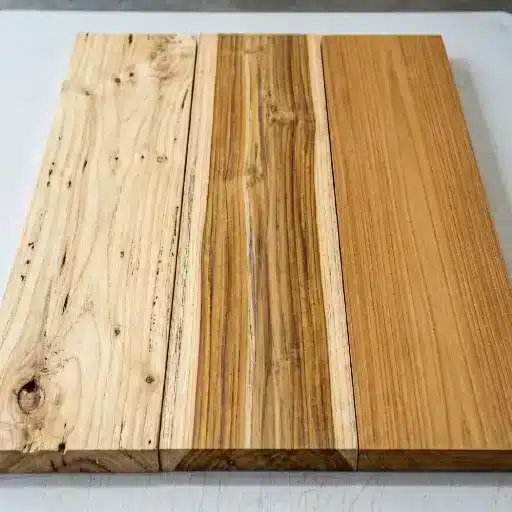
Understanding teak starts with its oil content. Unlike most hardwoods, teak’s protective oils run through the entire wood structure, not just the surface. That’s why water beads on freshly cut teak instead of soaking in, and why the wood can shrug off rain, salt, and humidity that would ruin oak or maple.
The numbers explain the reputation. Teak has a Janka hardness of roughly 1,070 pounds-force, which places it in the medium-hard range, harder than pine, poplar, and mahogany. More importantly, teak has among the lowest shrinkage of any commercial hardwood, with radial shrinkage of 2.5%, tangential of 5.3%, and volumetric of 7.2%. That dimensional stability is why teak resists warping and cracking through years of wet-dry cycling. It’s also packed with up to 1.4% silica, which adds scratch resistance and grip when wet, and gives the wood a density around 0.66 specific gravity.
Those properties are why a well-built teak piece can last 50 to 70 years outdoors, and why marine builders have trusted it for boat decks for generations. Cleaned properly, the wood’s own oils do most of the work, which means you don’t need nearly as much chemical protection as with any other exterior wood.
First, Decide Your Teak Care Goal

Before you clean, decide what you actually want from the piece. Teak care splits into three distinct goals, and each one changes your routine.
Leave it natural and let it gray. This is the lowest-maintenance choice. You clean occasionally with soap and water and accept the silver-gray patina that develops naturally. No oil, no sealer, no fuss.
Restore weathered teak to golden. If your teak has already grayed and you want the warm honey color back, you need a teak cleaner or brightener that removes the oxidized surface layer, then you seal it to keep the color.
Protect the golden look from the start. If you bought new teak and want it to stay golden, you apply a UV-inhibiting teak sealer and reapply on schedule. Oiling alone will not stop graying, which we explain below.
Climate and patience matter too. In a hot, sunny climate the gray develops fast, while shaded pieces gray more slowly. If you want minimal upkeep, embrace the gray. If you want a consistent golden look for a deck or dining set, commit to sealing. Once you pick a goal, the cleaning methods below stay the same; only your protection step changes.
Routine Cleaning: The Gentle Soap-and-Water Method
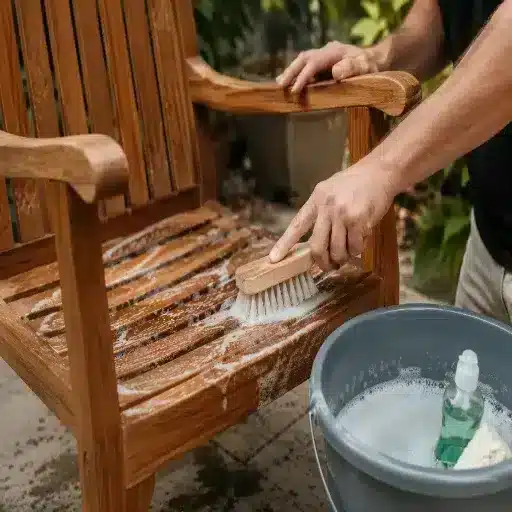
For most teak, routine cleaning is a ten-minute job. This is the method to use every few weeks for light grime and every quarter for furniture exposed to the weather.
- Remove cushions and loose debris. Take off any cushions or covers and brush away leaves, dust, and cobwebs with a soft brush.
- Mix a mild soap solution. Add a few drops of pH-neutral dish soap to a bucket of warm water. Mild soap preserves the natural oils; harsh detergents and degreasers strip them.
- Scrub with the grain. Use a soft-bristle brush or sponge and work along the grain, not across it. Pay extra attention to corners and feet where grime collects.
- Rinse thoroughly. Use a garden hose at normal pressure to wash away all soap residue. Leftover soap attracts dirt and leaves a dull film.
- Dry completely. Let the piece air-dry in the shade for 24 to 36 hours before storing or applying any oil or sealer.
Avoid dish soap residue by rinsing well, since even mild soaps can build up over time. For stains that survive a soap wash, you can spot-clean with a paste of baking soda and water, then rinse and dry. This simple routine handles bird droppings, sap, pollen, and everyday dust.
Don’t use the same cleaner on teak that you use on sealed indoor furniture. Sealed surfaces tolerate stronger products, while bare teak reacts to them. If you are comparing products for different surfaces, our guide to the best wood cleaner breaks down which cleaners are safe by finish type.
Deep Cleaning and Restoration: When Soap Isn’t Enough
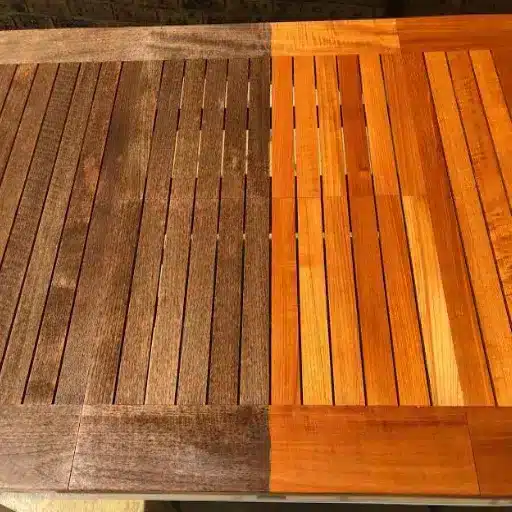
Weathered teak with black spots, heavy grime, or a deep gray color needs more than soap. This is where a dedicated teak cleaner comes in.
Teak cleaners and brighteners typically contain oxalic acid, which removes the oxidized surface layer, mildew, and stains that soap cannot touch. Most systems come in two parts: a cleaner that lifts dirt and a brightener that restores the natural color. You work in small sections, keep the surface wet, scrub gently with the grain, and rinse thoroughly before moving on.
If you prefer a budget-friendly DIY option, Practical Sailor’s independent testing found that plain oxalic acid, roughly 1 cup dissolved in a quart of warm water, revived neglected teak as well as commercial products. It needs a little more scrubbing, but it is a fraction of the cost.
Whichever route you choose, the process is the same:
- Test the cleaner on an inconspicuous spot first.
- Wear gloves and eye protection; oxalic acid is corrosive.
- Keep the surface wet so the product does not dry on the wood.
- Rinse with plenty of fresh water.
- Let the teak dry completely, up to 48 to 72 hours, before any protection step.
For deeply grayed teak, a light sanding with 120 to 220 grit paper, again with the grain, can speed up restoration. Sand sparingly, because every pass removes a little wood. A good rule is to sand only when restoring, never as part of regular cleaning.
How to Remove Mold, Mildew, and Black Spots From Teak
Mold and mildew are the most common teak complaint, especially in damp, shaded spots. The good news is that mild cases respond to a simple vinegar solution.
Mix equal parts white vinegar and water in a spray bottle, spray the affected area, and let it sit for 10 to 15 minutes. Scrub gently with a soft brush, then rinse thoroughly. Never let the vinegar dry on the wood, because the acidity can affect the color. Repeat for stubborn black spots, or add a few drops of dish soap to the mix.
For heavier mildew, oxygen bleach is a gentler alternative to chlorine bleach. It lifts mold without the harsh effects. Chlorine bleach, by contrast, breaks down the lignin that holds wood fibers together and strips the natural oils, which is why most teak guides warn against it. Never mix bleach with ammonia, which produces toxic fumes.
Prevention matters as much as cleaning. Keep furniture in sunny, well-ventilated spots, use breathable furniture covers instead of plastic tarps that trap moisture, and treat spills and bird droppings quickly. Dry, airy teak simply does not grow mold.
The Gray Patina: Embrace It or Restore It
Every new teak owner eventually asks the same question: why did my beautiful golden furniture turn gray?
The answer is UV light. Over about six months to a year outdoors, sunlight oxidizes the surface fibers and oils, and rain washes away natural tannins. The wood shifts from golden honey to a soft silver-gray. This is a surface-level chemical change, not structural damage. The internal oil content and durability stay fully intact.
That means the gray is your choice to make. Many people love the low-maintenance silver-gray look, which fits coastal and modern spaces perfectly. If that’s you, you’re done. Keep cleaning occasionally with soap and water and the gray stays even and attractive.
If you want the golden color back, restore it with a teak cleaner or brightener as described above, lightly sand if needed, then apply a sealer to slow future graying. Restored teak looks stunning but demands a little more upkeep.
The honest truth is that gray is not a sign of neglect. It is teak weathering naturally, the same way good leather develops a patina. Deciding to embrace it or reverse it is purely about the look you want.
Teak Oil vs. Teak Sealer: What Actually Protects the Golden Look
This is the most confusing part of teak care, because a lot of well-meaning advice gets it wrong. Teak oil does not prevent graying.
Westminster Teak, a longtime teak specialist, is blunt about it: teak oil offers minimal UV resistance, which is exactly what causes graying. Oil only deepens the color temporarily, can darken unevenly, and can even encourage mildew in damp climates. If you start oiling and then stop, the wood can gray in patchy, uneven streaks.
A teak sealer with UV inhibitors is the real protection. It blocks the sun’s rays that oxidize the surface, preserves the golden color, and needs reapplication only once or twice a year. Sealers do not affect durability, only appearance, which is exactly what you want from a cosmetic treatment.
| Option | What it does | UV protection | Reapplication |
|---|---|---|---|
| Leave bare | Nothing; wood weathers naturally | None | Never |
| Teak oil | Deepens color temporarily | Minimal | Every 2 to 3 months |
| Teak sealer | Slows graying, preserves golden color | Strong | Once or twice a year |
| Teak cleaner/brightener | Removes oxidation and restores color | None (a treatment) | As needed |
If you choose oil, apply it to bone-dry wood and rub off any excess, or the surface turns sticky and starts attracting dirt. If you want the golden look without the maintenance, a sealer is the better choice. And if you are happy with gray, skip both. The wood’s own oils already do the protection.
What NOT to Do: Common Teak Cleaning Mistakes
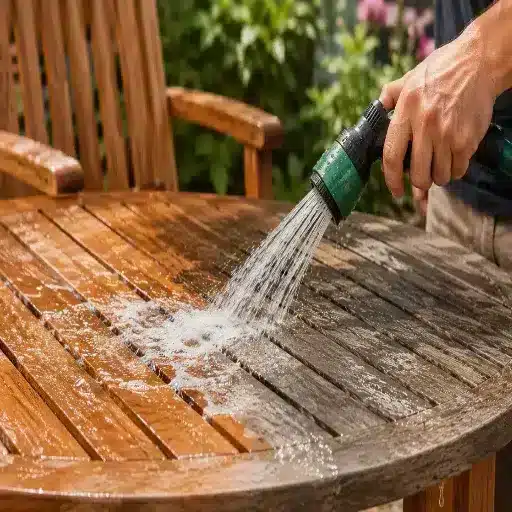
The list of teak killers is short, but each one is serious.
- Pressure washers. High-pressure water pits the surface, blasts out natural oils, roughens the grain, and can loosen joints. The safe alternative is a garden hose at normal pressure. A low-pressure rinse under 1,200 PSI with a wide fan nozzle can be part of a deep restoration of very dirty old teak, but it’s risky and easy to get wrong, so avoid it unless you’re confident.
- Chlorine bleach and ammonia. Both break down the wood’s structure and strip oils. Use vinegar or oxygen bleach for mold instead, and never mix bleach with ammonia.
- Steel wool and metal brushes. Scratches trap moisture and invite mold. Use soft-bristle nylon brushes or sponges.
- Letting cleaners dry on the surface. Always keep teak wet while a cleaner works, then rinse. Dried product causes discoloration and raised grain.
- Over-oiling. Too much oil makes the surface sticky and dirt-attracting. Less is more.
- Over-sanding. Sanding between every cleaning removes wood and shortens the piece’s life. Save it for serious restoration.
- Film-forming finishes. Varnish and polyurethane crack and peel on outdoor teak. If you seal, use a product that soaks into the wood.
Caring for Teak by Location and Season
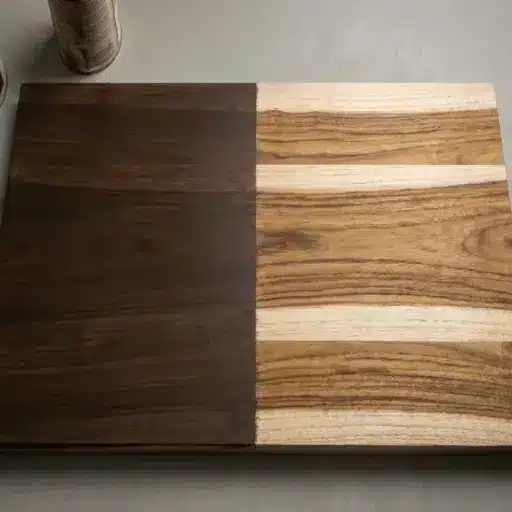
Teak adapts to different settings, but the care routine shifts a little depending on where it lives.
Patio and garden furniture. This is where teak shines. Clean every few weeks in the summer, every quarter if it is exposed year-round, and deeply once or twice a year in spring.
Boat decks and coastal teak. Salt, sun, and wet conditions make boat teak the hardest-working wood on earth. Clean more often, rinse salt off regularly, and be diligent about keeping the surface wet during cleaner application. The silica content that gives teak wet grip also makes it the standard for marine decking.
Indoor teak. A teak dining table or cutting board follows gentler rules. Dust regularly and use a barely-damp cloth for cleaning. Oily woods like teak can develop a cloudy film from water-based cleaners, so a dry or barely-damp approach works best indoors.
Seasonal calendar. In spring, do a deep clean and restore or seal if needed. Through summer, spot-clean after storms and parties. In fall, clean thoroughly before storing furniture for winter. In winter, store pieces under breathable covers in a dry, sheltered spot.
FAQ
How do you clean teak wood?
Scrub with mild soap and water and a soft-bristle brush, working with the grain. Rinse thoroughly and let the wood dry completely. For deep cleaning, use a dedicated teak cleaner with oxalic acid.
Can you use vinegar to clean teak?
Yes, diluted white vinegar mixed with water is an effective, eco-friendly way to remove mold and mildew from teak. Spray it on, let it sit for 10 to 15 minutes, scrub gently, and rinse. Never let it dry on the wood.
Can you pressure wash teak furniture?
Generally, no. Pressure washing strips natural oils, roughens the grain, and can loosen joints. Use a garden hose at normal pressure and a soft brush instead.
Should I use teak oil or teak sealer?
If you want to keep the golden color, use a teak sealer with UV inhibitors. Teak oil deepens color temporarily but does not prevent graying and needs frequent reapplication.
Why does teak turn gray?
Ultraviolet light oxidizes the surface fibers and oils over six months to a year. The gray is cosmetic, not damage, and durability stays intact.
How do you remove mold from teak?
Spray a 1:1 vinegar and water solution on the affected area, let it sit, scrub gently, and rinse. For heavy mildew, use oxygen bleach instead of chlorine bleach.
Does teak need to be sealed?
No. Teak’s natural oils protect it outdoors without any finish. Sealing is optional and only changes the appearance, not the durability.
How often should you clean teak furniture?
Light-clean every few weeks, give it a proper wash every quarter, and deep-clean or restore once or twice a year.
Conclusion
Learning how to clean teak wood comes down to one idea: protect the natural oils that make teak special. Clean routinely with mild soap and water, use a teak cleaner only when you need to restore, decide whether to embrace or reverse the gray patina, and never reach for a pressure washer, bleach, or steel wool.
When you care for teak this way, a single piece can serve your family for 50 years or more. That is more than good maintenance. It means responsibly sourced wood stays in use instead of heading to a landfill, which is sustainability in its most practical form.
At VitalWood Global, we source teak and other hardwoods from certified sustainable forests and take the same care with our material that we hope you will take with yours. If you are planning an outdoor project, explore our sustainably sourced wood products and our complete guide on how to clean wood. And if you would like help choosing the right wood for your next build, get in touch with our team.