
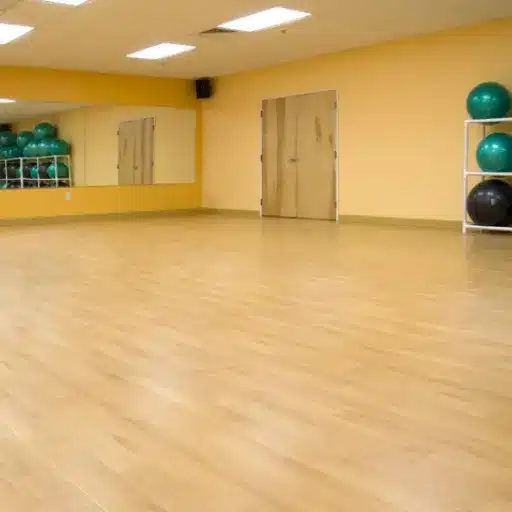
Maple Sports Flooring: The Standard For Gyms & Courts
Maple sports flooring is a hardwood athletic surface milled from northern hard maple and installed over an engineered subfloor system that controls shock absorption, ball bounce, and stability. It is the surface used for most competitive basketball and volleyball courts in North America. The wood itself is only half the story: the subfloor system underneath is what makes a floor fast, safe, and long-lasting.
In 2019, the facilities director at a mid-sized high school district faced a familiar problem. Three gymnasiums needed new floors, and the synthetic quote came in lower than the maple bid. The district chose synthetic for two gyms and maple for the competition court. Six years later, the synthetic surfaces were showing dead spots and needed panel replacement, while the maple court was on its second annual recoat and still playing like new. The lesson was not that maple is always cheaper. It was that a maple floor is a system, and systems that are specified well outlast surfaces that are bought on price.
If you are specifying a floor for a school, recreation center, or multi-use facility, this guide is for you. You will learn how MFMA grades work, what performance numbers actually get written into a spec, how subfloor systems differ, what maple sports flooring costs in 2026, and how to budget for the decades of ownership that follow. If you are still weighing species and construction, our overview of engineered maple flooring is the right starting point, and this article picks up where it leaves off.
Key Takeaways
- Maple sports flooring is a system, not just boards: northern hard maple over a resilient subfloor determines performance, safety, and lifespan.
- MFMA grades (First, Second & Better, Third, Utility) govern appearance and price only. They do not change how the floor performs.
- Expect roughly $8 to $22 per square foot installed for standard systems, with competition-grade and combined elastic builds running higher.
- A well-maintained maple court serves 40 to 80+ years, with annual recoats and a full resurface every 8 to 10 years.
- FSC/PEFC sourcing, FloorScore, and low-VOC water-based finishes let a maple floor contribute to green-building goals.
What Is Maple Sports Flooring?
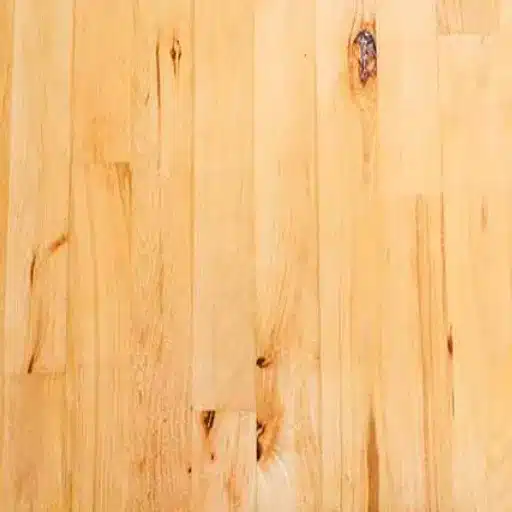
Maple sports flooring is a hardwood athletic floor made from northern hard maple, typically cut into strips and installed over a resilient subfloor system that provides shock absorption and consistent ball response. The Maple Flooring Manufacturers Association (MFMA) sets the grading, milling, and performance standards that most North American projects specify.
The MFMA reports that maple appears on roughly 70% of U.S. sports floors, with northern hard maple accounting for about 58%. That is more than 17 million square feet installed each year. Those numbers are not marketing. They reflect a surface that has been refined for competitive play for over a century.
Why Northern Hard Maple
Northern hard maple is grown in colder northern latitudes, where shorter growing seasons produce a tighter, more uniform grain. That density is the point. The wood resists dents from shoes, equipment, and dropped weights far better than softer species, and its light, reflective color brightens a gym while making game lines and graphics stand out clearly.
Hard maple ranks around 1,450 on the Janka hardness scale, according to NWFA data. For comparison, white oak sits near 1,360 and Douglas fir around 660. Only a handful of commercial species match maple’s combination of hardness, uniformity, and light color.
Quick definition to remember: maple sports flooring equals northern hard maple, milled to MFMA tolerances, installed over an engineered resilient system. Remove any one of those three parts, and you no longer have a competition-grade floor.
MFMA Grades at a Glance
Here is the part that trips up most first-time specifiers. Maple grades describe appearance, not performance. A Third Grade floor plays identically to a First Grade floor. Grade affects how the floor looks, how much it costs, and how much color variation and natural character it shows.
| Grade | Appearance | Typical Facilities | Price Tier |
|---|---|---|---|
| First (Select) | Cleanest, most uniform, lightest color | Pro arenas, televised courts, showcase gyms | Highest |
| Second & Better (Standard) | Some knots and color variation; not on ends or edges | Most high school and college gyms; the common spec | Mid |
| Third & Better | More natural character and darker tone | Practice courts, budget-driven builds | Lower |
| Third (Natural) | Visible knots, burls, and color streaks | Recreation centers, value projects | Lowest |
The MFMA defines five grades in total for random-length strip, and member mills hold to tight milling tolerances. Every strip carries a mill number on the back as a quality guarantee, and MFMA member mills undergo four unannounced inspections each year.
Specifying a floor and unsure which grade your budget supports? Contact our team with your facility type and square footage, and we will outline the grades and systems that fit.
Hard Maple vs. Soft Maple: What “Maple” Must Mean
Not all maple is sports flooring. This is the single most important specification check you can make, because a “maple floor” can be sold that is not hard maple at all.
Hard maple is Acer saccharum, also called sugar maple. It is the species the MFMA recognizes for athletic floors. Soft maple species, such as red maple and silver maple, look similar in a photograph but rank far lower on the Janka scale, often between 700 and 1,000. A soft maple floor will dent, wear unevenly, and fail to meet the performance expectations of a competitive court.
If a bid looks dramatically cheaper than the others, ask one question: which species is being supplied, and can the mill document it? A legitimate supplier will answer without hesitation.
Performance Characteristics That Actually Get Specified
When an architect writes a maple floor spec, these are the characteristics that matter. They are the numbers that separate a real athletic floor from boards on a slab.
Shock Absorption and Vertical Deflection
Shock absorption measures how much force the floor absorbs compared with a rigid surface. Vertical deflection measures how much the floor gives under load. A resilient maple system sinks slightly underfoot and springs back, which is why coaches and sports-medicine professionals call it an orthopedic surface. It reduces stress on ankles, knees, and lower backs over a season of play.
Ball Bounce and Surface Friction
Ball bounce measures how a basketball rebounds off the surface. The MFMA sets a rebound standard of roughly 93% for competitive courts, and a floor that meets it plays predictably for shooters and passers alike. Surface friction controls how much an athlete slides when cutting and stopping. Too much friction causes joint injuries; too little causes slips. The MFMA criteria keep both in a safe band.
Rolling Load and Compression Strength
Rolling load matters in any gym that hosts assemblies, events, or maintenance equipment. A floor that dents under a loaded table or a floor-cleaning machine loses its flatness, and flatness is what keeps play consistent. Compression strength confirms the floor can carry the loads a busy facility places on it.
Subfloor Systems: Why the Maple Isn’t the Floor
Two gyms can have identical maple strips and perform completely differently, because the subfloor does the invisible work. There are three families of systems, and each one suits a different facility.
Anchored (Fixed) Systems
Anchored systems are secured to the slab through sleepers and channels. They feel firm and consistent underfoot and are the traditional choice for dedicated competition courts where predictable play is the priority.
Floating Systems
Floating systems rest on resilient pads without being fastened to the slab. They deliver uniform shock absorption and are often the practical choice for multipurpose spaces and buildings where the slab cannot be altered.
Fixed-Resilient (Hybrid) Systems
Fixed-resilient systems combine anchoring with resilient components to balance stability and shock absorption. They are common in high-level competition venues that also host events.
Sleepers, Pads, and Vapor Barriers
Every system layers the same core components: a moisture barrier, a structural layer, resilient pads, and the maple surface. MFMA guidance calls for a minimum 6-mil polyethylene vapor barrier over concrete, resilient pads, and sleeper spacing at 9 inches on center for First and Second Grade and 8 inches on center for Third Grade. The pads provide the spring; the barrier keeps ground moisture out of the wood.
Retrofits and Constrained Clearances
Renovations are where system choice gets interesting. Older buildings rarely have the slab depression needed for a deep area-elastic build, so the available floor height often decides the system for you. Thinner resilient systems and engineered wood flooring constructions can fit clearances that a full-depth system cannot.
Maple Sports Flooring Cost (2026)
Maple sports flooring cost depends on three variables: grade, system type, and site conditions. The installed price per square foot ranges widely, so treat any single number as a starting point rather than a bid.
| Item | Typical Range (per sq ft) |
|---|---|
| Material (maple strip) | $7.50 to $14.00 |
| Installation | $3.50 to $8.00 |
| Standard hardwood system, installed | $8 to $22 |
| Competition-grade, installed | $13 to $20 |
| Area-elastic system, installed | $15 to $24 |
| Combined area + point elastic, installed | $22 to $32 |
By grade, material costs run roughly $11.50 to $14.00 for First Grade, $9.50 to $11.00 for Second, and $7.50 to $9.00 for Third. Those spreads explain most of the price gap between two otherwise similar bids.
What Drives the Number
Beyond grade and system, several line items move the total:
- Subfloor preparation and leveling. Slab flatness problems add cost before a single board is laid.
- Moisture mitigation. A coating or membrane over a damp slab adds $1.50 to $3.00 per square foot.
- Game lines, graphics, and final topcoat. Custom painting and logos commonly add $10,000 to $25,000 to a project.
- Climate control. A gym that holds stable humidity may need dedicated equipment, which can run $25,000 to $80,000.
Whole-Project Examples
To make the ranges concrete, here are three typical budgets. A 5,000 square foot recreation gym in Third Grade maple generally lands between $65,000 and $85,000. A 7,500 square foot high school competition court in Second & Better grade typically runs $115,000 to $150,000. A 10,000 square foot college or professional floor in First Grade often falls between $180,000 and $250,000.
Lifespan, Re-Sanding, and Cost of Ownership
The sticker price is the smallest part of what a floor costs you over time. The better question is cost per year of service, and maple wins that comparison decisively.
How Long a Maple Floor Lasts
A properly maintained maple floor can serve for 60 to 80 years or more, and MFMA notes that many floors deliver dependable service past 60 years despite heavy use. Some high-traffic installs are resurfaced on a shorter cycle, so treat 40 to 80 years as the honest working range.
Maintenance follows a predictable rhythm. Dust-mop daily, keep indoor relative humidity between 35% and 50% year-round, and screen and recoat roughly once a year in heavy-use facilities. A deeper resurface comes every 8 to 10 years. That is the entire secret to maple longevity, and it is not a secret at all. It is a schedule.
Cost Per Year
Consider a 7,500 square foot high school court that costs $130,000 installed. Rec coats at roughly $1.50 to $2.50 per square foot and refinishing at about $3 to $8 per square foot, spread across a 45-year service life, turn that six-figure number into a modest annual figure. Compare that with a synthetic surface replaced every 10 to 12 years, and the maple floor’s cost per year of play often comes out lower.
Maple vs. Synthetic Gym Flooring
Synthetic surfaces have real advantages, and pretending otherwise does not help a specifier. Here is the honest comparison.
| Factor | Maple | Synthetic |
|---|---|---|
| Ball response | Consistent, ~93% rebound standard | Good, but rarely matches maple precision |
| Refinishability | Rec oats yearly, resurface every 8 to 10 years | Panels replaced, not refinished |
| Moisture tolerance | Sensitive; needs humidity control | Handles humidity better |
| Multipurpose events | Needs covers and care | Tolerates non-athletic use |
| Lifespan | 40 to 80+ years | Often 10 to 12 years |
| Prestige and tradition | The competition standard | Practical for hard-working gyms |
The rule of thumb holds up: choose maple for dedicated competition venues, and consider synthetic for genuinely multipurpose gyms that host as many events as games. Modular synthetic flooring runs about $8 to $12 per square foot in material, which is why it wins on first cost but not always on cost per year.
Sustainability, Indoor Air Quality, and Green Building
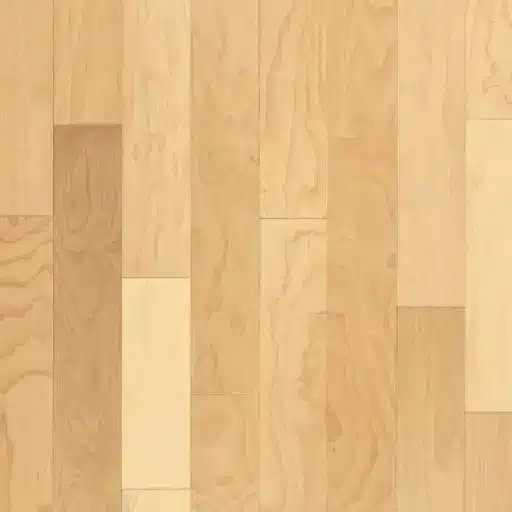
Sustainability is not a marketing line on a sports floor. It is a specification item, and it is often a project requirement.
Maple is a renewable North American species, harvested under forest management programs that replant and regenerate. Choosing FSC or PEFC certified supply lets a project document responsible sourcing, and the Forest Stewardship Council certification is the most widely recognized standard for that claim.
Indoor air quality matters just as much in a gym, where athletes breathe hard and ventilation is a design constraint. Specify low-VOC water-based finishes and products that meet FloorScore and CARB/EPA TSCA requirements. A maple floor built from hard maple veneer and finished with water-based chemistry can contribute to LEED credits while keeping the air clean for the people who use the facility every day. That is a genuine advantage over solvent-heavy alternatives, and it belongs in the spec.
How to Specify a Maple Sports Floor
Use this checklist to move from “we need a gym floor” to a defensible specification.
- Define the activities. Basketball, volleyball, and multipurpose use point to different performance profiles.
- Choose the subfloor system. Match the system to the primary activity and the available slab depression.
- Select the grade. Decide whether you are buying appearance or value, and specify the grade in writing.
- Confirm the species. Require documented northern hard maple (Acer saccharum).
- Specify the finish. Low-VOC water-based, with a defined gloss and slip rating.
- Plan humidity control. Set a year-round target of 35% to 50% relative humidity.
- Require an experienced installer. MFMA maintains an accredited installer program and publishes guide specifications.
- Agree on the maintenance schedule. Write down the recoat and resurface cycle before the floor is installed.
Questions to Ask Your Supplier
Before you sign, ask which grade and species they are quoting, which subfloor system the price includes, whether the finish meets FloorScore, and what maintenance plan they recommend for the first five years. A supplier who can answer all four clearly is a supplier you can build on.
FAQ About Maple Sports Flooring
What is maple sports flooring made of?
Maple sports flooring is made from northern hard maple (Acer saccharum) milled to MFMA tolerances, installed over an engineered subfloor system with a vapor barrier, sleepers, and resilient pads. The system, not the wood alone, delivers the performance.
What grade of maple is used for sports floors?
Second & Better grade is the most commonly specified grade for high school and college gyms. First Grade is reserved for pro arenas and showcase courts, while Third Grade serves recreation centers and value-driven projects. Grade affects appearance and price, not performance.
How much does a maple gym floor cost per square foot?
Installed maple sports flooring typically costs $8 to $22 per square foot. Competition-grade installs run $13 to $20, area-elastic systems $15 to $24, and combined area and point elastic builds $22 to $32. Grade, system, and site conditions drive the final number.
How long does a maple gym floor last?
A well-maintained maple floor serves 40 to 80+ years. Recoat annually in heavy-use facilities and plan a full resurface every 8 to 10 years. Humidity control between 35% and 50% is the single biggest factor in longevity.
How many times can a maple sports floor be refinished?
A solid 25/32-inch maple floor has enough thickness for many resurface cycles over its life. The limit comes from how much material a sanding removes, which is why resurfacing on schedule matters more than resurfacing often. Thin engineered systems refinish fewer times, and some cannot be sanded at all.
Is maple or synthetic better for a gymnasium?
Choose maple for dedicated competition courts where ball response, refinishability, and tradition matter. Choose synthetic for genuinely multipurpose gyms that host frequent non-athletic events. Synthetic wins on first cost; maple often wins on cost per year.
Can engineered maple be used in a gym?
Engineered maple is more common in multi-use spaces, studios, and constrained retrofits than in competition courts. It is stable and can fit limited slab depressions, but verify the wear-layer thickness against your expected resurface needs before specifying it.
Conclusion
Maple sports flooring has held the competition standard for over a century for reasons that have nothing to do with tradition alone. Northern hard maple is dense, uniform, and light, and when it sits on the right subfloor system, it delivers ball response and shock absorption that other surfaces struggle to match.
The decisions that matter are straightforward. Confirm the species and insist on documented hard maple. Choose the grade for appearance and budget, not performance. Match the subfloor system to the activities and the building. Plan humidity control and a recoat schedule from day one. Get those four things right, and you are specifying a floor that will serve a community for decades.
Ready to move from research to a real quote? Contact our team with your facility type, square footage, and target grade. We supply MFMA-grade hard maple and can help you build a specification that holds up in a bid room and on a court for the next 40 years.