
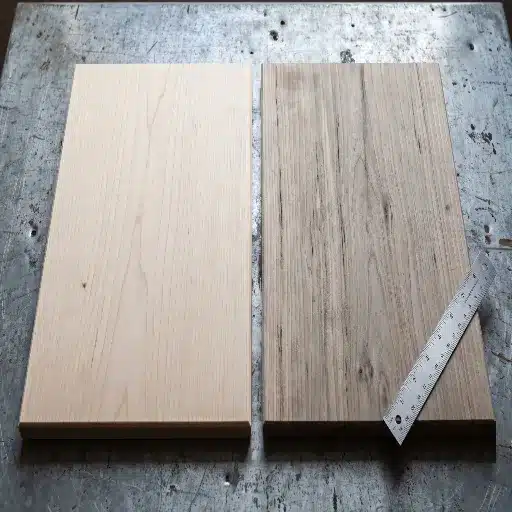
Hard Maple Vs Soft Maple Flooring: What’s The Real Difference?
Hard maple vs soft maple flooring comes down to one simple fact: they are two different woods sold under one confusing name. Hard maple is sugar maple (Acer saccharum), and it scores about 1,450 on the Janka hardness scale. Soft maple is a trade label covering four species, red, silver, boxelder, and bigleaf maple, that range from roughly 700 to 950 Janka. For flooring, you almost always want hard maple, and it usually costs 15 to 25% more.
That answer is where most articles stop, and it leaves you unable to tell which wood is in the showroom or on the quote in front of you.
Lena found that out the hard way. In March 2025 she bought 900 square feet of “maple” flooring for a rental property, at roughly $2.40 per square foot less than the hard maple she’d priced the month before. Eleven months later, every chair leg in the dining room had left a dent in the floor. Her installer took one look and said what she hadn’t been told: it was red maple, a soft maple, and it was never meant for a dining room.
We’ve spent years sourcing and manufacturing maple products, so we’ve watched that conversation play out many times. You already know maple is a good, hard, light-colored floor, that part is true. What we’ll show you here is how the two maple categories actually differ in wood-science terms, where each one genuinely earns its place, and exactly how to verify the species before you pay for it.
Key Takeaways
- Hard maple = sugar maple (Acer saccharum) at ~1,450 Janka. Soft maple is a trade label, not one tree, red maple ~950, silver maple ~700.
- The Janka gap of roughly 500 points is large enough to change how a floor performs, but it measures dent resistance, not whether the finish will scratch.
- Soft maple can be a legitimate floor in bedrooms and home offices. It is a poor choice for kitchens, entryways, and stairs.
- Soft maple actually has better dimensional stability than hard maple, the one category where it beats the premium species.
- Almost all flooring sold as “maple” is hard maple. Your job is to confirm Acer saccharum on the spec sheet, not to trust the word “maple.”
Hard Maple vs Soft Maple Flooring at a Glance
| Attribute | Hard Maple | Soft Maple |
|---|---|---|
| Species | Sugar maple (Acer saccharum), black maple (Acer nigrum) | Red maple, silver maple, boxelder, bigleaf maple |
| Janka hardness | ~1,450 lbf | ~700–950 lbf (red maple ~950; silver maple ~700) |
| Specific gravity | ~0.63 | ~0.54 |
| Color | Pale, creamy, near-white; uniform | More variation; gray, brown, and reddish streaks |
| Grain | Fine, tight, straight | More irregular and wandering |
| Dimensional stability | Good | Better, lower tangential shrinkage |
| Stain behavior | Prone to blotching | Slightly more forgiving, still blotch-prone |
| Workability | Harder on blades; may need pre-drilling | Easier to cut, sand, and install |
| Relative cost | Baseline | ~15–25% lower |
| Best use | High-traffic floors, sports courts, commercial | Low-traffic bedrooms and home offices |
What Is the Difference Between Hard Maple and Soft Maple?
The difference between hard maple and soft maple flooring comes down to botany, not marketing. “Hard” and “soft” describe two separate groups of maple trees whose wood happens to look similar in a plank but behaves very differently underfoot.
Hard Maple Is One Botanical Family
Hard maple refers to sugar maple (Acer saccharum) and its close relative black maple (Acer nigrum). At roughly 1,450 Janka and a specific gravity near 0.63, it sits among the hardest domestic hardwoods, harder than white oak (1,360) and red oak (1,290).
This is the wood behind the maple lumber you’ve seen in cutting boards, butcher blocks, and basketball courts. The Maple Flooring Manufacturers Association (MFMA) states that all maple flooring produced to its standard is made exclusively from sugar maple. When a supplier says “Northern Hard Maple,” that’s the grade system they mean.
Soft Maple Is a Trade Label, Not a Species
“Soft maple” is a commercial category, and that’s the single most important thing to understand about it. It covers four distinct trees:
- Red maple (Acer rubrum), around 950 Janka
- Silver maple (Acer saccharinum), around 700 Janka, the softest of the group
- Boxelder (Acer negundo)
- Bigleaf maple (Acer macrophyllum), the West Coast species
Because it’s a label rather than a species, the hardness range is wide. That’s why you’ll see soft maple quoted at 700 in one place and 1,000 in another. Both numbers can be right, depending on which tree the mill was cutting.
Why the Names Are Misleading
Here’s the part that rarely gets said plainly: soft maple is still a hardwood. It is not a softwood, and it is not comparable to pine or poplar. Red maple at ~950 Janka is roughly equal to American cherry, a species sold as premium flooring every day, and yellow poplar, also sold as flooring, sits at 540. So when a manufacturer says soft maple is “not recommended for flooring,” the honest translation is “not recommended for high-traffic flooring,” not “this will fall apart under your feet.” Treat the label as a caution flag, not a verdict.
This is also the key to the red maple vs sugar maple question. Sugar maple is hard maple, and red maple is soft maple, so that comparison is really the same decision you’re reading about here.
Hardness and Durability: The Janka Gap in Practice
The Janka test measures the force required to embed a steel ball halfway into a wood sample. It’s the industry’s shorthand for dent resistance, and the two maple categories sit far apart on it, as the National Wood Flooring Association hardness charts show.
Reading the Numbers
| Wood | Janka Hardness (lbf) |
|---|---|
| Hard maple | ~1,450 |
| White oak | ~1,360 |
| Red oak | ~1,290 |
| Red maple (soft) | ~950 |
| American cherry | ~950 |
| Silver maple (soft) | ~700 |
| Yellow poplar | ~540 |
A 500-point gap between hard maple and red maple is meaningful. It’s the difference between a floor that shrugs off dog claws and dining chairs and one that collects dents in a busy room.
Worth noting: hard maple is only about 90 points harder than white oak. If your choice is hard maple versus white oak, hardness is close to a tie, and the decision should turn on appearance and stain behavior instead. Our guide to maple vs oak flooring walks through that comparison in detail.
What Janka Does and Doesn’t Measure
This is where a lot of buying decisions go wrong. Janka measures resistance to denting; it does not measure how well a finish resists scratching, and it says nothing about how visible a scratch will be once it happens. A hard maple floor with a soft finish will scratch, while a red maple floor with a tough, modern finish layer can outperform it. That’s why the wear layer and finish chemistry matter as much as the species.
Why Hard Maple Owns Sports Floors
Look at a gymnasium if you want proof of what hard maple can take. It is the standard surface for basketball courts and athletic facilities across North America, specified under MFMA grading as “Northern Hard Maple.” Those floors absorb decades of running, pivoting, and impact, then get sanded and refinished rather than replaced. No soft maple product is specified for that job, a useful sanity check when you weigh whether the 15 to 25% premium is worth it.
Appearance: Color, Grain, and Finish
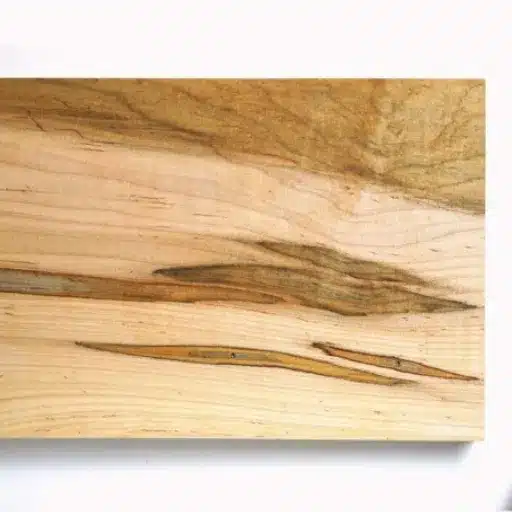
Hardness decides how a maple floor wears. Appearance decides whether you’ll still like it in ten years.
Hard Maple’s Look
Hard maple is pale, creamy, and near-white, with a fine, tight, straight grain that reads as clean and quiet. It pairs naturally with modern, minimalist, and Scandinavian interiors. One caveat: maple slowly darkens under UV exposure and oil-based finishes, shifting toward honey over time. That’s not a defect, but it’s a surprise if nobody warned you.
Soft Maple’s Look
Soft maple shows noticeably more variation. You’ll see gray, brown, and reddish streaks, plus a grain that wanders more than hard maple’s. Depending on your taste, that reads as either character or inconsistency.
For a clear, uniform, natural finish, hard maple wins comfortably. For a floor where variation is welcome, soft maple’s look can be an advantage rather than a compromise.
Staining, Finishing, and Color Change
Both maple types share maple’s most notorious finishing problem: blotching. Maple has a dense, diffuse-porous grain that absorbs stain unevenly, so pigment grabs in some areas and skips others. Soft maple is marginally more forgiving, but neither is an easy species to stain.
The practical answer is that maple is usually best left natural or treated with a light dye and a clear topcoat. If you’re set on a stained look, a pre-stain conditioner, gel or dye stains, and a test board are not optional. And if you want the fuller picture on maple’s trade-offs before you commit, our honest guide to maple wood flooring pros and cons covers the maintenance burden and color change in depth.
Can You Use Soft Maple for Flooring?
Yes, with limits. Soft maple is a real hardwood that will serve you well in the right room and disappoint you in the wrong one.
Where Soft Maple Works
Red maple at ~950 Janka is a reasonable floor for bedrooms, home offices, closets, and low-traffic hallways. Foot traffic there is light, furniture rarely moves, and the occasional dropped object is unlikely to leave a mark you’ll notice. If you want the maple look on a tighter budget, this is where that trade makes sense.
Where It Doesn’t
Skip soft maple for kitchens, entryways, staircases, playrooms, and homes with large dogs. Those rooms concentrate the forces soft maple handles worst: point loads from chair legs, tracked-in grit, and repeated impact.
Silver maple deserves special caution. At ~700 Janka it is the softest option in the group and the one most likely to show wear quickly.
What Manufacturers Actually Sell
Here’s the reassuring part. Because hard maple is what buyers expect, the overwhelming majority of flooring sold simply as “maple” is hard maple. Soft maple usually enters the market explicitly labeled, as “red maple flooring,” or as a cheaper, unlabeled product. So the risk isn’t that you’ll accidentally buy soft maple; it’s that a mislabeled or vaguely described product will be sold to you at a hard maple price.
Dimensional Stability: The One Place Soft Maple Wins
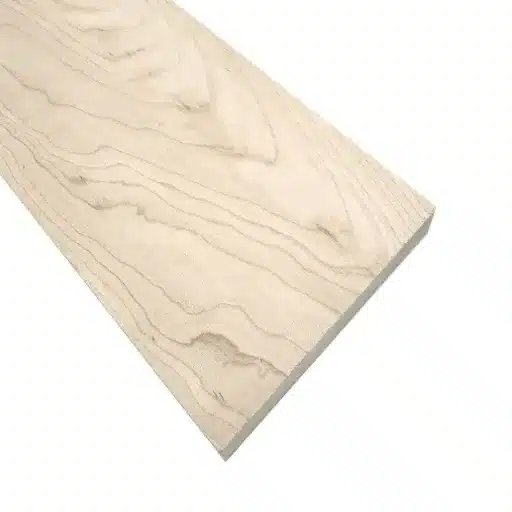
Every article about maple tells you hard maple is better. On one measure, that’s wrong.
Published shrinkage data place hard maple’s tangential shrinkage near 10%, while soft maple’s runs closer to 7 to 8%. Lower shrinkage means less seasonal movement, so the floor expands and contracts less as indoor humidity swings from summer to winter. In a climate with real humidity swings, that makes soft maple less prone to the warping and twisting that can afflict a solid floor.
Two caveats keep this in proportion. The gap is small enough that it rarely decides a purchase on its own, and acclimation, subfloor preparation, and humidity control matter far more than the difference between these two species.
Engineered Maple: Where the Species Question Hides
If you’re buying engineered maple flooring, the species question changes shape entirely. There’s no single board to inspect, the maple you’re paying for is a thin layer on top of something else.
The Wear Layer Is the Floor
Engineered maple is a real maple veneer bonded to a cross-laminated plywood or high-density fiberboard (HDF) core. The veneer, the wear layer, is what you see, walk on, and eventually sand; the core holds the board flat. The species lives in the wear layer. A 2 to 6 mm maple veneer over a stable core is real maple flooring, while a printed or paper-thin surface is not, no matter what the box says.
What to Demand on a Spec Sheet
When you request engineered maple, ask for the species by name in writing:
- “Acer saccharum” or “Northern Hard Maple”, not just “maple”
- Wear layer of 3–4 mm or thicker if you want refinishing headroom
- Core material, plywood or HDF, stated explicitly
- MFMA grade, if the supplier is claiming a flooring-grade standard
If a supplier can’t or won’t put the botanical name on the quote, treat that as your answer. If you’d like the full breakdown of veneer thickness against lifespan, our guide to engineered maple vs solid maple covers the construction and cost differences side by side.
HDF Cores and Refinishing Limits
Core type quietly determines what happens years from now. A plywood core can be sanded along with its wear layer. Many HDF-core products cannot be sanded at all and support only a screen-and-recoat.
Practically, that means a 2 mm wear layer buys you roughly one careful refinish, 3–4 mm supports two to three, and an HDF core with a thin veneer supports none. The full limitations are covered in our guide to refinishing maple floors.
How to Tell Hard Maple from Soft Maple
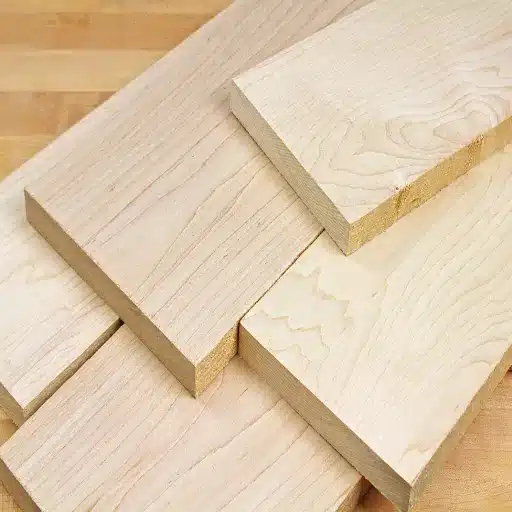
If you’re trying to identify wood you already own, or verify a sample, you have five field tests. None is perfect alone, but together they’re reliable.
- Fingernail or nail test. Press a nail into an inconspicuous spot. Soft maple dents relatively easily; hard maple resists or barely marks. Treat this as a clue, not proof, soft maple can still resist a thumbnail.
- Check the weight and density. Hard maple is noticeably heavier. Specific gravity averages ~0.63 versus ~0.54 for soft maple, with roughly 0.55 as the practical dividing line.
- Look at the end grain. Under about 10x magnification, hard maple shows two distinctly different ray widths. Soft maple shows only one. This is the most reliable visual test.
- Try the ferrous sulfate test. A ferrous sulfate solution turns soft maple a translucent blue-black and hard maple a greenish-gray. It requires a scrap piece and a hidden spot.
- Listen and watch your tools. Hard maple taps with a ring; soft maple thuds. Soft maple also tends to fuzz or tear out when machined, while hard maple planes cleanly.
When Ray, a flooring contractor we work with, took on a 1960s restoration last year, the homeowner was certain the original floors were hard maple. The nail test suggested otherwise, but the end-grain check settled it in under a minute: single ray width, soft maple, original to the house. Ray adjusted his sanding schedule, quoted accordingly, and the homeowner walked in knowing exactly what was underfoot.
For installed floors, the honest shortcut is this: read the spec sheet, not the floor. If no documentation exists, an end-grain check from a hidden area is your best evidence.
Hard Maple vs Soft Maple Flooring Cost
Soft maple typically runs 15 to 25% less than hard maple. That gap is driven by hard maple’s slower growth, lower usable yield, and heavy demand from commercial and athletic buyers.
| Product | Material (per sq ft) | Installed (per sq ft) |
|---|---|---|
| Solid red maple (soft) | ~$3–$8 | ~$6–$14 |
| Solid hard maple | ~$4–$12 | ~$8–$19 |
| Engineered hard maple | ~$3.50–$10 | ~$6–$15 |
These are typical U.S. ranges. Region, grade, plank width, and finish all shift them, sometimes substantially.
Two things to watch. First, a price far below the soft maple range usually means the product isn’t solid maple at all. Second, “hard maple at a soft maple price” is the exact scenario worth questioning.
Sustainability and Sourcing
Both maple categories are temperate North American hardwoods, and both are widely available under Forest Stewardship Council (FSC) and PEFC certification. Maple’s fast growth and strong regeneration make it one of the more sustainable domestic hardwood choices.
There is also a materials-efficiency argument for engineered maple. A thin maple veneer over a stable core uses far less premium hardwood per square foot than a solid 3/4″ board, and if you want the maple look while stretching the resource further, engineered construction is the more efficient path. You can see the range of maple surfaces we produce on our real maple veneer page.
We also verify species on incoming stock rather than trusting a supplier’s label, the only way to guarantee that a spec sheet saying Acer saccharum actually delivers it.
Hard Maple vs Soft Maple: Which Should You Choose?
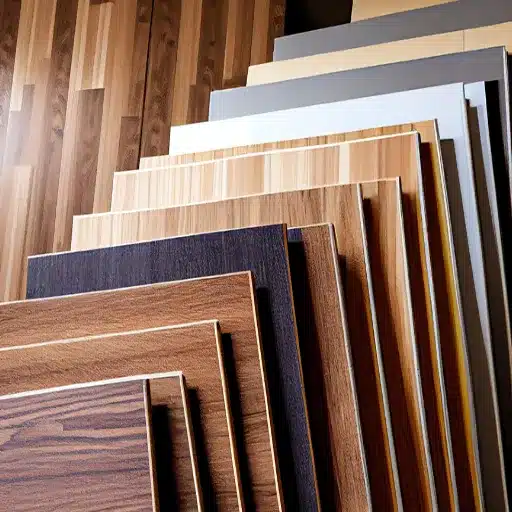
Choose hard maple if you:
- Have kids, dogs, or heavy foot traffic
- Are flooring a kitchen, entryway, or staircase
- Plan to refinish the floor more than once over its life
- Want the standard used in gymnasiums and sports courts
- Want a uniform, pale, modern look
Choose soft maple if you:
- Are flooring a bedroom, home office, or low-traffic room
- Are working to a tight budget and want the maple aesthetic
- Actually want more color and grain variation
- Have confirmed the species is red maple, not silver maple
The single most useful step is the least glamorous one: get the botanical name in writing before you order. It takes one email and it settles the entire question.
FAQ About Hard Maple and Soft Maple Flooring
Is soft maple good for flooring?
Yes, in the right room. Red maple at ~950 Janka is a legitimate floor for bedrooms, home offices, and low-traffic hallways. It’s a poor choice for kitchens, entryways, or stairs, where concentrated impact and grit will show.
Is soft maple harder than oak?
No. Soft maple runs ~700–950 Janka, while red oak is ~1,290 and white oak is ~1,360. Even hard maple (1,450) beats white oak only by about 90 points.
Is red maple the same as soft maple?
Red maple is one of four species sold under the soft maple label. At ~950 Janka it’s the hardest and the most viable soft maple option for flooring.
How can you tell hard maple from soft maple?
Check the end grain under magnification (hard maple shows two ray widths, soft maple one), compare density against a specific gravity of ~0.55, or use a ferrous sulfate solution, which turns soft maple blue-black.
Does soft maple dent easily?
It dents more easily than hard maple. The roughly 500-point Janka gap means furniture legs, pet claws, and dropped objects will mark soft maple where hard maple holds up.
Is hard maple worth the extra cost?
In high-traffic rooms, usually yes. The 15–25% premium buys meaningfully better dent resistance. In a spare bedroom, it’s harder to justify, soft maple will serve you just as well for less.
Conclusion
Hard maple vs soft maple flooring is not a choice between two grades of the same wood. They’re two groups of trees sold under one convenient label, and the difference between them, roughly 1,450 Janka versus 700 to 950, changes how a floor ages in your home.
The short version: hard maple (sugar maple, Acer saccharum) is the high-traffic choice and the sports-floor standard. Soft maple is a legitimate hardwood that belongs in low-traffic rooms, costs 15 to 25% less, and holds one genuine engineering advantage in dimensional stability. Neither is a mistake; buying the wrong one for the room is.
Before you order, ask for the botanical name and the wear-layer thickness in writing, solid or engineered. That one step prevents the situation Lena walked into.
Not sure which maple fits your project? Contact our team for species verification, samples, or a wholesale quote. We’ll tell you honestly which one your room actually needs.