
Custom Wood Veneer Manufacturing: Capabilities, Services & How to Specify (2026 Guide)
Custom wood veneer manufacturing is the production of veneer sheets and panels to exact project specifications — including species selection, cut type, dimensions, grain matching, substrate pairing, and surface finish — rather than pulling from standard stock inventory. The best manufacturers combine hand-selection of flitches, precision slicing, sequenced matching, and in-house pressing to deliver visually consistent surfaces across large architectural installations.
If you have ever walked into a corporate lobby where a forty-foot walnut feature wall flows with uninterrupted grain from floor to ceiling, you have experienced custom veneer manufacturing at its finest. That level of visual continuity does not happen by accident. It requires a manufacturer who controls every variable from log selection through final inspection, and who understands that “custom” means more than non-standard dimensions. It means predictable beauty at scale.
Most procurement teams and architects understand what veneer is. Far fewer know how to evaluate whether a manufacturer can actually deliver the custom capabilities their project demands. The gap between a stock veneer supplier and a true custom manufacturing partner is significant, and choosing the wrong one can leave you with mismatched panels, blown lead times, and change orders that erase your margin.
In this guide, you will learn exactly what custom wood veneer manufacturing includes, how the custom order workflow moves from specification to delivery, and what capabilities separate premium manufacturers from commodity suppliers. By the end, you will know how to specify custom veneer with confidence and ask the right questions before signing a purchase order.
When Elena Vasquez, the Miami project architect, specified rift-cut white oak for a twelve-story hospitality project, her initial supplier assured her they could “handle custom.” Three months later, the first delivery arrived with panels that looked like they came from three different forests. The grain patterns clashed, the color shifted between boxes, and the bookmatched sequences were broken. Her contractor stopped the installation. She switched to a manufacturer with documented flitch sequencing, locked master samples, and in-house pressing. The replacement panels arrived in numbered installation sequence, and the feature walls matched perfectly from lobby to penthouse. “The difference,” she told her team, “was not the species or the cut. It was whether the manufacturer actually had custom capabilities or was just relabeling stock.”
Key Takeaways
- Custom wood veneer manufacturing goes beyond non-standard dimensions to include species selection, cut customization, grain sequencing, substrate pairing, and bespoke finishing.
- Flitch sequencing and project-level matching are the defining capabilities that separate true custom manufacturers from stock resellers.
- MOQs range from 500–800 m² for private-label modifications to 2,000 m²+ for full OEM custom runs, with lead times from 30 to 60 days depending on complexity.
- 2026 technology including CNC precision slicing, AI-powered optical grading, and digital printing is expanding what custom veneer can achieve.
- Engineered or reconstituted veneer offers unlimited color and pattern consistency without harvesting rare or endangered species.
What Is Custom Wood Veneer Manufacturing?
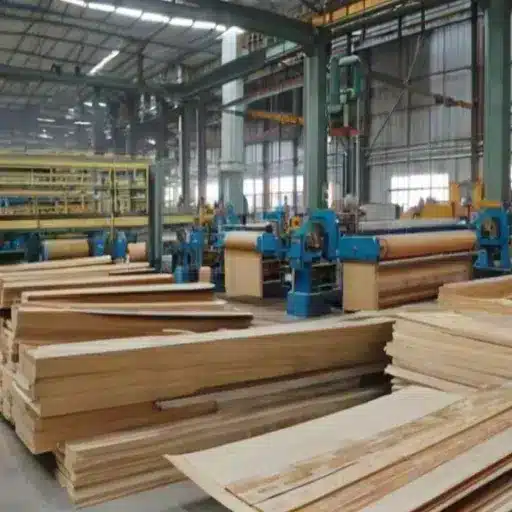
Custom wood veneer manufacturing is the production of veneer to specifications that go beyond standard stock offerings. While standard veneer is sliced from commonly available species in standard thicknesses and dimensions, custom manufacturing gives you control over every variable that affects the final appearance and performance of the material.
The scope of customization typically includes species selection, slicing method, thickness, width, and length, grain matching type, substrate pairing, surface finish, and performance ratings such as fire classification or acoustic backing. A true custom manufacturer does not simply cut stock sheets to size. They select specific logs, sequence slices from the same flitch, and manage color and grain continuity across hundreds of panels.
This distinction matters because many suppliers use the word “custom” loosely. Ordering a non-standard sheet size from a stock catalog is not custom manufacturing. True custom work begins at the log yard, where the manufacturer selects timber based on your project’s visual requirements, not on what happens to be available in the warehouse.
For commercial specifiers, understanding this distinction is essential. When your project requires visual continuity across a large surface, or when you need a specific species, figure, or color that stock suppliers do not carry, only a manufacturer with genuine custom capabilities can deliver. For a broader view of how to evaluate manufacturing partners, our complete guide to choosing a wood veneer manufacturer breaks down exactly what to look for in a production partner.
Core Custom Capabilities: What Manufacturers Can Deliver
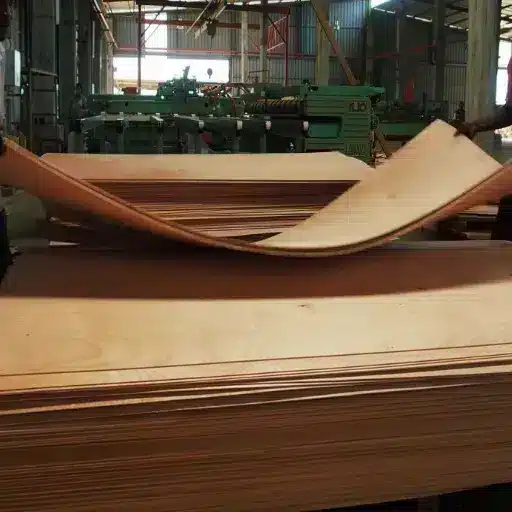
Not every veneer manufacturer offers the same custom services. Understanding the full range of capabilities helps you specify accurately and evaluate whether a potential partner can meet your project’s demands.
Species Selection and Sourcing
Custom manufacturing begins with the ability to source and specify the exact species your project requires. Premium manufacturers maintain relationships with log suppliers across multiple continents, giving them access to domestic hardwoods like oak, maple, cherry, and walnut, as well as exotic species like teak, zebrawood, and figured burls.
Increasingly, custom manufacturers also offer engineered or reconstituted species. These products are manufactured from fast-growing renewable species like poplar and ayous, then dyed and pressed to replicate the appearance of rare or endangered hardwoods. The result is visually consistent, highly sustainable, and frees your project from the supply constraints and ethical concerns of harvesting old-growth exotic timber.
FSC-certified custom sourcing is also available from responsible manufacturers. When you specify certified species for a custom run, the chain of custody documentation follows that specific batch from the forest through every production phase to your site. This matters for LEED credits, corporate sustainability reporting, and client conversations about environmental responsibility.
Slicing and Cut Customization
The slicing method determines the grain pattern, visual character, and yield of the finished veneer. Custom manufacturers offer all four primary cutting methods to specification:
| Cut Type | Grain Pattern | Best For | Yield |
|---|---|---|---|
| Rotary | Broad, swirling, varied | Large commercial surfaces, plywood cores | ~90% |
| Flat (Plain) | Cathedral or crown figure | High-end furniture, architectural panels | ~70–80% |
| Quarter | Tight, straight, parallel lines | Modern minimalist designs | ~70% |
| Rift | Consistent straight grain, minimal fleck | Luxury contemporary interiors | ~65% |
Custom manufacturers can also produce non-standard thicknesses. While standard decorative veneer is typically 0.3 to 0.6 millimeters, custom capabilities extend from ultra-thin 0.2 millimeter sheets for lightweight applications up to 5.0 millimeter architectural panels requiring extra durability. Width and length can also be specified beyond standard sheet dimensions, with some manufacturers producing continuous sheets up to 3,400 millimeters or longer for seamless large-format installations.
Matching and Sequencing Services
This is where true custom manufacturing separates itself from stock supply. Matching and sequencing ensure visual continuity across multiple panels, and there are several techniques a custom manufacturer should offer:
- Book matching: Alternating sheets are flipped like pages in a book, creating symmetrical mirror images. This is the classic choice for dramatic feature walls and reception desks.
- Slip matching: Sheets are laid side by side in sequence without flipping. This produces a more uniform, repetitive grain that works well for large contemporary surfaces.
- Random matching: Sheets are assembled without intentional sequence, creating a natural, varied appearance suitable for rustic or casual designs.
- Flitch sequencing: The most critical custom capability. The manufacturer maintains the exact order in which sheets were sliced from the same log, ensuring that adjacent panels came from adjacent slices. This preserves color and grain continuity across large installations.
For large commercial projects, flitch sequencing is non-negotiable. Without it, you risk visible shifts in color and grain where one panel ends, and the next begins. A premium custom manufacturer will catalog every flitch upon arrival, review length, width, grain orientation, and color, and create master samples that become the locked standard for the entire production run.
Splicing, Layup, and Panel Fabrication
Individual veneer leaves are rarely large enough to cover a standard panel on their own. Custom manufacturers offer in-house splicing and layup services that join multiple leaves into full-size faces. Advanced facilities use cross-feed and longitudinal splicers with double guillotines to create precise edges and seamless joints.
Custom panel fabrication includes pressing veneer onto substrates of your specification. Common options include FSC-certified plywood, recycled-content MDF, moisture-resistant particleboard, lightweight honeycomb cores for large installations, and fire-retardant or bendable specialty cores. The substrate choice depends on the application: plywood offers structural strength for cabinetry, MDF provides a smooth surface ideal for painted or lacquered finishes, and honeycomb cores reduce weight for ceiling panels or oversized wall installations.
Some manufacturers also offer curved and formed panel capabilities, wrapping veneer over concave, convex, and compound curves without telegraphing joints or cracking the face. This is essential for branded environments, hospitality interiors, and architectural millwork with non-planar surfaces.
Finishing and Surface Treatment
Custom finishing transforms raw veneer into a finished product ready for installation. Capabilities typically include:
- Custom staining and dyeing: Color matching to specific standards or existing materials
- Smoking and fuming: Ammonia-based darkening that reacts with natural tannins for deep, rich tones without added pigments
- UV-cured coatings: Instant hardening under ultraviolet light for durability and consistency
- Water-based and low-VOC lacquers: Meeting LEED, BREEAM, and WELL certification requirements
- Textured surfaces: Wire-brushed, sandblasted, or hand-scraped finishes for tactile interest
- Digital printing and laser engraving: Custom patterns, brand elements, or intricate designs applied directly to real wood surfaces
The finishing phase is where custom orders lock in their final appearance. A responsible manufacturer will produce finished samples for your approval before applying the treatment to the full production run, ensuring the color and sheen match your design intent under actual project lighting conditions.
Quality Control for Custom Orders
Custom manufacturing demands a higher standard of quality control than stock production. Key QC capabilities include:
- Master sample locking: An approved sample becomes the immutable standard against which every panel is measured
- Automated optical grading: Machine vision systems detect defects, measure color uniformity, and flag thickness variations with precision down to 0.1 millimeters
- Batch documentation: Every custom run carries traceable batch IDs, production parameters, and QC reports
- Mid-production sample pulls: For large orders, manufacturers pull samples from the beginning, middle, and end of the run to confirm consistency
When a design-build firm in Seattle ordered rift-cut white oak for a corporate headquarters, their supplier maintained detailed production records and retained matching flitches from the original run. Nine months later, when the project resumed after a construction delay, the additional 200 panels were visually indistinguishable from the first batch. That level of consistency is only possible when the manufacturer has robust QC systems and documented custom production parameters.
The Custom Order Workflow: From Specification to Delivery
Understanding how a custom order moves from concept to delivery helps you plan timelines, set expectations with stakeholders, and avoid surprises.
Step 1: Project Brief and Technical Specification
The process begins with a detailed brief that defines every variable. A complete specification typically includes:
- Species and cut type
- Target dimensions (thickness, width, length)
- Matching type (book, slip, random, flitch-sequenced)
- Substrate type and performance requirements
- Finish specification (clear, stained, textured)
- Performance ratings (fire class, acoustic NRC, moisture resistance)
- Quantity and installation sequence requirements
The more detailed your brief, the more accurate the manufacturer’s quote and the fewer surprises during production. Vague specifications lead to assumptions, and assumptions lead to mismatches.
Step 2: Sample Request and Approval
Before any production begins, the manufacturer produces A-grade samples or mockup panels for your approval. This is a critical checkpoint. Samples should represent the exact species, cut, finish, and substrate specified. For large projects, some manufacturers produce full-scale mockups that can be reviewed under project lighting conditions.
Once approved, the master sample is locked. It becomes the standard against which the entire production run is measured. Typical sample lead time is 5 to 10 working days, depending on species availability and finishing complexity.
Step 3: Production and In-Process Quality Control
Production follows the standard veneer manufacturing process — log selection, steaming, slicing, drying, grading, splicing, pressing, and finishing — but with the additional controls required for custom work. Flitches are selected based on the approved master sample, slices are sequenced to maintain continuity, and mid-production pulls confirm that color and grain remain within tolerance.
The underlying manufacturing process follows seven distinct phases — log selection, steaming, slicing, drying, grading, splicing, pressing, and finishing — with the additional controls required for custom work layered on top of each step.
Step 4: Final Inspection and Protective Packaging
After finishing, every panel undergoes a final inspection against the locked master sample. Panels are then bundled in installation sequence — a critical detail for large projects. If your installation plan calls for panel A-1 followed by A-2 followed by B-1, the manufacturer should package and label them in that exact order.
Protective wrapping prevents surface damage during transit. For sequenced custom orders, climate-controlled packaging maintains moisture stability so panels arrive in the same condition they left the factory.
Step 5: Delivery and Installation Support
Custom orders should arrive ready for installation, with clear labeling, batch documentation, and chain of custody certificates where applicable. Some manufacturers offer installation support, including substrate preparation guidance, adhesive selection recommendations, and on-site consultation for complex applications.
MOQs, Lead Times, and Bulk Specifications
Understanding minimum order quantities and lead times helps you plan procurement timelines and budget realistically.
Minimum Order Quantities by Tier
The industry currently operates on a three-tier framework:
| Customization Level | MOQ | Description |
|---|---|---|
| Stock/Private Label | 500–800 m² | Modified finish or dimensions from existing stock |
| ODM Customization | 1,000–1,500 m² | Modified species, thickness, width, or finish |
| OEM Full Custom | 2,000 m²+ | Complete spec control from raw material to packaging |
For smaller projects, domestic custom shops often have no formal MOQ but charge significantly higher per-unit prices. Orders below standard MOQs may face premiums of 40% or more during peak seasons.
Lead Time Ranges (2026)
| Order Type | Lead Time |
|---|---|
| Samples only | 5–10 working days |
| Standard custom sizes | ~30 days |
| ODM modifications | 30–40 days |
| OEM full custom | 45–60 days |
| Complex architectural millwork (US-based) | 8–10 weeks |
Lead times vary based on species availability, sample approval cycles, finishing complexity, and shipping distance. Planning is essential. For phased construction projects, confirm whether your manufacturer can stage deliveries to align with your installation schedule. Understanding how supply chain logistics affect delivery is also critical — our wood veneer supply chain guide covers lead times, shipping protocols, and disruption mitigation in detail.
Bulk Specification Parameters
- Standard sheet size: 1,220 × 2,440 mm (4 × 8 feet)
- Custom lengths: Up to 3,400 mm+ available
- Thickness range: 0.2 mm to 5.0 mm, depending on application
- Moisture content: 6–12% (custom-specified for destination climate zone)
- Backing options: Paper, poly, phenolic, fleece, PSA, wood-on-wood
- Quality compliance: AWI standards, FSC/PEFC chain of custody, CARB P2 / TSCA Title VI emissions compliance
For a deeper dive into manufacturer pricing structures, volume discounts, and cost drivers, see our wood veneer manufacturer pricing guide.
Custom vs. Standard Veneer: When to Specify Each
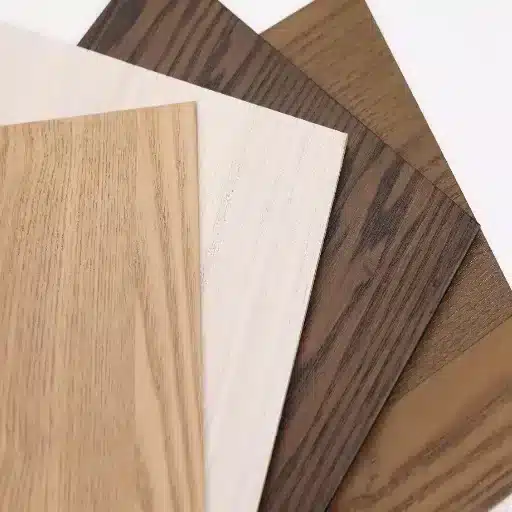
Not every project requires custom manufacturing. Understanding when custom is worth the investment helps you allocate budget effectively.
Specify standard veneer when:
- Cost sensitivity outweighs visual continuity requirements
- Surfaces are small or broken by openings, fixtures, or furniture
- The timeline is extremely tight, and the stock is immediately available
- The species and appearance in the standard inventory meet your design intent
Specify custom veneer when:
- Large feature walls or continuous surfaces require grain continuity
- Rare or specific species, figures, or colors are required
- Curved, formed, or non-planar surfaces are part of the design
- Brand-specific color matching is needed
- LEED or sustainability certifications require a documented chain of custody
- Phased construction demands batch consistency across months or years
The cost differential is significant but often justified. Custom orders typically carry a 20 to 40% premium over stock. For projects where visual impact drives client satisfaction — hospitality lobbies, corporate headquarters, luxury residential — that premium is a sound investment. For back-of-house areas, utility spaces, or projects where surfaces will be largely concealed, standard veneer is the pragmatic choice.
2026 Technology Expanding Custom Possibilities

The custom veneer industry is evolving rapidly. Several technologies are expanding what manufacturers can deliver:
CNC Precision Slicing
Computer numerical control systems govern slicing machinery with tolerances measured in hundredths of a millimeter. These systems adjust blade angles, feed rates, and pressure in real time based on wood-density sensors and preprogrammed species profiles. For custom orders, CNC precision means tighter tolerances on non-standard thicknesses and more consistent results across large production runs.
AI-Powered Optical Grading
Machine vision systems trained on millions of sheet images can classify defects, measure color uniformity, and predict structural issues faster than human inspectors. For custom manufacturing, AI grading ensures that every sheet in a sequenced run meets the same visual standard, reducing the risk of a single off-color sheet disrupting a feature wall.
Digital Printing on Veneer
High-resolution digital printing directly onto veneer substrates allows manufacturers to create custom designs, intricate patterns, and realistic replicas of endangered exotic species without harvesting restricted timber. For designers, this opens creative possibilities that were previously impossible or ethically problematic.
Laser Cutting and Marquetry
Laser technology enables intricate inlay designs, geometric patterns, and custom brand elements to be cut with sub-millimeter precision. This is increasingly used in corporate branded environments, hospitality features, and high-end residential millwork.
Reconstituted Veneer Engineering
Engineered veneer production has advanced to the point where manufacturers can create virtually any color, pattern, or grain structure from fast-growing renewable species. The segment is growing at 12-15% annually, driven by demand for consistency, sustainability, and freedom from constraints on rare-species supply.
Sustainability in Custom Veneer Manufacturing
Sustainability is not an afterthought in custom manufacturing. It is a specification option available at every stage.
FSC-certified custom orders include full chain of custody documentation that follows your specific batch from the certified forest through every production phase. This is essential for LEED Materials and Resources credits, corporate sustainability reporting, and client conversations about environmental responsibility.
Engineered or reconstituted veneer reduces pressure on old-growth forests by replicating rare appearances using fast-growing species like poplar and ayous. These products produce 18 to 35% lower carbon emissions than harvesting slow-growing exotic hardwoods.
Low-VOC adhesives and water-based finishes are increasingly standard in custom production lines. They eliminate formaldehyde emissions, improve indoor air quality, and meet the stringent requirements of LEED, BREEAM, and WELL certifications.
Material efficiency is another sustainability advantage. One cubic meter of log produces up to 2,000 square meters of usable veneer surface — roughly 40 times more than solid lumber. Custom cutting to exact project dimensions further reduces on-site waste by up to 40% compared to standard stock sizes.
When you specify sustainability in a custom order, you are not sacrificing performance or aesthetics. You are making a choice that aligns your project with the growing expectation that beautiful interiors should also be responsible ones.
Frequently Asked Questions About Custom Wood Veneer Manufacturing
What is the minimum order quantity for custom wood veneer?
MOQs vary by customization level. Stock or private-label modifications typically require 500 to 800 square meters. ODM customization with modified species, thickness, or finish starts at 1,000 to 1,500 square meters. Full OEM custom runs with complete specification control usually require 2,000 square meters or more. Domestic custom shops may accept smaller orders at higher per-unit prices.
How long does custom veneer manufacturing take?
Sample production takes 5 to 10 working days. Standard custom sizing ships in approximately 30 days. ODM modifications require 30 to 40 days. Full OEM custom runs take 45 to 60 days. Complex architectural millwork from US-based shops can require 8 to 10 weeks. Lead times depend on species availability, sample approval cycles, finishing complexity, and shipping distance.
Can manufacturers match grain across 50 or more panels?
Yes, but only manufacturers with flitch sequencing capabilities. The process involves slicing consecutive sheets from the same log, maintaining their exact order, and packaging them in installation sequence. Without flitch sequencing, color and grain variation between panels becomes visible. Always confirm that your manufacturer’s catalogs fit by project and can be delivered in numbered sequence.
What is the difference between book matching and slip matching?
Book matching flips alternating sheets like pages in a book, creating symmetrical mirror images across the joint. Slip matching slides consecutive sheets side by side without flipping, producing a more uniform, repetitive grain flow. Book matching is dramatic and formal. Slip matching is consistent and contemporary. The choice depends on your design intent and the scale of the installation.
Can custom veneer replicate rare or endangered species?
Engineered or reconstituted veneer can replicate the appearance of rare species using fast-growing, renewable timber as the base material. The wood fibers are dyed, layered, and re-sliced to create consistent sheets with designed patterns. This approach avoids the ethical and supply-chain issues of harvesting endangered hardwoods while delivering visual results that are often more uniform than natural alternatives.
What substrates can custom veneer be pressed onto?
Common substrates include MDF (smooth surface, cost-effective), plywood (structural stability, screw-holding strength), particleboard (budget-friendly for vertical applications), honeycomb core (lightweight for large installations), and specialty cores including fire-retardant, moisture-resistant, and bendable options. The right substrate depends on the application, structural requirements, and performance standards of your project.
Can custom veneer meet fire code requirements?
Yes. Custom veneer panels can be manufactured with fire-rated substrates and surface treatments to meet Class A, B, or C requirements under ASTM E84 or EN 13501-1 standards. Specify your fire rating requirement in the initial brief so the manufacturer can select appropriate core materials and finishing systems.
Conclusion
Custom wood veneer manufacturing is the bridge between a designer’s vision and a finished interior that delivers on that promise. It is not simply about non-standard dimensions or exotic species. It is about control over grain continuity, color consistency, substrate performance, and environmental credentials.
The manufacturers who excel in this space combine traditional craftsmanship with precision technology. They hand-select flitches, sequence every sheet, lock master samples, and document every batch. They offer engineered alternatives that expand creative possibilities without expanding environmental impact. And they understand that a custom order is not a transaction — it is a partnership that extends from specification through installation.
For architects, builders, and procurement professionals, the lesson is straightforward. Ask detailed questions before you sign. Confirm flitch sequencing, sample locking, in-house pressing, and batch documentation. Understand MOQs and lead times so your procurement schedule aligns with your construction timeline. And specify sustainability credentials at the outset so they are integrated into every phase of production, not added as an afterthought.
The next time your project calls for a veneer surface that must perform beautifully at scale, remember that the specification starts with choosing a manufacturer who can actually deliver custom, not just label stock differently. That choice will shape the aesthetics, durability, and sustainability story of your project for decades.
Ready to explore custom wood veneer manufacturing for your next project? Contact VitalWood Global to discuss your specifications, request samples, and receive a detailed project quote. We will walk you through every capability, every option, and every timeline to ensure your custom veneer meets your exacting standards.
Sources: