
Hickory Flooring Color Variation: Sapwood, Heartwood and Grades
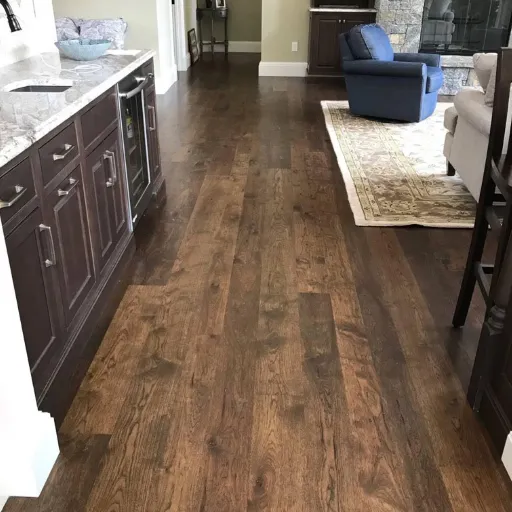
Hickory flooring color variation is the species itself, not a manufacturing flaw. Each board combines pale sapwood with darker heartwood, and the grade you buy decides how much of each the mill sorts into your boxes.
The NWFA/NOFMA unfinished flooring standard makes that plain. In the Select grade, the highest standard grade for hickory, “the natural color of the wood shall not be considered a defect.”
So the floor that surprised you is behaving as specified. The question is whether the specification was written down before you ordered.
This guide covers the mechanism, the grades, the standards language behind them, and a preview routine that catches the problem while changing the order is still free.
Key Takeaways
- Hickory’s color swing comes from heartwood and sapwood, and it’s wider than in any other common domestic flooring species.
- The NWFA/NOFMA Select grade explicitly admits heartwood and sapwood variation, so contrast alone isn’t grounds for a claim.
- Want a uniform hickory floor? Specify Clear Red (95% heartwood) or Clear White (95% bright sapwood), not “Select.”
- Grade names such as Natural, Character, and Rustic are proprietary. Heartwood and sapwood percentages are the comparable figure.
- Variation is controlled at the order: one lot, spare boxes, and a full-layout approval before release.
If you are choosing a grade now, request samples from a single lot and ask for a full-layout photo before you commit.
Why Hickory Flooring Color Varies So Much
Hickory grows a wide band of pale sapwood around a relatively small, dark heart. That proportion is unusual among North American hardwoods, and it’s the physical reason a hickory floor reads as mottled where an oak floor reads as even.
treats hickory as the stand-out exception in hardwood color sorting for exactly this reason: the sapwood band is so wide that it dominates the face of a finished board.
Sapwood and Heartwood: The Basic Mechanism
Sapwood is the living outer layer of the tree. It carries water and is pale by nature. Heartwood is the older, darker core, where extractives have accumulated over decades.
The National Wood Flooring Association describes hickory heartwood as “tan or reddish” and hickory sapwood as “white to cream, with fine brown lines.” Pecan, which mills routinely sell as hickory, runs “reddish brown with dark brown stripes” in the heartwood and “white or creamy white with pinkish tones” in the sapwood.
When boards from both zones land in the same room, the contrast is structural rather than incidental. It won’t sand out, and it won’t even out under a clear finish.
Springwood and Summerwood: Why One Board Is Two-Toned
Hickory also shows a sharp difference between the fast growth of spring and the dense latewood of summer. The NWFA notes “pronounced differentiations in color between spring wood and summer wood” in both hickory and pecan.
That is why a single plank can read as two colors along its own length. The dark band isn’t a stain or a defect. It’s the growth ring the board was cut across.
Mineral Streaks and What They Are
Mineral streaks are dark lines and blotches where the tree absorbed minerals from the soil. In hickory they often run blue-black or olive, and they sit alongside the heartwood and sapwood contrast rather than replacing it.
The standards treat them as a grade characteristic, not damage. Under the NWFA/NOFMA rules, Select hickory limits streaks to a quarter-inch wide and three inches long, one per three feet. No. 1 Common admits “numerous dark streaks or black spots.”
What Is Calico Hickory?
Calico hickory is flooring sorted from boards that show a roughly even split of cream sapwood and brown heartwood, commonly a 40/60 color split or greater. “Calico” is an informal trade description, not a formal grade.
The part buyers get backwards is the price. Because calico depends on sorting, and because only part of a production run qualifies, calico hickory usually costs more than ordinary hickory. It’s a selected look, not a cheaper one.
One trade source defines the threshold at a 40/60 split or better, and notes that calico commands a premium for exactly that reason. If a supplier offers you “calico” at a discount, ask what the sorting rule is.
Hickory Flooring Grades: What Each One Actually Allows
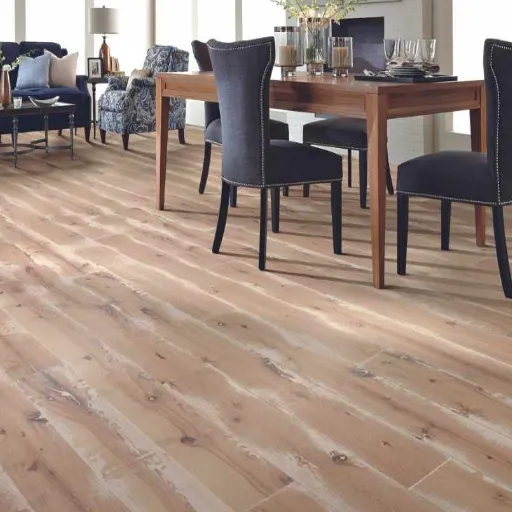
Most guides to hickory flooring color variation stop at “Select is calmer.” That’s true and almost useless. Here is what the published rules actually specify.
The Standard Grades: Select, No. 1 Common, No. 2 Common
The NWFA/NOFMA unfinished flooring standard defines three standard grades for hickory and pecan.
- Select. The highest standard grade. The face is “practically free of all defects,” but variation in natural color, heartwood, and sapwood is admitted. Knots, streaks, and checks are tightly limited.
- No. 1 Common. A floor with “varying wood characteristics and colors,” including heavy streaks, stained sapwood, and sound knots. Distinct color variation is allowed, but predominantly dark or discolored pieces aren’t.
- No. 2 Common. “Intended to give a ‘rustic’ appearance.” Knot holes, worm holes, and heavy character are allowed within limits.
Note what Select doesn’t promise. It limits defects and streaks. It doesn’t limit color.
Clear Red and Clear White: The Color-Sorted Grades
If you want a genuinely uniform hickory floor, these are the two grades to ask for by name.
- Clear Red is “special stock selected for its deep red/brown color with the minimal contrast of the lighter sapwood.” The face must be 95% heartwood.
- Clear White is “special stock selected for its creamy color with the minimal contrast of the darker heartwood.” The face must be 95% bright sapwood.
Both carry all the Select grade rules on top of the color sort. In practice, Clear White gives you a pale, calm floor. Clear Red gives you a deep, even one.
These are the grades most buyers never hear about, because they cost more and because color sorting is work. Ask for them directly.
What Mills Add: Natural, Character and Rustic
Below the standard grades, mill terminology takes over, and the numbers differ between suppliers.
One major hardwood sorter defines Rustic as a minimum of 70% darker heartwood and a maximum of 30% light sapwood, with unlimited knots and character marks. Another specifies 80% or more heartwood for the same name. Other mills split the middle with Light Rustic, Character, Country, or Mill Run.
The lesson isn’t which number is right. It’s that the name alone tells you nothing until you ask which rule the mill applies.
Why “Select & Better” Means Two Different Things
This is the contradiction worth knowing before you sign.
The NWFA/NOFMA standard defines Select & Better as a combination of Clear Red, Clear White, and Select, with Select rules applying. In other words, the standard treats it as a blend of three sorted grades.
Some retailers and mills describe Select & Better as “mostly heartwood” or “a tighter color band.” That description doesn’t match the standard definition, and you can end up with more contrast than the phrase implies.
If a quote says Select & Better, ask two questions. Which of the three component grades dominate, and what heartwood-to-sapwood ratio will the shipment hold? A supplier who can answer both is quoting a specification. One who can’t is quoting a name.
| Grade | Basis | Heartwood / sapwood | Typical look |
|---|---|---|---|
| Clear White | NWFA/NOFMA special | 95% bright sapwood | Pale, creamy, calm |
| Clear Red | NWFA/NOFMA special | 95% heartwood | Deep reddish brown, even |
| Select | NWFA/NOFMA standard | Unlimited mix admitted | Tighter defects, still varies |
| Select & Better | Combination of the three above | Depends on the blend | Varies by mill |
| No. 1 Common | NWFA/NOFMA standard | Distinct variation allowed | Classic calico |
| No. 2 Common | NWFA/NOFMA standard | Unlimited | Rustic, heavy character |
| Mill “Rustic” | Proprietary | 70/30 to 80/20 by mill | Bold, knots, wide contrast |
Price tracks the sort, not the hardness. Market benchmarks for 2026 put Select & Better material at roughly $4.50 to $6.50 per sq ft, Character at $3.25 to $4.75, and Cabin or Tavern grades at $2.25 to $3.50. These are market ranges, not a quotation. For a project-specific figure, see our guide to hickory flooring cost.
Select vs. Character Hickory: Which Should You Buy?
Grade changes appearance and price. It doesn’t change hardness or durability, because every grade is the same wood.
Choose a color-sorted or Select grade if:
- Your design depends on calm, uniform surfaces.
- The room is small, and heavy plank contrast would close it in.
- You’re matching cabinetry or an existing floor.
- You want a modern, minimal palette.
Choose a Character, Natural, or Rustic grade if:
- You have pets, children, or heavy traffic, and want a floor that hides wear.
- You like visible grain, knots, and contrast as the design feature.
- The room is large, where strong variation reads as character rather than noise.
- You’re working in a farmhouse, industrial, or rustic setting.
There is a real middle path. A Natural or Character grade with a wire-brushed texture mutes the contrast and hides scratches better than a smooth Select floor. Many buyers who think they want Select actually want that.
For a fuller comparison of hardness, movement, and care, read our hickory flooring pros and cons.
How to Preview Hickory Color Variation Before You Buy
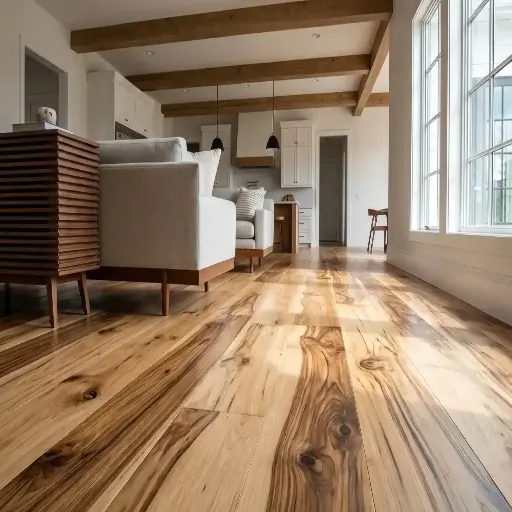
A six-inch sample can’t show you a 1,200 sq ft floor. Here is a preview routine that can.
- Order at least three large samples. Ask for them from the lot you will actually buy, not from showroom stock. One sample shows a board. Three show a range.
- Put them on the subfloor, not on a bench. Light falls differently on a horizontal surface than a vertical one, and your floor is horizontal.
- View across a full day. Morning light, midday, and evening lamps all change the read. The floor you approve at noon isn’t the floor you live with at eight.
- Ask for a full-layout photo. A photograph of an installed floor in your grade shows plank-to-plank rhythm, which no single sample can. Be cautious of staged photos where a rug covers the middle.
- Request a mock panel for large projects. A 4 by 4 ft panel laid and finished on site settles the question before a container ships.
Then protect the decision in the paperwork. Specify the grade, the supplier’s sorting rule, and the acceptable heartwood-to-sapwood ratio in writing, and keep the approved sample.
Ready to see the range for yourself? Ask us for samples from the current lot, and we will confirm what that grade will hold at your quantity.
Is Variation a Defect, and Does It Change Over Time?
Natural variation is even in its distribution. It runs board to board, follows the grain, and matches the grade you specified. Under the standard, it’s not a defect at any grade, including Select.
Two things are worth separating from it.
Blotchy, patchy discoloration. Uneven patches that don’t follow the grain can come from handling and drying problems rather than from the wood’s structure. That is worth raising with the supplier rather than accepting.
Finish defects. A milky patch, a tide mark, or a glossy run is a coating problem. It has nothing to do with grade.
As for change over time, hickory ambers. The floor darkens slightly and warms with UV exposure, with most of the shift falling in the first 6 to 18 months of trade guidance. Pale boards move toward honey. Darker boards move toward cocoa.
The practical consequence is simple. Approve your sample knowing what it will look like in two years, not what it looks like in the box. Rugs and furniture will leave lighter protected areas, and that is normal too.
Can You Get a Hickory Floor With No Color Variation?
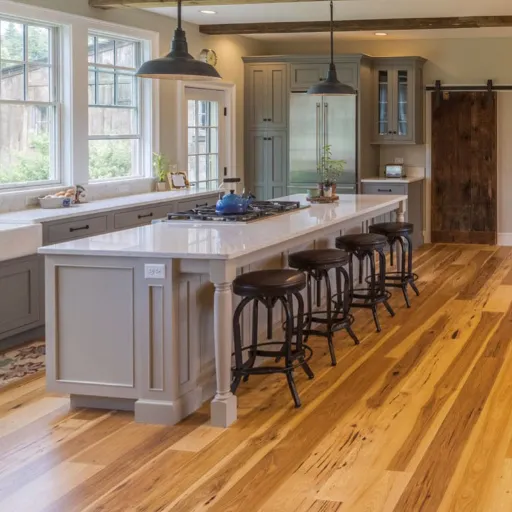
No. Not in natural hickory. Hickory flooring color variation can be reduced, but not eliminated. Even the color-sorted grades vary board to board, because they’re 95% sorted, not 100%.
You can get close. Clear White reads as a calm, pale floor with modest contrast. Clear Red reads as a deep, even one. Engineered hickory helps on a different axis, because a controlled core and a repeatable face sequence make a large run easier to hold than solid stock.
If you want a floor with genuinely little variation, the honest answer is a different species. White oak and maple both deliver a calmer surface. Our hickory vs pecan flooring comparison sets out the trade-off between hickory’s hardness and oak’s calm.
Matching Hickory to an Existing Floor
Replacement boards are the hardest version of this problem. A board installed today won’t match a floor that has ambered for five years, even from the same mill.
Hickory flooring color variation also moves with age, so a replacement has to match the floor as it is now, not as it shipped. Three habits make a match possible rather than hopeful.
- Order attic stock at installation, from the same lot, and label the boxes.
- Keep the lot number, grade, finish, and installation date with the project file.
- Send the supplier species, grade, lot, finish, and daylight photographs of the surrounding floor.
Our veneer color matching guide covers the same discipline for panel work, if your project includes both.
Specifying Hickory Color for Commercial Projects
On a multi-unit job, “hickory” isn’t a specification. The color argument reaches the site when nobody wrote down what was acceptable.
Write the ratio, not the name. A submittal that says “Clear White, 95% bright sapwood” or “No. 1 Common, distinct variation allowed” gives an inspector something to measure. A submittal that says “hickory, natural” gives them an opinion.
Three more controls prevent most site disputes.
- Mock-up approval. Approve a laid, finished panel before the run releases, and photograph it under the project lighting.
- Blend instruction. Require installers to pull from several boxes rather than laying box by box, which produces visible bands.
- Spare-box planning. Budget 5% to 10% attic stock from the same lot for future repair and for the punch list.
For veneer and panel specifications on the same project, our veneer grades reference covers the panel-side terminology, which doesn’t always map onto flooring grades.
Note: Flooring grade names and percentages come from published mill and association practice. Confirm the specific rule with your supplier before writing it into a contract. For the broader system, see our engineered hickory flooring guide.
FAQ About Hickory Flooring Color Variation
Why does hickory flooring vary so much in color?
Hickory flooring color variation comes from the board itself. Hickory combines a wide band of pale sapwood with a smaller, dark heartwood core, and the difference between spring and summer growth is pronounced. When both zones appear in one floor, the result is the mottled look the trade calls calico. It’s a species trait, not a defect.
Is hickory color variation a defect?
No. The NWFA/NOFMA Select grade rules state that natural color variation “shall not be considered a defect,” and lower grades allow more. Patchy discoloration that doesn’t follow the grain is a different question and is worth raising with the supplier.
What is the difference between Select and Character hickory?
Select limits defects, streaks, and knots tightly but still permits heartwood and sapwood variation. Character, a mill term rather than a standard grade, allows harder color contrast plus knots and character marks. Grade changes appearance and price, not hardness.
Can hickory flooring be one uniform color?
Not completely. The closest option is a color-sorted grade. Clear White must be 95% bright sapwood, and Clear Red must be 95% heartwood. Buyers who need a fully uniform floor should choose white oak or maple instead.
Does stain hide hickory color variation?
Partly. A stain compresses the contrast, and a light neutral tone does it best. It can’t remove the difference, because hickory’s density varies between sapwood and heartwood and stain absorbs unevenly. Prefinished hickory avoids the site-staining risk altogether.
Does hickory flooring darken over time?
Yes. Hickory ambers under UV exposure, with most of the change falling in the first 6 to 18 months. Pale boards warm toward honey and darker boards toward cocoa, which is why approving a sample should account for where it will be in two years.
Should I choose oak instead if I want a uniform floor?
If uniformity is the priority, yes. White oak and maple both offer a calmer surface, and oak is easier to refinish and to match for repairs. Hickory earns its place when dent resistance and visible character matter more than calm.
Conclusion
Hickory flooring color variation is a specification question, and it has a specification answer. Sapwood and heartwood create the contrast. The grade decides how much of each is sorted in. The standard says plainly that the natural color isn’t a defect.
So decide before you order, not after. Choose a color-sorted grade if you want calm, a Character grade if you want character, and preview both with samples from the real lot, on the floor, across a full day.
Then protect the choice. One lot, a written ratio, spare boxes, and an approved mock-up will settle more disputes than any conversation after delivery.
Send your grade, quantity, and destination and we will confirm what the current hickory lot will hold, with samples and documentation before you commit.