
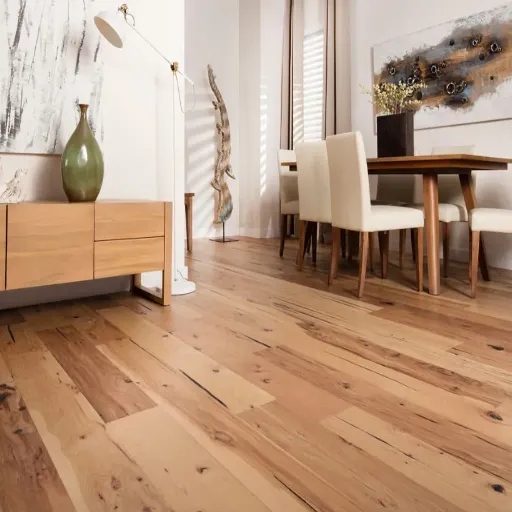
Hickory Flooring Pros and Cons: Is Hickory Right for Your Home?
Hickory flooring is the right choice for busy, pet-heavy homes that want the hardest common domestic hardwood and can live with bold color variation. It’s a poor fit for anyone who wants a calm, uniform floor, a tight budget, or a finish that hides scratches.
That’s the short answer. Hickory’s strengths are wood properties: hardness, character, domestic supply, refinishability.
Its weaknesses are project properties: color variation, movement, machining, staining, cost, and repair matching. The wood is fixed. The project is not.
Maya learned that the expensive way. She ordered 1,600 square feet of wide-plank hickory from a showroom photo. The boxes arrived with boards ranging from cream to near walnut.
Some were beautiful. Together, they looked nothing like the photo.
This guide gives you the preview she didn’t get: the real advantages and disadvantages of hickory hardwood flooring, which grades and constructions remove most of the risk, and who should walk away. If you want to see the color range first, request a sample and a quote before you commit.
Key Takeaways
- Hickory is the hardest common domestic flooring species, rated 1,820 to 2,140 on the Janka scale versus 1,220 to 1,290 for red oak.
- The pros are wood properties; the cons are project properties. Grade, construction, finish, and humidity control can shrink most of the cons.
- Color variation is the defining trade-off, and it’s a grade decision: Select is calm, Natural or Character is calico, and Rustic is bold.
- True hickory moves much more than red oak, but pecan, often sold as hickory, moves much less.
- Hickory usually costs 15% to 30% more than red oak at material level, and more to install.
Hickory Flooring Pros and Cons at a Glance
| Factor | What hickory delivers | The trade-off | What it means for you |
|---|---|---|---|
| Hardness | Janka 1,820-2,140; dents are rare | The finish still scratches, and the floor is hard underfoot | Best for dent-prone traffic from pets, kids, and furniture |
| Appearance | Bold grain, knots, mineral streaks, cream-to-brown color | Can look busy in a calm, minimal room | Preview a full layout and choose the grade deliberately |
| Stability | Engineered cores handle movement well | Solid true hickory moves more than red oak | Choose engineered for wide planks, concrete, or basements |
| Workability | Durable surface that lasts for decades | Dulls blades, sands slowly, stains unevenly | Hire an experienced installer; avoid DIY sanding |
| Cost | Mid-premium, below the top of the maple range | 15%-30% more than red oak, plus labor | Budget for material, labor, and a 10% contingency |
| Care | Sweep and damp-clean like any sealed floor | Not waterproof; spills and humidity matter | Good for kitchens with prompt cleanup |
| Resale value | A character statement some buyers love | Polarizing; neutral oak is safer | Best for design-led buyers, not quick flips |
The Pros of Hickory Flooring
The Hardest Common Domestic Floor
Hickory wins the hardness contest. The commercial average is about 1,820 on the Janka scale. Shagbark tests near 1,880, and pignut reaches about 2,140. Red oak sits near 1,220 to 1,290, white oak near 1,350 to 1,360, and hard maple near 1,450.
That makes hickory roughly 40% to 75% harder than red oak. It resists dents from dog claws, dropped toys, chair legs, and daily chaos better than any common domestic alternative.
Hardness isn’t durability, though. Janka predicts dents, not scratches or finish wear. That distinction explains several of the cons later.
Character No Other Domestic Species Matches
Hickory has the widest natural color range of any common domestic hardwood. Sapwood runs from cream to white, sometimes with a pink cast. Heartwood runs medium to dark brown, and mineral streaks add blue-black lines.
In a farmhouse, rustic, or industrial room, that range is the point. It gives a floor visual depth that uniform oak can’t match.
In a minimalist room, the same trait competes with clean lines. That isn’t a defect. It’s a design decision.
A Domestic, Widely Available Species
Hickory grows across the eastern United States and isn’t CITES-listed or considered threatened by the IUCN. That gives it a shorter, more controllable supply chain than tropical exotics.
Look for FSC or PEFC certification, and for imports, Lacey Act due care and PPQ 505 declarations. VitalWood Global sources hickory from certified forests and provides the paperwork with your order.
The claim that hickory is “not eco-friendly” doesn’t hold up. A domestic, legally harvested, certified hardwood isn’t a sustainability problem. Forest management and chain of custody are the real issues, and both are auditable.
Solid and Engineered Formats
Solid boards are typically 3/4 inch thick and 3 to 5 inches wide. Engineered boards use real hickory veneer over a cross-ply core, which resists movement and allows wider planks.
Solid hickory can be sanded three to five times; engineered hickory one to three times, depending on wear layer. Engineered isn’t fake wood. It’s often the better way to build a hickory floor, because the core counteracts the species’ natural movement. Our engineered hickory flooring guide covers construction, wear layers, and installation.
The Cons of Hickory Flooring, Stated Plainly
Color Variation Is the Defining Trade-Off
The number one complaint about hickory isn’t damage. It’s appearance. Boards can range from pale cream to dark brown in the same room, and the contrast is often stronger than buyers expect.
Grade is the control. Select or Clear grade sorts out most of the contrast. Natural or Character grade keeps the mix of sapwood and heartwood that creates the classic “calico” look. Rustic grade adds knots and heavier character.
Ask for a full-layout photo and a sample from the actual lot, view it in your room lighting, and blend boards from several boxes during installation. For more detail, read our guide to hickory flooring color variation.
It Moves More Than Most Buyers Expect
True hickory is dimensionally active. Shagbark shrinks about 7.0% radially, 10.5% tangentially, and 16.7% volumetrically. Pignut is higher at 7.2%, 11.5%, and 17.9%. Red oak moves 4.0%, 8.6%, and 13.7%.
In a home, that shows up as seasonal gapping in dry winter air and slight swelling in humid summer air. It’s normal behavior, not a defect, but it surprises buyers who expect a tight floor year-round.
Keep indoor relative humidity between 35% and 55%, acclimate the flooring before installation, and follow the expansion-gap requirements. For wide planks, solid hickory is riskier than engineered.
Hard to Machine, Sand and Stain
Hickory blunts cutting edges, tears out during machining, and needs sharp carbide tooling and pre-drilling in some applications. Installers charge more because the work takes longer and consumes more blades. Sanding is slower for the same reason.
Staining is the bigger surprise. Many articles say hickory “takes stain well.” It takes finish well, but it stains unevenly because density varies between sapwood and heartwood. The dense heartwood absorbs less stain, which produces a blotching problem.
The fix is a process: water-pop the wood, apply a pre-conditioner, use a gel or dye-based stain, and test on offcuts from the actual lot. If you want consistent color, buy prefinished hickory or choose a natural clear finish.
The Finish Still Scratches
Hickory resists dents. It doesn’t resist scratches. The finish takes that damage, whether it’s aluminum oxide, polyurethane, or oil.
Scratches can also be more visible on hickory than on oak. Dark heartwood shows fine light scratches, while pale sapwood hides them. A high-contrast floor displays damage unevenly.
Finish choice matters more than species. A matte or wire-brushed surface hides scratches better than high gloss. Felt pads, doormats, and a no-shoes rule do more than paying for a harder species.
A 15% to 30% Premium Over Red Oak
Hickory material typically runs $4.15 to $7.15 per square foot. Red oak runs about $3 to $5.75, and white oak about $3.75 to $7. That puts hickory roughly 15% to 30% above red oak, and it can overlap white oak at the top.
Installation adds more. Engineered hardwood runs $8 to $14 per square foot installed, while solid runs $9 to $23. Hickory often lands at the higher end because of the labor premium.
The premium buys dent resistance and character. It doesn’t buy a longer finish life.
Repairs and Comfort Are Trade-Offs
Replacing one damaged hickory board is difficult because the wood is dense, the finish is hard to blend, and the color range makes a perfect match unlikely. Order 5% to 10% extra and store it for future repairs.
A very hard floor also transmits impact. It’s less comfortable underfoot than cork or carpet, and dropped dishes break more easily. Rugs and cushioned underlayment help.
The Species Catch: True Hickory vs. Pecan
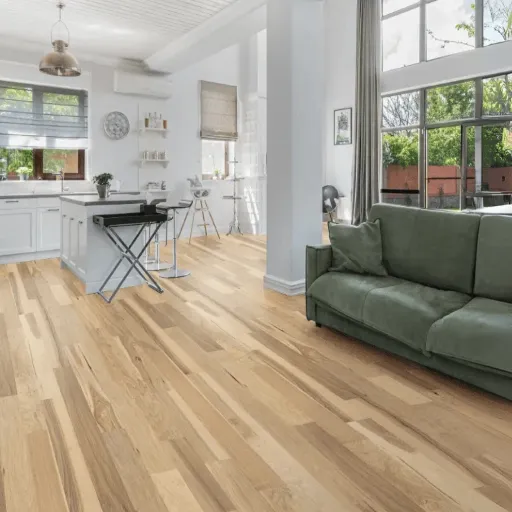
“Hickory” is a commercial group, not a single species. It includes true hickories such as shagbark, pignut, mockernut, and shellbark, plus pecan hickories such as pecan, bitternut, and water hickory. Pecan is routinely mixed with true hickory and sold under the same label.
The properties aren’t identical. The figures below come from The Wood Database’s shagbark hickory and pecan entries.
| Species | Janka | Density | Radial shrinkage | Tangential shrinkage | Volumetric shrinkage |
|---|---|---|---|---|---|
| Shagbark hickory | 1,880 | 50 lb/ft3 | 7.0% | 10.5% | 16.7% |
| Pignut hickory | 2,140 | 52 lb/ft3 | 7.2% | 11.5% | 17.9% |
| Pecan | 1,820 | 46 lb/ft3 | 4.9% | 8.9% | 13.6% |
| Red oak | 1,220-1,290 | 43.8 lb/ft3 | 4.0% | 8.6% | 13.7% |
| White oak | 1,350-1,360 | 47.0 lb/ft3 | 5.6% | 10.5% | 16.3% |
Pecan moves much less than true hickory. Its shrinkage is close to red oak, not to shagbark. So the blanket claim that “hickory moves a lot” depends on which species is in the box.
That doesn’t make pecan a better floor. It’s slightly less hard and less dense. It does mean the risk profile changes, especially for wide solid planks in a home with seasonal humidity swings. Ask your supplier for the scientific name or species mix on the spec sheet.
Solid vs. Engineered Hickory: Which Cons Shrink?
Engineered hickory doesn’t change the surface. The veneer is still real hickory, with the same hardness and color range. What changes is the core, and the core handles movement.
A cross-ply core resists the expansion and contraction that solid hickory experiences. That makes engineered hickory more stable in wide planks, over concrete, in basements, and over radiant heat. It also reduces the seasonal gapping that frustrates owners of solid wide-plank hickory.
| Consideration | Solid hickory | Engineered hickory |
|---|---|---|
| Best for | Nail-down over plywood; site-finished look | Wide planks, concrete, basements, radiant heat |
| Movement | Higher; strict humidity control needed | Lower; cross-ply core counteracts movement |
| Refinishing | 3-5+ sands | 1-3 sands depending on wear layer |
| Installation | Nail or staple; subfloor-dependent | Float, glue, or nail; more options |
| Cost | $9-$23 installed | $8-$14 installed |
Wear layer determines refinishing life. A 0.6 mm veneer can’t be sanded. A 2 mm veneer supports about one light sand. A 3 to 4 mm veneer supports one to two, and 6 mm or thicker supports two to three.
The NWFA rule is to leave at least 3/32 inch (2.4 mm) of wear layer above the tongue after sanding.
Aim for at least 2 mm, and choose 3 to 4 mm if you want the option to refinish. Our guide to engineered wood flooring explains cores, joints, and installation.
Is Hickory Good for Kitchens, Pets and Busy Homes?
Kitchens and Entryways
Is hickory flooring good for kitchens? Yes, if you accept that it isn’t waterproof. It handles traffic, dropped utensils, and chair movement well. It doesn’t handle standing water, dishwasher leaks, or repeated wet mopping.
Use mats at the sink and dishwasher, wipe spills promptly, and keep humidity in range. Hickory flooring maintenance is simple: sweep, damp-clean, and avoid standing water. If the kitchen leads to a pool or mudroom, consider tile in the wet zone and hickory nearby.
Dogs, Cats and Kids
This is hickory’s best use case. Its dent resistance outperforms oak, maple, and walnut against claws, toys, and traffic. A busy household with two large dogs will put fewer dents in hickory than in any common domestic alternative.
The caveats are scratches, slipperiness, and accidents. Claws can still scratch the finish, smooth surfaces can be slippery for older dogs, and urine or water bowls can damage any wood floor if left standing. A matte finish, rugs, and prompt cleanup solve most of it. For the full pet decision, read is hickory flooring good for dogs.
Bedrooms, Basements and Radiant Heat
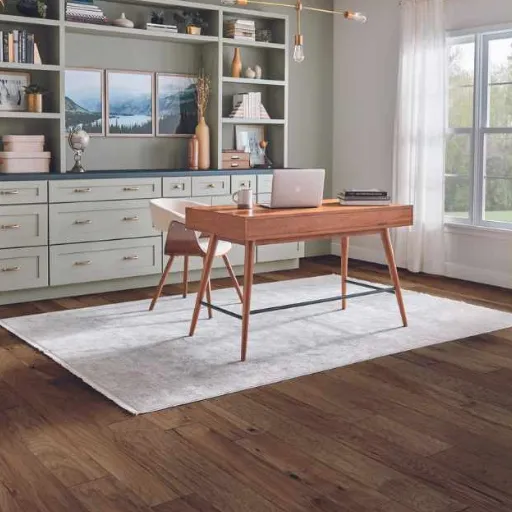
Bedrooms and home offices are low-risk rooms. Hickory’s hardness is welcome under desks and beds, though a high-contrast floor can feel busy in a small bedroom. Choose Select grade there if you want calm.
Engineered hickory is the right choice for basements and concrete. Solid hickory over concrete is a poor specification because of movement and moisture risk. Engineered hickory can float or glue down over a prepared slab with a moisture barrier, and it works over radiant heat when the manufacturer approves it.
Test the slab for moisture before installation, and follow the adhesive and barrier specifications. A dry, conditioned basement is a good home for engineered hickory. A basement that floods isn’t a good home for any wood floor.
| Room | Suitability | Why | Recommendation |
|---|---|---|---|
| Living room | Excellent | High traffic, dent resistance | Natural or Character grade, 3-4 mm wear layer |
| Bedroom | Very good | Low traffic, comfortable with rugs | Select grade for a calmer look |
| Home office | Excellent | Chairs and desks, hard surface | Matte finish, felt pads |
| Kitchen | Good with care | Water risk, high traffic | Mats, prompt cleanup, engineered |
| Mudroom | Excellent | Highest traffic and dent risk | Natural or Rustic grade |
| Basement | Engineered only | Moisture and slab movement | Engineered with moisture barrier |
| Bathroom or laundry | No | Standing water and humidity | Tile, LVP, or waterproof engineered |
How Hickory Compares with Oak, Maple and Walnut
Hickory is the hardest common species, but it isn’t the calmest, the cheapest, or the most stable. The right choice depends on which of those matters most.
Hickory is the hardest, boldest, and most expensive of the common species. Red and white oak are calmer and cheaper. Maple is paler and cleaner. Walnut is softer, darker, and more formal.
For the head-to-head decision, our full hickory vs oak flooring comparison covers hardness, movement, cost, staining, and room fit. For the same framework applied to other species, see maple flooring pros and cons and walnut flooring pros and cons.
Hickory Flooring Cost in 2026
Hickory costs more because the raw material is less abundant than oak, the wood is harder to mill, and installation takes longer. On a 1,000 square foot project, labor and site conditions can matter as much as the material.
Using public 2026 planning benchmarks from Fixr, hickory material runs $4.15 to $7.15 per square foot. Engineered installation runs $8 to $14, and solid installation runs $9 to $23.
| Format | Material per sq ft | Installed per sq ft | 1,000 sq ft total |
|---|---|---|---|
| Engineered hickory | $4.15-$7.15 | $8-$14 | $8,000-$14,000 |
| Solid hickory | $4.15-$7.15 | $9-$23 | $9,000-$23,000 |
| Prefinished retail hickory | $6-$14 | Varies | Quote-dependent |
These are planning ranges, not quotes. Regional labor, subfloor condition, stair work, and trim all move the number. Get an itemized quote that separates material, labor, underlayment, trim, and disposal.
Add 10% for cuts and waste, plus 5% for future repairs. Budget for trim, stair nosings, transitions, a moisture barrier, floor leveling, and removal. Wide planks and hand-scraped finishes carry a premium too.
Ready to compare real numbers? Send us your square footage and subfloor details and we’ll help you build an itemized estimate.
Who Should Not Buy Hickory
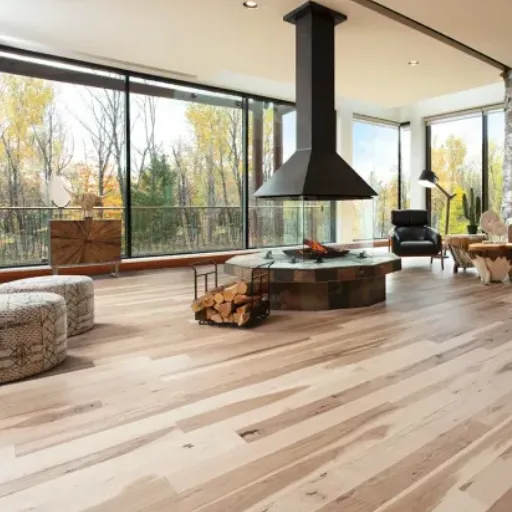
Hickory isn’t the right floor for everyone, and saying so is more useful than pretending otherwise.
- You want a calm, uniform floor. Choose white oak, red oak, or Select-grade hickory.
- Your budget is tight. Red oak delivers a similar service life for less.
- The room is a bathroom, laundry, or sauna. Choose tile, LVP, or waterproof engineered.
- You have no humidity control. Choose engineered hickory or a more stable species.
- You plan to sand and stain it yourself. Choose prefinished hickory or oak.
- You’re flipping the house. Neutral oak is the safer resale choice.
- Your interior is ultra-minimal. Choose maple or white oak.
None of these are failures of hickory. They’re mismatches between the floor and the project.
FAQ About Hickory Flooring Pros and Cons
What are the disadvantages of hickory flooring?
The main disadvantages are dramatic color variation, high movement in true hickory, a 15% to 30% premium over red oak, and difficult sanding, staining, and repair. It’s also hard underfoot, and the finish still scratches.
Is hickory flooring worth the money?
It can be, if dent resistance and character matter more than a uniform look. Hickory costs 15% to 30% more than red oak but outperforms it on dents. Buyers who want low variation should choose oak.
Does hickory flooring scratch easily?
Hickory resists dents, not scratches. The finish takes scratches, and high-contrast heartwood makes them more visible than on oak. Finish type, sheen, and felt pads matter more than species.
Is hickory flooring too busy?
It can be. Natural or Character grade is the classic calico look; Select grade is much calmer. In a minimalist room, hickory competes with clean lines. In a farmhouse or industrial room, it adds depth.
Is hickory flooring good for dogs?
Yes, for dent resistance. Hickory handles claws and traffic better than oak or maple. Watch for finish scratches, slipperiness, and accident moisture. A matte finish, rugs, and prompt cleanup help.
Is hickory flooring waterproof?
No. Hickory is wood, and wood isn’t waterproof. Engineered hickory handles minor moisture better than solid, but standing water, leaks, and wet mopping can damage any hickory floor.
Can hickory flooring be refinished?
Solid hickory can be refinished three to five times. Engineered hickory one to three times, depending on wear layer. A 0.6 mm veneer can’t be sanded; 2 mm supports one light sand.
Is hickory the same as pecan?
No, but they’re often sold together. Hickory is a commercial group that includes true hickories and pecan hickories. Pecan is slightly less hard and dense, and it moves less.
Conclusion
Hickory flooring pros and cons come down to one question: do you want the hardest common domestic floor enough to accept its color range, movement, and cost?
If you have a busy household, pets, high-traffic rooms, and a design that can carry bold character, hickory is an excellent choice. Choose the grade deliberately, use engineered construction for wide planks or concrete, and keep humidity in range.
If you want a calm, uniform floor, a tight budget, or a low-maintenance finish, oak or maple will serve you better. That isn’t a compromise. It’s the right floor for the project.
The Hendersons learned that on a lake house remodel. Their solid wide-plank hickory gapped through the first heating season. The floor wasn’t defective; the specification was wrong for a house with big humidity swings.
You don’t have to learn that lesson on your own floor. Talk to our team about samples, certification paperwork, or a quote. We’ll help you match the species, grade, and construction to the way you actually live.