
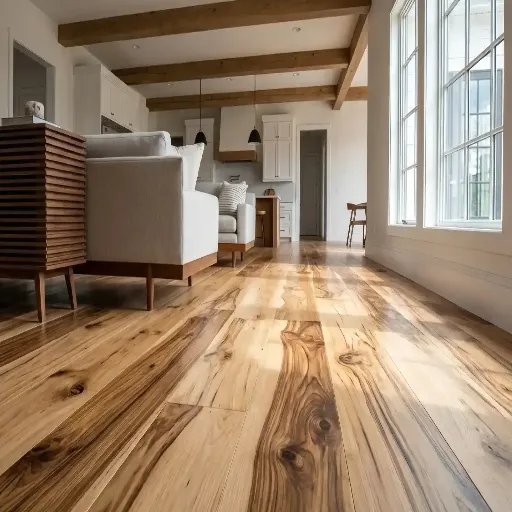
Engineered Hickory Flooring: 2026 Buying & Installation Guide
Engineered hickory flooring is a real hickory wear layer bonded to a cross-laminated plywood or HDF core. It gives you the hardest common North American flooring species with far more dimensional stability than solid hickory, which is why it is the sensible choice for wide planks, concrete slabs, radiant heat and homes where humidity swings.
Hickory is also the species most likely to surprise its buyer. The same tree produces cream sapwood and dark brown heartwood, sometimes in the same box. It is hard enough to shrug off a dropped wrench, yet its finish still scratches. And because hickory moves more than oak or maple, the engineered core is not a luxury here. It is the fix.
This guide comes from the manufacturing side of the industry. We buy, slice, grade and bond wood veneer, so we will show you what the label hides: which hickory you are actually buying, what the wear layer really determines, what a fair 2026 price looks like, and where the species will disappoint you if nobody warns you first.
Key Takeaways
- Hickory rates 1,820 to 2,140 on the Janka scale, well above red oak at about 1,220. Hardness resists dents, not scratches.
- Hickory shrinks roughly 7% radially and 10.5% to 11.5% tangentially, compared with 4.0% and 8.6% for red oak. That movement is the strongest argument for engineered construction.
- The “hickory” label covers true hickories and pecan hickories. Pecan is routinely sold as hickory, and Janka and color vary across the group.
- Expect $4 to $8 per sq ft for engineered hickory material and $8 to $14 per sq ft installed in 2026, depending on grade and wear layer.
- A wear layer under 2 mm limits refinishing. If you want a floor you can sand twice, specify 3 mm or more.
What Is Engineered Hickory Flooring?
Engineered hickory flooring is a flooring plank made from a thin top layer of real hickory veneer bonded to a multi-layer plywood or HDF core. The core is built with crossed plies, so it expands and contracts far less than a solid board of the same width. The top layer is real wood, not a printed image, and it can be sanded and refinished within the limits of its thickness.
That definition matters because the category is crowded with lookalikes. Laminate uses a photographic layer under a clear wear film. Vinyl and SPC are plastic through and through. Engineered hickory is a wood floor, and it behaves like one: it dents, it ages, it can be repaired, and it responds to humidity.
The Anatomy of an Engineered Hickory Plank
Every engineered plank has three jobs to do.
- Wear layer. The hickory face, usually 0.6 mm to 6 mm thick. This is the wood you see, touch and eventually sand.
- Core. Cross-laminated plywood, HDF or a lamellar block. This is what resists moisture movement and holds the plank flat.
- Backing. A balancing layer that keeps tension even so the plank does not bow.
The wear layer determines how long the floor can be refinished. The core determines where the floor can be installed. Buyers tend to shop the wear layer and ignore the core, which is backwards for hickory. A thick face on a weak core will still cup.
If you want the broader construction primer first, our guide to engineered wood flooring covers cores, joints and finishes in detail.
Want to compare a sample against your project drawings? Request an engineered hickory sample and tell us the room, the subfloor and the finish you have in mind.
Why Choose Engineered Hickory Over Solid Hickory?
Hickory is one of the most dimensionally active species used for flooring. Shagbark hickory shrinks about 7.0% radially and 10.5% tangentially; pignut runs about 7.2% and 11.5%. Red oak, the usual benchmark, sits at 4.0% and 8.6%. That gap is not academic. It is the difference between a floor that stays flat through a dry winter and one that gaps, cups or crowns.
A cross-ply core interrupts that movement. Each layer pulls against the next, so the assembly responds to humidity far more slowly than a solid plank. That is why engineered hickory can be made 7 or 8 inches wide without the cupping risk that makes wide solid hickory a gamble.
There are practical advantages too. Engineered hickory can go over concrete slabs and radiant heat, where solid hickory usually cannot. It uses the premium species more efficiently, because a valuable log yields more veneer faces than solid boards. And it typically costs less installed, even when the material price per square foot looks similar.
Engineered vs. Solid Hickory at a Glance
| Factor | Engineered Hickory | Solid Hickory |
|---|---|---|
| Construction | Hickory veneer over cross-ply core | 3/4 in. solid hickory |
| Dimensional stability | High | Low to moderate |
| Plank widths | Up to 8 in. and wider | Typically 3 to 5 in. |
| Concrete and radiant heat | Yes, with approved assembly | Usually no |
| Refinishing | 1 to 3 times, by wear layer | 3 to 5 times |
| Installed cost (2026 est.) | $8 to $14 per sq ft | $9 to $23 per sq ft |
| Best use | Wide planks, slabs, basements, humid climates | Traditional nail-down over plywood |
For the full trade-off, including acoustic feel and site-finished options, see engineered hickory vs. solid hickory. The short version: solid hickory wins on sanding life. Engineered wins on everything that determines whether the floor stays flat.
Hickory’s Real Hardness: Janka 1,820 to 2,140
Hickory is the hardest common North American flooring species. The Wood Database lists shagbark hickory at 1,880 and pignut at 2,140; pecan, which is sold as hickory, comes in around 1,820. Red oak is about 1,220. That is not a small edge. It is a different category of dent resistance.
Here is how the common species compare, with 2026 material cost as a rough anchor.
| Species | Janka (lbf) | Density (lb/ft³) | Character | Material cost (est.) |
|---|---|---|---|---|
| Pignut hickory | 2,140 | 52 | Bold, varied, very hard | 4to4to8 per sq ft |
| Shagbark hickory | 1,880 | 50 | Bold grain, cream to brown | 4to4to8 per sq ft |
| Pecan (sold as hickory) | 1,820 | 48 to 50 | Similar look, slightly softer | 4to4to7 per sq ft |
| Hard maple | 1,450 | 44 | Uniform, creamy, fine grain | 6to6to10 per sq ft |
| White oak | 1,360 | 47 | Calm, linear, water resistant | 4to4to7 per sq ft |
| Red oak | 1,220 | 43.8 | Open grain, warm, plentiful | 3to3to6 per sq ft |
| Black walnut | 1,010 | 38 | Dark, soft, premium | 6to6to11 per sq ft |
Two things get lost in the hardness marketing.
First, Janka measures dent resistance, not scratch resistance. A steel chair leg or a dog’s nails can still mark the finish. The finish, not the wood, takes that damage. An aluminum oxide or UV-cured coating will outperform a soft oil finish on scratches even on a softer species.
Second, hard is not always comfortable. A very dense floor is unforgiving underfoot and unkind to dropped dishes. Homeowners with joint pain or a preference for quiet, cushioned floors sometimes choose oak or walnut after standing on both.
Field note: Priya, an architect in Denver, specified solid 7-inch hickory for a 2,400 sq ft loft. The floor was installed in February with the heat off and the windows open for the crew. Within six weeks, the planks had cupped at the edges and gapped at the ends. The fix was not a better installer. It was a different assembly: engineered hickory with a 4 mm face, a written acclimation protocol and a humidity log kept on site for the first month.
If dents are your main worry, hickory earns its reputation. If scratches are your main worry, spend your budget on finish quality and a matte texture, not on a higher Janka number. Our hickory flooring pros and cons breaks down where the species helps and where it does not.
The Look: Sapwood, Heartwood, Mineral Streaks and “Calico”
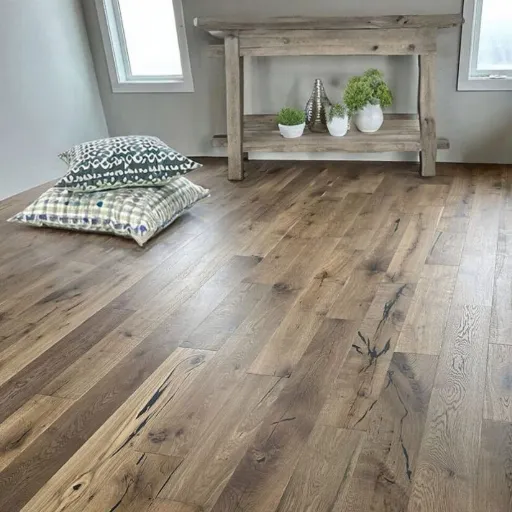
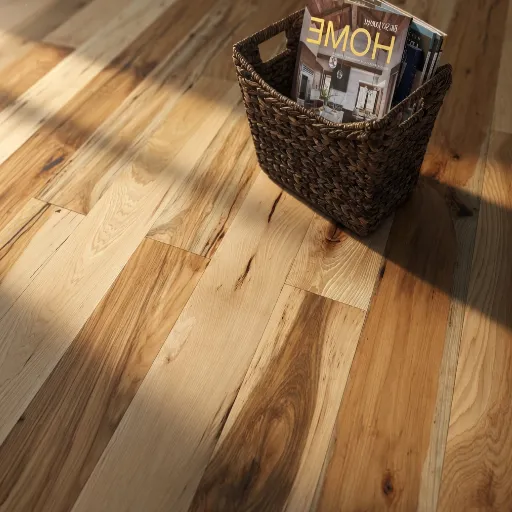
No other common domestic species varies as much from board to board. Hickory sapwood is cream to white, sometimes with a pink cast. Heartwood ranges from medium tan to deep reddish brown. Mineral streaks add blue-black lines. Put them in one room and you get the mottled, high-contrast floor the trade calls “calico.”
That look is either the reason you want hickory or the reason you should not buy it. There is no neutral hickory floor. If your design depends on calm, uniform color, oak or maple will serve you better, and we will say so before you order.
Grades: Select, Natural/Character and Rustic
Grade is how the industry controls that variation. Names differ by manufacturer, but the logic is consistent.
- Select or Clear. More uniform color, fewer mineral streaks and knots, higher cost. It still varies, because it is wood.
- Natural or Character. Mixed sapwood and heartwood, visible mineral streaks, the classic calico floor. This is the most common hickory grade.
- Rustic. Knots, checks, heavy color contrast and dramatic grain. The most casual look, often paired with hand-scraped or wire-brushed textures.
Grade names are not standardized across mills. One company’s “natural” can be another’s “character.” Ask for a photo of an installed floor in the grade you are buying, not a single hand sample.
How to Avoid Color Mismatch
Color complaints are usually lot problems, not defects. Hickory varies by tree, by region and by run. Three habits prevent most of them.
- View a full-layout photo, not a 6-inch sample.
- Order all material for the project in one lot, or reserve attic stock from the same lot.
- Blend planks from several boxes during installation instead of laying box by box.
Finish changes perception too. A clear water-based coating keeps the contrast cool and crisp. An ambering oil warms the sapwood and softens the difference. Wire-brushing mutes it further. For a deeper look at grading and color control, read hickory flooring color variation.
Hickory Species and Trade Names: True Hickory vs. Pecan
“Hickory” is a commercial group, not a single species. That is the most important thing to understand before you compare quotes.
True hickories include shagbark (Carya ovata), pignut (C. glabra), mockernut and shellbark. Pecan hickories include pecan (C. illinoinensis), water hickory, bitternut and nutmeg.
Pecan is routinely sold as hickory because the wood looks similar and the density ranges overlap. It is a legitimate commercial designation, not a scam, but it explains why one “hickory” floor feels harder than another.
Can you tell them apart once the floor is finished? Usually not. Grain and color overlap too much.
That is why the spec sheet matters more than the marketing name. Ask for the scientific name, the country or region of harvest and the grade. A supplier who cannot answer those questions is not a technical partner.
One honest note on durability: hickory heartwood is rated non-durable to perishable and vulnerable to insects in ground contact. Indoors, that rating is close to irrelevant. The finish and a dry environment are what protect the floor. But do not use hickory for exterior decking or direct ground contact and expect it to behave like cedar or ipe.
For the full buyer-protection discussion, see hickory vs. pecan. The Wood Database entry on true hickory and pecan hickory is the neutral reference we use for species data.
Hickory vs. Oak, Maple and Walnut
Most buyers arrive choosing between four species. The decision is less about which is “best” and more about which trade-off fits the room.
| Factor | Hickory | Red Oak | Hard Maple | Black Walnut |
|---|---|---|---|---|
| Janka | 1,820 to 2,140 | 1,220 | 1,450 | 1,010 |
| Movement | High | Moderate | Moderate | Low to moderate |
| Color range | Very wide, calico | Warm, fairly uniform | Cream to tan, uniform | Dark chocolate to purple-brown |
| Grain | Bold, dramatic | Open, linear | Fine, subtle | Straight to wavy, soft |
| Dent resistance | Best | Good | Very good | Lowest |
| Scratch resistance | Finish-dependent | Finish-dependent | Finish-dependent | Finish-dependent |
| Refinishing | Good, dense sanding | Excellent | Good | Good, but soft |
| Cost (material) | 4to4to8 | 3to3to6 | 6to6to10 | 6to6to11 |
| Best for | Pets, traffic, character | Value, tradition, calm | Clean modern interiors, sports | Premium design, low traffic |
A simple decision framework:
- Choose hickory if you want the hardest floor, you like visible variation and you have pets, kids or heavy traffic.
- Choose oak if you want a proven, repairable floor at a lower price and a calmer look.
- Choose maple if you want a uniform, creamy floor for a modern or minimalist interior.
- Choose walnut if the design is the priority and the room is low traffic.
For head-to-head detail, read hickory vs. oak flooring and hickory vs. maple flooring. Our species pages for engineered oak, engineered maple and engineered walnut carry the same data for each species.
Construction Specs That Matter
Most hickory buyers compare color and price. The specs that decide how the floor performs are less visible.
| Wear layer | What it supports | Practical refinish count |
|---|---|---|
| 0.6 mm | Entry-level engineered | No sanding; recoat only if compatible |
| 1 to 2 mm | Standard residential | One light screen-and-recoat or one careful sand |
| 3 to 4 mm | Premium residential, light commercial | One to two full sands |
| 6 mm+ | High-end, commercial, long-life | Two to three full sands over decades |
The NWFA working rule is that you should not sand below 3/32 inch (2.4 mm) of wear layer remaining above the tongue. In practice, a 2 mm floor has one refinish in it at most. A 4 mm floor has a real maintenance plan. If you are buying hickory for a forever home, this is the number to argue about, not the Janka rating.
Core and joint matter as much.
- Plywood core is the proven choice for stability and moisture tolerance.
- HDF core is flatter and quieter underfoot but less forgiving of standing water.
- Lamellar or solid-sawn core behaves more like solid wood and costs more.
- Tongue-and-groove is the default for glue-down and nail-down. Click joints suit floating installations but limit refinishing and repair.
Finish matters too. Aluminum oxide resists scratches but is hard to spot-repair. UV-cured oil looks natural and can be recoated locally. For a full comparison of construction options, see best engineered wood flooring.
Engineered Hickory Flooring Cost (2026)
Prices vary by region, grade, width and wear layer. These ranges are planning estimates, not quotes.
| Cost element | Low | High | Notes |
|---|---|---|---|
| Engineered hickory material | $4 per sq ft | $8 per sq ft | 2 mm to 4 mm face, standard widths |
| Wide or long plank premium | $1 per sq ft | $3 per sq ft | 7 in. and wider, longer boards |
| Select grade premium | 15% | 25% | Over natural or character grade |
| Installation, glue or nail | $3 per sq ft | $6 per sq ft | Subfloor dependent |
| Installation, floating | $2 per sq ft | $4 per sq ft | Over approved underlayment |
| Total installed, engineered | $8 per sq ft | $14 per sq ft | Typical residential project |
| Solid hickory installed | $9 per sq ft | $23 per sq ft | For comparison |
Public benchmarks land in the same range. Fixr’s hardwood cost data puts hickory material at $4.15 to $7.15 per sq ft, engineered installed at $8 to $14 and solid installed at $9 to $23. Treat those figures as a sanity check, then get a project-specific number.
Worked Example: 1,200 Sq Ft Over Concrete
A 1,200 sq ft main floor over a concrete slab, 4 mm wear layer, natural grade, glue-down installation:
- Material at $6.50 per sq ft: $7,800
- Moisture barrier and adhesive: $1,200 to $1,800
- Installation at $4.50 per sq ft: $5,400
- Trim, transitions and disposal: $900 to $1,400
- Total: roughly $15,300 to $16,400
A 2 mm entry-level version might land near $11,000, with no meaningful refinishing life. That is the trade you are making.
Watch for costs that quotes omit: subfloor flattening, moisture mitigation, stair work, furniture moving, old floor removal and the spare boxes you will want for repairs. A 5% attic stock allowance is cheap insurance on a variegated floor, where a future board replacement will never match exactly.
Ready to price your project? Send us the square footage, subfloor type and wear layer and we will return a written quote with the grade and lot assumptions stated. For a broader pricing primer, see engineered wood flooring cost and hickory flooring cost.
Installation Methods and Moisture Control
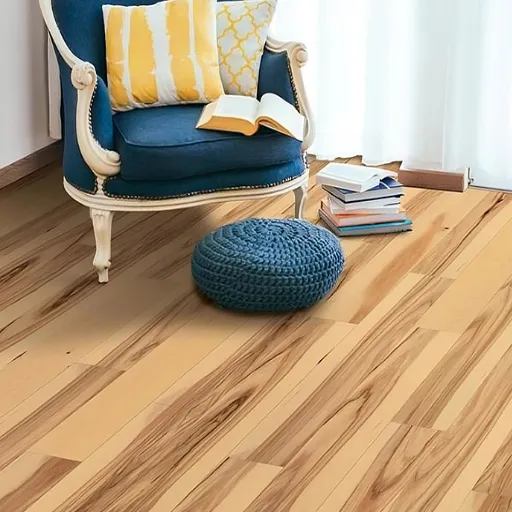
This section is deliberately short. The mechanics belong in our engineered wood flooring installation guide, which covers subfloor prep, tools and step-by-step sequencing.
What matters for hickory specifically is moisture discipline.
- Acclimation is not optional. Hickory’s movement is high, so the material should sit in the conditioned space until it stabilizes. Follow the manufacturer’s written requirement, not a general rule of thumb.
- Test the slab. Use an in-situ relative humidity test or calcium chloride test, and record the result. A plastic sheet taped to the floor is not a moisture test.
- Control the room. Target roughly 35% to 55% relative humidity year-round. In cold climates, that usually means a whole-home humidifier.
- Respect expansion gaps. Leave the specified gap at walls and fixed objects, and use transitions at doorways and large openings.
- Radiant heat. Engineered hickory can work, but only with an approved assembly and a surface temperature the manufacturer allows. Solid hickory generally cannot.
Glue-down suits concrete, nail-down suits plywood and floating is the fastest DIY option, though it limits refinishing and repair.
Best Rooms for Engineered Hickory Flooring
Hickory belongs where people and animals actually live.
Excellent choices: living rooms, family rooms, bedrooms, hallways, home offices and pet households. The hardness handles traffic, and the color variation hides dust and small marks better than a uniform floor.
Good with conditions: kitchens, basements, over concrete and over radiant heat. Use engineered construction, a moisture barrier and a finish that can handle occasional spills. For basements, read engineered wood flooring for basement before you buy. If water resistance is the priority, compare waterproof engineered wood flooring and be honest about what “waterproof” means for a wood product.
Poor choices: full bathrooms, saunas, laundry rooms with frequent leaks and unconditioned spaces. Hickory is not a tile substitute. No wood floor is.
Pet owners should read is hickory flooring good for dogs before choosing a finish. The species resists dents well. The finish still takes scratches, and smooth surfaces can be slippery for older dogs.
Hickory Flooring Problems and How to Avoid Them
Most hickory complaints trace back to moisture, grade or finish, not to the species being “bad.”
| Problem | Likely cause | Fix | Prevention |
|---|---|---|---|
| Seasonal gapping | Low indoor humidity in winter | Humidification; wait for seasonal equilibration | Control RH at 35% to 55%; acclimatize |
| Cupping or buckling | Moisture from below or a wet slab | Find and stop the source; dry gradually; replace severe boards | Test the slab; use a moisture barrier |
| Checking or splitting | Very dry conditions, fast acclimation | Humidify; repair small checks with filler | Condition the space before delivery |
| Color mismatch | Mixed lots or grades | Blend; replace isolated boards | Same-lot order; full-layout approval |
| Finish scratches | Grit, pets, furniture | Screen-and-recoat; spot repair | Mats, felt pads, matte textured finish |
| Dents | Heavy impact on any wood | Steam repair for small dents | Accept that wood dents; use rugs at pivot points |
The gapping question deserves a direct answer. A hickory floor that gaps slightly in February and closes in June is behaving normally. A floor that gaps in summer, or gaps more than a few millimeters, has a humidity or moisture problem worth investigating.
For diagnosis and repair in more depth, see hickory flooring problems.
Finishing, Staining and Color Control
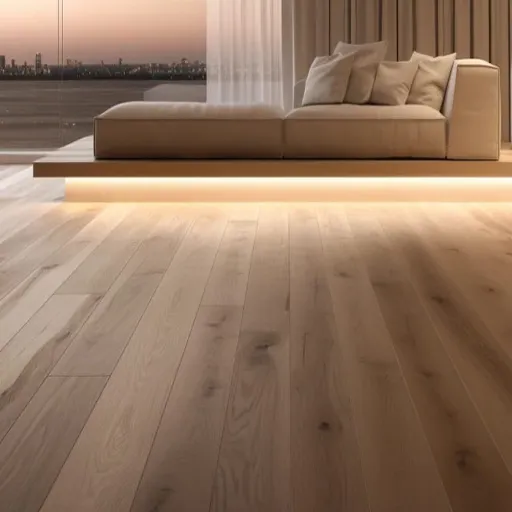
Hickory is difficult to stain evenly. The reason is density: sapwood and heartwood absorb stain at different rates, so a single coat can look blotchy across a calico floor. This is a species behavior, not an installer error.
The practical responses are well established.
- Water-popping raises the grain and evens absorption before staining.
- A pre-conditioner or stain controller slows absorption on dense areas.
- Gel stain sits on the surface and is more forgiving on variable density.
- Test panels made from the actual flooring, not scrap pine, are the only reliable preview.
Most hickory floors are left natural or lightly toned for a reason. The species already has more color than a stain can improve. If you want a darker floor, consider walnut or a factory-finished hickory in a proven color rather than site-staining a calico floor.
Prefinished engineered hickory avoids the problem entirely. The factory controls sanding, grain-raising, stain and coating under consistent conditions, and you get a warranty on the finish.
Refinishing, Repair and Care
A hickory floor stays looking right with boring maintenance.
- Dry-mop or vacuum weekly. Grit is what dulls a finish.
- Damp-clean with a pH-neutral wood floor cleaner. Never wet-mop, and never steam-mop a wood floor.
- Use felt pads under furniture and mats at exterior doors and sink zones.
- Keep relative humidity between roughly 35% and 55%.
- Wipe spills promptly, especially in kitchens and pet areas.
When the finish dulls but the wood is sound, a screen-and-recoat restores the sheen without sanding the wear layer. When the wood itself is marked, a full sand is the next step, and the wear layer decides whether that is possible.
Hickory is harder to sand than oak or maple. It dulls abrasives, burnishes under a slow machine and tears out at the edges if the tooling is not sharp. That makes refinishing slower and more expensive, and it is one more reason to specify a wear layer worth refinishing in the first place.
Small dents can often be raised with a damp cloth and an iron. Board replacement is possible but color matching in a variegated floor is imperfect by nature. Keep spare boards from the original lot. For the full method, see refinishing engineered hickory floors and refinishing engineered hardwood floors. Our wood floor cleaning guide covers routine care without harsh chemistry.
Sustainability and Legal Sourcing
Hickory is native to the eastern United States and is not CITES-listed. It is not on the IUCN Red List as a threatened species. That is a good starting point, but “not endangered” is not the same as “responsibly sourced,” and buyers increasingly ask for proof.
The compliance framework that actually applies:
- Lacey Act due care. U. S. law prohibits illegally sourced wood, and importers must exercise due care. Keep species, origin and supplier documentation.
- PPQ 505 declaration. Imports of wood products require a declaration covering scientific name, country of harvest, quantity and value.
- FSC or PEFC certification. Chain-of-custody certification is the clearest third-party evidence of responsible forest management.
- AHEC American Hardwood Assured. A legality assurance program for U. S. hardwoods that uses satellite imagery and risk assessment to verify origin.
- EUDR due diligence. If you sell into the EU, ask for the due diligence statement. U. S. hardwood is currently treated as low risk by AHEC, but the paperwork still matters.
Hickory is abundant in eastern forests yet often treated as an underutilized hardwood, which makes it a credible domestic alternative to tropical species. Ask your supplier for the scientific name, the harvest region and the certification status in writing. A manufacturer who cannot provide that is not ready for a serious project.
For more on our sourcing position, see sustainable veneer, FSC-certified wood veneer panels and sustainable hickory flooring.
FAQ About Engineered Hickory Flooring
Is engineered hickory flooring real wood?
Yes. The wear layer is real hickory veneer, usually 0.6 mm to 6 mm thick, bonded to a plywood or HDF core. It is not laminate or vinyl. You can sand and refinish it within the limits of the wear layer.
Is engineered hickory waterproof?
No. It is more dimensionally stable than solid hickory, and some products resist incidental moisture well, but it is still a wood floor. Standing water, leaks and steam will damage it. Use it in kitchens and basements only with moisture control and a manufacturer-approved assembly.
Can engineered hickory be refinished?
Yes, if the wear layer is thick enough. Under 1 mm, plan on recoating only. Around 2 mm supports one careful sand. A 3 mm to 4 mm face supports one to two full refinishes, and 6 mm or more supports two to three over the life of the floor.
Is hickory hard or soft?
Very hard. Janka ratings run from about 1,820 for pecan to 2,140 for pignut, compared with roughly 1,220 for red oak. It is the hardest common North American flooring species. Hardness resists dents, though, not scratches.
Does hickory flooring dent easily?
Less than any common alternative. A dropped tool or a heavy chair leg can still mark it, but day-to-day traffic, pets and toys are unlikely to dent it. The finish will show scratches before the wood shows dents.
Is hickory flooring good for dogs?
Yes, for dent resistance. Claws, toys and traffic are unlikely to dent the wood. The real risks are finish scratches, slippery surfaces for older dogs and accident moisture. Choose a matte or textured finish and a wear layer of at least 2 mm.
Is hickory flooring good for kitchens?
Yes, with conditions. It handles traffic and dropped items well. Spills and standing water are the risk, so wipe promptly, seal the floor and keep humidity stable. It is not a substitute for tile in a wet zone.
What wear layer should I choose?
For a forever home, 3 mm to 4 mm. For rentals or light use, 2 mm. Avoid anything under 1 mm if you ever want to refinish. For commercial spaces, 4 mm to 6 mm, and check the warranty terms for traffic load.
Is hickory flooring worth the price?
If you need dent resistance and like the look, yes. It costs more than red oak at the low end but less than hard maple at the high end, and it outlasts most alternatives. If you want a calm, uniform floor, spend the same money on white oak instead.
Can engineered hickory go over concrete or radiant heat?
Yes, with an approved assembly. Glue-down over a tested slab is common. Radiant heat requires a manufacturer-approved system and a surface temperature within its limit. Solid hickory is usually not suitable for either.
How long does engineered hickory flooring last?
Twenty to thirty years is realistic for a 3 mm to 4 mm product with normal care and one refinish. Entry-level 0.6 mm products may last 10 to 15 years in a residential setting, with no sanding life.
Is hickory the same as pecan?
Not exactly. Pecan is a hickory-group species, and it is routinely sold as hickory. It is slightly softer, around 1,820 Janka, and looks similar. Ask for the scientific name if the distinction matters to your specification.
Hickory vs. oak: which is better?
Hickory is harder and more visually dramatic. Oak is calmer, cheaper at the low end and easier to refinish. Choose hickory for pets, traffic and character; choose oak for a traditional look, a lower price and a quieter floor.
Conclusion
Engineered hickory flooring solves the species’ main weakness without giving up its main strength. The cross-ply core controls hickory’s unusually high movement. The hickory face gives you the hardest common domestic floor and a look no other species reproduces.
Buy it well and three numbers matter more than the marketing: the wear layer, the grade and the moisture plan. A 3 mm to 4 mm face buys you refinishing life. The right grade buys you the color variation you actually want. A tested slab and controlled humidity keep the floor flat.
Hickory is not the right floor for every room or every taste. It is the right floor for households that want hardness and character, and for projects where a stable, wide, real-wood plank has to perform. We would rather tell you that plainly than sell you a floor that disappoints you in year two.
Next step: Request hickory samples, certification documents or a project quote. Send us the room, the square footage, the subfloor and the look you want, and our technical team will recommend a construction, grade and wear layer. For commercial and wholesale projects, start with commercial hickory flooring.