
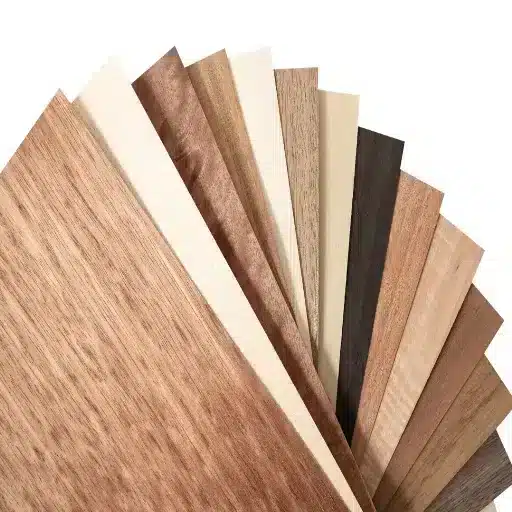
Wood Veneer for Green Building: A Specification Guide to LEED, WELL & Sustainable Certification
Wood veneers make a perfect material regarding FSC qualification for multiple LEED V4.1 and WELL v2 credits and are affixed only with FSC certification, NAUF or NAF composite cores, and low-VOC adhesives. Understanding these compliance pathways through which architects and designers can reduce embodied carbon while adding valuable certification points.
Only when Elena Ramos, a LEED AP at a Denver architectural firm, specified walnut veneer wall panels for a boutique hotel project last spring did she assume that the FSC label on the sample would equate to compliance for full credit. Three weeks into submittals, the contractor’s review discovered a very costly gap. The veneer face was FSC Controlled Wood. Zero dollars is allocated toward Materials & Resources credits (LEED). The project team scrapped and searched for FSC Pure veneer bonded with FSC-certified cores. The delay set the team back two weeks and nearly threw the project off course of completion.
No one should be surprised to see so many similar stories emerging around Elena. Green building certification has moved well beyond mere checklists. Now, regardless of what material is chosen, there will be documentation requirements, levels of compliance, and potential pitfalls. Wood veneer thus merges aesthetics, performance, and sustainability. When done properly, it’s probably one of the most straightforward paths to credit.
When done improperly, it becomes a submittal nightmare. This guide will walk you through how to specify wood veneer properly in your LEED v4.1 and WELL v2 projects. Including what FSC certification tier actually does earn credits, how to avoid the composite wood trap in compliance, what to ask manufacturers to provide as documentation, and how such new emerging options as thermally modified veneer broaden your sustainable palette.
Key Takeaways
- Specify FSC Pure or FSC Mixed veneer with certified cores as FSC Controlled Wood does not offer anything in contributing to any of the LEED MR credits with a $0 value.
- Hardwood veneer plywood is either of the assessments at composite wood under LEED that must meet the somewhat strict requirements of the EPA TSCA TITLE VI OR CARB ATCM Phase 2 formaldehyde limits.
- Health Product Declarations, Declare Labels, or CDPH Standard Method v1.2 compliance shall be furnished for configurations within WELL v2 Features X05-X08.
- Thermally modified wood veneer is timber that is chemically untreated and long-lasting and decay-resistant, making it an alternative material to treated wood or for Red List compliance projects.
- Postmodern veneer manufacturing saves 40-70% of carbon emissions compared to one equivalent solid wood processing and consumes more than 85-90% of the raw material.
Why Wood Veneer Is a Strategic Green Building Material

Sustainability is no longer something that can be said, although in architecture. a client expects it. Codes require it. Certification programs reward it. Veneer answers the three questions in a highly efficient manner are able to do so.
A log processed into wood veneer offers 20 to 40 times more than what can be manufactured from the same log milled into a solid timber. This is no minor by-product but a big rethinking about the use of forest resources. Modern veneering processes enable around 85-90% raw material utilization. A traditional sawmill often extracts only around 25% of its wood by volume. This is critical in determining the embodied carbon of the entire life cycle.
As a matter of fact, panels made from veneer add 30-50% less embodied carbon per square meter of finished area than solid timber materials. The warmth, grain, and biophilic benefits of natural wood are considered to be without the carbon mass of timber. For the LEED v4.1 or WELL v2 projects pursuing it, this translates straight into measurable environmental performance.
The argument does not end at just aesthetics. It is often because natural wood surfaces will help reduce stress, improve cognitive function, and improve well-being among occupants in a biophilic study. Moreover, WELL v2 uses a material connection with nature as a strategy in design. Veneer: practice this and learn how to enclose the whole interior in natural wood faster and more cost-effectively.
Understanding FSC Certification for Wood Veneer
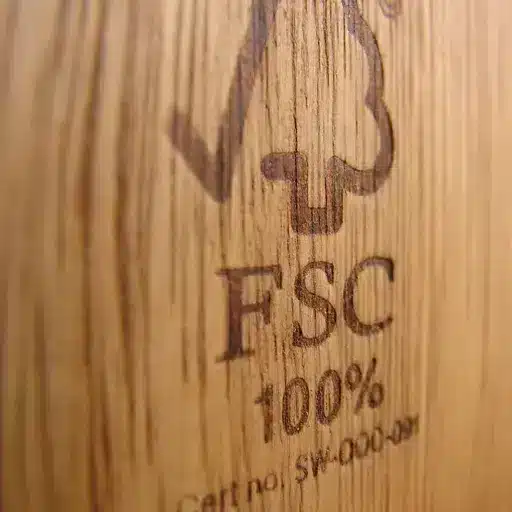
Forest Stewardship Council certification is the gold standard for responsibly sourced wood. But not all FSC labels are equal. Specifiers who treat every FSC logo as interchangeable risk the same submittal failure Elena Ramos encountered.
FSC Pure, FSC Mixed, and FSC Controlled Wood
FSC Pure means 100% of the wood fiber comes from FSC-certified forests. This tier offers the highest credit contribution in LEED calculations. If you need maximum MR credit value, FSC Pure is your target.
FSC Mixed blends FSC-certified fiber with controlled or recycled sources under chain-of-custody certification. A fabricator with FSC CoC certification can combine FSC Pure veneer faces with FSC Mixed or FSC Pure cores to create an FSC-labeled finished panel. This tier still contributes full value toward LEED MR credits.
FSC Controlled Wood is where specifiers stumble. Controlled Wood comes from sources that avoid unacceptable practices like illegal logging and genetically modified trees. It is not FSC-certified forest material. Under LEED v4.1, FSC Controlled Wood contributes zero dollars toward MR credit calculations. The veneer supplier can market it as responsibly sourced. It simply will not help your project earn certification points.
How to Calculate MR Credit Contributions
LEED v4.1 Materials & Resources credits use a cost-based methodology. You calculate the total cost of all wood-based materials in the project. Then you determine what percentage of that cost qualifies as FSC Pure or FSC Mixed. To reach the threshold for full credit, you need a meaningful portion of your wood budget to carry valid FSC claims.
Here is the multiplier effect most specifiers miss. An FSC-certified veneer face on a standard core earns credit for the veneer cost only. An FSC-certified veneer face on an FSC-certified core earns credit for both the veneer and the core cost. That can double or triple your MR contribution from the same panel assembly.
Documentation Required
Never rely on a product brochure. For LEED submittals, you need three documents from your veneer supplier or panel fabricator:
- FSC Chain-of-Custody Certificate proving the manufacturer or fabricator holds a valid FSC accreditation.
- Cost statement breaking down the dollar value of FSC-certified components.
- Product label or invoice clearly identifying the FSC claim (Pure, Mixed, or Controlled) for the specific material lot.
The fabricator applying veneer to the core must hold FSC CoC certification. The veneer supplier alone cannot create an FSC-labeled finished panel.
LEED v4.1: How Wood Veneer Earns Credits
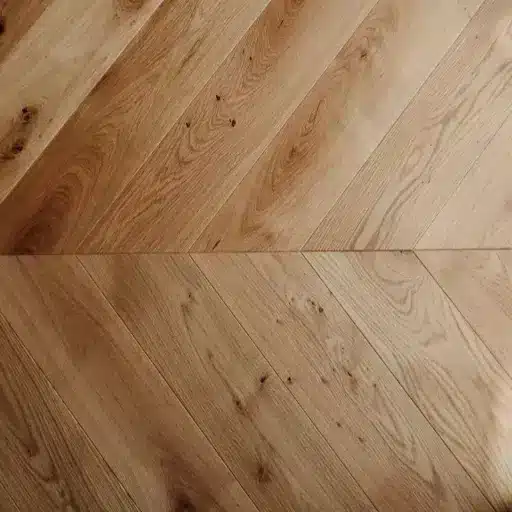
LEED v4.1 organizes credits into categories. Wood veneer assemblies can contribute directly to Materials & Resources and Indoor Environmental Quality credits. Understanding exactly how requires looking at each credit individually.
Materials & Resources Credits
BPDO – Sourcing of Raw Materials rewards projects that use products with responsible sourcing certifications. FSC-certified veneer and cores contribute here. The more certified wood you specify by cost, the stronger your contribution.
BPDO – Environmental Product Declarations requires third-party verified EPDs for building products. Leading veneer panel manufacturers now publish ISO-compliant EPDs for complete assemblies. Request these early in design development. Not every supplier has them ready.
Regional Materials credits materials extracted, processed, and manufactured within 500 miles of the project site. If your veneer supplier or panel fabricator operates within that radius, document the manufacturing location and raw material origin. Regional sourcing can stack with FSC certification for dual credit contribution.
Indoor Environmental Quality Credits
This is where compliance gets technical. And where many projects fail.
Low-Emitting Materials – Composite Wood requires at least 75% of all composite wood by cost or surface area to meet stringent formaldehyde limits. The critical detail: hardwood veneer plywood is classified as composite wood under LEED. It is not exempt like High-Pressure Laminate.
Your veneer panels must meet one of these standards:
- CARB ULEF (Ultra Low Emitting Formaldehyde)
- NAF (No Added Formaldehyde)
- NAUF (No Added Urea Formaldehyde)
- EPA TSCA Title VI compliance
Specifying a beautiful FSC-certified walnut veneer face bonded to a standard urea-formaldehyde core will fail this credit. The core matters as much as the face.
Low-Emitting Materials – VOC Emissions requires products to pass CDPH Standard Method v1.2 testing. Ask your supplier for a compliance letter or certificate showing the veneer assembly meets these limits.
Low-Emitting Materials – Adhesives & Sealants applies to the glues used to laminate veneer in shop or field conditions. Specify adhesives with no added urea-formaldehyde and low VOC content.
The Composite Wood Trap
Marcus Chen, a project manager at a commercial interiors firm in Atlanta, learned this lesson the hard way. His team specified FSC-certified oak veneer for a corporate headquarters pursuing LEED Gold. The submittals looked perfect until the LEED reviewer flagged the core material. The veneer was bonded to standard particleboard that exceeded formaldehyde limits. The entire wall panel system failed the EQ Low-Emitting Materials credit. Replacement panels added six weeks to the schedule.
The fix is simple if you catch it early. Always specify the core substrate in your veneer schedule. Require TSCA Title VI or CARB Phase 2 compliance. Better yet, specify NAF or NAUF cores from manufacturers like Columbia Forest Products’ PureBond line. The premium is modest. The compliance certainty is invaluable.
WELL Building Standard v2: Material Health & Wood Veneer
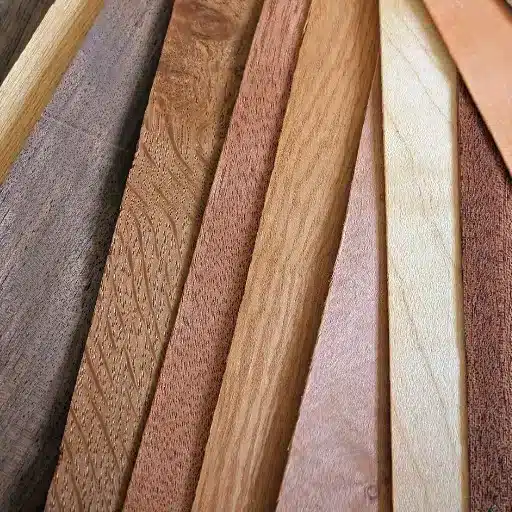
While LEED focuses on building performance and environmental impact, WELL v2 focuses on human health. Material health features are among the most consistently pursued WELL credits. Wood veneer assemblies play a significant role.
Features X05–X08: VOC Restrictions
WELL v2 imposes VOC constraints on construction materials. For wood veneer assemblies, compliance involves:
- Composite wood cores must be NAUF, NAF, or ULEF;
- Glues and finishes need to meet demanding VOC limits;
- End-product needs to meet CDPH Standard Method v1.2 or have UL GREENGUARD Gold Certification.
Material Transparency
It rewards products that hold proof verified by a third party. For veneer assemblies, these kinds of documents are most important for:
- Health Product Declarations (HPDs) disclosed to 100 ppm
- Declare Labels from ILFI
- Cradle to Cradle-certified
These reports list each chemical ingredient in the product. For projects running on both LEED and WELL, HPDs can meet Option 2 of the LEED v4.1 disclosure paths while contributing directly to Features X05–X08 of WELL.
Red List Compliance
Chemicals from the Red List are to be steered clear of for projects compliant with the Living Building Challenge or rigorous WELL interpretations prevailing them. The Red List includes halogenated polymers, PFAS, added formaldehyde, and specific antimicrobial treatments. Especially small is thermally modified veneer, highly durable and chemical preservative-free.
Acoustic Performance
It is an apparent neglect of the acoustic properties of the veneer material to meet the WELL Features S03 and S05, which have to do with the treatment of noise in buildings. Properties of perforated wood veneer panels, integrated with acoustical backings, match all requirements of acoustic performance and aesthetics for biophilic designs. Provide Noise Reduction Coefficient ratings appropriate when using veneer in open plan offices, conference rooms, or hospitality spaces.
Thermally Modified Wood Veneer: The Chemical-Free Option
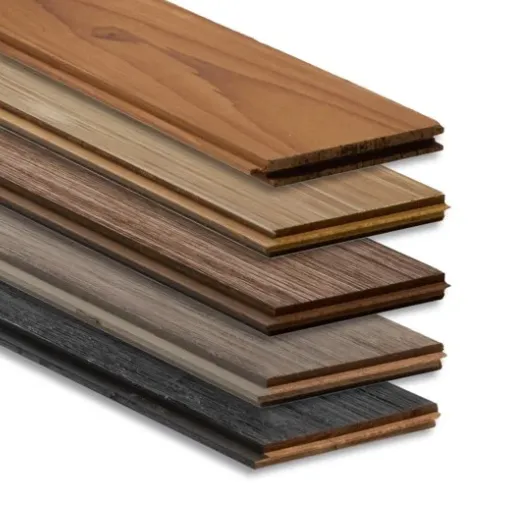
Not every sustainable project should utilize chemical treatments, as some clients have outrightly banned those treatments. An elegant alternative can be provided by thermally modified wood veneer.
It is a simple process. Wood is heated to a temperature between 160 and 215 degrees Celsius in a controlled oxygen-free environment. The heat changes the cellular structures of wood. This breaks down sugars and nutrients that are known to feed the decay fungus. Eventually, the material obtained is more dimensionally stable, has better decay resistance, and is less susceptible to dampness.
No chemicals. No preservatives. No biocides.
Thermally modified veneer takes an entire category of compliance concerns off the list, ideal for WELL certification projects, red list compliance, and/or general environmental ethics. Formaldehyde content does not need to be documented as well, because during the modification process, there is no addition of resins or adhesives to the wood itself.
The performance of thermally modified veneer has been proven to be excellent in those applications where veneering is applied, even though it tends to be used in facade design, bathroom countertop, and kitchen areas, and in every way it becomes moisture-free, which indeed stresses the natural ages with regular veneer. The process darkens the color to a natural state, developing rich, unvarying tones that are more and more preferred by designers for modern-day looks.
Thermal modification of wood products turned out to be one of the fastest-growing areas as far as sustainable construction is concerned. As whole-life carbon accounting has immediately become part of building codes, chemical-free durability will be appreciated.
Need specification support for a chemical-free project? Contact our team for thermally modified veneer options and custom quotes.
Specification Checklist for Sustainable Wood Veneer
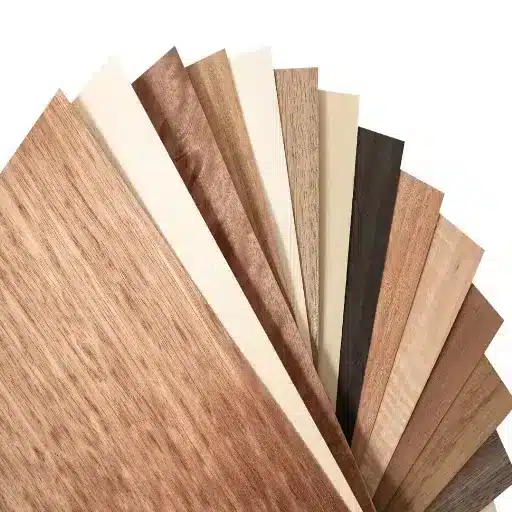
Use this checklist when writing specifications or reviewing submittals. Share it with your project team, contractor, and veneer supplier.
Face Veneer Requirements
- Wood Species: As per the selection of the architect out of the accepted samples
- Cutting mat: As specified by the architect, out of the accepted samples
- Thickness: From 0.55 mm to 0.70 mm, typically for light commercial applications, but can be adapted as per experiment, for instance, in very low thicknesses used in decorative laminates
- Certifications: FSC Pure or FSC Mixed. Provide CoC certificate and cost.
- Source: Preference for species harvested within a 500-mile radius of the project site, if available.
Core/Substrate Requirements
- Composite cores: Must be labeled TSCA Title VI compliant or must meet the limits of CARB ATCM Phase 2
- Resin type: NAF, NAUF, or ULEF as per the LEED EQ credit compliance
- Certification: FSC Core will maximize contribution to MR credits.
- EPD: To include life cycle analysis, this shall be verified by a third-party Environmental Product Declaration.
Adhesives, Finishes & Coatings
- Laminating adhesives: No added formaldehyde resins; low-VOC formulations
- Finishes: Waterborne, plant-based, or UV-cured finishes to aid in EQ submittals
- VOC testing: Comply with CDPH v1.2 Standard Method or UL GREENGUARD Gold
- Red List: Halogenated polymers, PFASs, added formaldehyde, and antimicrobials should be avoided, where feasible.
Required Submittals
- FSC Chain of Custody certificate for the manufacturer and fabricator
- Statement of costs of certified wood components
- EPD of panel assembly
- CARB/EPA TSCA Title VI compliance declaration
- Low-emitting materials declaration (CDPH or GREENGUARD Gold)
- HPD or Declare Label (For WELL or LEED Disclosures Paths)
- Documentation on regional materials indicating where they were extracted and manufactured
Ready-to-Use Specification Language
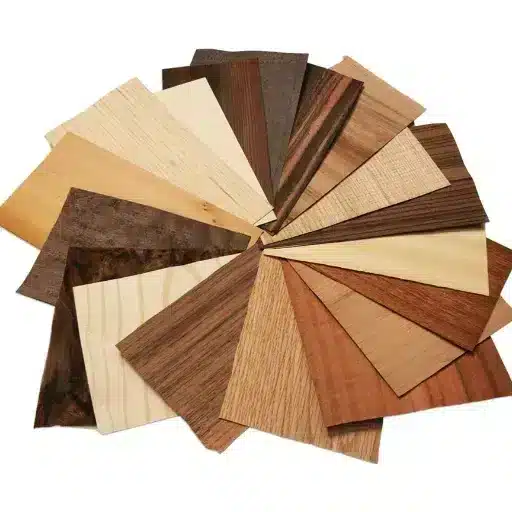
Copy and adapt this language directly into your project manual. This corresponds to typical LEED v4.1 and WELL v2 requirements for wood veneer panel assemblies.
Use FSC Pure and FSC Mixed chain-of-custody-certified wood veneer and panel assemblies. They have cores that have no added and must comply with EPA TSCA Title VI and CARB ATCM Phase 2 formaldehyde emission standards. Environmental Product Declaration, FSC Chain-of-Custody certificates with cost documentation and CDPH Standard Method v1.2 or UL GREENGUARD Gold low-emitting materials verification shall be provided.
For WELL projects, add:
Health Product Declarations or Declare Labels with 100 ppm disclosure for adhesives, finishes, and composite wood substrates in all veneer panel assemblies.
Sample Submittal Requirements Section
The following documents should be sent for wood veneer panel products: (1) Copy of FSC chain-of-custody certificate; (2) Detailed breakdown of costs on FSC-certified components; (3) Third-party verified EPD for a panel assembly; (4) EPA TSCA Title VI or CARB ATCM Phase 2 Compliance letter; (5) Standard Method v1.2 or GREENGUARD Gold for low-emitting materials by either CDPH; (6) Claim an HPD or Declare label if by Wellness features X05–X08.
2026 Trends: What’s Next for Sustainable Veneer
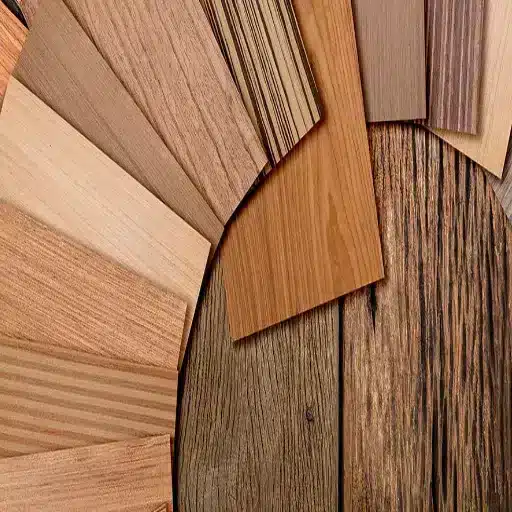
The wood veneer industry is evolving rapidly. Specifiers who stay ahead of these trends will deliver more innovative, more sustainable projects.
Digital printing on veneer has surged approximately 30% in adoption over the past year. The technology replicates the grain and color of rare, endangered, or geographically unavailable species without depleting those timber stocks. For projects seeking exotic aesthetics with ethical sourcing, digitally printed reconstituted veneer offers a compelling solution.
EPD standardization is accelerating across major manufacturer portfolios. Where EPDs were once rare premium offerings, they are becoming baseline documentation. Within two years, expect EPDs to be as standard as FSC certificates for commercial veneer products.
Acoustic veneer systems are gaining market share in open-plan commercial and hospitality interiors. These integrate perforated or slotted veneer faces with acoustic fleece or mineral wool backings. They satisfy WELL acoustic performance requirements while delivering the biophilic warmth that only natural wood provides.
Whole-life carbon accounting is shifting from being optional to compulsory for an increasing number of jurisdictions. In this sense, veneer poses an inherent material efficiency of 20-40 times the surface area of solid wood per log, making it the likely default selection for carbon-conscious design. Given that buildings are encountering a continuously growing share of embodied carbon allowances, veneer might substitute solid wood wherever aesthetics really count, and mass is less needed.
Artificial intelligence-based grading and defect detection is helping trim down waste in the production setup. Machine vision systems now find optimal cut patterns in real-time and improve yield and consistency. While the sustainability benefit is availed indirectly, the yield is more significant: less waste at the factory as a result of using fewer logs harvested for a similar yield.
Sophia Patel, an interior designer in Portland, recently completed a WELL Platinum wellness center using perforated acoustic cherry veneer panels. The client initially wanted solid wood. Sophia presented the carbon data. The veneer option reduced embodied carbon by 42% while delivering the same visual warmth. The acoustic backing added functionality that solid wood could not provide. The project earned WELL Features X05, X07, and S05 through a single material specification.
Stories like Sophia’s illustrate where sustainable design is heading. It is not about sacrifice. It is about smarter specification.
Conclusion
Wood veneer is not just cheaper as a cheaper form as opposed to solid wood today. It is a strategic material that provides green building certification, measurable environmental performance, human health benefits, and design flexibility.
The trick is accurate specification. Make sure your FSC level is not certified as being in question. Look for NAUF or NAF as the core type, request EPDs, HPDs, and CDPH compliance letters ahead of submittals, know hardwood veneer plywood falls under composite wood, and look at possible choices, such as thermally modified veneers, for projects in which durability without chemicals is paramount.
When you try to incorporate certification of wood and veneer into your design, you are not just finishing a surface. You are making a data-driven decision that conserves forests, cuts embodied carbon emissions, and creates healthier indoor environments.
Ready to specify certified wood veneer for your next LEED or WELL project? Contact VitalWood Global for FSC-certified veneer options, LEED compliance packages, and custom specification support. Our team can provide chain-of-custody documentation, EPDs, and sample submittals tailored to your certification pathway.
Together, we can build spaces that perform beautifully and responsibly.