
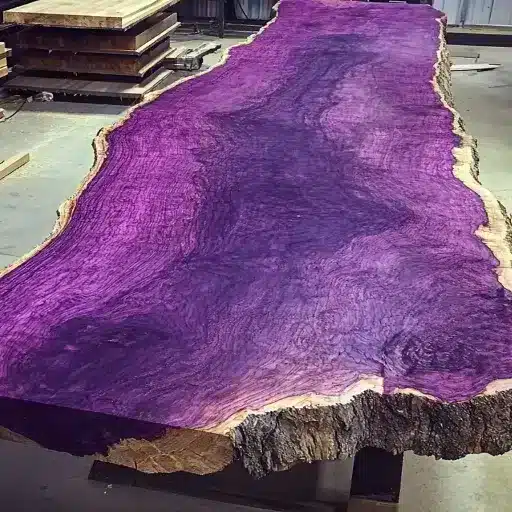
Purple Heart Wood Tree: From Rainforest Giant to Deep‑Purple Boards
Most people first meet purple heart as a shockingly purple board on a lumber rack, not as a living giant buried in a tropical canopy. The moment you realize that vivid color comes from a specific purple heart wood tree, the questions start: where it grows, how old it has to be, and what it costs the forest every time one comes down.
What Exactly Is the Purple Heart Wood Tree?
At its core, the purple heart wood tree is a trade name wrapped around a small cluster of closely related tropical hardwoods, not a single magical species. Woodworkers talk about “purpleheart” like it’s one tree, but in the forest you’re really looking at a group of dense, leggy legumes that all happen to yield that same startling violet heartwood once the log is opened up.
The Peltogyne genus: main species used for lumber
Botanically, the purpleheart story sits inside the genus Peltogyne, a group of neotropical trees in the legume family scattered across Central and South America. In the lumber yard you almost never see a species name on the bunk sticker, but in the literature you’ll run into names like Peltogyne paniculata, Peltogyne purpurea, or Peltogyne venosa as the main commercial sources of purpleheart boards and beams. Different regions tend to favor different species—Brazil, Guyana, and Suriname each have their “local” Peltogyne—but once you’re at the planer the working properties are close enough that they’re bundled together for trade. That’s why most serious databases just list “Peltogyne spp.” and move on; for a furniture maker or turner, density, color, and stability matter more than which Latin binomial was on the herbarium sheet.
From a practical standpoint, you can think of the genus as a family of cousins that all share the same genetic trick: they deposit purple‑toned extractives into the heartwood as the tree matures, while the surrounding sapwood stays much paler. So when you order purpleheart, you’re really buying the performance and color profile of that genus, not betting on a single tightly defined species boundary.
Tree size, form, and how it looks in the canopy
In the forest, a mature purple heart wood tree doesn’t look exotic so much as archetypal: tall, straight, and trying hard to get its crown into the light above everything else. You’re usually dealing with heights in the 25–40 meter range and respectable diameters that can push past 70–80 cm on good sites, big enough that a single stem can yield multiple long, clear faces without insane amounts of waste. The trunk tends to be fairly cylindrical with only modest buttressing compared to some of its rainforest neighbors, which is one reason it’s commercially attractive—you get usable log volume instead of a mass of flared, twisted base wood.
Up in the canopy, the tree reads like a classic emergent or upper‑canopy hardwood: a relatively compact crown riding high, with branching that doesn’t start until a long way up the bole. You’d walk past the bark without much excitement—generally gray‑brown, not wildly fissured, not screaming for attention—so it’s really the scale and straightness that tip off an experienced forester that this might be a Peltogyne worth marking. On a cruise line, it’s the stem profile and the stand context, not some cartoonishly purple bark, that makes you stop and note it.
Heartwood vs sapwood in a real log cross‑section
Open up a fresh purpleheart log and the heartwood–sapwood contrast is what makes everyone pull out their phone for a photo. The outer ring of sapwood is typically a pale grayish or yellow‑brown band, sometimes only a few centimeters thick, clinging to the outside of the disc in a way that almost looks like it belongs to a different species. Inside that ring, the heartwood core shows the familiar dull gray‑purple or brown‑violet the trade is built on—less neon than a finished, oxidized board, but clearly on the purple side of the spectrum rather than red or chocolate.
You can usually see the transition as a fairly sharp line rather than a vague gradient, which matters when you’re deciding how aggressively to trim off sapwood on higher‑end jobs. That said, the very center of the log can show color variability, especially in older trees where growth stresses, minor decay pockets, or mineral streaks have left their signatures. On a big end face, you might have a heartwood diameter of 55–60 cm with only a thin sapwood collar, which is why mills like it: a high percentage of the cross‑section is the dense, purple stuff you’re actually being paid for. And if you’ve ever watched a sawyer chase that transition around a slightly out‑of‑round log, you know how quickly decisions at the cross‑section level turn into real yield differences down the line.
Where in the World These Trees Actually Grow

The purple heart wood tree isn’t scattered all over the tropics; it’s a very specific Neotropical story. Think narrow band, not global smear.
Native range across Central and South America
In the wild, purpleheart sits in a belt that runs from southern Mexico and Central America down through the northern half of South America, with real commercial weight in countries like Brazil, Guyana, Suriname, and parts of the Amazon basin. According to regional timber profiles and wood‑species databases, most of the lumber on the market traces back to that Guiana Shield–Amazonia corridor rather than some vague “South American” catch‑all. So if you’re looking at a clean, straight 2800 mm board in a warehouse, odds are good the tree it came from was standing in a lowland tropical forest not far from a major river system that could move logs or sawn stock out.
The range isn’t uniform, either. Some Peltogyne species lean more toward Central America, others are very much Amazon or Guiana basin specialists, which is why you see different species names pop up depending on whether the source is a Brazilian forestry paper or a Caribbean logging report. For most of us on the receiving end, that nuance only shows up as small shifts in density or color tone between batches.
Climate, soil, and forest type purpleheart prefers
Ecologically, the purple heart wood tree is a classic moist lowland tropical hardwood: it likes high rainfall, warm temperatures year‑round, and doesn’t appreciate long dry seasons. Forestry sources put it mainly in evergreen or semi‑evergreen rainforests rather than in savannas or dry forests, often below about 600–700 meters elevation where moisture and heat stay fairly consistent. You’ll often find it on well‑drained soils—not waterlogged swamps—but with enough fertility and depth to support a 30‑plus‑meter stem without the whole thing toppling over in the first serious storm.
Stand‑level, it’s usually part of mixed‑species forests, not monoculture stands, sharing space with other commercial hardwoods like ipe, jatoba, or massaranduba depending on the exact region. That said, loggers will tell you: once you know what you’re looking for, you start seeing it in the same kinds of micro‑sites—spots with decent drainage, good light access once a gap opens, and just enough competition that the tree is pushed into that straight, columnar form we like for lumber. It’s not rare in a mystical sense, but it’s not a pioneer weed species either; it sits in that middle ground where site and stand dynamics really matter.
Is the Purple Heart Wood Tree Endangered or Sustainable?
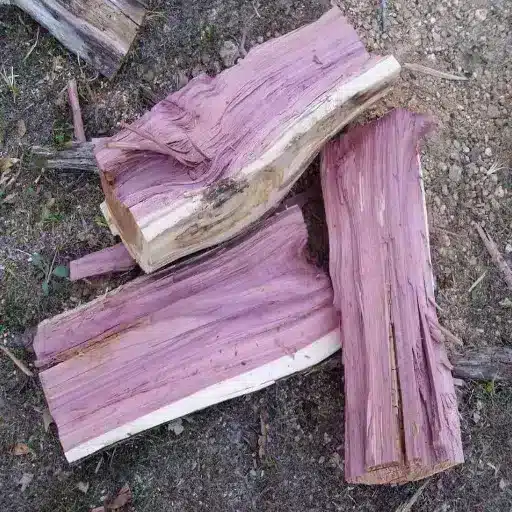
The honest answer is: it depends which purpleheart you’re talking about and how it was cut. The trade name covers multiple Peltogyne species, some doing relatively fine under current pressure, others flagged as vulnerable in specific countries.
Conservation status and logging pressures
From a conservation standpoint, purpleheart sits in that awkward middle ground: not universally listed as endangered, but absolutely on the radar in parts of its range. The Wood Database notes that several of the commonly harvested Peltogyne species used in the lumber trade are not currently on the IUCN Red List of Threatened Species, even though the genus as a whole is treated as a single “purpleheart” bucket in commerce. At the same time, individual species like Peltogyne purpurea have been assessed as Vulnerable in national red books and conservation lists for Costa Rica, Panama, and Colombia because of habitat loss and selective logging pressure on big, high‑value trees. So you can’t just say “purple heart wood tree is safe” or “purpleheart is endangered” and be done with it; the reality is patchy and very region‑specific.
Logging pressure is mostly about size and value. A straight 40‑meter Peltogyne with a 0.9–1.0 meter stem diameter is a serious prize in a mixed tropical forest, so it tends to be one of the first trees marked when concessions are working a block. Over time, repeated targeting of the largest, cleanest individuals can reduce the genetic and structural backbone of local populations even if total tree counts still look acceptable on paper. That said, in certified or tightly regulated concessions, you’ll see minimum diameter limits, retention of seed trees, and harvest cycles designed to keep purpleheart as a long‑term component of the stand rather than a one‑generation cash grab. On the ground, that’s the difference between seeing the species pop up in regeneration plots 25 years later or not at all.
Certification signals (FSC, legal harvest, documented origin)
From a buyer’s point of view, “Is this sustainable?” quickly turns into “What paperwork can I trust?” This is where certification and due diligence tools matter more than marketing copy. FSC certification is still the gold‑standard shorthand for responsible tropical sourcing, and you can find purpleheart products—decking, structural members, specialty timbers—offered as FSC 100% from well‑managed South American forests. That FSC logo doesn’t magically fix every ecological issue, but it at least tells you the harvest came through a certified management plan with independent auditing, chain‑of‑custody tracking, and some guardrails on impact.
Legal harvest evidence and documented origin sit right behind that. For purpleheart, serious suppliers will be able to show you not just a country of origin, but concession details, harvest permits, and chain‑of‑custody numbers that tie your batch back to a specific management unit. If you’re specifying for public projects or clients with procurement policies, you’ll also see guidance from agencies and NGOs steering buyers toward hardwoods that can be sourced with Category A‑type evidence—typically meaning third‑party certified legality and sustainability, often via FSC or equivalent schemes. In practice, when I see purpleheart on a spec today, the follow‑up is automatic: “Show me the FSC or robust legality documentation, and tell me which Peltogyne species and region we’re actually talking about.” Anything less is basically guessing with someone else’s forest.
3 Practical Questions Woodworkers Ask About the Tree
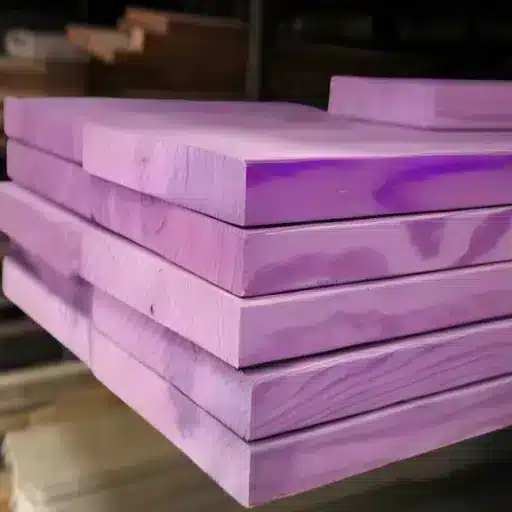
If you’ve worked with more than one batch of purpleheart, you already know the tree matters. The purple heart wood tree isn’t a black‑box that magically spits out identical boards; species, age, and growing conditions all leave fingerprints on what you see in the shop.
Does species (Peltogyne spp.) change how the wood behaves?
Short answer: yes, but not in the neat, catalog‑friendly way we’d like. You’ve got a whole cluster of Peltogyne species feeding the market, and they don’t line up perfectly on density, movement, or cutting behavior. One batch will plane clean with a sharp knife and just a hint of fuzz at the latewood, the next from a different region will feel a touch heavier and show more interlocked grain that loves to tear if you get greedy with feed speed. That variability is why serious suppliers and wood databases talk about a range for properties like density and hardness across “purpleheart” rather than one tidy number.
From a practical perspective, I treat purpleheart more like a family of steels than a single alloy: close enough that you can trust the broad behavior—hard, dense, durable—but different enough that once you find a batch that machines and finishes exactly how you like, you label those offcuts with source and date. Over time you start seeing patterns: certain mills or regions produce stock that burns a bit easier on the router, or that moves less across the grain after a harsh season change. That’s not random; that’s species mix plus site conditions showing through in the wood.
At what age/diameter does usable purple heartwood develop?
In the tree, color is a maturity story. The sapwood on younger or small‑diameter trees is pale and relatively thin, while the heartwood in the center hasn’t fully developed that deep purple we’re all chasing yet. Field descriptions and technical sheets for Peltogyne purpurea and related species point to commercial trees often being in the 25–35‑year range or older when harvested, with diameters large enough that the purple heartwood core gives you a decent yield after you trim off the lighter outer ring. If you’ve ever seen a small‑diameter log cross‑section, you’ll know the frustration: you might have a 28 cm disc with only a modest purple core and a lot of sapwood waste.
So in practice, “usable purple heartwood” tends to show up in a meaningful way once the tree has put enough years into laying down pigment‑rich, extractive‑laden heartwood at the center. Log buyers and mill operators don’t talk about it as a strict age rule—they talk in terms of minimum top‑end diameters they’re willing to truck out of the bush. Below a certain size, the yield just isn’t worth it; above that, you start getting those 2.7–3.2 m pieces where most of the face is solid purpleheart, not a band of color surrounded by pale edges you have to rip off.
How does the living tree influence color shift and oxidation later?
The color drama you see in the shop—fresh cut brown‑violet going to vivid purple, then slowly drifting toward a deeper, browner tone—is rooted in chemistry the tree built over decades. The heartwood is loaded with extractives that respond to oxygen and UV, and the exact mix of those compounds varies by species and growing conditions, which is why one board will “purple up” in a few days of light and another needs a week under the same exposure. You’ll see it on a bench: two offcuts side by side from different batches, same finish, one heading toward eggplant, the other stopping just a bit more muted and wine‑colored.
Grain and density play into that, too. Tighter, heavier pieces seem to shift color a bit more slowly and can hold onto their purple tone longer if you protect them with a UV‑inhibiting finish; more open or stressed stock will sometimes darken and brown faster under UV, especially if it’s left bare or under a thin oil that offers little UV blocking. That’s why finishing guides for purpleheart hammer on two things: limit direct UV where you can, and choose a topcoat with real UV absorbers if you want that “new” purple phase to stick around for more than a season. The living purple heart wood tree sets the chemical stage; your milling and finishing choices decide how fast that script plays out in the finished piece.
Working with Purple Heart Wood: What the Tree Doesn’t Tell You

The purple heart wood tree sets the physics; your tools and lungs have to deal with the consequences. On paper it’s just a dense tropical hardwood—at the jointer you find out what that really means.
Density, movement, and machining quirks
Purpleheart sits firmly in the “heavy, high‑strength” camp, closer to ipe than to walnut in how it feels under a blade. You notice it the first time you pick up a 1×4 that feels more like a steel flat bar than a board. That density is great for wear surfaces and structural pieces, but it punishes dull tools: carbide isn’t optional, it’s the default, and even then you’ll see edge life drop faster than you expect if you push feed rates too hard. Tear‑out can be sneaky; the grain often looks straight until you hit a local patch of interlock and suddenly the planer starts lifting chunks instead of shaving dust. So you creep up on final thickness, take lighter passes, and keep the knives absurdly sharp.
Movement is moderate but not negligible. The wood is generally stable once it’s properly dried and acclimated, yet it’s dense enough that any moisture gradient inside the board turns into real stress. You’ll sometimes see a 100 mm wide offcut move a millimeter or two after a heavy rip cut as the stress releases and the internal moisture profile evens out. It’s not balsa; you respect the drying schedule, let it sit in the shop longer than you would domestic hardwoods, and you design joinery with a bit of forgiveness rather than assuming it will behave like quartered white oak on its best day.
Glue, finish, and health considerations tied back to the species
On the glue side, purpleheart generally bonds well, but the natural oils and extractives in the heartwood mean surface prep matters. Fresh, slightly roughened surfaces and a decent open‑time adhesive—PVA Type II/III, urea formaldehyde, epoxy—are your friends; old, oxidized surfaces that have sat around for weeks are more likely to give you a starved joint if you don’t clean them up first. Clamp pressure needs to be real, not token, because you’re trying to pull together dense fibers that don’t compress as easily as domestic softwoods. I like to hit jointed edges with a light pass right before glue‑up; you’d notice the difference in squeeze‑out on a long edge‑glued panel.
Finishing is where the chemistry of the species crashes into aesthetics. Fresh‑machined purpleheart can look dull brown‑violet, then pop into a more vivid purple with a bit of light exposure, and eventually drift toward a deeper, browner tone over months or years. Clear oils and non‑UV‑blocking finishes accelerate the shift; they warm the color but don’t protect the underlying pigments from UV. If a client actually wants to keep that “new purple” phase, you’re talking UV‑inhibiting film finishes—modern polyurethanes or conversion varnishes with absorbers—and some honest conversation about expectations, because even the best schedule is slowing oxidation, not stopping it.
Health‑wise, the same extractives that make purpleheart durable and colorful can irritate people. A fair number of woodworkers report skin sensitivity, eye irritation, or respiratory issues when machining it heavily, especially in enclosed shops with marginal dust collection. It’s not universal, but it’s common enough that I treat purpleheart dust like something between walnut and tropical irritant species: solid dust extraction, a real respirator when you’re hogging away on the drum sander, and gloves if you already know your skin reacts to exotic hardwoods. The tree doesn’t advertise any of that when it’s standing in the forest. The first long ripping session on a table saw with marginal dust collection does.
Frequently Asked Questions (FAQ)
-
Q: What kind of tree does purple heart wood actually come from?
A: “Purpleheart” isn’t one single tree but several species in the Peltogyne genus, native to Central and South American rainforests. In practice, your board might be Peltogyne purpurea or Peltogyne venosa and you’ll never see that on the invoice. A 2.7‑meter decking plank in your shop probably started life as a tall, straight canopy tree in a mixed tropical stand. -
Q: Is the purple heart wood tree endangered, or is it okay to use in projects?
A: It’s not blanket‑listed like some rosewoods, but the picture is mixed. Some Peltogyne species are locally considered vulnerable where logging and habitat loss overlap. When you spec purpleheart for a large deck or stair stringer run, the responsible move is to insist on documented origin and, ideally, FSC or equivalent certification rather than generic “South American hardwood” paperwork. -
Q: Where do purple heart wood trees grow, and does that affect the lumber?
A: They grow in humid, lowland tropical forests from southern Mexico down into the Amazon and Guiana Shield. Site conditions matter: a slow‑grown tree on well‑drained soil in northern Brazil can yield slightly denser, finer‑textured stock than a faster‑grown cousin elsewhere. You’ll feel it when you plane two boards from different suppliers and one “sings” under the knife while the other fights back. -
Q: At what size does a purple heart wood tree start producing that full purple heartwood?
A: Usable purple heartwood develops as the tree matures and the inner growth rings are converted to extractive‑rich heartwood. In small 25–30 cm logs you might see a relatively thin purple core with lots of pale sapwood to trim off, which kills yield. Mills prefer larger stems where a cross‑section gives you a broad, mostly purple disc so a 150 mm board is purple edge‑to‑edge. -
Q: Why does purpleheart change color after I work it if the tree is naturally purple?
A: In the standing tree, those pigments sit in a protected, low‑oxygen environment. Once you saw or plane the heartwood, fresh surfaces meet oxygen and UV, so the color walks through phases: brown‑violet when cut, brighter purple after a bit of light, then gradually browner. Leave two offcuts on a sunny windowsill for a week and you’ll see one side dramatically different from the face that stayed on the bench.
References
-
Utah State University Extension. (n.d.). Redcedar, Eastern – Heartwood Color and Properties. https://extension.usu.edu/treebrowser/catalog/redcedar-eastern
-
Purdue University Fort Wayne. (2023). Eastern Redbud – Native Trees Information Page. https://www.pfw.edu/native-trees/eastern-redbud
-
The Ohio State University. (2024). Redbud (Cercis canadensis) – Tree Profile. https://u.osu.edu/ckowalski222/trees/
-
Franklin & Marshall College Arboretum. (2024). Princess Tree (Paulownia tomentosa) – Tree Species Listing. https://www.fandm.edu/arboretum/complete-tree-species-listing/princess-tree-paulownia-tomentosa.html