

Fire Rated Wood Veneer Panels: The Specifier’s Guide to Code-Compliant Wood Interiors
Fire rated wood veneer panels are real wood-faced architectural panels bonded to engineered cores that slow flame spread and reduce smoke development enough to meet building code requirements. The fire rating lives in the core — not the thin veneer face — which means specifiers must choose the right substrate, standard, and class for each project location.
The lobby looked perfect in the rendering. Quarter-sawn white oak veneer on every corridor wall, warm and continuous from the elevator lobby to the executive suite. Then the plan checker sent back the submittal. The panels had no fire rating. The architect had not known that IBC Section 803 requires a Class A interior finish in corridors. The interior designer had not known that a fire-rated version of the same oak veneer existed. And the specifier had not known how to write the callout, so the millwork shop would not substitute a standard core.
That rejection cost the project three weeks and a painful change order. This guide exists so it never happens on yours.
Fire rated wood veneer panels are not exotic products. They are standard items from multiple manufacturers. The problem is that the specification landscape is fragmented across ASTM E84, EN 13501-1, and NFPA 285, with no unified reference that tells you which standard applies, which core delivers it, and how to document it on a drawing. Whether you are specifying for a hospital corridor or a high-rise lobby, you will leave this article with a defensible specification and a clear view of your core options.
Key Takeaways
- Fire rated wood veneer panels achieve their rating from the core substrate, not the thin wood face. FR-MDF, gypsum, and mineral fiber are the most common cores that deliver code-compliant ratings.
- ASTM E84 governs U.S. surface burning characteristics (Class A/B/C). EN 13501-1 governs European reaction-to-fire (Euroclass A1 through F). NFPA 285 tests wall assemblies, not panels.
- Class A does not mean non-combustible. It means low flame spread (FSI 0–25). True non-combustibility requires A2-s1,d0 under EN 13501-1, typically achieved with gypsum cores.
- Fire-rated panels typically cost 1.3 to 2.0 times standard veneer panels, driven by core material and certification testing.
- FSC certification and fire rating are independent. A sustainably sourced panel is not automatically fire-rated, and a fire-rated panel is not automatically sustainable.
Why Fire Ratings Matter for Wood Veneer Panels
Building codes treat wood as combustible. The International Building Code (IBC) and NFPA 101 Life Safety Code restrict interior finish materials based on two metrics: flame spread and smoke development. Fire rated wood veneer panels are no exception. At roughly 0.5 to 1.0 millimeters thick, the veneer face burns off in seconds during a fire event. The rating comes almost entirely from what is behind it.
That is why specifying the wrong rating — or omitting it entirely — leads to plan-check rejection, change orders, and liability exposure. Engineered cores and fire-retardant treatments can push a wood-veneered panel to Class A or even non-combustible status. Most specifiers simply do not know the difference between the paths that get you there.
When Fire-Rated Veneer Is Required
Corridors, exits, high-rise interiors above 75 feet, healthcare occupancies, and atriums almost always require Class A under IBC Section 803.
When It Is Optional but Wise
Hospitality lobbies, corporate reception areas, and retail flagship spaces may not trigger mandatory Class A if sprinklered and low-occupancy. Many owners and insurers still demand it as a risk-management decision.
When It Is Over-Specified
Back-of-house utility rooms and equipment closets rarely need rated veneer. Standard panels are usually sufficient. Upgrading these spaces to Class A is a budget that could move to sustainability certifications or acoustic treatments instead.
If you want a broader primer on how veneer panels are built before diving into fire ratings, start with our complete guide to wood veneer panels, then return here for the code-compliance detail.
The Three Fire Standards Specifiers Need to Know
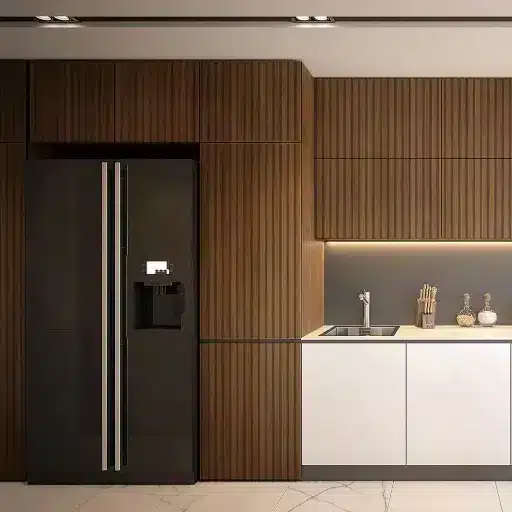
In practice, you will encounter three standards on any given project. Two test the material itself. One tests the assembly. Confusing them is the single most common mistake we see in fire-rated veneer specifications.
| Standard | Scope | Region | What It Tests |
|---|---|---|---|
| ASTM E84 | Material | United States | Surface burning characteristics (flame spread + smoke) |
| EN 13501-1 | Material | Europe / Global | Reaction to fire (combustibility + smoke + droplets) |
| NFPA 285 | Assembly | United States | Fire propagation through exterior wall assemblies |
ASTM E84 — Surface Burning Characteristics
ASTM E84 is the Steiner tunnel test. A panel sample is mounted on a ceiling-like position inside a long chamber, exposed to a controlled flame source, and measured for how far and how fast flames travel across its surface. The result is a Flame Spread Index (FSI) and a Smoke Developed Index (SDI). These two numbers determine Class A, B, or C.
EN 13501-1 — Reaction to Fire
EN 13501-1 uses a single-flame source test and additional furnace methods to classify materials from A1 (non-combustible) down to F (no performance determined). The suffixes matter: s1 means low smoke production, d0 means no flaming droplets. A2-s1,d0 is the gold standard for high-occupancy European interiors.
NFPA 285 — Assembly Fire Propagation
NFPA 285 does not test panels. It tests complete wall assemblies — insulation, air barriers, cavity details, and exterior finish — in a multi-story burn scenario. A panel alone cannot be “NFPA 285 rated.” Only a wall system can. If your project requires NFPA 285 compliance, you need an assembly-specific test report from the wall system designer, not just a panel data sheet.
ASTM E84 Class A, B, and C: What the Numbers Mean
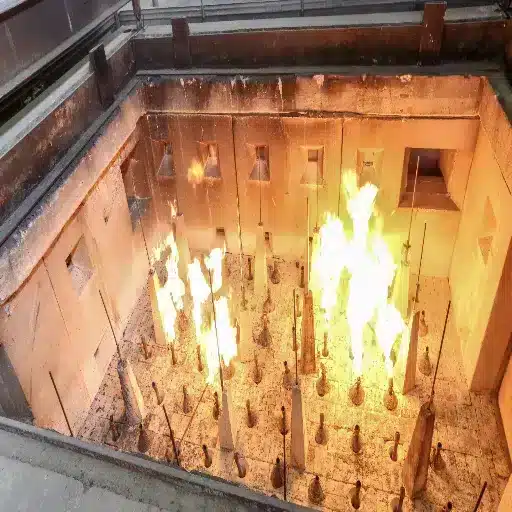
The numbers that come out of the Steiner tunnel drive every plan-check conversation in the United States. Here is what they mean in plain language.
Class A means a Flame Spread Index of 0 to 25 and a Smoke Developed Index of 0 to 450. This is the threshold for corridors, exits, high-rise interiors, and most public occupancies. It is the most commonly specified rating for commercial wood veneer panels.
Class B means an FSI of 26 to 75 with the same SDI cap of 450. Some sprinklered office and retail interiors accept it, though most cores can achieve Class A with minimal additional cost.
Class C means an FSI of 76 to 200. It is generally prohibited in exits and corridors under the IBC and is rarely specified for commercial veneer work.
The Class A Misconception
Class A does not mean the panel will not burn. It means flames spread slowly across its surface, and smoke development stays within limits. A Class A panel will still char and burn through in a sustained fire. True non-combustibility requires EN 13501-1 A1 or A2, which gypsum-core panels can achieve.
EN 13501-1 for European and Global Projects

European projects and multinational firms increasingly reference EN 13501-1. The Euroclass system is not directly convertible from ASTM E84.
The Euroclass scale runs A1, A2, B, C, D, E, and F. A1 is fully non-combustible. A2 is limited combustibility. B through E show progressively worse reaction-to-fire performance. F means no test data or failure.
The suffixes are where specifiers often get lost:
- s1, s2, s3 rate smoke production. S1 is low smoke. S3 is not a requirement met.
- d0, d1, d2 rate flaming droplets. D0 means none. D2 means heavy dripping.
A2-s1,d0 is the specification you will see on high-occupancy European projects. Gypsum-core panels achieve this without fire-retardant chemicals.
When U.S. Projects Reference EN 13501-1
Do not assume that an ASTM E84 Class A panel automatically meets A2-s1,d0. The tests measure different things, and substitution without verification can trigger a rejected submittal.
Core Substrates for Fire Rated Wood Veneer Panels
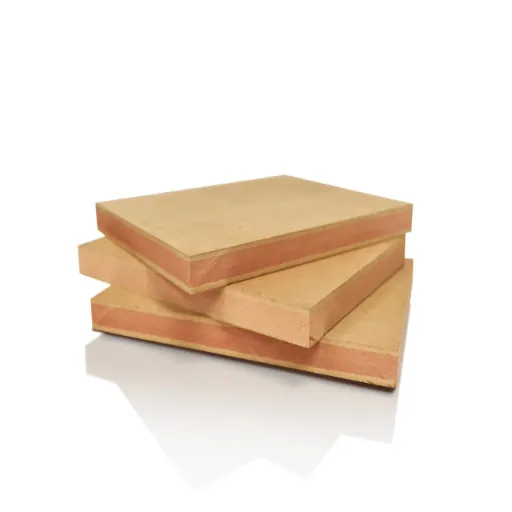
The veneer face is decorative and thin. At 0.5 to 1.0 millimeters, it contributes almost nothing to the fire rating. The core beneath it does all the work. Choosing the right core is the most important decision in a fire-rated veneer specification.
Fire-Retardant MDF (FR-MDF)
FR-MDF is the workhorse of the fire-rated veneer world. Manufacturers achieve the rating by pressure-impregnating standard MDF with fire-retardant chemicals, or by formulating the resin itself to be inherently fire-retardant. Both approaches can deliver ASTM E84 Class A. FR-MDF machines well, bonds reliably to veneer faces, and costs less than gypsum alternatives. The trade-off is moisture sensitivity — it swells more than standard MDF when exposed to humidity.
Gypsum Core
Gypsum is non-combustible. A wood veneer panel bonded to a gypsum core can achieve EN 13501-1 A2-s1,d0 without any fire-retardant chemicals in the veneer or adhesive. That makes it the cleanest option for sustainability-focused projects. The downside is weight — gypsum-core panels are significantly heavier than FR-MDF, which affects handling, installation hardware, and seismic loading.
Fire-Retardant Particleboard (FR-PB)
FR-PB is the budget option. It typically achieves Class B or C under ASTM E84, which makes it suitable for institutional millwork, cabinet interiors, and back-of-house applications where Class A is not triggered. It is heavier and less machinable than FR-MDF, so you will see it more in fixed casework than in large wall panels.
PET and Recycled PET Felt Core
Lightweight, acoustic, and popular for slatted and grooved veneer panels. PET cores can achieve Class A or B, depending on formulation. If your project needs perforated fire-rated panels with NRC above 0.80, PET often delivers both.
Mineral Fiber, Cementitious, and Honeycomb Cores
Mineral fiber and cementitious cores appear where non-combustibility is mandatory, though bonding veneer to them requires specialized adhesives. Aluminum honeycomb is used in aviation and modular systems for its lightweight. Paper honeycomb is generally avoided for fire-rated applications unless specifically treated.
Core-Rating Decision Table
| Core Material | Typical ASTM E84 | Typical EN 13501-1 | Weight | Best Application |
|---|---|---|---|---|
| FR-MDF | Class A | B-s1,d0 | Medium | Walls, ceilings, millwork |
| Gypsum | Class A | A2-s1,d0 | Heavy | High-rise, corridors, atriums |
| FR-Particleboard | Class B–C | C–D | Heavy | Cabinet interiors, institutional |
| PET Felt | Class A–B | B–C | Light | Acoustic slat panels, feature walls |
| Mineral Fiber | Class A | A2 | Heavy | Non-combustible mandatory zones |
Use this table as a starting point, not a final substitute for requesting test reports on the exact species, finish, and adhesive combination you plan to specify.
Manufacturers achieve fire ratings through pressure-impregnated chemicals, inherently fire-retardant resins, or non-combustible cores like gypsum. Each method affects bonding, weight, and end-of-life disposal differently. Always require that the manufacturer confirm bonding compatibility between your specified veneer species, adhesive, and core in writing.
Specifying Fire-Rated Veneer Panels: A Checklist

A complete specification answers these questions. Skip one, and the panel that ships may surprise you.
- Occupancy and code jurisdiction (IBC, NFPA 101, local amendments)
- Location within the building (corridor, lobby, egress path, high-rise zone)
- Required fire standard (ASTM E84, EN 13501-1, or NFPA 285 assembly rating)
- Required class or rating (Class A, B, C; or A2-s1,d0, B-s1,d0)
- Core substrate (FR-MDF, gypsum, PET, mineral fiber)
- Veneer species, grade, and matching
- Finish (natural, stained, UV clear — note that some finishes void ratings)
- Acoustic requirements (perforated? NRC target?)
- Certification (FSC, PEFC, CARB P2, TSCA Title VI)
- Mockup or sample approval with current fire-test documentation
- Installation substrate and conditions (adhesives, air gaps, backing boards)
A complete callout reads cleanly when assembled:
Walnut veneer panel, plain sliced, AA grade, FR-MDF core, Class A per ASTM E84, natural clear UV finish, FSC certified. Submit sample with test report for approval.
Drop that on a drawing and your millwork shop has zero room for assumption.
Cost, Sustainability, and Fire Rating Decisions
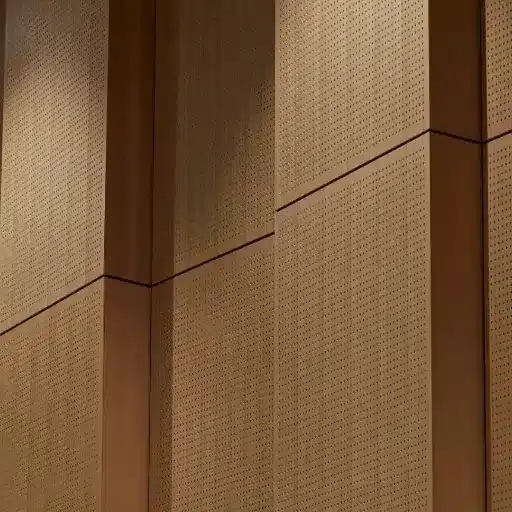
Fire rated wood veneer panels typically cost 30 to 100 percent more than standard panels in the same species, driven by core material and certification testing. FR-MDF is the sweet spot for most commercial interiors — Class A at moderate weight and cost. Gypsum-core panels are the most expensive and heaviest option, but they offer the highest ratings and the cleanest sustainability profile.
Sustainability Trade-Offs
Here is where the decision gets interesting. FR chemicals can complicate end-of-life recycling. Some jurisdictions classify pressure-impregnated FR-MDF as hazardous waste. Inherently fire-retardant resins and gypsum cores avoid that problem. If your project is pursuing LEED or WELL certification, the core choice matters as much as the veneer species. Pair the right core with FSC-certified wood veneer panels to cover both fire rating and sustainability requirements.
When to Upgrade and When to Downgrade
Corridors and exits always need Class A. Back-of-house spaces with sprinklers may accept Class B in some jurisdictions. Atriums need Class A with attention to smoke development. If you are unsure which class applies, ask your code consultant before design development closes.
Maria, a senior specifier at a healthcare-focused firm in Chicago, specified standard walnut veneer for all public corridors on a 200-bed hospital expansion. At the 50 percent DD review, the owner’s code consultant flagged that IBC Section 803 required Class A for corridor finishes. The team had eight weeks to redesign. We helped Maria map every veneer location to the correct fire class, swapped corridor walls to FR-MDF Class A, and kept standard cores in patient rooms where code allowed. The redesign added roughly 12 percent to the veneer budget but avoided a three-month delay.
Common Mistakes Specifiers Make With Fire-Rated Veneer
The same errors show up on nearly every fire-rated veneer consultation we run. Watch for these.
- Assuming Class A means the panel will not burn. It will. It just spreads flame slowly. True non-combustibility is a different category entirely.
- Specifying a fire-rated panel and then painting or staining it on-site. Many finishes void the fire rating. If the design calls for a custom stain, specify a factory-applied fire-rated finish system, or verify with the manufacturer that the proposed finish is compatible.
- Confusing ASTM E84 with NFPA 285. ASTM E84 tests the panel material. NFPA 285 tests the wall assembly. A panel with a Class A ASTM E84 report is not automatically compliant in an NFPA 285 assembly.
- Omitting the installation substrate from the spec. A Class A panel mounted on a combustible substrate with an air gap may not perform as intended. Specify the backing board, adhesive, and fastening system together.
- Assuming all fire-rated cores are equal. FR-MDF and gypsum behave very differently in terms of moisture, weight, and machinability. Match the core to the application, not just the rating.
- Not requesting current test reports. Fire-test reports expire or are updated when formulations change. Always ask for the report that matches the exact species, finish, and core you are specifying.
Fire-Rated Veneer by Application: A Quick-Reference Map
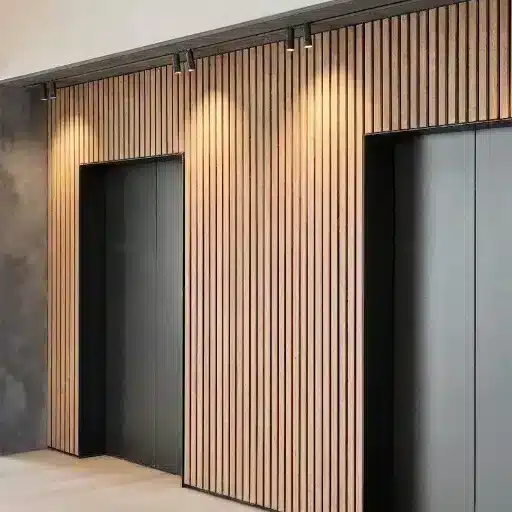
Different building types trigger different requirements. Here is where fire-rated wood veneer panels most commonly appear, and what specifiers typically need.
Corridors and Egress Paths
Class A ASTM E84 is mandatory. FR-MDF is the default core for most commercial projects. Gypsum core is preferred where liability exposure is highest — hospitals, high-rises, transit hubs. Avoid finishes that void the rating.
High-Rise Interior Finish
IBC restricts interior finish above 75 feet to Class A in most occupancies. Gypsum-core panels are increasingly preferred here because insurers value the non-combustible profile.
Healthcare
Hospitals and clinics need Class A plus low smoke production. If your project references EN 13501-1, specify A2-s1,d0 or at minimum B-s1,d0. CDPH VOC compliance is standard for healthcare interiors, and infection-control-friendly finishes may limit stain options.
Hospitality Lobbies and Restaurants
Class A or B, depending on occupancy and sprinkler coverage. Many hospitality clients voluntarily specify Class A for brand consistency across properties, even when code does not require it.
Atriums and Large Volume Spaces
Smoke development matters as much as flame spread in atriums. An s1 smoke rating under EN 13501-1 is critical. Complex installation conditions — suspended ceilings, curved surfaces, integrated lighting — affect both fire performance and fabrication.
Acoustic Ceilings and Feature Walls
Perforated fire-rated panels with PET or mineral wool backing can deliver both NRC values above 0.80 and Class A fire ratings. Verify both metrics together.
The Rating Lives in the Core
If you remember nothing else, remember this: the fire rating of a wood veneer panel lives in the core, not the face. The veneer gives you beauty, grain, and warmth. The core gives you compliance. Specify the core first, the veneer second, and the finish third — and always confirm that the specific combination has been tested and documented.
Three actions move every fire-rated veneer specification forward.
- Match the standard to the project’s jurisdiction. ASTM E84 for U.S. commercial work. EN 13501-1 for European or multinational projects. NFPA 285 only when the wall assembly requires it.
- Match the core to the rating and application. FR-MDF for most Class A walls. Gypsum for non-combustible requirements. PET for acoustic feature walls.
- Request test reports with the exact species, finish, and core specified. A generic Class A letter is not enough.
VitalWood Global supplies fire rated wood veneer panels across ASTM E84 and EN 13501-1 ratings, with FR-MDF, gypsum, and PET core options available. FSC-certified sourcing and formaldehyde-free core options are available on request. Request a fire-rated sample set with test reports, and our specification team will review your drawings, confirm the rating requirements, and ship samples to your studio or jobsite. Code-compliant wood interiors are not a compromise. They are a specification decision, and this guide gives you the framework to make it confidently.