
Why Maple Flooring Turns Yellow And How To Keep It Light
Yes, maple flooring turns yellow. But the color change almost never comes from where people assume. In most homes, the culprit is the finish sitting on top of the wood, not the wood itself.
Here is what makes this question so frustrating. Search “does maple flooring turn yellow” and you will find two confident, opposite answers. One camp says only the film yellows and the wood underneath is fine. The other insists maple is photosensitive and changes on its own. Both groups are describing something real. Neither one is telling you the whole story, and neither one tells you how to figure out which situation you are standing on.
The good news: the two causes look almost identical but leave different fingerprints. Once you know what to look for, a five-second test tells you which one you have. That matters, because one is fixable with a different finish and the other is not.
This guide explains both mechanisms in plain language, gives you the test that separates them, and walks through what actually works to keep maple floors light. We also cover the engineered and prefinished cases that most advice ignores, and what a fix costs in 2026.
VitalWood Global manufactures maple veneer and engineered wood products, so we spend a lot of time thinking about how maple behaves under a finish. That work is where this explanation comes from.
Key Takeaways
- Two separate things yellow a maple floor: the finish film (mostly oil-based polyurethane) and the wood itself reacting to UV light.
- The rug test tells them apart. Pale under rugs and warm in the sun means UV. Uniform amber everywhere, including under rugs, means the finish.
- Oil-based polyurethane ambering is baked into the cured film and cannot be cleaned, polished, or screened away. Only a full sand-to-bare-wood removes it.
- A water-based finish with a UV inhibitor is the single biggest lever for keeping maple light. Sheen level has no effect on color.
- Some honey tone is normal. Maple’s color shift is not a defect, and no finish stops it completely.
Does Maple Flooring Turn Yellow? The Short Answer
Maple flooring commonly turns warmer over time. In the great majority of cases, the change you are seeing is the finish aging, not the wood. Oil-based polyurethane, linseed oil, tung oil, Danish oil, amber shellac, and lacquer all warm toward amber as they cure and age. Pale maple makes that shift obvious because there is nowhere for it to hide.
The second cause is the wood itself. Maple is a light, low-tannin hardwood, and UV light interacts with the wood’s surface over years. That change is slower, and it is permanent.
So the honest answer has two parts. If your maple went yellow, you are most likely looking at finish ambering. If it went yellow in some places and stayed pale in others, you are looking at light. And if the amber is uniform across the entire floor, including the areas that never see sun, the finish is the whole story.
The Two Causes, Side by Side
| Finish ambering | Wood photosensitivity | |
|---|---|---|
| What changes | The cured finish film on the surface | The wood surface itself |
| Why it happens | Alkyd-based finishes contain bonds that absorb UV and re-emit it as warm light | UV interacts with lignin and the wood’s extractives |
| Does light matter? | No. It happens in the dark, and UV only speeds it up | Yes. No light, no change |
| Where you see it | Uniform across the whole floor, including under rugs | Follows the light; protected areas stay pale |
| Typical speed | Noticeable in 1–3 years, clearly amber by year 5+ | Slow, gradual, measured in years |
| Can it be fixed? | Yes, by sanding to bare wood | Not fully; can be lightened with bleach or lye |
| How to avoid it | Use a water-based, non-ambering finish | Use a UV-inhibited finish and manage direct sunlight |
Do you want to see how this plays out in real flooring specs? Explore our engineered maple flooring guide to see how wear layers, cores, and finish systems come together.
Why You’ll Find Contradictory Answers Online
The contradiction has a simple explanation. The people writing about finish chemistry are usually finishing furniture in a shop. The people writing about sun damage are usually talking about floors in a house. Those are not the same environment, and they do not produce the same result.
A cabinet lives indoors, often out of direct light, and its film is what visitors notice. A floor takes the full force of a south-facing window for a decade. Same wood, same chemistry, wildly different UV dose.
So when a finishing guide tells you the wood underneath never changed, it is describing a piece of furniture. When a flooring guide tells you maple is photosensitive, it is describing a floor. Both statements can be true at once. The useful question is not “who is right” but “which mechanism is dominant on my floor.” The test below answers that.
Cause 1: The Finish Ambers (The Most Common Case)
Diane noticed it during a spring repaint. Her maple living room floor, twelve years old, had taken on a warm orange cast that she had somehow stopped seeing. Her painter told her it was the wood. Her flooring contractor told her it was the finish. Both men were certain, and they could not both be right.
They could, actually, but only one of them matched what she was seeing. Her floor was amber in the corners, amber under the sofa, amber everywhere. That uniform tint is the signature of a finish problem.
Why Oil-Based Polyurethane Turns Amber
Oil-based polyurethane is a urethane-modified alkyd resin carried in mineral spirits. As that film cures, it forms aromatic carbon bonds that absorb ultraviolet light and re-emit it at warmer wavelengths. In plain terms, the amber is built into the chemistry from the moment the can is opened, and it deepens with age and light. That chemistry is the whole story behind oil-based polyurethane yellowing.
Water-based polyurethane works differently. It uses an acrylic-urethane resin that lacks those aromatic groups, so a good water-based film dries clear and largely stays clear. That single difference is why water-based finishes are the default recommendation for pale maple.
The Other Finishes That Amber
Polyurethane is not the only offender. Linseed oil, tung oil, Danish oil, amber shellac, and nitrocellulose lacquer all warm over time. If a finish has an oil base or a natural resin with a warm tone, expect it to deepen.
One caution worth knowing: products marketed as “non-yellowing” oil-based polyurethane are mostly marketing. They yellow less than standard oil-based formulas, but more than a decent water-based finish. If color stability is the goal, the base chemistry matters more than the label.
Why the Amber in the Film Cannot Be Undone
Here is the part that changes what you do next. The amber is part of the cured polymer, not a layer sitting on top of it. Cleaning will not touch it. Polishing will not touch it. A screen-and-recoat will not touch it either, because a recoat adds a new clear layer over the old ambered one.
The only thing that removes finish ambering is sanding down to bare wood and starting over. That is an expensive answer, and it is the reason prevention matters so much more than correction on pale maple.
Cause 2: Why Maple Wood Turns Yellow Under UV Light
The second mechanism is slower and less common, but it is real. Maple is a light, low-extractive hardwood, and its surface responds to ultraviolet light over time. It is also the answer to why maple wood turns yellow in some rooms but not others.
What UV Does to Maple
Ultraviolet light degrades lignin, the natural polymer that binds wood fibers and contributes to its color. Maple starts so pale that even a modest shift is visible, which is exactly why maple, birch, ash, and pine are all rated high for visible color change. Dark woods hide the same process. Pale woods broadcast it.
Does Maple Darken or Lighten? Resolving the Contradiction
This is where the internet gets genuinely confusing, and it is worth settling. Some sources say maple darkens to honey. Others say low-tannin woods like maple and ash lighten toward white in strong direct sun.
Both observations come from real floors. The direction depends on three variables: how much UV the surface receives, what finish is on it, and how much extractive content the particular boards carry. A shaded floor with an ambering oil finish reads as golden. A floor behind a single-pane window with a clear finish can read bleached, because there is no pigment left to darken and the surface is being washed out.
For most people asking this question, the “went yellow” complaint is the finish plus a milder warm shift underneath. Understanding that the wood’s own contribution is real but secondary keeps you from chasing the wrong fix.
How Fast It Happens
Light is the accelerator. A floor taking direct sun through a south-facing window can change several times faster than one in a shaded interior, and a single bright season can do as much work as three or four quiet years. Industry guidance puts a sunny window at roughly three to four times the rate of dark interior storage, and full outdoor exposure far higher.
Treat those multipliers as directional rather than precise. The point is not the exact number. The point is that sunlight is the variable you can actually control, and a rug or a blind changes the math more than any product will. The National Wood Flooring Association publishes hardwood finishing standards if you want the technical detail behind finish performance.
Species matters too. If you are uncertain which maple you have, hard maple vs soft maple explains how the two types differ in density, appearance, and how they take a finish.
The Rug Test: Which Yellowing Do You Have?
This is the part that no other guide gives you, and it takes less than a minute.
- Lift the area rugs. Especially any rug that has not moved in a year or more.
- Look behind heavy furniture. Couches, bookcases, and beds that have stayed put.
- Compare the protected areas to the sunlit areas. Stand where you can see both.
- Read the pattern.
- Act on what you find.
Here is what each outcome means.
| What you see | Most likely cause | What actually fixes it |
|---|---|---|
| Protected areas pale, sunlit areas warm | UV-driven change in the wood and top of the film | Manage sunlight; refinish with a UV-inhibited water-based system |
| Uniform amber everywhere, including under rugs | Oil-based finish ambering | Full sand to bare wood, then a water-based finish |
| Same color under the rug as around it, whole floor uniformly honey | Both, with the finish dominant | Full sand to bare wood if you want a real reset |
| Sharp pale rectangles matching old furniture | UV. The floor aged around the object | Full refinish, or accept it and rearrange |
| Blotchy, cloudy patches rather than a uniform tint | That is a staining problem, not a yellowing problem | Treat it as a stain issue, not a yellowing issue |
The logic behind the test is straightforward. Finish ambering happens whether or not light reaches the floor, because it is chemistry rather than exposure. UV-driven change cannot happen without light. So the location of the color difference tells you which mechanism you are dealing with.
How to Keep Maple Floors From Turning Yellow
You cannot stop color change completely, and any company that tells you otherwise is selling something. What you can do is slow it down dramatically and keep the floor closer to the tone you chose.
- Choose a water-based finish, not oil-based. This is the single biggest lever, and it costs you nothing extra in effort.
- Specify a UV-inhibited system. A water-based finish with a UV blocker, or an additive mixed into a compatible finish at application time, slows the wood’s own shift.
- Manage direct sunlight. UV window film on the worst exposures, blinds during peak hours, or rugs over the brightest patches. Note that low-emissivity glass does not guarantee high UV blocking.
- Reset your expectations. No finish stops color change. UV protection also has a service life and typically needs professional reapplication every few years.
- Test prefinished planks before you commit. The sunlight test below is the only reliable preview at purchase time.
- Maintain the floor properly. A pH-neutral cleaner, no vinegar or oil-based soaps, indoor humidity around 35–50%, felt pads under furniture, and regular dust removal. Our guide to cleaning wood floors covers the routine.
Best Finish for Maple Floors: Water-Based vs. Oil-Based
| Water-based | Oil-based | |
|---|---|---|
| Color behavior | Dries clear, stays clear | Amber from day one, deepens over time |
| Film build | Thinner; usually 3–4 coats | Thicker; usually 2–3 coats |
| Dry and recoat time | Hours; several coats in one day | 8–12 hours between coats; roughly one per day |
| Full cure | Days | Weeks |
| Odor and VOCs | Low odor, low VOC | Strong solvent odor, high VOC |
| Durability | Excellent in commercial-grade formulas | Excellent, and more forgiving while fresh |
| Cost | Higher per gallon | Lower per gallon |
| Best for pale maple | Yes | No |
The trade-off is real. Oil-based finishes build a thicker film and hide small surface imperfections a little better in the first few years. Water-based finishes keep pale maple pale and let you finish a room in a single day. On maple, the color argument usually settles it.
Sheen Does Not Affect Color
One persistent belief deserves a direct answer. A matte finish will not stay lighter than a gloss finish. Sheen controls how light reflects off the surface, not what the film does chemically. A matte oil-based polyurethane ambers exactly like a gloss oil-based polyurethane. Choose sheen for how the floor looks today, and choose chemistry for how it looks in five years.
Testing a Prefinished Maple Floor Before You Buy It
Choosing prefinished maple puts the finish decision in someone else’s hands, which makes it worth testing before you commit to a whole house.
Ask your supplier for an extra plank from the same production lot. Leave one plank in direct sunlight for two to three months and keep an identical plank sealed in its box in the dark. Then compare them side by side.
That comparison is the only honest preview available to you. Once the floor is installed, you cannot run this test. You can only watch it happen.
While you have the supplier’s attention, ask four questions. Is the finish water-based or oil-modified? Are UV inhibitors used? How thick is the wear layer? Can the surface be sanded and refinished later? Those answers matter more than the name on the carton. Engineered maple vs solid maple explains how wear-layer thickness sets your options down the road.
Engineered and Prefinished Maple: A Different Situation
Most advice about maple yellowing assumes a site-finished solid floor. Engineered and factory-finished maple introduce variables those guides never address.
Factory UV Aluminum-Oxide Finishes
Prefinished maple usually carries an aluminum-oxide finish, sometimes with UV protection built in. Those finishes resist wear extremely well, which is exactly why they are popular. But they are still films, and films still change.
The clearest real-world example comes from a homeowner whose prefinished maple floor, installed with a UV aluminum-oxide finish, sat behind a single-pane window for about twelve years. When the area rug finally moved, it left a sharply pale rectangle. The protected wood had barely changed. Everything around it had. That is UV doing the work, and it is why some manufacturers now market anti-yellowing UV protection on prefinished maple products.
Why Screen-and-Recoat Cannot Fix Ambering
A screen-and-recoat is the lightest possible maintenance pass. It scuffs the surface and adds a fresh clear layer. It is inexpensive, fast, and genuinely useful for worn traffic areas.
It cannot fix ambering. Adding a clear coat over an ambered film gives you a thicker ambered film. If the amber lives in the finish, the finish has to come off, and that means sanding to bare wood.
The Wear-Layer Math
Sanding to bare wood consumes wear layer, so the construction of your floor decides whether a fix is even possible.
- Solid 3/4-inch maple: roughly 5–8 sandings over its life. Refinishing is almost always available.
- Engineered, 2 mm wear layer: about one careful sand. Treat it as a single-shot option.
- Engineered, 3–4 mm wear layer: two to three cycles with a skilled contractor.
- HDF or fiberboard core: screen-and-recoat only. There is no wear layer to sand.
This is where honesty matters. If your amber is in the film and your wear layer is thin, a full refinish may not be a responsible recommendation. In that case, the sensible plan is usually to accept the tone you have and choose a warmer color deliberately when the floor is eventually replaced.
Why Some Prefinished Maple Arrives Discolored
Manufacturing variables matter too. Maple is heat-sensitive, so hot pressing can yellow or scorch a maple veneer surface. Cold pressing avoids that risk, which is why some manufacturers cold-press maple veneer even though it is slower. If prefinished maple arrives with dark streaks or patches, inspect it at delivery and raise it before installation. After installation, those boards are considerably harder to argue about.
Maple Floor Yellow Fix: Can Yellowed Floors Be Restored?
Yes and no, and the split matters. The finish amber can be removed completely. The wood’s own color cannot be fully reversed.
What Sanding Fixes and What It Doesn’t
Sanding to bare wood removes the ambered film, and most homeowners are genuinely surprised by how light the maple underneath turns out to be. What remains is the wood’s own color, developed over years of light exposure. That part is permanent. Expect a soft, gentle tone rather than the bright white the floor had on day one. That is not a failed job. It is what the wood is now.
Bleaching and Lye: Real Options, Real Cautions
If the wood-level color is warmer than you want, you have two established tools. A two-part bleach uses an alkali followed by hydrogen peroxide to lighten the wood itself. Apply the parts separately with drying and rinsing in between rather than pre-mixing them, then neutralize carefully. Wood lye is a gentler option that neutralizes warm tones ahead of an oil finish.
Both are professional-grade processes with real potential to go wrong, and both should be tested on an offcut from your actual floor first. If you want to understand the material side better, the USDA Forest Products Laboratory publishes the standard reference on wood chemistry and species behavior, and the Maple Flooring Manufacturers Association is the species authority for maple specifically.
Whitewashing Is Not a Fix
This is the caution most guides skip. Whitewashing is a design choice, not a restorative treatment. Applied over maple that has already ambered, and especially without a tannin blocker, a white finish can read muddy or butter-yellow within a season and leave you worse off than the uniform honey you started with.
If what you actually want is a different color rather than a lighter one, that is a different job with a different answer. Staining maple floors covers how to add color evenly to a species that resists it.
What It Costs to Fix Yellowed Maple Floors
| Scope | Typical professional cost | Does it fix ambering? |
|---|---|---|
| Screen-and-recoat | Lowest per square foot | No. It adds a layer over the amber |
| Full sand-and-refinish, natural | Mid range, roughly $3–$8 per sq ft | Yes, if the amber is in the film |
| Full sand-and-refinish with color correction | Higher than a natural refinish | Yes, and it can shift the tone deliberately |
| Engineered with a thin wear layer | Feasibility depends on wear layer | Often not advisable |
| Replacement | Highest | Yes, and it resets the clock |
Costs vary widely by region, floor condition, finish system, and how much furniture has to move, so treat those ranges as a starting point and get local quotes.
One buying note is worth repeating. The cheapest quote you receive will often be a screen-and-recoat. That is also the one that will not solve the problem you called about.
Refinishing Beats Replacing
When a refinish is possible, it is almost always the better call. You keep the wood you already own, you avoid the waste of tearing out a sound floor, and you reduce the carbon cost of new material. A low-VOC water-based system also keeps the air in an occupied home cleaner during the work. When you do buy new, look for Forest Stewardship Council certification so the maple comes from responsibly managed forests. This is one of the few home-improvement decisions where the most sustainable choice is also the most economical.
The Veneer Connection: Matching Panels to Your Floor
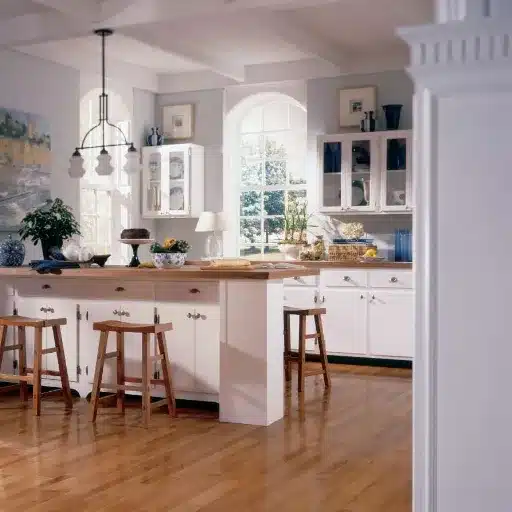
If your project pairs maple flooring with maple veneer cabinetry, wall panels, or built-ins, there is a detail that catches people out. The floor and the panels must be finished with the same system, or they will visibly drift apart.
A water-based, UV-inhibited finish on the floor and an ambering oil finish on the panels will look harmonized on install day and noticeably mismatched three years later. Specify finish type and UV protection as one schedule across the whole project: floor, panels, and trim together. Maple veneer panels are where this comes up most often, and our guide to finishing veneer panels covers the technique side.
Maple Flooring Color Change FAQ: Does Maple Flooring Turn Yellow?
Does maple flooring turn yellow?
Yes, it commonly does. In most homes the cause is the finish, especially oil-based polyurethane, which ambers as it cures and ages. The wood itself can also shift under UV light, but that change is slower and secondary.
Why does maple wood turn yellow?
Two reasons. Oil-based finishes contain chemistry that turns amber over time, and UV light interacts with the wood’s lignin and extractives. Pale maple makes both changes easy to see because there is no color to hide behind.
Does maple flooring darken over time?
Usually it warms toward honey rather than darkening dramatically. How much depends on the finish, the amount of light the floor receives, and the individual boards. It will not deepen the way cherry does.
Will prefinished maple flooring turn yellow?
It can. Factory aluminum-oxide finishes resist wear well but still change with age and light. Some prefinished products use UV inhibitors to slow the shift, so check the specification before buying.
Can you stop maple floors from turning yellow?
Not completely, but you can slow it substantially. Choose a water-based, UV-inhibited finish, manage direct sunlight with film, blinds, or rugs, and keep humidity steady.
How do you keep maple floors white?
Start with a water-based UV-inhibited finish and control sunlight aggressively. Be realistic about the outcome: sealed maple will drift from bright cream toward a warmer tone over years, and a whitewashed floor can go muddy without a tannin blocker.
Does water-based polyurethane yellow on maple?
Far less than oil-based, and premium water-based formulas stay essentially clear. Budget water-based products can pick up a faint tint over several years, so it is worth choosing a well-regarded commercial-grade finish.
Can yellowed maple floors be restored?
The finish amber can be fully removed by sanding to bare wood. The wood’s own color change cannot be fully reversed, though bleaching or lye can lighten it. Always test on an offcut first.
Is maple flooring yellowing a defect?
No. Some color change is normal and expected for maple. It is a characteristic of the species and the finishes used on it, not a manufacturing fault.
Does whitewashed maple turn yellow?
It can, and this is a common disappointment. Maple tannins can push a white finish toward butter-yellow without a tannin blocker. Whitewashing over already-ambered maple tends to make the problem more visible, not less.
How long does it take for maple floors to yellow?
With an oil-based finish, a visible warm cast often appears within one to three years and becomes clearly amber by year five or beyond. UV-driven change is slower, though direct sun accelerates it.
Does the sheen level affect yellowing?
No. Matte, satin, and gloss finishes amber according to their chemistry, not their sheen. Only the finish type and UV protection change the outcome.
Final Thoughts
Does maple flooring turn yellow? Yes, and now you know it is neither a mystery nor a defect. It is a pale wood and a finish doing exactly what pale wood and finishes do.
Here is the short version. Use the rug test to identify what you are dealing with. If the change follows the light, sunlight is your lever and a UV-inhibited water-based finish is your protection. If the amber is uniform across the whole floor, the finish is the cause, and only a sand-to-bare-wood will reset it. Either way, water-based chemistry is the choice that keeps maple closest to the color you fell in love with.
Ready to specify maple with confidence? Talk to our team about finish schedules, maple veneer panels, and engineered maple products for your next project. We will tell you honestly what will hold its color and what will not.
For a balanced look at the trade-offs before you commit, maple flooring pros and cons covers hardness, scratch visibility, moisture, and cost alongside the color question.