

Prefinished Engineered Wood Flooring: The Complete 2026 Guide
Prefinished engineered wood flooring is real wood veneer bonded to a stable plywood or HDF core, with the finish already applied and UV-cured at the factory. It arrives walk-on-ready: no site sanding, no staining, no sealing, no waiting for a coating to cure in your home.
That is the definition. It is also where most guides stop, which is a problem, because the definition tells you nothing about the two decisions that actually determine whether you will still like this floor in ten years: how thick the wear layer is, and what the finish chemistry can and cannot be repaired.
Those two numbers decide how many times the floor can ever be re-sanded, whether a scratch can be spot-fixed or becomes permanent, and what the warranty really covers. Retailers describe them as “7 layers of aluminum oxide” and leave it there.
This guide covers finish method end to end. If you are still deciding between engineered and solid construction, our engineered wood flooring guide explains how engineered wood flooring is constructed. This page assumes you have made that call and are choosing how the floor gets its finish.
Key Takeaways
- Prefinished means finished at the mill. The coating is applied and UV-cured in a controlled factory line, so the floor arrives walk-on-ready with no dust, no solvent smell, and no cure time in your home.
- Factory aluminum oxide finishes out-wear site-applied polyurethane, and are far harder to repair. That is the trade, and no warranty figure changes it.
- Wear-layer thickness, not the finish, decides how many times a floor can be re-sanded. A 1.2 mm wear layer may never be sanded at all; a 4 mm wear layer can usually take two cycles.
- Micro-bevels are a manufacturing feature, not gaps. Real gaps trace to milling tolerance, moisture content, subfloor condition and indoor humidity outside roughly 35 to 55 percent.
- Prefinished usually wins on total installed cost despite a higher material price, because you never pay for days of on-site finishing labour and cure time.
Last updated: September 2026 · Reading time: 18 minutes
What Is Prefinished Engineered Wood Flooring?
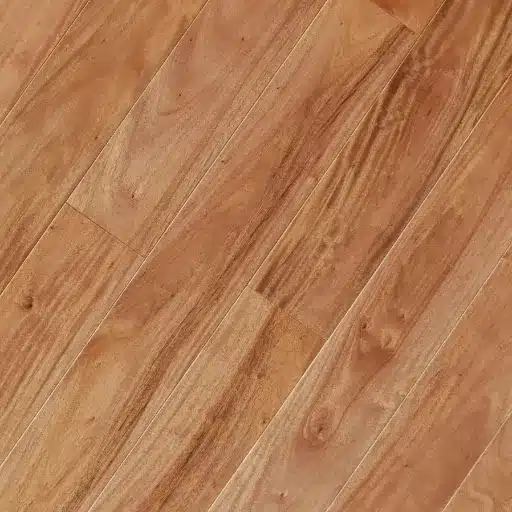
Prefinished engineered wood flooring is a layered plank: a thin slice of genuine hardwood on top, a cross-laminated core beneath it, and a factory-applied finish on the surface. The wood you see and touch is real hardwood, not a photographic layer, which is what separates it from laminate and luxury vinyl.
The “engineered” half refers to the core. The “prefinished” half refers to the coating. Both matter, and they are independent choices.
Real Wood Veneer Over a Stable Core
The top layer is called the wear layer or face veneer. It is sliced from a real log, usually between 1.2 mm and 6 mm thick. Below it sits a core built from cross-plied layers of plywood, or a high-density fibreboard (HDF) panel, or in some imports an SPC/WPC mineral composite.
That combination is why prefinished engineered hardwood flooring is specified for both homes and commercial projects. The surface is genuine hardwood, and the build under it is dimensionally stable.
Cross-plying is the engineering trick. Each layer’s grain runs perpendicular to the one below it, which cancels most of the seasonal movement that makes solid wood cup and crown. That dimensional stability is why engineered floors tolerate slab installation and radiant heat that would destroy a solid plank.
What “Prefinished” Actually Means
The finish is applied, cured and quality-checked at the mill. Stain, sealer and topcoats go on in a production line, then cure under high-intensity ultraviolet light in seconds rather than hours. The boards are inspected, bundled and shipped ready to install.
Unfinished engineered flooring does exist, but it is a small minority of what ships today. Confirm the finish status in writing before you order. A surprising number of disputes start with a buyer assuming “engineered” meant “prefinished.”
How It Differs From Laminate, LVP and Site-Finished Wood
- Laminate: a printed photographic layer under a melamine wear sheet. No real wood on the surface.
- Luxury vinyl (LVP): PVC, printed, entirely synthetic.
- Site-finished wood: real wood, but sanded, stained and sealed after installation.
- Prefinished engineered: real wood veneer, factory finish, installed as-is.
That last distinction is the whole subject of this guide.
Prefinished vs. Unfinished (Site-Finished): The Core Decision
This is the fork most buyers actually face. The comparison below includes the cost, lifespan and refinishability rows that most published tables leave out.
| Factor | Prefinished (factory) | Unfinished (site-finished) |
|---|---|---|
| Where finish is applied | Controlled mill line | In your home, after install |
| Install duration | 1 to 3 days | 5 to 10 days |
| Dust and odour | Minimal; no site sanding | Heavy sanding dust; solvent odour |
| Cure and walk-on time | Walk-on immediately | 24 to 48 hours to foot traffic |
| Furniture placement | Immediately | 7 to 14 days over polyurethane |
| Custom colour and sheen | Fixed at order; dye-lot limited | Unlimited; matched on site |
| Surface appearance | Micro-bevels at every joint | Perfectly flush, seamless |
| Material cost | Higher, roughly $4.50 to $8.00/sq ft mid-market | Lower raw material |
| Finishing labour | $0 | Roughly $2 to $9/sq ft |
| Total installed cost | Roughly $6 to $14/sq ft | Roughly $8 to $15/sq ft |
| Expected lifespan | 20 to 40 years, finish and wear layer permitting | 30 to 60 years with periodic refinishing |
| Refinish path | Limited by wear layer; factory finish must be fully removed | Full sand and recoat from the start |
| Best for | Schedule pressure, occupied homes, most projects | Custom colour matching, flush seamless floors |
The Total-Cost Reversal Most Retailers Gloss Over
Prefinished planks cost more per square foot at the till. They usually cost less per square foot installed.
Site finishing adds roughly $2 to $9 per square foot of labour depending on the system, plus days of cure time during which the room is unusable. On a 500 square foot project, that finishing delta alone can run $1,000 to $4,500, which typically more than offsets the material premium.
Tom, a contractor in Portland, priced two kitchens in the same summer. The first client chose site-finished white oak for a custom stain match and accepted an eight-day schedule. The second chose prefinished engineered in a warm matte, and Tom had the family back in the room the same evening he finished laying. Same square footage, three days of labour difference.
For full generic engineered pricing beyond the finish-method delta, see our engineered wood flooring cost breakdown.
When Site-Finishing Is Still the Right Answer
- You need a custom stain matched to existing floors elsewhere in the house.
- You want a perfectly flush, bevel-free surface with zero shadow lines.
- A designer wants colour and sheen control dialled in on site.
- The floor will take heavy abuse early and you want a thick, renewable finish layer.
Matching Prefinished Into an Existing Floor
Be honest about this one. Dye lots shift between production runs, sheen drifts with UV exposure, and the micro-bevels will not align with a flush site-finished floor. A perfect invisible splice is unlikely.
Plan the transition at a doorway or a natural break, and buy the spare boxes now. Our deeper comparison lives in prefinished vs unfinished hardwood flooring.
Ready to spec a floor that matches how you actually live on it? Talk to our team about samples and specifications before you commit to a finish.
How Prefinished Engineered Flooring Is Made
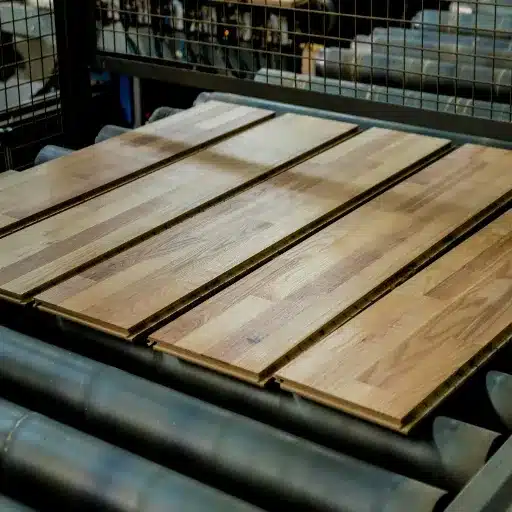
This section is the reason a manufacturer should write this guide and a retailer should not. Understanding the line explains every claim you will read on a specification sheet.
- Veneer slicing. A log is sliced or peeled into thin face layers, then graded for colour and character.
- Core layup and pressing. Face, core plies and backing are glued and pressed under heat and pressure into a stable panel.
- Profiling. Edges are machined into tongue-and-groove or click-lock joints, and the micro-bevel is cut.
- Staining. Colour is applied and dried, or the plank is left natural.
- UV cure line. Sealers and topcoats are applied and cured under high-intensity UV lamps in seconds.
- Aluminum oxide topcoats. The wear mineral is suspended in the top urethane coats.
- Curing and QC. Film thickness, sheen and adhesion are checked before packaging.
Why UV Curing Changes Everything
UV-cured coatings cross-link in seconds under intense light. That produces a harder, denser and far more uniform film than air-dried site-applied polyurethane ever reaches. A site finish has to dry slowly enough to level, which limits how hard it can get. A factory finish has no such constraint.
How Aluminum Oxide Is Loaded Into the Coating
Aluminum oxide is a hard mineral, roughly Mohs 9, second only to diamond at 10. It is suspended in the urethane rather than sprayed on top, and the loading percentage plus the number of coats carrying it drive wear performance.
Here is where the marketing gets slippery. A “7 layers of aluminum oxide” claim often means seven total coats, with the mineral present in only the top one or two. Seven coats and seven aluminum oxide coats are very different products at very different prices. For the chemistry in depth, see aluminum oxide floor finish.
Why the Factory Wins on Consistency
Temperature, humidity and dust are controlled on the line. Every plank in the run receives an identical film thickness and sheen. Site finishing cannot match that uniformity, because it happens in a room with a door that opens. Our own UV-cured and lacquer veneer finishes use the same curing logic, and every batch passes finish and wear-layer QC before it ships.
Factory Finish Types Compared
Four finish families dominate prefinished engineered flooring. They trade durability against repairability, and you cannot have both at the maximum.
| Attribute | Aluminum Oxide | UV Oil | Hardwax Oil | UV Lacquer |
|---|---|---|---|---|
| Durability | Highest | Moderate | Moderate | High |
| Appearance | Film-forming, even | Natural, open pore | Natural, low sheen | Smooth film |
| Scratch visibility | Bright white lines | Blends well | Blends best | Visible lines |
| Spot repair | Difficult to impossible | Yes, spot re-oil | Yes, spot re-oil | Limited |
| DIY recoat | Usually not viable | Yes | Yes | No |
| Ongoing maintenance | Damp clean only | Periodic re-oil | Periodic re-oil | Damp clean only |
| Water and chemical sensitivity | Low | Moderate | Moderate to high | Low |
| Best fit | High traffic, commercial, rentals | Owner-occupied, repairability | Design-led interiors | Mid-traffic residential |
Aluminum Oxide: Maximum Wear, Minimum Repair
Aluminum oxide gives the best abrasion performance and the longest warranty terms. The cost is repairability. A scratch on an AO finish shows as a bright white line because the coating is hard and opaque when fractured. Blending a spot repair is difficult or impossible for most installers, and many AO finishes reject a recoat entirely because the next coat will not bond.
Priya found this out the hard way. Her dog skidded across the living room in February 2025 and left a two-foot white arc across her aluminum oxide oak. Three flooring companies quoted a fix, and all three told her the same thing: the only way to remove that line was to sand and refinish the entire room, roughly $1,800, because the coating would not accept a patch. An oil-finished floor would have needed a cloth and twenty minutes.
UV Oil and Hardwax Oil: Repairable, Not Indestructible
Oil systems sink into the wood rather than forming a film on top, so a scratch can be spot-repaired with a cloth and a bottle without sanding the whole floor. The honest downside nobody puts in the brochure is pathing: with foot traffic, the oil wears unevenly along the walking routes, and those paths show as matte tracks against a slightly more saturated surrounding floor.
UV Lacquer: The Middle Path
UV lacquer sits between the two extremes. It is a film finish with better repairability than aluminum oxide and better durability than a pure oil, which makes it a reasonable default for mid-traffic residential rooms.
Which Finish for Which Room
- Rentals, offices, retail, multifamily → aluminum oxide.
- Owner-occupied homes where repairability matters → UV oil or hardwax oil.
- Kitchens and bathrooms → check the water-resistance guidance first; prefinished engineered flooring is not waterproof.
- Undecided between the two front-runners → see UV oil vs aluminum oxide flooring.
Durability: Abrasion, Hardness and Wear-Layer Math
Wear layer thickness engineered hardwood flooring starts at 1.2 mm and runs to 6 mm. It is the single most consequential specification on a prefinished engineered floor, because it caps how many times the floor can ever be re-sanded, no matter what the finish claims.
| Wear Layer | Typical Use Case | Re-sand Capacity | Durability Expectation | Verdict |
|---|---|---|---|---|
| 1.2 mm | Budget residential, light traffic | 0 to 1 screen-and-recoat only | Finish lifetime only | Do not buy expecting refinishing |
| 2 mm | Standard residential | 1 careful sand | 15 to 25 years | Adequate if you will not refinish |
| 3 mm | Quality residential | 2 to 3 cycles | 25 to 35 years | The sensible sweet spot |
| 4 mm | Premium residential, light commercial | 2 to 3 cycles comfortably | 30 to 40 years | Buy once, refinish twice |
| 6 mm | Premium, solid-like performance | 3 or more cycles | 40 years and up | Near-solid behaviour in engineered form |
Reading Abrasion Test Numbers Honestly
Manufacturers publish Taber abrasion results in the 12,000 to 15,000-plus cycle range, measured against a standard reference floor of roughly 12,000 cycles. Treat those as manufacturer claims, not independent results. Taber numbers are only comparable within the same test method and the same abrasive wheel, so a figure from one brand’s lab means little next to a figure from another’s.
Janka Hardness: What It Does and Does Not Tell You
Janka measures the force required to embed a steel ball halfway into a wood sample. It is a species property, not a floor property.
A high Janka number means the wood dents less. It says nothing about how the finish resists abrasion, nothing about scratch visibility, and nothing about repairability. Hickory out-scores oak on Janka; both will show claw marks through the same aluminum oxide coating.
So use Janka to compare species. Use wear-layer thickness and coating chemistry to compare floors. They answer different questions, and the SERP routinely mixes them up.
The NWFA 3/32″ Rule and Why It Matters
A wood floor cannot be sanded below roughly 3/32 inch, or 2.4 mm, of usable wear layer. That single number caps every floor’s refinishing life. Translate it into the table above and you can see why a 1.2 mm floor is effectively a one-life product while a 4 mm floor is not. The finishing standards behind this rule are published by the National Wood Flooring Association.
Why the Finish Is Not the Floor’s Lifespan
Four independent clocks run on any prefinished engineered floor:
- Finish wear (surface condition)
- Wear-layer exhaustion (how much wood remains)
- Core moisture exposure (subfloor and humidity)
- Installation quality (acclimation, gaps, fastening)
A 50-year warranty on one clock tells you nothing about the other three. For the full lifespan breakdown, see how long does prefinished engineered wood flooring last.
Micro-Bevels, Gaps and Overwood: What to Expect
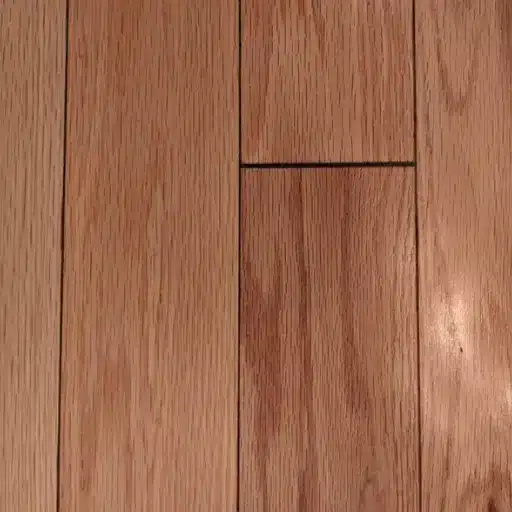
This is the most-disputed topic in the entire category, and the forums that argue about it have no authority behind them. Here is the plain version.
Bevels Are a Feature, Not a Defect
Factory-finished planks almost always carry a machined micro-bevel: a small chamfer at each edge. The bevel exists to hide overwood (the tiny height differences between adjacent planks) and to absorb normal milling variance. Without it, every plank joint would have to be perfect, which is not possible at production speed.
The trade-off is honest: bevels trap dust, and under raking light from a window they read as fine shadow lines across the floor. Under normal overhead light you will not see them.
When It’s a Real Gap
Real gaps look different. Watch for:
- End gaps of 1/8 to 3/16 inch at butt joints
- Non-uniform gaps that vary across the floor rather than being consistent
- Overwood at butt joints, where a joint moves visibly under thumb pressure
These trace to milling tolerance, moisture content at the time of installation, subfloor condition, or indoor humidity outside roughly 35 to 55 percent. They do not trace to the finish being factory-applied. The claim that all factory-finished floors gap is folklore, and the widely repeated “99.9 percent of prefinished engineered floors are beveled” figure has no published source.
Document It Before You Call Anyone
If you have a complaint, capture evidence first:
- Moisture readings from the subfloor and the planks
- A humidity log covering the weeks after installation
- Photographs with a reference straightedge laid across the joints
- Your acclimation records and the installer’s moisture report
That file determines whether the conversation goes to the installer or the manufacturer, and without it you are arguing from memory. Our dedicated guide covers prefinished engineered hardwood problems in depth, and the trade press has documented how non-uniform gapping actually develops.
Prefinished Engineered Wood Flooring Cost in 2026
Costs below are 2026 ranges to verify locally, not quotes. Pricing varies by region, species, format and volume.
| Cost Line | Budget | Mid-Market | Premium |
|---|---|---|---|
| Material only | $2.50 to $4.50/sq ft | $4.50 to $8.00/sq ft | $9.00 to $14.00/sq ft |
| Installation (floating) | $1.50 to $2.50 | $2.00 to $3.50 | $3.00 to $5.00 |
| Installation (glue-down) | $2.00 to $3.00 | $3.00 to $4.50 | $4.00 to $6.00 |
| Underlayment and moisture barrier | $0.30 to $0.75 | $0.50 to $1.50 | $1.00 to $2.00 |
| Trim and transitions | $1.00 to $2.00 | $1.50 to $3.00 | $2.00 to $4.00 |
| Subfloor prep | $0.50 to $2.00 | $1.00 to $3.00 | $2.00 to $4.00 |
Material Cost by Grade
Budget engineered floors typically run $2.50 to $4.50 per square foot with thin wear layers and short warranties. Mid-market prefinished engineered sits around $4.50 to $8.00. Premium wide-plank and exotic species reach $9 to $14. Always ask for the wear-layer thickness in millimetres before comparing two prices, because a cheap 1.2 mm plank and a mid-priced 3 mm plank are not competing products.
A 500 Sq Ft Worked Example
A mid-market prefinished engineered floor, 3 mm wear layer, floating installation over a prepared slab:
| Line | Calculation | Cost |
|---|---|---|
| Material | 500 sq ft @ $6.50 | $3,250 |
| Spare box (5% allowance) | 25 sq ft @ $6.50 | $163 |
| Underlayment and vapour barrier | 500 sq ft @ $0.90 | $450 |
| Installation (floating) | 500 sq ft @ $2.75 | $1,375 |
| Trim and transitions | 60 linear ft @ $2.50 | $150 |
| Subfloor prep and levelling | Lump sum | $600 |
| Total installed | $5,988 |
That lands at roughly $12.00 per square foot installed.
The Same Room, Site-Finished
Price the identical room in unfinished engineered at $4.50 per square foot of material, and you save about $1,000 up front. Then add the finishing: roughly $1,750 in labour and $350 in stain and finish materials for the same 500 square feet.
The site-finished version ends up about $1,100 more before shared costs. It also costs you four to eight days of unusable floor and a house full of sanding dust.
Prefinished does not win because the material is cheaper. It wins because the labour you avoid is larger than the premium you pay.
Hidden Costs to Budget For
- Moisture testing of the slab or subfloor
- Levelling compound where the substrate is out of tolerance
- Transition strips at doorways and material changes
- Acclimation time in the actual room before installation
- The spare box, which is far cheaper now than trying to match a dye lot in five years
Total Installed Cost: Prefinished vs. Site-Finished
Prefinished engineered commonly lands at $6 to $14 per square foot installed. Site-finished commonly lands at $8 to $15. The ranges overlap, and the honest summary is this: prefinished wins decisively when your time has value, and site-finishing wins when custom colour matters more than schedule.
Installation Overview: Acclimation, Subfloor and Methods
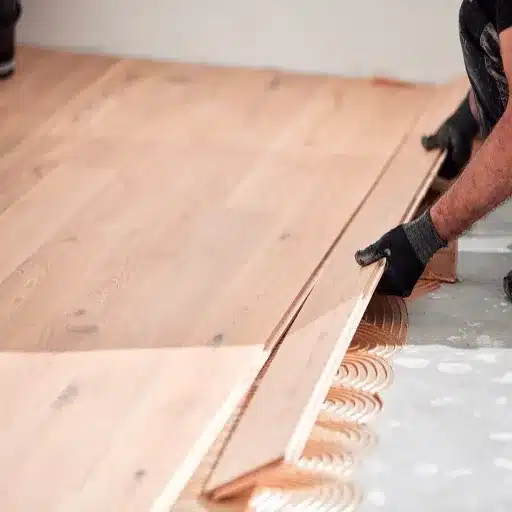
Prefinished engineered flooring installs faster than any site-finished alternative. What follows is an overview only, because the step-by-step detail lives in its own guide.
The essentials: acclimation in the room where the floor will live, moisture testing of the subfloor, and a choice between floating, glue-down and nail-down depending on the substrate. Expansion gaps at the perimeter, and awareness that some click-lock systems have limits over a slab.
Why Prefinished Installs Faster
There is no sanding, no stain to dry and no finish to cure. Work is measured in days, not weeks, and the floor is walk-on-ready the moment the last plank seats.
For the full step-by-step procedure, tools and subfloor preparation detail, see our full step-by-step install guide. We deliberately keep this section short so the two pages do not compete.
Where Prefinished Engineered Wood Flooring Works
Prefinished construction opens up rooms that solid wood cannot handle. Each application carries its own caveat.
Concrete Slabs, and Why Prefinished Wins There
No wet coating needs to cure over the slab, so there is no risk of trapping slab moisture under a fresh finish. The critical details are vapour management and the choice between glue-down and floating. See prefinished engineered flooring over concrete for slab-specific guidance including radiant heat.
Radiant Heat
Engineered construction tolerates radiant heat far better than solid wood, but surface temperature limits and a gradual ramp schedule still apply. Never heat a new floor aggressively in the first weeks.
Basements and Below Grade
Below-grade moisture is a different problem from slab moisture, and it usually requires a dedicated barrier strategy. Our guide to engineered flooring for basements covers that separately.
Kitchens and Bathrooms
Prefinished engineered wood flooring is not waterproof. Standing water at seams and around fixtures will damage the core over time. If water resistance is a hard requirement, review our water resistance in kitchens and bathrooms guidance before specifying wood at all.
Homes With Pets and Kids
Scratch visibility matters more than scratch resistance. A matte sheen and a mid-tone species hide wear far better than a glossy finish on a very light or very dark floor. A glossy floor will show every claw mark as a highlight. For finish and species selection in pet households, see best prefinished flooring for dogs.
Commercial and High-Traffic Spaces
Commercial projects specify prefinished for three reasons: turnaround speed, consistent appearance across large floor plates, and predictable wear performance for budgeting. Hospitality, multifamily, office and retail each carry different recoat cycles and submittal requirements.
Elena learned why the documentation matters on a 40,000 square foot multifamily project in 2024. Her client needed green building credits, and the prefinished product she had approved listed “low VOC” in the marketing copy with no certificate attached. Producing the actual FloorScore documentation cost the supplier eleven days and nearly delayed the submittal. Specify the certificate, not the claim. Our commercial engineered wood flooring guide covers specification, maintenance budgets and submittal documentation.
Working on a commercial submittal? We supply wear-layer data, coating specifications and certification documents for green building credits. Request specification support.
Finishes, Sheens and Grades: Matte, Wire-Brushed and Smooth
Sheen Levels and What They Hide
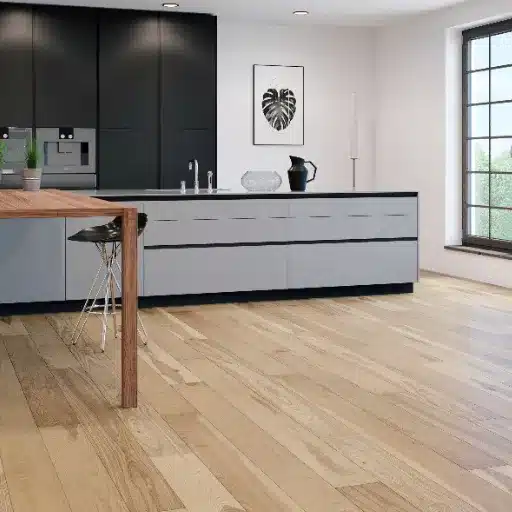
Matte hides scratches, dust and bevel shadows best. Semi-gloss and gloss amplify every flaw and every footprint. Matte and low-sheen finishes remain the dominant direction in 2026 for exactly this reason.
Surface Textures
- Smooth: clean and contemporary; shows scratches most readily.
- Wire-brushed: raised grain texture that disguises wear well, a strong choice for pet households.
- Hand-scraped: pronounced undulation; hides damage exceptionally, but collects dust in the valleys.
- Distressed: maximum camouflage, most rustic appearance.
Grade and Character
Clear or Select grade gives uniform colour at the highest price. Natural or Character grade introduces colour and grain variation. Rustic grade shows knots and mineral streaks and is the most forgiving of daily life.
Grade moves price, and it determines whether the floor hides or highlights variation. For the full breakdown, see prefinished wood flooring finishes, and for plank width as a separate decision, our wide plank formats guide.
Care, Recoat and Refinishing Limits
Factory-finished floors are easy to maintain and difficult to restore. Both halves of that sentence are true and both matter.
Routine Care for a Factory Finish
- Remove dry debris first, before any moisture touches the floor.
- Damp mop, never wet mop. A wrung-out cloth, not a sopping one.
- No wax and no oil soaps on a film finish. They build up and dull the surface.
- Clean the bevels. That is where grit collects and abrades the edges over time.
Our wood floor cleaning routine covers the full chemistry, and the prefinished engineered flooring maintenance guide covers factory-specific products.
Screen-and-Recoat: Sometimes, Not Always
A screen-and-recoat is the light refresh where the surface is abraded and a new coat is applied without sanding to bare wood. It works well on oil finishes. It frequently fails on aluminum oxide, because the hard, dense AO film does not give the new coat anything to bond to. The trade press has documented recoat failures on factory-finished floors in detail, and those failures are also why some warranties explicitly state that any abrasion voids coverage.
What Actually Voids a Prefinished Warranty
A 25 or 50 year prefinished warranty almost never covers the things buyers assume it covers. Read for these clauses before you buy.
- Abrasion or recoating. Sanding, screening or applying any third-party coating commonly voids the finish warranty outright.
- Improper maintenance. Wet mopping, steam mops, wax, oil soaps and abrasive cleaners are standard exclusions.
- Humidity outside range. Many warranties require indoor relative humidity to stay within roughly 35 to 55 percent.
- Installation defects. These are the installer’s responsibility, not the manufacturer’s, which is why subfloor moisture records matter.
- Non-transferability. Many prefinished warranties do not follow the floor to a new owner when you sell the house.
The headline year count is marketing. The exclusion list is the actual coverage.
Full Refinishing: What the Factory Finish Changes
A full refinish must remove the entire AO coating and clear finish out of the bevel grooves. On a beveled floor it is not unusual to sand off more than 1/16 inch before reaching clean wood, which consumes the wear layer you were trying to preserve. That is the mechanism behind the wear-layer table earlier, and it is why refinishing is not a resource you can assume.
When Replacement Beats Refinishing
- 1.2 mm wear layer: replace rather than refinish. There is no safe material to remove.
- 2 mm: one careful sand, and only by an experienced finisher.
- 3 mm and above: refinishing is a realistic option, budgeted at one to three cycles.
Whether your floor can be refinished at all is answered directly in can you refinish prefinished engineered hardwood. For the general sand-and-recoat workflow on engineered floors, see refinishing engineered hardwood floors.
Sustainability and Indoor Air Quality
Factory Curing vs. On-Site Coatings
UV curing on a controlled line consolidates the finish and contains solvent handling inside the plant. A site-finished floor coats your home instead, and can off-gas for days to weeks in an occupied house. For families moving in during a renovation, that difference is not abstract.
What “Low-VOC” Actually Certifies
Low-VOC is a claim that must be documented, not asserted. The programmes to look for:
- FloorScore for hard surface flooring emissions
- CARB Phase 2 and EPA TSCA Title VI for formaldehyde limits in composite cores
- FSC and PEFC for forest sourcing
A finish’s VOC content and a product’s total emissions are two different measurements, and a low-VOC finish on a non-compliant core solves nothing. Ask for the certificate, not the marketing line.
Material Efficiency of a Veneer Wear Layer
A thin veneer over a stable core uses a fraction of the solid timber that a solid floor of the same area requires. That material efficiency is the core sustainability argument for engineered construction, and it is why we source sustainably sourced veneer rather than framing the claim loosely.
End of Life
Refinish before you replace, and repair before you refinish. The lowest-carbon floor is the one already installed in your house.
Choosing the Right Prefinished Engineered Hardwood Flooring
This is the checklist to carry into a showroom or a specification meeting.
- Wear layer thickness, in millimetres, and the number of re-sands it buys.
- Core construction: plywood, HDF, or SPC/WPC composite.
- Coating system matched to the room: AO, oil, or lacquer.
- Sheen and texture, chosen for what they hide rather than what they show.
- Joint type versus installation method: click-lock or tongue-and-groove.
- Warranty terms: read what is excluded and whether it transfers on sale.
- Bevel and overwood tolerance acceptable for your project.
- Spare-box allowance for future repair, bought on the same dye lot.
- Certifications and documentation for green building credits.
Red Flags to Avoid
- “7 layers” with no coat-type detail
- Wear layer thickness not stated at all
- A warranty that covers the finish only and is non-transferable
- No certifier named for a low-VOC or formaldehyde claim
- A price quote given without a wear-layer figure to compare against
For brand-level product selection, start from our wear layer and selection criteria hub.
For species, compare engineered oak flooring and engineered maple flooring.
FAQ
What does prefinished mean in flooring?
Prefinished means the stain, sealer and topcoats were applied and cured at the factory rather than on site after installation. The floor arrives ready to install and walk on.
Is prefinished engineered wood flooring waterproof?
No. It is water-resistant at the surface, not waterproof. Standing water at seams or around fixtures can reach the core and cause swelling. Avoid it in full bathrooms.
Can you refinish prefinished engineered hardwood?
Sometimes, and it depends on wear-layer thickness. A 3 mm or 4 mm wear layer can usually take one to three sanding cycles. A 1.2 mm wear layer cannot be sanded safely at all.
Do prefinished floors have gaps?
Micro-bevels at the joints are intentional and are not gaps. True gaps of 1/8 to 3/16 inch at butt joints, or non-uniform gapping, trace to milling tolerance, moisture content, subfloor condition or humidity outside roughly 35 to 55 percent.
Why do prefinished floors have bevels?
The micro-bevel is machined to hide overwood, the small height differences between adjacent planks, and to absorb normal milling variance. Without it, every joint would need to be perfectly flush, which is not achievable at production speed.
Do prefinished floors need to be glued down?
No, and floating is the most common method. Glue-down is often preferred over concrete slabs and in large commercial floor plates. Nail-down applies to plywood subfloors only. The right method depends on the substrate and the joint profile.
How long do prefinished engineered floors last?
It depends on which of four independent clocks you mean:
- Finish wear: the surface coating, typically 5 to 15 years in a busy home before it looks tired.
- Wear layer: 15 to 40 years depending on whether the veneer is 1.2 mm or 6 mm.
- Core integrity: 20 to 40 years if moisture stays controlled.
- Installation quality: the floor’s real lifespan cap if acclimation or subfloor prep was skipped.
A well-installed 3 mm prefinished engineered floor in a normal home is a 25 to 35 year floor, and it can be refinished once or twice inside that window. A 1.2 mm floor lasts as long as its factory finish does, because it cannot be sanded.
Are prefinished floors as good as finished on site?
Durability is usually better, because factory UV curing produces a harder and more uniform film. Repairability and seamlessness are usually worse. It depends on whether you value traffic resistance or future repairability more.
Does prefinished flooring need acclimation?
Yes. Acclimation lets the planks reach the moisture content of the room before installation, which reduces gapping. Follow the manufacturer’s stated window and check subfloor moisture first.
Can you stain prefinished floors?
Not without removing the factory finish. A prefinished surface is a sealed film or an oiled surface; stain cannot penetrate it. If you need a custom colour, start with unfinished engineered flooring.
How many coats of aluminum oxide are on prefinished floors?
It varies widely. Some premium finishes carry five to ten total coats, but the mineral is often present in only the top one or two. Ask how many coats contain aluminum oxide, not how many coats exist.
Is prefinished flooring low VOC?
It can be, but the claim needs documentation. Ask for FloorScore certification for emissions and CARB Phase 2 or EPA TSCA Title VI compliance for the core.
Can you put prefinished flooring over tile or concrete?
Over concrete, yes, with proper vapour management. Over existing tile, it depends on the tile’s condition and height, and most manufacturers require it to be sound, flat and clean.
Is aluminum oxide finish good for hardwood floors?
Excellent for wear resistance, poor for repairability. It dominates commercial specifications, but a scratch shows as a bright white line and spot repair is often impossible.
What is the best wear layer thickness for prefinished engineered flooring?
For most homes, 3 mm is the sweet spot. It supports two to three refinishing cycles at a mid-range price. Choose 4 mm or above for premium use, and avoid 1.2 mm unless you accept a one-life floor.
Does prefinished flooring increase home value?
Hardwood is consistently cited by real estate professionals as a desirable feature, and engineered wood qualifies as real wood. Whether it raises appraised value depends on your local market.
What does a prefinished engineered hardwood warranty actually cover?
Mostly the finish, and rarely the wear layer or installation. Read what is excluded, whether abrasion voids coverage, and whether it transfers on sale. The headline year count tells you very little.
Conclusion
Prefinished engineered wood flooring is the default choice in the category for good reasons. It is dimensionally stable, quick to install, walk-on-ready the same day, and factory-finished to a consistency site finishing cannot match.
But the warranty figure is not the specification. The specification is the wear layer in millimetres, the coating chemistry on top of it, and an honest understanding of what each finish system can and cannot be repaired. A 3 mm prefinished engineered floor with an oil finish will outlive a 1.2 mm floor with a 50-year finish warranty in almost any real home, because one can be restored and the other cannot.
Choose the finish by how you will live on the floor. Then read the specification sheet and confirm the numbers before you order.
Ready to move forward? Talk to our team about samples, specifications and wholesale pricing, or start with our engineered wood flooring guide if you are still weighing construction options.