
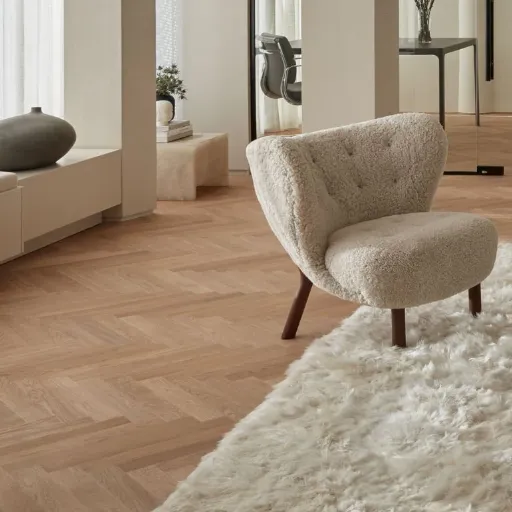
Sustainable Walnut Flooring: Is Walnut Eco-Friendly?
Sustainable walnut flooring is possible, but “sustainable” is not a property of walnut itself. American black walnut (Juglans nigra) is not endangered and is not listed on the CITES appendices. What decides whether a walnut floor is sustainable is how the wood was harvested, whether the forest was managed responsibly, and how long the floor stays in service.
That distinction matters because “walnut” on a label can describe several species. Some are true walnuts. Some are tropical lookalikes sold under an unregulated trade name. The sustainability story changes with the species, the harvest country, and the paperwork behind the claim.
This guide gives you the straight answer, separates black walnut from the substitutes, and shows you exactly which documents to request before you buy. If you are specifying a project, you can request our commercial walnut documentation and samples at any point.
Key Takeaways
- American black walnut (Juglans nigra) is IUCN Least Concern and not CITES-listed. The species itself is not the problem.
- “Sustainable” is a supply-chain claim. It depends on legal harvest, responsible forest management, and a long service life.
- An FSC or PEFC logo is not proof. Ask for the certificate code, the claim category, and the chain-of-custody record.
- The Lacey Act and the EUDR put the paperwork burden on the importer. A buyer should ask to see it.
- Engineered walnut can stretch scarce veneer, but the core, adhesive, and finish decide the indoor-air story.
What “Sustainable Walnut Flooring” Actually Means
A sustainable walnut floor satisfies five conditions. The wood must be harvested legally. The forest must be managed for regrowth and biodiversity. The manufacturing process must use the resource efficiently. The finished floor must last a long time. And the adhesives and finishes must not undermine indoor air quality.
Most marketing pages stop at the first condition. They show a leaf, a forest photo, and the word “natural.” That is not a supply-chain claim. It is a mood.
Think of sustainability as a chain with five links. A floor can be FSC-certified and still fail the durability test if it is installed over a wet subfloor. It can be legally harvested and still be a poor use of a scarce species if it is replaced every eight years. The strongest claim is the one that holds at every link.
This is also why price and sustainability are not opposites. Walnut is scarce, and responsible sourcing costs more. A floor that lasts 40 years justifies that premium.
Is Walnut Sustainable? The Honest Answer
Yes, walnut can be a sustainable flooring choice, but only when three things are true: the wood is legally sourced, the forest is responsibly managed, and the floor is built to last. The species alone does not guarantee any of them.
The good news is that American black walnut is not a conservation emergency. According to The Wood Database, the IUCN Red List classifies Juglans nigra as Least Concern, and it does not appear on the CITES appendices. U.S. hardwood forests are also expanding. According to the American Hardwood Export Council, growing stock rose from 5.2 billion cubic meters in 1953 to 12.0 billion in 2017, and hardwood forest area grew from 99 million to 117 million hectares over the same period.
The caution is scarcity. Walnut accounts for less than 5% of the U.S. hardwood resource and carries the highest per-board-foot export price of any widely traded American hardwood, according to Lumber Export. That is why it costs more than oak or maple. The price reflects supply, not endangerment.
| Factor | Why it matters | How to verify |
|---|---|---|
| Species | “Walnut” can mean several species with different status | Ask for the scientific name (genus and species) |
| Harvest origin | Legal risk and forest management vary by country and region | Ask for country and state or region of harvest |
| Certification | Shows chain of custody, not just a logo | Verify the certificate code with the certifier |
| Adhesive and core | Composite cores can affect indoor air quality | Ask for a TSCA Title VI or CARB Phase II test report |
| Wear layer | Determines whether the floor can be refinished | Ask for the wear-layer thickness in millimeters |
Is Walnut Endangered, and Is the “Walnut” on the Label Really Walnut?
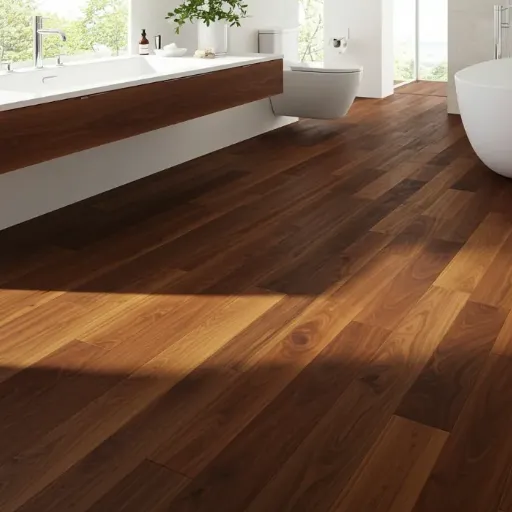
Black walnut is not endangered. The IUCN Red List lists Juglans nigra as Least Concern, and the species is not listed on the CITES appendices. The fear usually comes from the label, not the tree.
“Walnut” is an unregulated trade name. True walnuts belong to the genus Juglans. That includes American black walnut, European or Persian walnut (J. regia), and Peruvian walnut, which is a true tropical Juglans. But Brazilian walnut is usually ipe (Handroanthus species) or imbuia (Phoebe porosa). New Guinea, African, Queensland, and Caribbean “walnut” are often different species entirely.
This is not a technicality. A conservation claim about “walnut” means nothing if the product is not walnut. Tropical substitutes can carry different sourcing risks, different durability, and a different price. The scientific name on the invoice is the only reliable anchor.
Consider a homeowner in Ohio who chooses “Brazilian walnut” because it is cheaper than black walnut. The invoice lists ipe. The floor performs well, but the sustainability story he was told does not apply to the species in the box. A five-second check of the scientific name would have prevented the confusion.
For the full species comparison, see our guide to Peruvian walnut vs black walnut. It explains which names are true Juglans, which are substitutes, and how to read a spec sheet.
How to Read a Species Name on a Spec Sheet
Look for three things: the genus and species, the country or state of harvest, and the certificate code if a certification is claimed. A label that says only “walnut” is incomplete. A label that says Juglans nigra, harvested in Pennsylvania, with an FSC certificate code, is verifiable.
The Legal Layer: Lacey Act, PPQ 505, and EUDR
Legality is the floor beneath certification. In the United States, the Lacey Act makes it illegal to import illegally harvested plants or plant products. Importers must exercise due care, and many wood products require a declaration.
The declaration is filed on a PPQ 505 form. It asks for the scientific name of each plant material, the country of harvest, the quantity, and the value. Phase VII of the Lacey Act implementation took effect on December 1, 2024, adding more product categories. As of January 1, 2026, APHIS no longer accepts paper submissions, so declarations go through ACE or LAWGS.
The European Union has a parallel regime. The EU Deforestation Regulation covers wood and furniture, among other commodities. Operators and traders must show that the products were not produced on recently deforested land and did not cause forest degradation. The current application dates are December 30, 2026, for large and medium operators and June 30, 2027, for micro and small operators.
The United States is currently classified as low-risk under the EUDR benchmarking framework. That simplifies due diligence, but it does not exempt anyone. A due diligence statement is still required. “Low risk” means less work, not no work.
| Document | Who provides it | What to check |
|---|---|---|
| PPQ 505 declaration | Importer of record or agent | Scientific name, country of harvest, quantity, value |
| EUDR due diligence statement | EU operator or trader | Product coverage, geolocation, risk assessment |
| FSC or PEFC certificate | Supplier | Certificate code, scope, claim category, expiry date |
| Formaldehyde test report | Manufacturer | TSCA Title VI or CARB Phase II compliance |
| Finish emissions certificate | Finish or flooring manufacturer | Product-specific FloorScore or GREENGUARD listing |
If a supplier cannot produce the first two documents, the conversation is over. Certification is not a substitute for legal compliance.
The Certification Layer: FSC, PEFC, and What a Valid Claim Looks Like
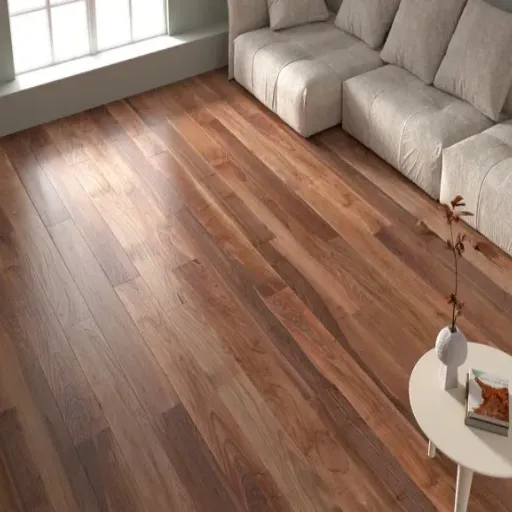
Forest certification is the most misunderstood part of sustainable walnut flooring. A logo is not a certificate. A certificate is a document with a code, a scope, and an expiry date.
FSC uses three labels. FSC 100% means all materials come from FSC-certified forests. FSC Mix means the product combines certified, recycled, and/or controlled wood. FSC Recycled means the product is made from 100% recycled material. Many walnut products are FSC Mix rather than FSC 100%. That is not a scandal, but the claim should match the label.
Chain of custody is the system that tracks certified material through every stage of processing, manufacturing, and distribution. FSC-certified organizations are audited by independent certification bodies and re-audited annually. A buyer can verify a certificate code through FSC’s public certificate search. If a claim looks wrong, FSC’s Claims Check service can review it.
PEFC and the Sustainable Forestry Initiative are recognized alternatives. They have their own standards and chain-of-custody systems. The verification process is the same: ask for the certificate, check the code, and confirm the scope covers the product you are buying.
Here is the uncomfortable part. Certification supports due diligence, but it is not a legal determination. A certified product can still be mislabeled. A supplier can still ship the wrong SKU. The certificate is evidence, not a guarantee.
Consider Maya, an interior designer in Portland. She specifies “FSC-certified walnut” for a client’s lobby. The quote comes back with an FSC logo but no code. She asks for the certificate number. It turns out to be FSC Mix, not FSC 100%, which changes the language she can use in the spec. The project stays on track because she caught it before the order, not after.
Five Questions That Expose a Weak Certification Claim
- Which claim category applies to this exact product: FSC 100%, FSC Mix, or FSC Recycled?
- What is the certificate code, and who is the certification body?
- Does the certificate scope cover this product and this manufacturing site?
- Can you provide the chain-of-custody record for this shipment?
- What is the certificate’s expiry date, and when was the last audit?
If the answers are vague, the claim is weak. A legitimate supplier will have the answers ready.
Engineered vs. Solid Walnut: Which Uses Walnut More Responsibly?
Engineered walnut is not automatically greener than solid walnut. It depends on how the board is built and what happens at the end of its life.
The resource argument for engineered flooring is real. A 4 mm wear layer on a 15 mm engineered board uses about one-fifth of the walnut fiber in a 19 mm solid board. That matters for a species that makes up less than 5% of the U.S. hardwood resource. Engineered construction also handles moisture and radiant heat better, which reduces failures and premature replacement.
The trade-off is the core. Engineered boards typically use plywood, HDF, or a lamellar core, and those layers involve adhesives. In the United States, composite wood products are regulated under TSCA Title VI, which sets emission limits identical to California’s CARB Phase II standard. Ask for a test report for the specific product, not a generic “E0” or “E1” marketing grade.
Finishes matter too. Water-based UV-cured polyurethane and hardwax oil generally have lower VOC profiles than solvent-based finishes. Product-specific FloorScore or GREENGUARD Gold certificates are useful, but they apply to the exact product tested, not the whole category.
Solid walnut uses more of the scarce species, but it uses less adhesive and can often be sanded more times. Neither option wins by default. The greener choice is the one with verified sourcing, a compliant core, a low-emitting finish, and a long service life.
| Factor | Solid walnut | Engineered walnut |
|---|---|---|
| Walnut fiber used | Higher | Lower |
| Dimensional stability | Lower | Higher |
| Refinish life | More sandings | Depends on wear layer |
| Adhesive risk | Lower | Higher, but regulated |
| Best use | Dry, stable interiors | Concrete, radiant heat, wide planks |
Refinish, Reclaim, Replace: The Lifecycle Answer
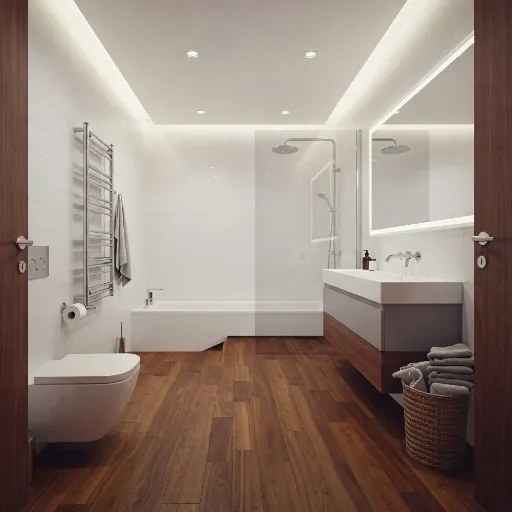
The most sustainable walnut floor is usually the one you keep. Walnut has a Janka hardness of about 1,010 lbf, which is soft for a hardwood. It dents. But dents can be repaired, and a floor with enough wear layer can be recoated or sanded instead of replaced.
Wear layer is the limiting factor. A thin engineered veneer may only support a recoat, not a full sand. A thicker veneer can be refinished once or twice. Solid walnut can be sanded several times. Before you replace a walnut floor, ask a contractor to measure the remaining wear layer. Our guide to refinishing walnut floors explains the tests and the limits.
Reclaimed and urban walnut are strong options when availability allows. Salvaged barn beams, factory flooring, and city trees keep material out of the waste stream and avoid new harvest. The caveats are real: nail holes, lead paint, inconsistent grading, and limited supply. But for the right project, reclaimed walnut is the most credible sustainability story in the room.
Order spare boxes. A small stash of matching boards makes future repairs possible without replacing an entire floor. That single decision can extend a floor’s life by years.
A facilities team in Chicago inherited a 15-year-old walnut floor with a worn finish but sound boards. Instead of replacing it, they had it cleaned and recoated. The floor stayed in service, the tenant kept the patina, and the project avoided new material. The cost was a fraction of replacement.
What to Ask a Supplier: A 10-Point Checklist
Before you buy sustainable walnut flooring, ask for these ten items. A supplier who can answer all ten is a supplier worth keeping.
- What is the scientific name, genus and species?
- What country and state or region was the wood harvested in?
- Is the product FSC 100%, FSC Mix, or FSC Recycled, and what is the certificate code?
- Can you provide the Lacey Act declaration or PPQ 505 for this shipment?
- For EU-bound projects, can you provide the EUDR due diligence statement?
- What is the formaldehyde test report under TSCA Title VI or CARB Phase II?
- What finish is used, and is there a product-specific FloorScore or GREENGUARD certificate?
- What is the wear layer, and how many refinishes does it support?
- What warranty applies, and does it survive commercial installation?
- How much spare stock should I hold for repairs and future matching?
If you are comparing suppliers, our guide to commercial walnut flooring shows how these questions fit into a submittal package. For the certification mechanics behind the claims, see our FSC-certified wood veneer panels guide and our broader explanation of sustainable veneer sourcing.
FAQ About Sustainable Walnut Flooring
Is walnut sustainable?
Walnut can be sustainable when it is legally harvested, responsibly managed, and used in a long-lasting floor. The species alone does not guarantee it.
Is walnut endangered?
No. American black walnut (Juglans nigra) is IUCN Least Concern and not CITES-listed. Some tropical species sold as “walnut” have different status and sourcing risks.
Is black walnut sustainable?
Yes, conditionally. It is not endangered, but it is a small share of the U.S. hardwood resource. Look for verified sourcing and a long service life.
Is Brazilian walnut endangered, and is it real walnut?
Brazilian walnut is usually ipe or imbuia, not a true Juglans. Its conservation and sourcing profile is different from black walnut. Check the scientific name before accepting any sustainability claim.
Is walnut flooring eco-friendly?
It can be. The strongest claims combine legal harvest, FSC or PEFC chain of custody, a compliant core and finish, and a floor that can be refinished rather than replaced.
Is engineered walnut sustainable?
It can use far less walnut fiber per square foot than solid wood, which matters for a scarce species. The trade-off is adhesive and core materials, so ask for TSCA Title VI or CARB Phase II documentation.
Is engineered hardwood toxic?
Not if it complies with U.S. formaldehyde limits. TSCA Title VI covers hardwood plywood, MDF, and particleboard, and its limits match CARB Phase II. Ask for the test report for the specific product.
Does walnut flooring need FSC certification?
Certification is voluntary, not a legal requirement. It is the clearest way to verify responsible forest management, but it does not replace Lacey Act or EUDR compliance.
Is reclaimed walnut more sustainable?
Usually, yes. It avoids new harvest and keeps usable wood in service. Check for lead paint, nail damage, and grading issues before you commit.
The Bottom Line on Sustainable Walnut Flooring
Walnut is not the environmental villain some fear, and it is not automatically the green hero some marketers claim. It is a scarce, beautiful, moderately soft hardwood with a legitimate sustainability story when the supply chain is verified.
Four things matter most. Black walnut is not endangered. Sustainability is a claim about a specific supply chain, not a species. A certificate is only useful when you can verify the code and the chain of custody. And the longest-lasting floor is usually the greenest one.
If you are planning a project, we can help you review the documentation, compare engineered and solid constructions, and choose a specification that holds up. Request a quote and our walnut sourcing documentation, or start with our engineered walnut flooring guide for the full product overview. For durability questions before you commit, see is walnut flooring durable.
The right floor is not the one with the best logo on the sample. It is the one you can document, maintain, and keep for decades.