
Engineered Walnut Flooring: 2026 Buying & Installation Guide
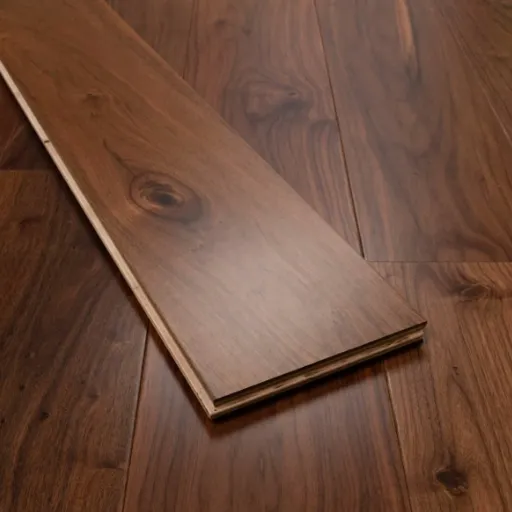
Engineered walnut flooring is real hardwood made with a top layer of walnut veneer bonded to a stable, cross-laminated core. It delivers the deep, chocolate-toned look designers specify on sight, while resisting the moisture and humidity swings that make solid walnut risky over concrete, below grade, and on radiant heat. If you want a premium floor with genuine character and the stability to go almost anywhere, engineered walnut is one of the most rewarding species you can choose.
There is a catch, and it is the reason this guide exists. Walnut is one of the softest common flooring species, it changes color as it ages, and the name “walnut” on a price tag does not always mean the tree you think it does. Nobody tells you that in a showroom. Understanding these quirks before you buy is the difference between a floor you love for decades and one you regret within a year.
Key Takeaways
- Engineered walnut pairs a real walnut wear layer with a cross-laminated core, so it works over concrete, below grade, and with radiant heat where solid walnut fails.
- Walnut is genuinely soft for a hardwood, about 1,010 on the Janka scale, softer than red oak, white oak, maple, and hickory. Engineered construction adds stability, never hardness.
- Walnut lightens and mellows with UV exposure rather than darkening, the opposite of cherry, and most of the change happens in the first three to six months.
- A wear layer of 3-4 mm supports one to three professional refinishes; 2 mm supports one careful sand; thinner layers only take a screen and recoat.
- American black walnut is not CITES-listed and is IUCN Least Concern, so the real sourcing questions are Lacey Act due care, EUDR, and asking for the scientific species name.
What Is Engineered Walnut Flooring?
Engineered walnut flooring is built in layers. The top layer is a real slice of walnut, called the wear layer or veneer, and it is the only part you actually walk on. Beneath it sits a core of cross-laminated plywood or high-density fiberboard, and under that a thin backing that balances the plank and keeps it flat.
That layered construction is what lets walnut go where solid walnut cannot. Solid walnut is a moisture-sensitive species. In dry seasons it shrinks and gaps; in humid seasons it cups.
Because the plies of an engineered core run in alternating directions, they resist that movement. The floor stays flatter year-round, which is why engineered walnut suits concrete slabs, below-grade rooms, and radiant heat.
The wear layer is the part that determines how long the floor lasts. A 2 mm layer can usually be sanded once, carefully, by a professional. A 3-4 mm layer handles one to three refinishes over its life.
A 6 mm layer behaves much more like solid wood. Below 2 mm, the only safe refresh is a light screen and recoat, because a full sand will cut into the core.
If you are new to the category, our pillar guide to engineered wood flooring explains the full picture, including how engineered products compare with laminate, vinyl, and solid hardwood.
Why Choose Engineered Walnut Over Solid Walnut?
When people say they want a walnut floor, most picture the solid boards found in older homes. Engineered walnut keeps the same species and removes the biggest drawback: solid walnut’s sensitivity to moisture.
Stability Where Solid Walnut Fails
Solid walnut is beautiful but demanding. It needs stable indoor humidity, and it should not be glued to concrete or installed below grade. Engineered walnut solves that problem because the core resists expansion and contraction. It is the reason designers choose engineered walnut for condos, kitchens, and radiant-heated homes.
An Efficient Use of a Premium Species
Engineered walnut uses a thin slice of walnut over a core made from more abundant wood. That matters because walnut is scarce and expensive. American black walnut makes up under 5% of the entire U.S. hardwood resource, and it commands the highest per-board-foot export price of any widely traded American hardwood.
A veneer wear layer lets you enjoy the species while stretching a limited supply further. When the core is certified plywood, the environmental advantage grows.
If the solid-versus-engineered decision is the one you are wrestling with, our comparison of engineered walnut vs solid walnut walks through stability, cost, lifespan, and refinishing in detail.
A Flatter, Wider Floor
Wide walnut planks are a sought-after look, but wide solid boards move more and risk seasonal gaps. Engineered walnut lets manufacturers produce wide and long planks that stay flat, so you can enjoy that expansive, uninterrupted surface without the worry. It is a format that suits contemporary interiors especially well.
Walnut Flooring Pros and Cons
No species is perfect, and walnut asks you to accept a few honest trade-offs. It is a premium wood with a real personality, and the more you know about it, the better you will choose.
| Pros | Cons |
|---|---|
| Rich, deep color no stain can replicate | Soft for a hardwood (about 1,010 Janka); dents from heels and chair legs |
| Warm, smooth, uniform grain with elegant character | Lightens over time with UV exposure |
| Stable in engineered form; suits concrete and radiant heat | Dark surface shows dust and light-colored pet hair |
| Wide plank options that stay flat | Premium price; well above oak |
| Hides minor marks on a dark base | Cream sapwood contrast if not properly graded |
| Efficient use of a scarce, premium species | Hard to color-match replacement boards years later |
The honest summary: walnut rewards you with a look that no other species matches, on a floor stable enough for almost any room. But it will not shrug off abuse the way oak or hickory will, and it will change color as it lives. If you need a hard, tough floor for a busy entryway or a home with large dogs, walnut may frustrate you. If you want a warm, sophisticated surface and will treat it with reasonable care, walnut is superb.
For a fuller decision guide covering both solid and engineered walnut, see our breakdown of walnut flooring pros and cons.
Black Walnut vs. European Walnut
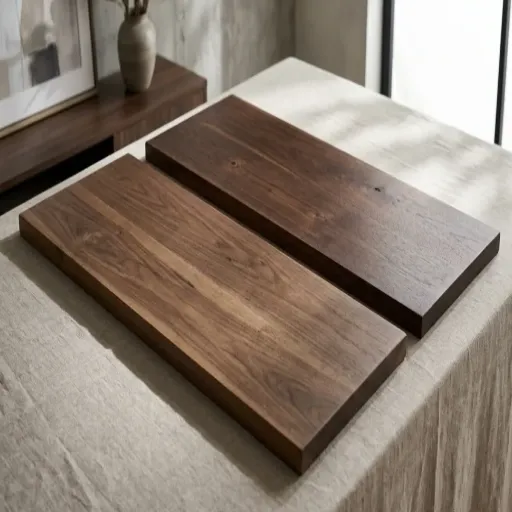
The word “walnut” covers a few different trees, and the two you will meet most often in flooring are American black walnut and European walnut.
American black walnut, Juglans nigra, is the species most North American flooring is built from. It measures about 1,010 on the Janka scale. It has a rich, chocolate-brown heartwood, a smoothly textured grain, and excellent working properties.
European walnut, also called Persian walnut or Juglans regia, is slightly lighter in tone and ranges from about 940 to 1,160 on the Janka scale. It tends to show more gray and purple undertones and a bit more figure.
Both are genuine walnuts and both are fine flooring species. The practical difference for a buyer is color and availability rather than durability. If you love the deep, uniform brown that “walnut” usually brings to mind, you are picturing black walnut. If you prefer a softer, more varied tone, European walnut is worth a look.
The “Walnut” You Are Actually Buying
Here is something almost no retailer explains, and it protects your wallet: not everything sold as walnut is a true walnut.
True walnuts belong to the genus Juglans. American black walnut is Juglans nigra; European walnut is Juglans regia. Peruvian walnut is also a true walnut. It refers to tropical Juglans species such as Juglans neotropica, and it measures around 1,080 on the Janka scale, close to black walnut.
Things get murkier with other trade names. “Brazilian walnut,” “New Guinea walnut,” “African walnut,” “Queensland walnut,” and “Caribbean walnut” are frequently not true walnuts at all. They are unrelated timbers sold under a walnut-sounding name that describes their appearance rather than their botany. Trade names are not regulated, so a board can look like walnut and share none of its lineage or its working properties.
The fix is simple. Ask for the scientific name on the spec sheet. If a supplier cannot or will not name the genus, treat the product with caution. A reputable manufacturer will always tell you exactly what species you are buying.
Wood veneer works the same way in cabinetry and paneling, and our guide to Peruvian walnut vs black walnut digs into the tropical species in detail so you can buy with confidence.
Walnut’s Real Hardness: Janka 1,010 and What It Means
Walnut is often called a luxury wood, which leads buyers to assume it is also a tough one. It is not. Walnut measures about 1,010 on the Janka hardness scale, and that places it among the softer common flooring species.
| Species | Janka (approx.) | Relative hardness |
|---|---|---|
| Hickory | 1,820 | Much harder |
| Hard maple | 1,450 | Harder |
| White oak | 1,360 | Harder |
| Red oak | 1,290 | Harder |
| Peruvian walnut | 1,080 | Slightly harder |
| Black walnut | 1,010 | Baseline |
| European walnut | 940-1,160 | Similar |
What does this mean in practice? Walnut dents. High heels, chair legs dragged across the floor, dropped objects, and pet claws can all leave marks. This is the single most important thing to accept about the species before you buy it.
The good news is how walnut wears. Dents in a dark floor tend to develop a slightly lighter or glossier patina over time, and because the base color is deep, minor marks blend in more than you might expect. A matte or wire-brushed finish hides even more. Felt pads under furniture, entry mats, and steady humidity control do most of the work of protecting a walnut floor.
If durability under heavy traffic is your top priority, our guide to is walnut flooring durable covers dents, scratches, pets, and traffic in depth, and it will tell you honestly when oak or hickory is the smarter choice.
How Walnut Changes Color Over Time
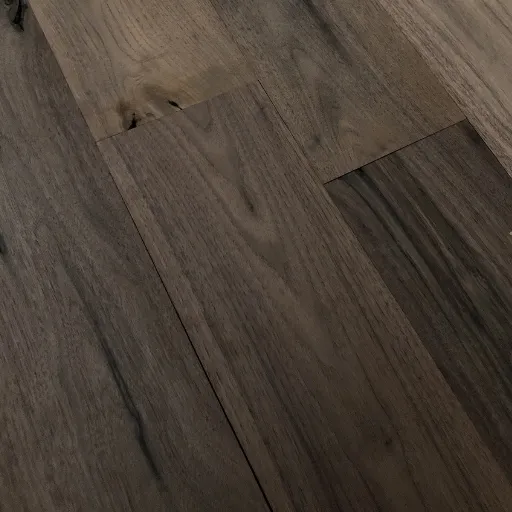
Walnut does something distinctive and beautiful: it lightens as it ages.
Unlike cherry, which darkens, or oak, which ambers, walnut’s dark heartwood pigments break down under ultraviolet light. Over months and years, that deep chocolate tone mellows toward a warmer, lighter brown, sometimes with golden undertones. It is the reverse of most hardwood aging, and no competitor guide would tell you to expect it.
Most of the change happens in the first three to six months after installation, then it stabilizes as the surface reaches a new equilibrium. Rooms with strong direct sunlight lighten faster than shaded rooms, which is why you can sometimes see faint “tan lines” where a rug or sofa shielded part of the floor.
You can manage the shift without fighting it. Rotate area rugs periodically so the floor ages evenly. Use window treatments or UV-filtering film in bright rooms to slow the process.
And choose your finish with the shift in mind. A water-based, UV-inhibited finish keeps the tone truer for longer, while an oil-based finish ambers the wood faster. If you are trying to match a walnut floor to cabinetry or furniture, plan for the floor to move a step lighter over its first year.
Our guide to does walnut flooring lighten explains the science and the timeline, including the one technical source that reports a darker oxidation path for some American walnut.
Grades, Sapwood, Steaming, and Formats
Once you settle on walnut, the next choices are grade, processing, and format. These shape the look more than most buyers expect.
Walnut Grades and Sapwood
Walnut has a dramatic heartwood-to-sapwood contrast. The heartwood is the deep brown most people want; the sapwood is a pale cream. Grade determines how much of that pale sapwood is allowed to show.
- Select or Clear grade: Mostly heartwood with minimal sapwood, for a uniform, deep, premium look.
- Character or Natural grade: More sapwood and color variation, giving a livelier, more rustic surface at a lower price.
- Mixed grades: A blend that can include significant sapwood and color shift.
If you want that classic rich walnut look, ask specifically how much sapwood the grade allows.
Steamed vs. Unsteamed
Many suppliers steam walnut before drying it. Steaming evens out the color by darkening the lighter sapwood and the pale streaks, producing a more uniform brown. Unsteamed walnut keeps more contrast and figure. Neither is better; they simply produce different looks.
Faces are usually plain-sliced or rotary-cut, which produces the sweeping grain most walnut flooring shows, or quarter or rift-cut for a straighter, more linear face. Plank widths run from about 3 inches to 7 inches and wider.
Formats and Color
Walnut is best left natural or lightly toned. The species has a color that no pigment stain improves, and staining risks muddying its depth. If you do want a shift, a light water-based toner is the safest choice.
Wide and long planks suit walnut’s smooth grain particularly well, and engineered walnut handles them without cupping. For the full format story, see our guide to wide plank engineered wood flooring.
Construction Specs That Matter
A walnut floor is only as good as its construction, and reading the spec sheet correctly is where buyers separate quality from disappointment.
Wear Layer Thickness
| Wear Layer | Refinishing Potential | Typical Lifespan | Best For |
|---|---|---|---|
| Under 2 mm | Screen and recoat only | 10-15 years | Rentals, tight budgets |
| 2 mm | One careful full refinish | 15-20 years | Entry-level homes |
| 3-4 mm | One to three refinishes | 25-40 years | Most homes |
| 6 mm or more | Three or more refinishes | 40-60+ years | Forever homes, commercial |
A thicker wear layer costs more upfront, but it is the single best predictor of how long your walnut floor will serve you. This matters even more for a soft species, because refinishing is how you erase a decade of dents.
Core Material
- Plywood core: The best all-rounder. Cross-laminated plies, stable, moisture-resistant, and fine for nail, glue, or floating installs.
- HDF core: Dense and dimensionally stable, common in click-lock products, but more moisture-sensitive at the edges than plywood.
- Lamellar or solid-sawn core: A premium option that behaves closest to solid wood, with excellent refinishing depth.
- SPC or WPC core: Rigid, waterproof composite cores found in hybrid products. Truly waterproof, but not real hardwood, so it cannot be refinished and it is not walnut.
Finish and Joint System
Factory-applied aluminum oxide finishes add scratch resistance and carry long warranties. Hardwax oil gives a more natural look and can be spot-repaired, at the cost of more frequent maintenance. Tongue-and-groove joints are standard for nail and glue installs; click-lock systems simplify floating installation.
If you are comparing products, our guide to the best engineered wood flooring lays out the selection criteria in one place.
Engineered Walnut Flooring Cost (2026)
Cost varies with grade, wear layer, plank width, finish, and installation method. The ranges below are national averages for the United States and will shift with region and product tier.
| Product Tier | Material /sq ft | Installation /sq ft | Total /sq ft |
|---|---|---|---|
| Budget walnut, 2 mm wear layer | $6-$8 | $3-$6 | $9-$14 |
| Mid-range black walnut, 3-4 mm wear layer | $8-$12 | $4-$7 | $12-$19 |
| Premium walnut, 4-6 mm wear layer | $11-$16 | $5-$9 | $16-$25 |
| Wide plank or custom finish | $14-$22 | $6-$10 | $20-$32 |
Walnut is one of the pricier flooring species. Expect it to run roughly 30-50% above red oak and 20-40% above white oak, though still below exotic imports. The premium reflects genuine scarcity: walnut is under 5% of the U.S. hardwood resource and is the most expensive widely traded American hardwood on export markets such as Japan, Vietnam, Germany, Italy, and the United Kingdom.
Engineered walnut generally costs 20-30% less installed than solid walnut of the same grade, because it uses less premium wood and installs faster. A 500-square-foot room in mid-range black walnut with a 3-4 mm wear layer typically lands between $6,000 and $9,500 installed.
Watch the hidden costs retailer quotes often omit: subfloor prep and leveling, underlayment and moisture barrier, transitions and trim, and stairs. These can add 1−1−4 per square foot. For a transparent breakdown by grade, wear layer, and room size, see our walnut flooring cost guide, or compare it against our general engineered wood flooring cost article for the wider category.
Installation Methods
Engineered walnut is more forgiving to install than solid walnut, but the fundamentals still decide whether the floor performs.
- Floating: Fastest and most DIY-friendly for click-lock products. Best over a sound, flat subfloor with a quality underlayment.
- Glue-down: The most stable option over concrete, and the quietest underfoot.
- Nail-down: Standard over plywood subfloors and a good choice when the core supports it.
Whatever the method, let the flooring acclimate to the room, test the subfloor and slab for moisture, leave the correct expansion gap at the walls, and get the subfloor flat to within about 3/16 inch over 10 feet. Skipped acclimation and hidden slab moisture are behind most walnut flooring failures.
This section is meant as an overview only. For the full step-by-step process, tools, and subfloor preparation, see our complete engineered wood flooring installation guide.
Best Rooms for Engineered Walnut Flooring
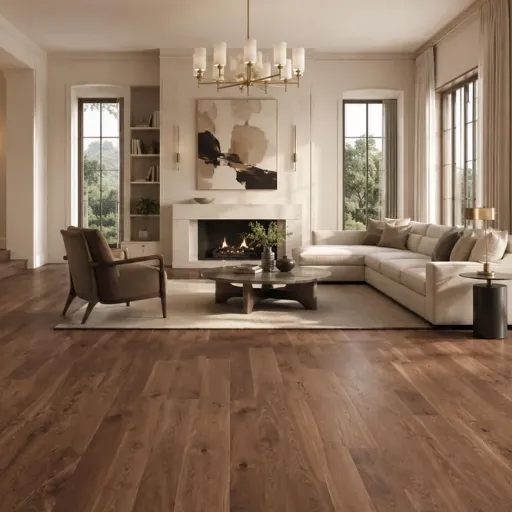
Walnut’s engineered form opens rooms that solid walnut cannot safely enter, and its softness guides where it performs best.
- Bedrooms: The ideal home for walnut. Low traffic and soft light let the deep color and mellow aging shine.
- Living rooms and dining rooms: Excellent, provided you use felt pads and mats under furniture.
- Home offices: A natural fit, with a warm, executive feel.
- Kitchens: Workable with the stable core, but walnut is soft for a kitchen and spills need quick attention.
- Hallways and high-traffic zones: The weak spot, because dents accumulate fastest where feet land. Consider oak or hickory here.
- Pet households: Manageable with a matte or textured finish and trimmed claws, but walnut will collect dents from larger, more active dogs.
- Over radiant heat: A strong fit, since the cross-ply core handles daily temperature swings.
- Below grade and over concrete: Only in engineered form, and only with a moisture barrier.
If water is the main worry, our waterproof engineered wood flooring guide and our engineered wood flooring for basement guide cover the moisture-prone situations in detail.
Refinishing, Dent Repair, and Care
Walnut asks for a light touch, both because it is soft and because its color has to age well.
Daily Cleaning
Sweep, dust-mop, or vacuum with a soft brush attachment regularly. On a dark floor, dust and light debris show quickly, so a simple routine keeps walnut looking its best. Add entry mats and felt pads under furniture to keep grit and pressure off the surface.
Cleaning Method
Use a barely damp mop with a manufacturer-approved, pH-neutral hardwood cleaner. Never use a steam mop, and do not let standing water sit on the joints. Our guide to cleaning wood floors covers safe products and routines in depth.
Repairing Dents
Because walnut dents rather than gouges, many marks can be eased with a steam treatment: place a damp cloth over the dent and gently press with a warm iron. Deeper dents can sometimes be raised with a wood sweller. For surface scratches, a color-matched touch-up stick or a light application of hardwax oil often hides the mark.
Refinishing Limits
Because engineered walnut has a real but finite wear layer, refinishing depends on thickness. A 3-4 mm layer can be sanded one to three times by a professional. A 2 mm layer supports one careful sand. Below that, only a screen and recoat is safe.
Walnut is softer than oak or maple, so it marks and burnishes more readily during sanding, which means grit progression and machine control matter more. Re-staining carries a blotch risk on walnut’s open grain, and most owners are better served by keeping the natural color. When it is time, our refinishing walnut floors guide covers the species-specific steps, and our general guide to refinishing engineered hardwood floors explains the process for the whole category.
Sustainability and Legal Sourcing
For architects, designers, and homeowners chasing green building goals, walnut has a genuinely strong story once you look past the myths.
A Common Myth, Cleared Up
Many people assume that because walnut is scarce and expensive, it must be endangered or restricted. It is not. American black walnut is not listed on the CITES appendices, and the IUCN classifies it as a species of Least Concern. The scarcity is about a low share of the resource, not about a threatened species.
The Real Compliance Framework
The questions that actually matter are about legality and due care. In the United States, the Lacey Act requires importers to exercise due care, including declaring the scientific name, country of harvest, quantity, and value of the wood on a PPQ 505 form. For destination markets, the EU Deforestation Regulation (EUDR) applies, and the United States has held the EU’s low-risk tier since May 22, 2025, per the American Hardwood Export Council.
Look for certification from the Forest Stewardship Council (FSC) or the Programme for the Endorsement of Forest Certification (PEFC). The National Wood Flooring Association (NWFA) also publishes guidance on responsible hardwood sourcing.
And the industry’s own American Hardwood Assured program now uses satellite imagery and AI to verify the legal origin of U.S. hardwoods down to the county level.
Roughly 92% of U.S. hardwood production comes from privately owned forestland, and the U.S. Forest Service pegs illegal harvest risk at under 1%, which is why American hardwoods are widely regarded as a low-risk sourcing choice.
Why a Veneer Wear Layer Is a Sustainability Win
Here is the angle most flooring articles miss. An engineered walnut floor concentrates the scarce hardwood where you actually need it, in a thin wear layer on top. That single plank uses a fraction of the slow-grown walnut a solid board requires. Pair that efficiency with certified cores and low-VOC binders, and engineered walnut becomes a resource-smart way to enjoy a premium species.
The walnut veneer wear layers we manufacture at VitalWood Global are designed to this exact principle. Learn more about how we approach sustainable veneer and FSC-certified wood veneer panels, or read our broader guide to sustainable walnut flooring.
Is Engineered Walnut Flooring Right for You?
Run through this short checklist before you commit.
- You want the deep, distinctive color of walnut and are happy to keep it natural rather than stained.
- You accept that walnut is soft, and you will use furniture pads, mats, and steady humidity control.
- You like the idea of a floor that mellows and lightens with age rather than one that stays static.
- You need a floor over concrete, below grade, or on radiant heat, where solid walnut is not an option.
- You want wide planks that stay flat across the seasons.
- You are comfortable with a premium price for a scarce, ethically sourced hardwood.
- You will verify the species and ask for the scientific name before you buy.
If most of those are true, engineered walnut is an excellent choice. If you need a floor that hides heavy wear, takes punishment from pets and traffic, or requires the least possible maintenance, oak or hickory will serve you better. Whichever you choose, our engineered oak flooring and engineered maple flooring guides cover the sibling species, and our walnut vs oak flooring comparison puts walnut and oak head to head.
FAQ About Engineered Walnut Flooring
Is engineered walnut flooring real wood?
Yes. The wear layer you walk on is real walnut. Only the core is engineered for stability. Beware of cheap products under about $4 per square foot, which are sometimes printed photographic layers rather than real walnut.
Is engineered walnut flooring waterproof?
No wood floor is truly waterproof. Engineered walnut is water-resistant because its core resists moisture, and it handles humidity far better than solid walnut. Wipe spills promptly and never let water stand on the joints.
Can engineered walnut flooring be refinished?
Yes, up to the limit of the wear layer. A 3-4 mm layer supports one to three professional refinishes, a 2 mm layer supports one careful sand, and thinner layers only take a screen and recoat.
Is walnut hard or soft?
Walnut is soft for a hardwood, at about 1,010 on the Janka scale. That is below red oak, white oak, maple, and hickory, which is why it dents more easily and suits lower-traffic rooms best.
Does walnut flooring get lighter or darker?
Walnut lightens with age as UV light breaks down its pigments, the opposite of cherry. Most of the change happens in the first three to six months, then it stabilizes. A UV-inhibited water-based finish slows the shift.
Is walnut flooring good for bedrooms?
Yes. Bedrooms are the ideal room for walnut because traffic is low and lighting is soft, which lets the color age gracefully.
Is walnut flooring good for pets?
It can work, but walnut is soft and will collect dents from larger, active dogs. Choose a matte or wire-brushed finish, keep claws trimmed, and expect some marks in high-traffic areas.
What is the best wear layer for engineered walnut?
For most homes, 3-4 mm is the sweet spot, because it allows one to three refinishes and stretches the floor’s life to 25-40 years. Choose 6 mm or more if you want a forever floor, and avoid anything under 2 mm unless you only need a screen and recoat.
Does walnut flooring need to be stained?
No. Walnut’s natural color is the draw, and staining risks muddying its depth. Keep it natural or use a light water-based toner for a small shift.
Can engineered walnut go over concrete or radiant heat?
Yes. The cross-laminated core makes engineered walnut a strong fit over concrete slabs and radiant-heat systems, where solid walnut is not recommended.
Conclusion
Engineered walnut flooring gives you the deep, characterful surface of walnut without the moisture risk that comes with solid boards. Choose a genuine black walnut product with a verified species, a 3-4 mm or thicker wear layer if you want refinishing headroom, and a plywood core for the best balance of stability and repairability. Accept that walnut is soft and that it will lighten and mellow with age, use a UV-inhibited finish to steer that change, and buy certified to support responsible forestry.
At VitalWood Global, we believe great flooring is informed, ethical, and built to last. If you are weighing options, start with our walnut flooring pros and cons guide, or compare walnut against oak in our walnut vs oak flooring breakdown.
Specifying at scale? Our commercial walnut flooring guide covers wear layers, finish systems, and submittals for architects and distributors. For samples, certifications, or a wholesale quote on our sustainably sourced engineered walnut flooring and walnut veneer, contact our team today.