
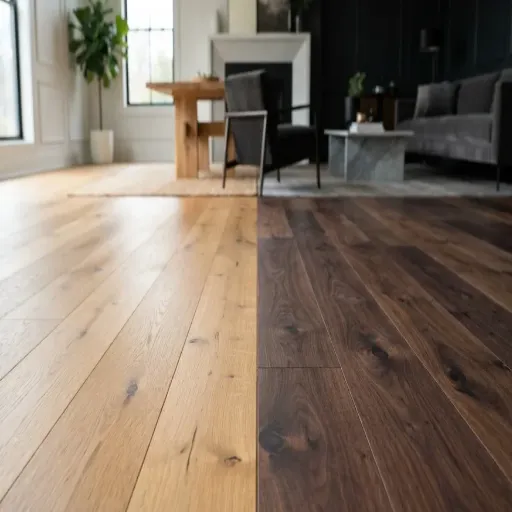
Walnut vs Oak Flooring: Which Species Should You Choose?
Walnut vs oak flooring comes down to a trade-off: oak is harder, more affordable, and hides everyday wear better, while black walnut is softer but delivers a darker, more distinctive look that stain cannot fully copy. If durability and budget lead, choose oak. If design impact leads and the room sees lighter traffic, choose walnut.
Walnut is often the floor people fall in love with at first sight. Oak is often the floor they are glad they chose five years later. The most beautiful showroom sample is not always the best floor for a busy hallway or a large dog.
This guide covers how each species ages, shows wear, handles moisture, and what it costs in 2026.
Key Takeaways
- Black walnut rates about 1,010 on the Janka scale, versus about 1,290 for red oak and 1,360 for white oak, making walnut roughly 22% to 26% softer.
- Oak’s open grain breaks up scratch lines, while walnut’s fine grain and dark color make light scratches, dents, and dust more visible.
- Walnut is dimensionally stable and visually distinctive, but no solid hardwood is waterproof, and walnut is not a high-traffic floor.
- Walnut usually costs 30% to 80% more than comparable oak, depending on grade, width, format, and market.
- Engineered construction improves stability over concrete, basements, and radiant heat. It never makes the wood surface harder.
Want to compare the two species in person? Request walnut and oak samples from our team, and we will help you match finish, grade, and plank width to your project.
Walnut vs Oak Flooring at a Glance
All three are real hardwoods that can last decades with proper care. The differences are about performance and aging, not authenticity.
| Characteristic | Red Oak | White Oak | Black Walnut |
|---|---|---|---|
| Janka hardness | ~1,290 | ~1,360 | ~1,010 |
| Grain | Bold, open, pronounced | Tighter, linear, subtle rays | Fine, smooth, low contrast |
| Color | Warm, pinkish tan | Cool beige, tan, gray-brown | Deep chocolate to mocha |
| Dent resistance | Good | Good | Moderate |
| Scratch visibility | Low to moderate | Low to moderate | High |
| Dimensional stability | Moderate plainsawn; high quartersawn | Moderate to high | High plainsawn |
| Moisture resistance | Moderate | Best of the three (tyloses) | Moderate; stable but not waterproof |
| Staining | Excellent, even absorption | Very good | Best kept natural or lightly toned |
| Color change over time | Ambers and warms | Ambers less than red oak | Lightens and mellows under UV |
| Material cost (2026) | $3-$7/sq ft | $4-$10/sq ft | $6-$15/sq ft |
| Installed cost (2026) | $6-$12/sq ft | $9-$17/sq ft | $10-$18/sq ft |
| Best rooms | Family rooms, hallways, traditional interiors | Kitchens, entries, modern and coastal interiors | Bedrooms, dining rooms, home offices |
Quick verdict: choose oak for hardness, lower cost, stain flexibility, and forgiveness. Choose walnut for a rich, design-forward floor in lower-traffic spaces. If you want walnut’s tone with oak’s durability, stained oak is a legitimate third option.
Hardness and Durability: Oak Is Harder, But Wear Is More Complicated
The Janka Numbers
Janka hardness measures the force required to push a steel ball halfway into a wood sample. The National Wood Flooring Association publishes the reference values the industry uses:
- Black walnut (Juglans nigra): about 1,010
- Red oak: about 1,290
- White oak: about 1,360
Walnut is roughly 22% softer than red oak and 26% softer than white oak based on those averages. The gap is real, but not the whole story. A dropped pan can dent almost any wood floor, and a large dog will eventually mark oak, too. Finish quality, plank grade, and room use often matter more than a few hundred pounds of Janka difference.
Why Oak Hides Wear Better
Here is the part buyers miss in the showroom. Walnut has a fine, smooth, low-contrast grain and a dark surface, so light scratches, scuffs, dust, and pet claws show up clearly. Oak has an open, pronounced grain that visually breaks up a scratch line, so the same wear disappears into the pattern. That is why an oak floor can look newer after five years even though it is the harder wood.
What This Means for Kids, Dogs, and High-Traffic Rooms
For a household with young children, large dogs, or heavy foot traffic, white oak or hickory is more practical. Walnut works better in bedrooms, dining rooms, home offices, and formal spaces. If walnut is non-negotiable, use rugs in traffic lanes, felt pads, trimmed nails, and a matte or wire-brushed finish.
Consider a typical scenario. Priya and her husband loved a wide-plank walnut sample for their main floor, but they had two young kids and a golden retriever. They tested a key and a leash against both samples. The walnut showed every pass.
They chose engineered white oak with a 4 mm wear layer and a matte finish, then saved walnut for their bedroom. The design compromise was small. The maintenance difference was not.
Appearance and Color: Chocolate, Honey, and How They Age
Walnut’s Look
Black walnut has deep chocolate-to-mocha heartwood, sometimes with purple, auburn, or gray undertones. Its grain is fine and smooth, with strong plank-to-plank variation and, in natural grades, pale cream sapwood. The look is modern, moody, and formal, and harder to imitate than most people expect.
For species detail, grades, and construction options, see our guide to engineered walnut flooring.
Oak’s Look
Red oak has a warm, pinkish cast and a bold, open grain that suits traditional and transitional interiors. White oak runs cooler and more neutral, with a tighter grain and subtle rays that anchor modern farmhouse, coastal, and contemporary rooms. Oak is the more versatile canvas because it accepts stain evenly across a wide color range. See our engineered oak flooring guide for species detail.
How Each Changes Over Time
Walnut generally lightens and mellows under ultraviolet light, mostly in the first three to six months. A rug left in place for a year can leave a visible “tan line.” Oak tends to amber and warm instead, and white oak changes less than red oak. Rotate rugs, manage direct sun, and expect some shift. For the full explanation, read our guide on whether walnut flooring lightens.
Stability, Moisture, and Room Suitability
Dimensional Stability
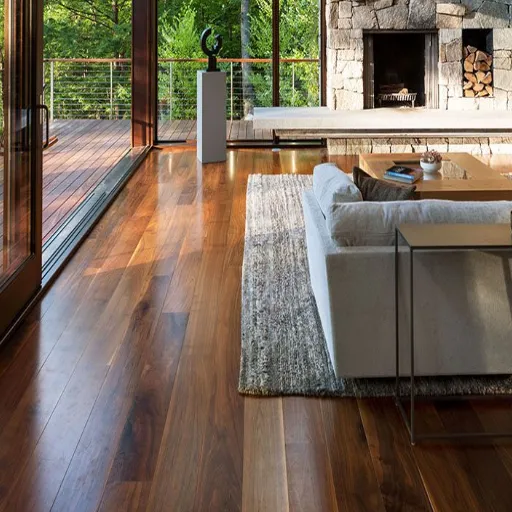
Dimensional stability describes how much wood expands and contracts as humidity changes. The USDA Forest Service Wood Handbook publishes shrinkage coefficients by species and cut. For plainsawn boards, black walnut’s coefficient is about 0.00274, compared with 0.00369 for red oak. In plain terms, walnut is more stable than red oak when both are cut the same way.
That is counter-intuitive: walnut is softer, but it moves less across a plainsawn plank. Quartersawn red oak is more stable than quartersawn walnut, so the result depends on the cut. Both work in wide planks when acclimated and kept at stable humidity.
Water, Humidity, and Moisture Resistance
No solid hardwood floor is waterproof. White oak has an advantage because structures called tyloses plug its pores, slowing water absorption. Red oak has fewer tyloses, and walnut is stable but not moisture-proof.
Keep indoor relative humidity roughly between 30% and 50%, wipe up spills, and fix leaks quickly. Engineered flooring is safer for kitchens, laundry rooms, basements, and radiant heat because its cross-laminated core resists movement.
Best Rooms for Each Species
Walnut suits bedrooms, dining rooms, living rooms, home offices, and formal spaces. Oak suits kitchens, entries, hallways, family rooms, pet households, and rental or multi-unit properties where durability and easy repair matter.
Staining and Finishing: Can Oak Look Like Walnut?
Walnut is usually kept natural or lightly toned. Heavy stain flattens the natural variation that makes the species desirable, and sapwood takes stain differently from heartwood. A matte or satin finish hides wear better than gloss; hardwax oil can be spot-repaired, while factory aluminum-oxide is more durable but harder to touch up.
Can You Stain Oak to Look Like Walnut?
Yes. Staining oak to a walnut tone is practical for buyers who want the look with more hardness and a lower price, but it is not a perfect substitute.
Red oak takes dark stain well, though its pink undertone and open grain remain visible. White oak is a better canvas for cool, chocolate-brown tones. A gel stain with a wood conditioner, tested on sample boards first, gives the most even result.
Expect less plank-to-plank variation than real walnut, and expect the grain to read as oak up close. What you gain is a harder surface, easier future color matching, and a lower installed cost. Our walnut flooring cost guide breaks down real walnut versus stained oak.
Species is only half the wear story. Matte finishes show fewer scratches than gloss, factory aluminum-oxide usually outperforms thin site-applied finishes, and wire-brushed textures camouflage minor marks. If you want walnut’s look but worry about wear, choose a textured matte finish and a character grade.
Engineered Walnut vs Oak: Construction, Care, and Refinishing
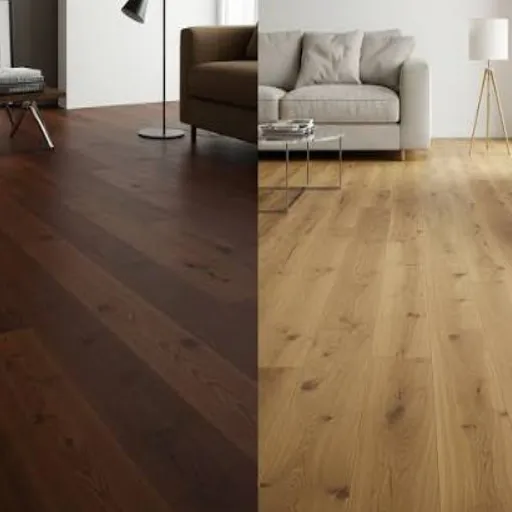
Engineered flooring places a thin slice of real hardwood, the wear layer, over a cross-laminated plywood or fiberboard core. The construction improves stability, which is why engineered floors work over concrete, in basements, and with radiant heat.
It does not change surface hardness. A walnut wear layer is still walnut; an oak layer is still oak.
Wear Layer and Refinishing Math
The wear layer determines how many times a floor can be sanded and refinished. These are working rules of thumb, not guarantees:
| Wear layer thickness | Refinishing capacity |
|---|---|
| Under 2 mm | Screen-and-recoat only; no full sand |
| About 2 mm | One careful sand |
| 3-4 mm | One to three refinishes |
| 6 mm or more | Three or more refinishes with proper care |
Each sanding pass removes roughly 0.75-1 mm of surface. The NWFA references a minimum remaining wear layer of about 3/32 inch (2.4 mm) for a safe re-sand. Solid 3/4-inch oak or walnut can typically be sanded five to eight times. For the full workflow, see our guide to refinishing engineered hardwood floors.
Care and Longevity
Daily care is similar: dry dust or vacuum, use a pH-neutral hardwood cleaner, avoid standing water, and keep felt pads under furniture. Walnut shows dust more, so darker floors need more frequent light cleaning. Thin wear layers may last 15 to 25 years, a 3-4 mm layer 25 to 40 years, and 6 mm or more 40 to 60 years with proper maintenance.
Walnut vs Oak Flooring Cost (2026)
Pricing varies by grade, plank width, finish, region, and availability, so treat these figures as ranges rather than quotes.
| Species and format | Material per sq ft | Installed per sq ft |
|---|---|---|
| Red oak, solid | $3-$7 | $6-$12 |
| White oak, solid | $4-$10 ($7-$13 wide plank) | $9-$17 |
| Black walnut, solid | $6-$15 | $10-$18 |
| Engineered walnut, 2 mm wear layer | $6-$9 | $9-$14 |
| Engineered walnut, 4-6 mm wear layer | $11-$18 | $16-$25 |
| Wide-plank or custom walnut | $14-$22 | $20-$32 |
Why Walnut Costs More
Walnut runs about 30% to 80% above comparable oak across most U.S. markets. The gap is widest at the entry level and narrower between premium white oak and walnut. Black walnut grows slowly, yields less usable lumber, accounts for under 5% of the U.S. hardwood resource, and commands the highest per-board-foot export price among widely traded American hardwoods.
Hidden Costs and a 500-Square-Foot Example
Retail prices rarely include underlayment, moisture barrier, trim, subfloor prep, or old-floor removal, which can add $2 to $5 per square foot. For 500 square feet, red oak at $9/sq ft runs about $4,500; white oak at $13, about $6,500; solid walnut at $14, about $7,000; engineered walnut at $20, about $10,000.
Daniel and Erin wanted a dark floor for a 900-square-foot open living and dining area. Real walnut priced near $13,000 installed.
Their contractor suggested white oak stained to a cool walnut tone. It came in near $8,000 and has held up through two years of dinner parties and a medium-sized dog. They lost some natural variation but gained hardness, savings, and peace of mind.
Sustainability and Responsible Sourcing
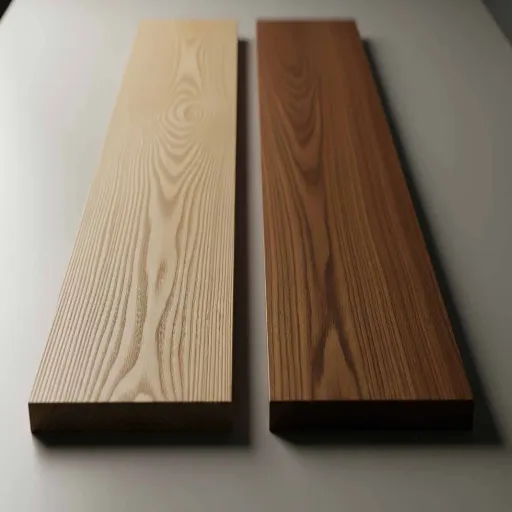
Both walnut and oak are renewable, carbon-storing materials when sourced from responsibly managed forests. Look for Forest Stewardship Council or PEFC chain-of-custody certification for the specific product, not just the brand.
For U.S. imports, the Lacey Act requires due care in verifying legal harvest. Black walnut is not CITES-listed and is IUCN Least Concern, so the main work is legal sourcing and documentation. Premium demand and limited supply explain walnut’s price.
Engineered construction adds efficiency: a thin walnut wear layer stretches each tree further than a solid board. At VitalWood Global, we pair certified sourcing with low-VOC finishes and can document species, harvest country, grade, and certification for each order. You can also explore our walnut veneer range.
Walnut vs Oak: Which Should You Choose?
Choose oak if you have kids, large dogs, or heavy traffic; want the hardest, most forgiving floor at a lower price; plan to stain a wide range of colors; want easy future repairs and color matching; or need white oak’s moisture resistance. Red oak is the budget and traditional choice. White oak is the versatile premium choice. For the species trade-offs beyond this head-to-head, read our walnut flooring pros and cons.
Choose walnut if the rich chocolate or mocha look is the design priority; the room is lower-traffic, such as a bedroom, dining room, or home office; you are comfortable with visible patina and more careful maintenance; you want a distinctive floor and accept the premium; or you are choosing engineered walnut for stability over concrete or radiant heat.
Choose engineered when you are installing over concrete, below grade, or over radiant heat; you want wide planks with better dimensional stability; you want a factory finish and faster installation; or you need a specific wear-layer thickness for your refinishing plans.
If you are also considering maple, our maple vs oak flooring comparison follows the same decision framework for a different species pairing.
Before you order, answer these questions:
- How much traffic will the room see, and do pets or kids use it daily?
- Do you want the floor to be the design feature, or a quiet backdrop?
- What is your all-in budget, including trim, underfloor prep, and removal?
- Will the floor go over concrete, a basement, or radiant heat?
- Do you plan to stain the floor, or keep it natural?
- How many refinishes do you need over the next 30 years?
- Can your supplier document species, grade, harvest origin, and certification?
If you answer honestly, the species usually picks itself.
FAQ About Walnut vs Oak Flooring
Is walnut harder than oak?
No. Black walnut rates about 1,010 on the Janka scale, while red oak rates about 1,290 and white oak about 1,360. Oak is harder and more dent-resistant; walnut is roughly 22% to 26% softer.
Is walnut or oak better for dogs?
Oak is usually better. It is harder, and its open grain hides scratches better. White oak is safest for large dogs. With walnut, use rugs, trim nails, and choose a matte or textured finish.
Which is more expensive, walnut or oak?
Walnut usually costs more. In 2026, black walnut runs $6-$15 per square foot in material and $10-$18 installed, versus $3-$7 and $6-$12 for red oak. White oak sits in between.
Does walnut scratch more easily than oak?
Walnut does not necessarily scratch more easily, but scratches are far more visible on its fine, dark surface. Oak’s pronounced grain breaks up scratch lines. For visual forgiveness, oak wins.
Does walnut flooring lighten or darken?
Walnut generally lightens and mellows under ultraviolet light, mostly in the first three to six months. Some sources also describe an oxidative darkening path, so the result depends on finish and light exposure. Oak tends to amber instead.
Can you stain oak to look like walnut?
Yes. Red or white oak can be stained to a walnut-like dark brown, especially with a gel stain and wood conditioner. The result is harder and often less expensive, but oak’s open grain and undertones remain visible, and it will not match walnut’s natural variation.
Is walnut good for kitchens?
Walnut can work in a kitchen, but it is not the most practical choice. Kitchens see spills, dropped items, and heavy traffic. White oak is more moisture-resistant and harder. If you choose walnut, use engineered construction and a durable matte finish.
Can engineered walnut be refinished?
It depends on the wear layer. Under 2 mm allows only a screen-and-recoat. About 2 mm allows one careful sand. A 3-4 mm layer allows one to three refinishes, and 6 mm or more allows three or more. Confirm the wear layer before you buy.
Conclusion
Walnut vs oak flooring has no single winner. Oak wins on hardness, price, stain flexibility, and forgiveness in busy homes. Walnut wins on design impact, a distinctive dark color, and dimensional stability. Engineered construction improves stability, never surface hardness. Wear layer, finish, and maintenance determine how long either floor stays looking new.
Choose oak if your rooms are busy or your budget is firm. Choose walnut if the look is the priority and the room can be treated with care. If you want both, stained white oak and a room-by-room plan are practical compromises. Confirm species, grade, wear layer, finish, harvest origin, and certification in writing before you buy.
For samples, certification documents, or a wholesale quote on sustainably sourced walnut and oak flooring, request samples and a quote from our team. We will help you choose a floor that looks right, performs well, and reflects your values.