
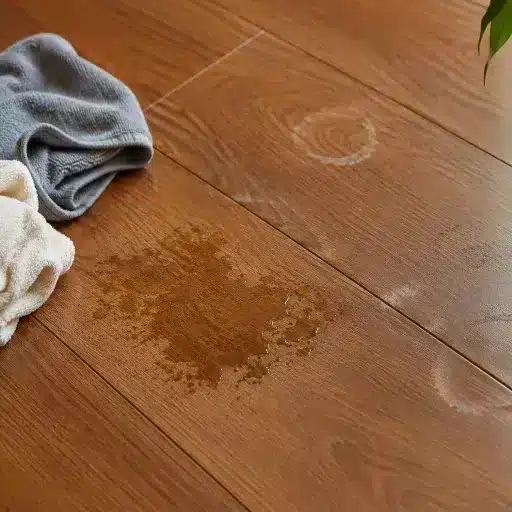
Water Stains on Wood Floors: Diagnose, Remove, and Know When to Replace
Water stains on wood floors fall into three buckets: white haze in the finish that you can lift with heat or oil, dark stains in the wood that need peroxide or oxalic acid, and structural damage like cupping or buckling that no cleaner can fix. Dry the floor within 24 to 48 hours, match the method to the stain and the floor type, and refinish or replace only when the damage crosses a clear line.
Rachel came home to a dishwasher leak across her white oak kitchen floor. She shut off the water, ran a wet vac, and pointed two fans and a dehumidifier at the room that same night. A week later, the light cupping had flattened, and the floor looked normal. Her neighbor waited three days to call for help and replaced twelve boards. This guide is part of our complete resource on how to remove water stains from wood. By the end, you will know how to read the mark, dry the floor fast, and decide whether repair or replacement is the smarter move.
If the damage already covers a large area, explore VitalWood Global’s custom wood flooring solutions for quality, sustainably sourced replacement boards that match your project.
Key Takeaways
- Water stains on wood floors are either surface haze, stains in the wood, or structural damage, and each needs a different fix.
- Speed of drying is the single biggest factor in saving a floor; aim for aggressive drying within 24 to 48 hours.
- White stains respond to heat, oil, or mild abrasives; dark and black stains need hydrogen peroxide or oxalic acid.
- Swollen laminate and buckled or delaminated boards cannot be cleaned back to health and must be replaced.
- Refinishing costs roughly 3 to 8 per square foot versus 8 to 15 to replace, and repair usually wins when under 30% of the floor is affected.
First, Identify the Stain and the Floor
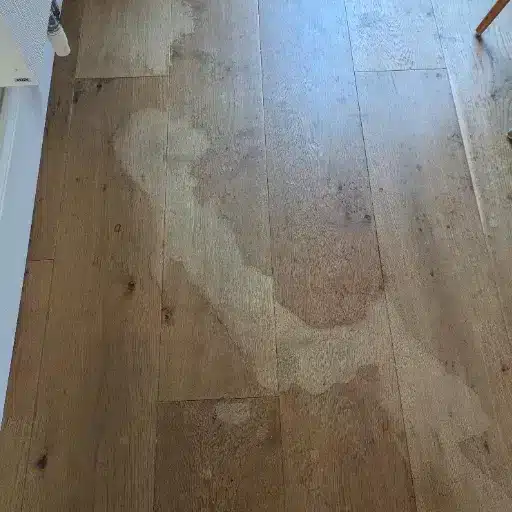
White or cloudy stains
White rings, foggy patches, and milky spots mean moisture is trapped in the finish, not the wood. These are the easiest marks to treat because you are not touching the wood fibers. A damp-cloth test confirms it: wipe the spot, and if it fades while wet and returns when dry, the problem is in the finish.
Dark or black stains
Dark brown, gray, or black stains mean water reached the wood and reacted with its tannins, often with iron from nails. Oak, walnut, and cherry are especially prone. These stains live inside the wood, so a surface cleaner will do little. Many black floor stains also trace back to tannins, and our guide to tannin stains on wood explains the chemistry in depth.
Solid hardwood vs. engineered vs. laminate
The same spill behaves differently depending on the floor. Solid hardwood is one piece of wood and can usually be sanded and refinished several times. Engineered wood has a real-wood wear layer, often 2 to 6 mm, over a plywood core, so many floors can be sanded only once or twice and thin ones not at all. Laminate is a printed layer over a fiberboard core, and once that core swells, the plank is done.
Know your floor before you choose a method. Aggressive sanding that saves a solid oak floor will destroy a thin engineered plank and is pointless on laminate.
Act Fast: Drying a Wet Wood Floor
Stop the source and extract standing water
Find and stop the leak, the overflowing appliance, or the humidity source first. Then remove standing water with towels, a wet vac, or a mop. Do not let water sit while you gather equipment.
Fans, dehumidifiers, and drying mats
Set up air movement and dehumidification right away. Restoration pros place air movers every 10 to 16 feet, run low-grain-refrigerant dehumidifiers, and use drying mats that pull moisture from beneath the boards. For a small spill, two household fans and a room dehumidifier are a reasonable start.
Target humidity and realistic dry times
Hold indoor humidity around 30 to 50 percent during drying. Solid hardwood typically dries in 5 to 7 days with professional gear, and 7 to 10 days for thick planks over concrete. Without good equipment, drying can take weeks and often ends in permanent damage.
Why the first 24 to 48 hours decide the outcome
Mold can begin within 24 to 48 hours of water exposure, and wood keeps absorbing moisture the longer it stays wet. According to Water Damage Pros, how fast you dry the floor is the main factor in whether boards can be saved. Every hour counts.
Removing White Water Stains from Wood Floors
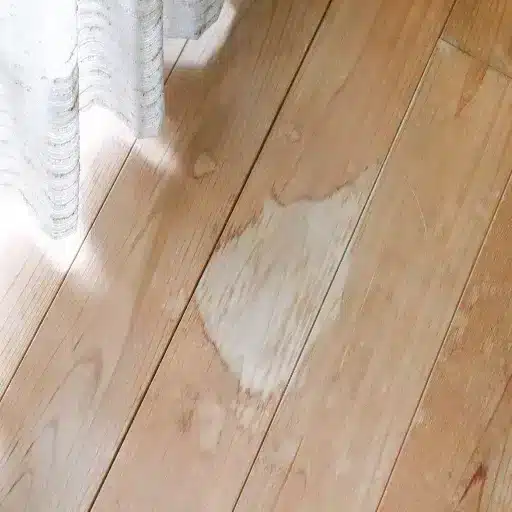
Heat method for large, flat areas
Floors give you room to work, so gentle heat is often the fastest fix for white haze. Lay a clean cotton towel over the spot and press a warm, dry iron for a few seconds at a time, checking often. A hair dryer on medium also works and is safer for wide areas.
Keep the heat low and moving. Too much heat can blur the finish or loosen the adhesive under engineered planks.
Oil, mayonnaise, and petroleum jelly
Rub mineral oil, mayonnaise, or petroleum jelly into the haze with the grain and let it sit for several hours or overnight, then buff dry. The oil slowly displaces the trapped moisture. Cover a mayo treatment with plastic wrap to keep it from drying out.
Mild abrasives
A paste of baking soda and water, or a small amount of non-gel white toothpaste, can lift light haze. Rub gently with the grain, wipe clean, and dry right away.
What changes on engineered and laminate
On engineered wood, favor heat and oil and avoid abrasives that can scratch the thin wear layer. On laminate, white haze is uncommon because the surface is not real wood; if you see cloudiness, the core may already be swelling and replacement is likely.
Removing Dark and Black Water Stains on Wood Floors
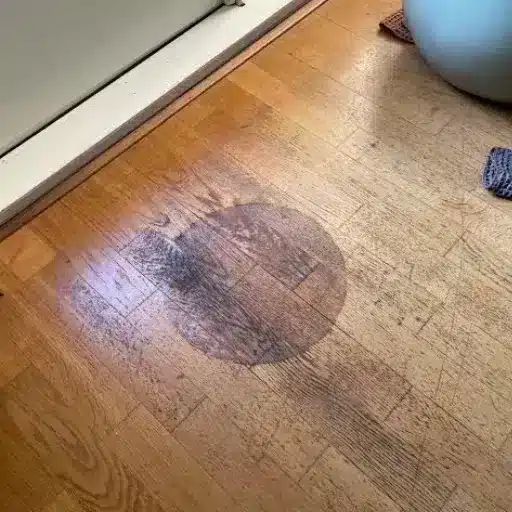
Hydrogen peroxide soaks
For fresh dark stains and pet marks, soak a cloth in 3% hydrogen peroxide, lay it over the spot, cover it with plastic wrap, and leave it for several hours or overnight. Peroxide releases oxygen that lightens the discoloration. Rinse with clean water and dry fully.
Peroxide is a mild bleach, so test it in a hidden area and keep it off unstained wood. Do not over-soak, since extra moisture can swell the boards you are trying to save.
Oxalic acid for iron and tannin marks
Oxalic acid, sold as wood bleach, is the workhorse for black iron and tannin stains and for nail rings. Floor Techie notes it is the best option for old, stubborn black water and rust-type marks. You must strip or sand the finish off the spot first so the acid reaches bare wood.
Mix the crystals per the label, apply to the whole affected area, and let it work.
Neutralizing, drying, and raising grain
After bleaching, neutralize the wood with a baking soda solution or a dilute household ammonia solution, then rinse with clean water and let it dry for at least 24 hours. Never use vinegar to neutralize an acid, since vinegar is also an acid and will not do the job.
Bleaching raises the grain, so sand the area lightly with 220-grit paper, stain to match, and reseal with polyurethane. Choosing the right product matters here, and our guide to the best water stain remover for wood compares oxalic acid, peroxide, and ring removers.
When chlorine bleach fits
Chlorine bleach is generally not effective on classic black water rings and can weaken fibers. Reserve it for dye or organic stains only, and never mix it with oxalic acid, ammonia, or peroxide, since those combinations release dangerous fumes.
Pet Urine and Other Black Stains
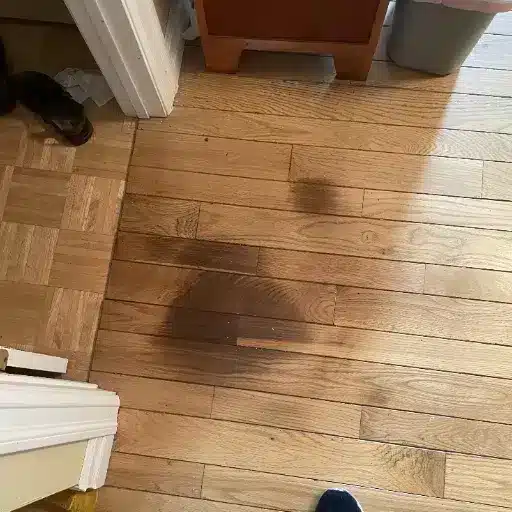
Why urine turns wood black
Pet urine carries uric acid and ammonia that react with wood tannins to form deep black stains. The longer it sits, the deeper it goes. Fresh accidents are far easier to fix than ones found weeks later under a rug.
Finding hidden spots with a black light
If you smell urine but cannot see the source, turn off the lights and scan with a black light. Dried urine glows a faint green or yellow. Mark each spot with painter’s tape so you treat all of them, not just the obvious one.
Peroxide soaks and enzyme cleaners
Tom’s rescue dog had been using the corner of his maple living room floor for weeks before he noticed. A black light revealed six separate spots. He blotted each one, soaked them with 3% hydrogen peroxide under plastic wrap overnight, then followed with an enzyme cleaner for odor. Three spots faded fully; three needed a light oxalic acid treatment before he restained and sealed the area.
For deep or old stains, Zerorez recommends the same escalate-from-peroxide approach. Always spot-test first.
Odor means the subfloor is involved
If the smell returns after the surface looks clean, urine has reached the subfloor. Surface treatments will not fix that. You may need to pull the affected boards, treat or seal the subfloor with an odor-blocking primer, and reinstall.
When Water Damage Is Structural, Not a Stain
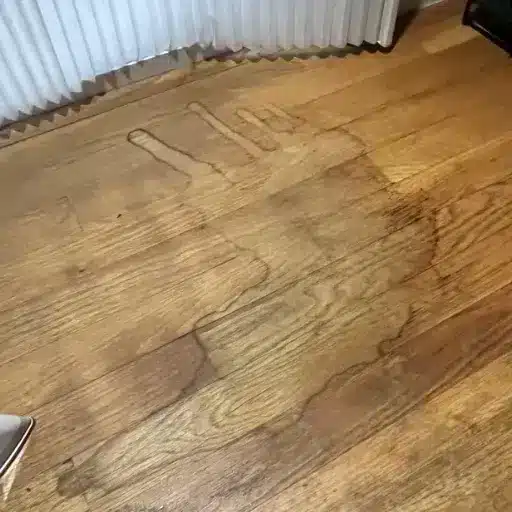
Cupping vs. crowning vs. buckling vs. delamination
Not every water problem is a stain. Learn the four shapes of structural damage:
- Cupping: board edges rise higher than the center. This often appears as the bottom absorbs moisture and can flatten as the floor dries and equalizes.
- Crowning: the center rises above the edges, usually when the top stays wet while the bottom dries, or when a cupped floor was sanded too soon.
- Buckling: boards tend to lift off the subfloor. This is severe and often permanent.
- Delamination: on engineered floors, the layers separate and the veneer bubbles. This is permanent.
What reverses on its own and what does not
Mild cupping often settles as moisture leaves the wood, which is why you should dry the floor fully before deciding to sand. Crowning, buckling, and delamination rarely reverse. Never sand a cupped floor while it is still wet, or you will create crowning once it dries flat.
Who can be saved
Solid hardwood gives you the most room to recover because you can dry, sand, and refinish it. Engineered wood can be saved if the wear layer is thick and the core has not swollen. Laminate that has swollen or warped cannot be repaired and must be replaced.
Refinish or Replace: Making the Call
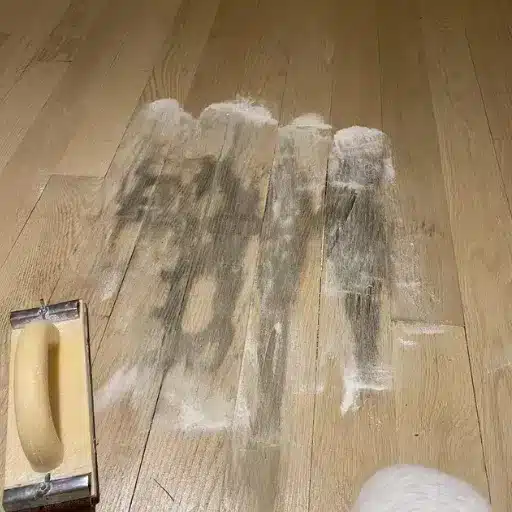
Sand and refinish
If the boards are structurally sound but stained or lightly cupped, sanding and refinishing is the usual fix. Expect to clean with mineral spirits, sand with the grain from about 120-grit up to 220, feather the edges, stain to match, and seal with polyurethane. Costs run roughly $3 to $8 per square foot.
The limit is the wear layer. Solid floors can be refinished several times, but many engineered floors only once, and thin ones not at all. For the full repair sequence, our guide to how to refinish water damaged wood walks through each step.
Replacing boards or planks
Replace boards that are buckled, delaminated, deeply stained, or too thin to sand again. Click-lock floating floors are the easiest to patch, since you can lift and swap single planks. Glue-down and nail-down floors take more care and may need a pro to weave in new boards without damaging the old ones.
The 30% rule and rough costs
A common rule of thumb is that restoration is cost-effective when under about 30% of the floor is damaged. Beyond that, or when the subfloor is involved, replacement becomes the smarter spend. Full replacement typically runs 8to8to15 per square foot, varying by species and region.
Matching species, grade, and finish on repairs
Repairs only look right if the new material matches the old. Match the species, the grade, the board width, and the finish sheen. If you cannot match the existing floor, replacing a larger area or the whole room often looks better than a patch that stands out.
Preventing Water Stains on Wood Floors
Spill response and mats
Wipe spills immediately instead of letting them sit. Place washable mats at sinks, under pet bowls, and beneath plant trays, and use trays with raised edges so a single overwatering does not reach the floor.
Humidity control and felt pads
Keep indoor humidity between 35 and 55 percent year-round so boards do not swell and shrink with the seasons. Add felt pads under furniture legs and use a humidifier in dry winters and a dehumidifier in humid summers.
No wet mopping
Skip soaking mops and steam cleaners on wood. Use a damp, well-wrung microfiber mop and a cleaner made for your finish. Excess water is the most common cause of the stains you just learned to remove.
Refreshing the protective finish
A sound finish is your best defense. Recoat polyurethane floors every few years and re-oil oiled floors on the maker’s schedule so water beads on the surface instead of soaking in. For a complete routine, see our guide to how to prevent water stains on wood.
When a Cleaner Is Not Enough
Some floors have moved past the point where any remover helps. Buckled boards, delaminated engineered planks, swollen laminate, soft subfloor, and spreading mold are not stain problems. They are replacement problems.
Lena mopped up a slow radiator leak on her laminate hallway for a month before she pulled the baseboard and found the fiberboard core swollen along six planks. No cleaner could flatten that core. She stopped chasing stains, replaced the run with a sustainably sourced engineered floor, and sealed the edges against future spills. The new floor has already shrugged off two overflows.
When replacement is the honest answer, quality material and a proper finish resist the next spill far better than a damaged floor. For responsibly sourced boards and expert guidance, get in touch with VitalWood Global.
FAQ
How do you remove water stains from wood floors?
Match the method to the stain. Use gentle heat, oil, or a mild abrasive for white haze in the finish, hydrogen peroxide or oxalic acid for dark stains in the wood, and sanding and refinishing for marks that survive those treatments. Always dry the floor fully first and test in a hidden spot.
What causes black water stains on hardwood floors?
Black stains form when water reaches the wood and reacts with tannins, often with iron from nails, or when pet urine introduces uric acid and ammonia. Oak, walnut, and cherry are especially prone. These stains sit in the wood and usually need peroxide, oxalic acid, or sanding.
Can you fix water-damaged hardwood floors without replacing them?
Often, yes. If boards are structurally sound, drying the floor fast and then sanding and refinishing can save it. Replacement is the call when boards are buckled, delaminated, deeply stained, or too thin to sand, or when more than about 30% of the floor is damaged.
How long does it take for a wet wood floor to dry?
With professional gear, solid hardwood usually dries in 5 to 7 days, and thick planks over concrete in 7 to 10 days. Without good equipment, drying can take weeks and often leads to permanent damage. Speed matters because mold can start within 24 to 48 hours.
Does cupping go away on hardwood floors?
Mild cupping often flattens as the floor dries and moisture equalizes through the board. Let the floor dry fully before deciding to sand, since sanding a still-cupped floor can cause crowning once it dries flat. Severe or lasting cupping usually needs sanding and refinishing.
Can you remove water stains from laminate flooring?
Surface marks on laminate can sometimes be wiped away, but a swollen or warped fiberboard core cannot be repaired. Small bubbles can sometimes be slit, glued, and weighted, but warping, mold, or widespread swelling means the affected planks must be replaced.
When should I replace instead of refinish a water-stained floor?
Replace when boards are buckled, delaminated, too thin to sand, or deeply stained, when the subfloor is soft or moldy, or when more than about 30% of the floor is affected. Refinish when the structure is sound and only the surface or a shallow layer is stained.
Conclusion
Water stains on wood floors are three different problems wearing one label. White haze sits in the finish and lifts with heat, oil, or a mild abrasive. Dark and black stains live in the wood and need hydrogen peroxide or oxalic acid, then neutralizing, drying, and resealing. Cupping, crowning, buckling, and delamination are structural, and no cleaner will reverse them.
Dry the floor within 24 to 48 hours, match every method to solid, engineered, or laminate construction, and use the 30% rule to choose between refinishing and replacing. When the damage has moved past what repair can fix, quality, sustainably sourced replacement flooring is the durable long-term move, and a sound finish plus steady humidity keeps the next spill from becoming a stain.
For more help, explore our complete guide to removing water stains from wood, plus related guides on white water stains, dark water stains, the best water stain remover for wood, refinishing water-damaged wood, preventing water stains, and tannin stains on wood.
Ready to repair or replace with quality, sustainable flooring? Get in touch with VitalWood Global for custom wood flooring solutions and expert guidance tailored to your project.