
Is Hickory Flooring Good for Dogs? An Honest Guide
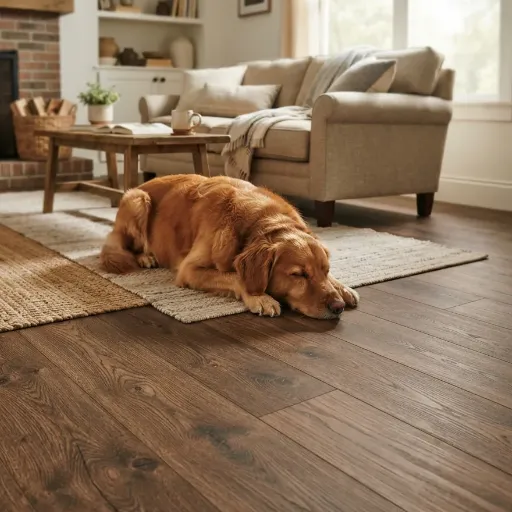
Is hickory flooring good for dogs? Yes, for most dog households, but not for the reason most guides give. Hickory is the hardest common domestic floor, rated 1,820 to 2,140 on the Janka scale, so it resists dents from toys, bowls and heavy dogs.
It is not scratch-proof. Your dog’s claws will still mark the finish, and on dark heartwood you will see every line.
The pages that recommend hickory stop at the Janka number. They do not explain that the finish takes the claw damage, that color variation changes how visible that damage is, or that hickory moves more than oak when a dog has an accident.
This guide covers what actually gets damaged, which grade and finish hide wear, how hickory compares with oak, maple and vinyl, and when another floor is the honest answer. If you already know you want hickory, request a pet-grade sample and we will send the specification with it.
Key Takeaways
- Hickory is the hardest common domestic floor, rated 1,820 to 2,140 on the Janka scale, and the best common species for dent resistance.
- It is not scratch-proof. Dog claws mark the finish, not the wood, and no wood species prevents that.
- Hickory’s varied grain hides wear better than maple or walnut, but dark heartwood boards show pale claw lines.
- Choose Natural/Character or Rustic grade, wire-brushed texture, matte sheen and a 3 to 4 mm wear layer.
- Hickory moves more than oak, so accidents are the bigger risk. Puppies and incontinent dogs need a waterproof floor.
The Short Answer: Is Hickory Flooring Good for Dogs?
Hickory is a good floor for dogs if you choose it for dent resistance and camouflage, not scratch immunity. For most dog households, the right specification is engineered hickory with a 3 to 4 mm wear layer, Natural/Character or Rustic grade, a wire-brushed texture and a matte finish.
The exception is a puppy, a senior dog with incontinence, or several large dogs that scratch at doors. In those homes, a waterproof rigid-core floor is the lower-risk choice. Hickory will survive the dog. It may not survive the accidents.
The pet-home specification in one list:
- Engineered construction, so the core resists moisture movement.
- A 3 to 4 mm wear layer, enough for a future re-sand.
- Natural/Character or Rustic grade, for camouflage.
- Wire-brushed texture, which hides scratches and gives paws grip.
- Matte sheen, because gloss turns every mark into a highlight.
- Aluminum oxide or hardwax oil, chosen by how you want damage to look.
- Indoor humidity held at 35% to 55%.
- Spare boards from the same lot.
If you are still comparing species and finishes, our guide to the best prefinished flooring for dogs covers the full cross-species specification.
Hickory Flooring and Dog Claws: What Hardness Actually Does
Janka Measures Dents, Not Scratches
The Janka test presses a steel ball into a wood sample until half the ball is embedded. It records how much force the wood resists. That is a static dent test.
A dog’s claw is a moving, angled point dragging across a coating a fraction of a millimetre thick. That is abrasion, not indentation. The two are related, but they are not the same.
The numbers still matter. Shagbark hickory tests at about 1,880, pignut at about 2,140, and pecan at about 1,820. Red oak sits near 1,220, white oak near 1,350, and hard maple near 1,450. That makes hickory roughly 40% to 75% harder than red oak, according to The Wood Database.
What that buys you is real. A heavy dog flopping down, a dropped chew toy, a bowl skidding across the floor: hickory resists those better than any common domestic species.
What Actually Gets Damaged on a Hickory Floor
Dog damage is not one problem. It is five, and hickory helps with exactly one.
| Damage | What causes it | Does hickory help? | What to do |
|---|---|---|---|
| Dents | Toys, bowls, furniture legs, a heavy dog | Yes, better than any common species | Felt pads, lift furniture |
| Finish scratches | Claws, grit, dragging | No, the finish takes it | Matte sheen, wire-brushed texture, trimmed nails |
| Edge swelling | Urine, wet paws, standing water | No, hickory moves more than oak | Blot immediately, seal edges, use mats |
| Seasonal gapping | Dry air, humidity swings | No, true hickory moves a lot | Hold humidity at 35% to 55% |
| Board mismatch | Replacing a damaged plank | No, the color range is wide | Keep spare boards from the same lot |
Hickory wins the dent row. It loses the other four, like every wood floor. The difference is how well it hides the loss.
The “Scratch-Resistant Hickory” Claim, Corrected
Many hickory guides call the species “hard to dent and scratch.” That is half right. It is hard to dent. Scratch resistance belongs to the finish, and every finish runs out.
This changes what you buy. If hardness prevented scratches, you would spend the budget on the hardest species. Because the finish takes the damage, you spend it on a matte, textured surface, a thicker wear layer and a finish system you can live with.
Why Hickory Hides Dog Wear Better Than Most Woods
The Camouflage Advantage of a Busy Grain
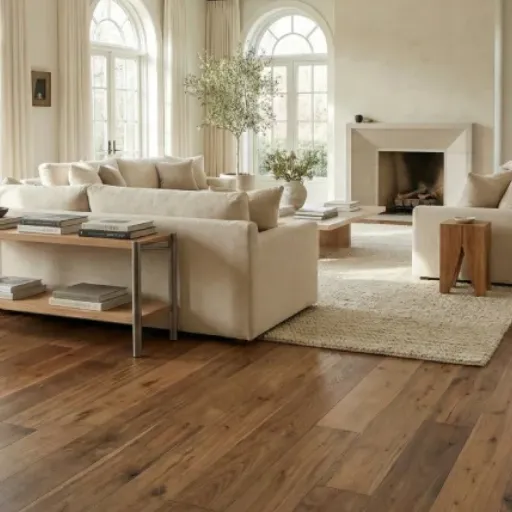
Hickory has an open, varied grain. Knots, mineral streaks and a wide sapwood-to-heartwood range break up reflected light. A scratch on a busy hickory board reads as one more line in a floor full of lines.
Hard maple is the opposite. Its uniform, closed grain shows every mark, because there is nothing nearby to blend into. Walnut has a different problem: a dark, even surface that shows dust, hair and pale scratches.
Hickory is not damage-resistant. It is damage-forgiving.
Where Hickory Shows Damage More, Not Less
The camouflage is not uniform. Sapwood runs from cream to white, sometimes with a pink cast. Heartwood runs medium to dark brown. A pale claw line disappears on sapwood and stands out on heartwood.
Erin learned this in her first winter. She chose Natural/Character hickory for a 1,400-square-foot living area because she wanted the calico look.
By February, the dark boards under the west window showed her shepherd’s route in pale lines. The pale boards beside them looked new. The floor was not inconsistent. The light was.
Gloss makes it worse. A semi-gloss surface reflects the room and turns every scratch into a bright edge. Matte scatters light and lets the grain hide the rest.
Choose the Grade for the Dog, Not Just the Decor
Grade is the lever most pet owners never touch. It sets how much contrast the floor has, and contrast decides how much wear the floor can absorb before it looks worn.
| Grade | Look | Hides wear? | Best for |
|---|---|---|---|
| Select/Clear | Calm, low contrast | Least; marks show evenly | Calm interiors, close maintenance |
| Natural/Character | Calico mix of sapwood and heartwood | Best balance | Most pet homes |
| Rustic | Knots, checks, mineral streaks | Most; marks blend into character | Large dogs, high traffic, farmhouse rooms |
Grade names vary by manufacturer. Ask for a full-layout photo and a sample from the actual lot. A floor that looks calm in a showroom photo can arrive as a calico. That is a grade decision, not a defect.
Hickory vs. Oak, Maple and LVP for Dogs
| Floor | Janka | Dents | Scratch visibility | Water | Pet verdict |
|---|---|---|---|---|---|
| Hickory | 1,820 to 2,140 | Best | Good, varies by board | Poor | Best dent resistance, needs finish discipline |
| White oak | ~1,350 | Very good | Good, even | Poor | Best all-round wood for a dog home |
| Red oak | ~1,220 | Good | Good, open grain | Poor | Best value wood option |
| Hard maple | ~1,450 | Very good | Poor, uniform grain | Poor | Hard but unforgiving |
| Black walnut | ~1,010 | Fair | Poor, dark shows dust | Poor | Bedrooms and calm dogs only |
| LVP | Not applicable | Not applicable | Best | Best | Best for accidents, not the feel of wood |
Hickory beats oak on dents and character; white oak wins on stability and calm. Maple is hard but shows every mark. Vinyl wins on water and scratches, then loses on feel and resale.
Solid or Engineered Hickory for a Dog Household?
True hickory is dimensionally active. Shagbark shrinks about 7.0% radially, 10.5% tangentially and 16.7% volumetrically. Pignut is higher at 7.2%, 11.5% and 17.9%.
Red oak moves 4.0%, 8.6% and 13.7%. Pecan, often sold as hickory, moves 4.9%, 8.9% and 13.6%.
A dog brings water to the floor through wet paws, bowls and accidents. A cross-ply core resists the movement moisture causes, which makes engineered hickory the lower-risk choice for wide planks, concrete, basements and radiant heat. Our engineered hickory flooring guide covers construction in detail.
Wear layer is the second decision. Specify 3 to 4 mm if you want a future re-sand. A 2 mm veneer buys one careful sand at most; a 0.6 mm veneer cannot be sanded at all. The NWFA rule is not to sand below 3/32 inch, or 2.4 mm, of wear layer above the tongue.
Dense hickory is also harder to sand than oak, so pet damage can cost more to refinish. Replacing a plank is often cheaper than sanding the room. Keep spare boards.
The Best Finish and Texture for Hickory Floors With Dogs
Matte beats gloss. Gloss reflects the room, and that reflection turns a scratch into a bright line. Matte scatters light, so the scratch stays a scratch.
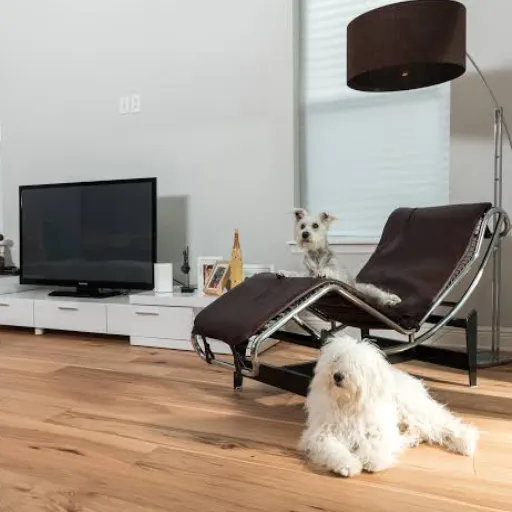
Texture does two jobs. Wire-brushed and hand-scraped surfaces break up reflected light and give paws something to grip. A smooth floor makes a dog dig in for traction, and that digging produces the scratch path.
Aluminum oxide versus oil. AO is the most abrasion-resistant factory finish, rated about 9 on the Mohs scale. It also scratches white. On hickory’s dark heartwood, those lines are conspicuous, and AO often cannot be spot-repaired.
Hardwax and UV oil scratch more visibly at first, then blend back in because you can spot-repair them without sanding the room. The cost is maintenance, and on hickory oil can deepen the color contrast.
Neither is wrong. You are choosing how damage will look, not whether it will happen. Our UV oil vs aluminum oxide flooring comparison covers the chemistry.
If the damage is already there, refinishing engineered hickory flooring explains wear layers, screening and board repair.
Slipperiness matters for senior dogs. A smooth film finish on dense hickory can be slick. Tom found out when his twelve-year-old Labrador started avoiding the hallway. The floor was not too hard. It was too slick.
Runners and a textured finish fixed it, and better traction reduced the digging that causes scratches.
Accidents, Puppies and Wet Paws
Urine is water plus salts. At a seam, it swells the edge, stains the wood and leaves an odor. Hickory’s high movement makes it less forgiving than oak, so prompt cleanup matters more, not less.
Blot within minutes. Use an enzyme cleaner, then dry the area. Keep bowls on a mat, seal the edges during installation, and never let water stand.
Seasonal gapping is normal. Persistent gaps or swollen seams point to a moisture problem, which our guide to hickory flooring problems covers.
For a puppy or a chronic-accident dog, the honest answer is a waterproof engineered wood flooring product or rigid-core vinyl. Priya made that call in stages: LVP in the mudroom and laundry, hickory in the living areas, and washable rugs along the puppy’s route. The hickory survived because the wettest rooms never had it.
How to Protect Hickory Floors From Dog Damage
Most damage is preventable with habits, not products.
- Trim or grind nails every three to four weeks.
- Place mats at doors, water bowls and crate exits.
- Clean dry first, then damp. pH-neutral cleaner, never steam.
- Wipe accidents and wet paws immediately.
- Add felt pads to every furniture leg. Lift, never drag.
- Hold indoor humidity at 35% to 55% year-round.
- Use rugs and runners on the dog’s main path.
- Keep spare boards from the same lot.
Want the specification in writing? Ask our team for the wear layer, grade and finish schedule on a pet-grade hickory product.
Who Should Choose Hickory, and Who Shouldn’t
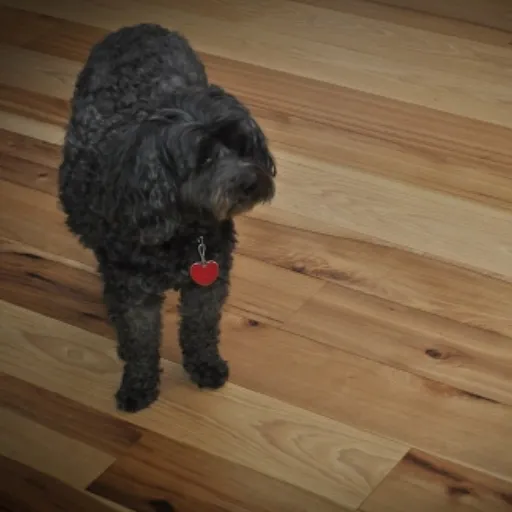
Choose hickory if you have a large or active dog, dent-prone traffic, a character-rich interior, and the willingness to maintain real wood. It is also a good fit if you want a domestic species with FSC or PEFC options.
Do not choose hickory if you have a puppy, a dog with chronic accidents, or several large dogs that scratch at doors. Do not choose it for a calm, uniform floor, a tight budget, or a home with no humidity control. White oak, red oak or a waterproof rigid-core floor will serve those homes better.
Cost is part of the decision. Hickory material runs about $4.15 to $7.15 per square foot, with engineered floors at $8 to $14 installed and solid floors at $9 to $23. The premium buys dent resistance and character, not a longer finish life.
For the full species-level trade-off, read our hickory flooring pros and cons guide.
FAQ
Is hickory flooring good for dogs?
Yes, for most dog households. Hickory is the hardest common domestic floor, rated 1,820 to 2,140 on the Janka scale, so it resists dents from toys, bowls and heavy dogs. Its varied grain also hides claw marks better than uniform species.
It is not scratch-proof, though. The finish takes the scratches, and accident moisture is the bigger risk.
Is hickory or oak better for dogs?
Both work. Hickory resists dents better and its busy grain hides wear. White oak is calmer, more stable and easier to refinish.
For a large, active dog in a character-rich home, choose hickory. For a calm interior or a humid home, white oak is safer.
Does hickory flooring scratch easily from dog nails?
The wood rarely scratches. The finish does. Hickory’s hardness protects against dents, not the sliding abrasion of claws.
Scratches show as light lines on dark heartwood and disappear into pale sapwood or busy grain. Matte, wire-brushed finishes hide them best.
What is the best finish for hickory floors with dogs?
A matte, wire-brushed finish with a 3 mm or thicker wear layer. Matte scatters light instead of revealing scratches, and texture breaks up marks and gives paws traction. Aluminum oxide resists abrasion but shows white lines on dark hickory. Hardwax oil blends scratches but needs maintenance.
Is hickory flooring slippery for dogs?
Smooth, glossy hickory can be slippery, especially for older dogs. The species is not the cause. The finish is.
Wire-brushed or hand-scraped hickory gives paws more grip, and rugs or runners help. Better traction also reduces the digging that causes scratches.
Can dog urine damage hickory floors?
Yes. Urine is water plus salts, and hickory moves more than oak, so moisture at seams can swell edges, stain the wood and leave an odor. Blot and clean within minutes, use an enzyme cleaner, and keep bowls on mats. Chronic accidents call for a waterproof floor.
Conclusion
Is hickory flooring good for dogs? For most homes, yes. It is the hardest common domestic floor, it hides wear better than maple or walnut, and it can be refinished instead of replaced. The catch is that hardness protects against dents, not claws, and hickory’s movement makes accidents the real risk.
Choose the grade for camouflage, the finish for the way damage will look, and the wear layer for the re-sand you may need in ten years. Keep the humidity steady and the nails trimmed. Then hickory is a genuinely good dog floor.
If you are specifying hickory for a pet home, talk to our team about grade, wear layer and finish schedules. We will send samples from the current lot so you can see the color range before you commit.