
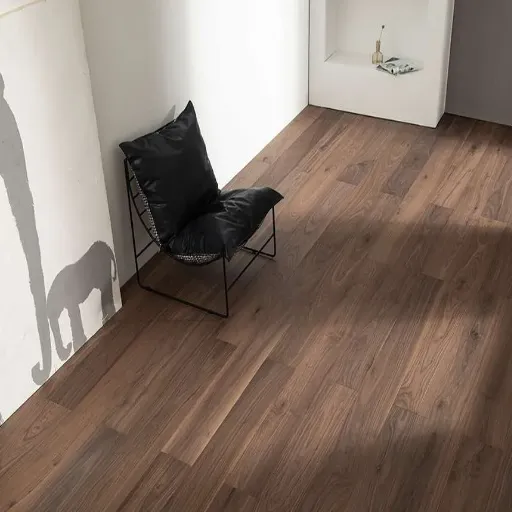
Engineered Walnut vs Solid Walnut: Which Wins in 2026?
Engineered walnut and solid walnut are both real walnut. The difference is how the plank is built, and that changes where it can go, how many times it can be refinished, and what it costs installed. Engineered wins over concrete, radiant heat, and wide planks. Solid wins when you want the deepest refinishing life in a stable, above-grade room.
The most common walnut mistake is paying for the wrong construction because a sales tag said “engineered is cheaper.” You have probably heard that engineered is more stable and solid is the real thing. Both claims are partly true, and neither is a complete answer.
This guide compares engineered walnut vs solid walnut on construction, stability, refinishing, cost, and lifespan, plus the walnut-specific issues that decide satisfaction: dents, color change, and sapwood. You will finish with a decision framework and a spec-sheet checklist.
Key Takeaways
- Both products are real walnut when the wear layer is real walnut. Engineered is not laminate or vinyl.
- Engineered wins on stability, placement flexibility, and upfront cost at thin wear layers.
- Solid wins on refinishing depth, solid feel underfoot, and long-term value in a stable, above-grade home.
- Walnut dents either way. Janka hardness is about 1,010, and engineered construction never changes surface hardness.
- At 4 to 6 mm wear layers, engineered walnut can cost as much as or more than solid. Compare installed cost and wear layer, not the label.
What Is Engineered Walnut Flooring?
Engineered walnut flooring is a real walnut wear layer, usually 0.6 to 6 mm thick, bonded over a cross-laminated plywood, HDF, or solid-sawn lamellar core, with a thin backing that balances the plank. The wear layer is the only part you walk on, and it is the specification that matters most.
The cross-lamination is the engineering. Each ply runs at an angle to the one below it, restraining the seasonal swelling and shrinking of solid wood. That’s why an engineered plank can be wider, thinner, and more stable than a solid board.
Not every product sold as engineered walnut is equal. A 0.6 mm wear layer is a veneer, not a floor you can sand. A 6 mm layer behaves much more like solid wood. Total plank thickness tells you very little on its own.
Engineered walnut is also not laminate, vinyl, or SPC. Those products use a printed image or a composite surface, can’t be refinished, and don’t age like real wood. The National Wood Flooring Association recognizes engineered flooring with a real wood wear layer as real wood flooring.
For a full species overview, start with our engineered walnut flooring guide.
What Is Solid Walnut Flooring?
Solid walnut flooring is a single milled piece of walnut, typically 3/4 inch (19 mm) thick, with tongue-and-groove edges and roughly 1/4 inch (6.4 mm) of sandable wood above the tongue. It is the traditional product and still the benchmark for refinishing depth.
Solid walnut is nailed over a wood subfloor, above grade, and needs stable indoor humidity, usually 35 to 55 percent. It isn’t a candidate for a concrete slab, a basement, or a radiant-heat system without special construction.
Engineered Walnut vs Solid Walnut: Side-by-Side
| Feature | Engineered Walnut | Solid Walnut |
|---|---|---|
| Construction | Real walnut wear layer over a cross-laminated core and backing | One solid piece of walnut, 3/4 inch (19 mm) typical |
| Wear layer | 0.6 to 6 mm; the key spec | About 1/4 inch (6.4 mm) above the tongue |
| Installation | Float, glue-down, or nail-down | Nail-down only |
| Where it can go | On, above, or below grade; concrete; radiant heat; condos | Above grade over a wood subfloor |
| Dimensional stability | High, because cross-lamination restrains movement | Moderate; moves with indoor humidity |
| Refinishing | 0 to 3+ times, depending on wear layer | 3 to 5 times, up to 5 to 8 in ideal conditions |
| Lifespan | 10 to 60+ years by wear layer | 50 to 100+ years with care |
| Material cost | $6 to $18 per sq ft | $6 to $15 per sq ft unfinished; $8 to $14 prefinished |
| Installed cost | $9 to $25 per sq ft | $10 to $20 per sq ft |
| Best for | Slabs, basements, radiant heat, wide planks, condos | Traditional rooms, long ownership, deep refinishing |
| Warranty | 20 to 50 years structural, depending on product | 25 to 50 years structural, typical |
| Sustainability | Uses less walnut per square foot; more adhesive | Uses more walnut; fewer adhesives |
For the species-neutral version of this comparison, see our guide to engineered hardwood vs. solid hardwood.
Stability, Moisture, and Where Each Floor Can Go
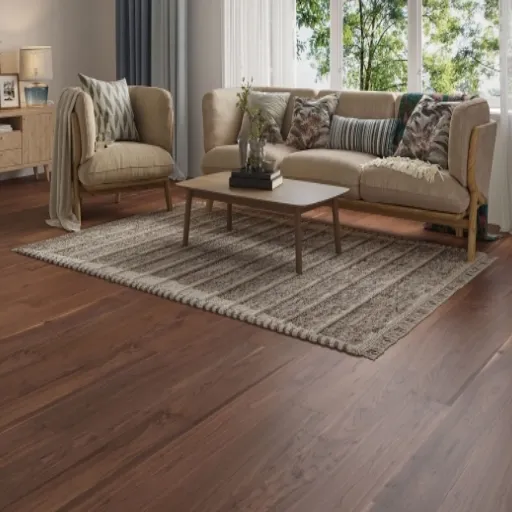
Walnut has a reputation for being more stable than oak. The data is more nuanced than the sales pitch.
Black walnut shrinks about 12.8 percent by volume from green to oven-dry, according to The Wood Database. Red oak is about 13.7 percent, and hard maple is about 14.7 percent. Walnut is more stable, but not dramatically so.
The cut matters. USDA Forest Service shrinkage coefficients put black walnut at about 0.00274 plainsawn and 0.00190 quartersawn, compared with red oak at 0.00369 and 0.00158. Plainsawn walnut moves less than plainsawn red oak. Quartersawn walnut moves more than quartersawn red oak.
What solves movement is the cross-laminated core. Engineered walnut restrains most seasonal movement, which is why it can go over concrete, below grade with moisture mitigation, and over radiant heat. Solid cannot.
Keep the home at 35 to 55 percent relative humidity; dry winter air opens seams and humid summers cup edges. Radiant heat has limits: keep the surface at or below 27°C (80°F) and ramp no faster than 2°C per day. Neither floor is waterproof, so wipe spills, use mats, and fix leaks quickly.
Consider Dana. She bought a 1970s condo with a concrete slab and radiant heat. The previous owner had installed 3/4-inch solid walnut. By February, the boards had cupped along the seams.
She replaced it with a 4 mm engineered walnut, glue-down, and it has stayed flat since.
Wear Layers and Refinishing: How Many Times Can You Sand Walnut?
Solid walnut carries about 1/4 inch of sandable wood above the tongue. Each sand-and-refinish pass removes roughly 0.75 to 1 mm. That supports 3 to 5 full refinishes in normal use, and 5 to 8 in ideal conditions with a careful operator.
Engineered walnut is limited by its wear layer. Use this table as a planning guide, not a warranty:
| Wear Layer | Refinishing Potential | Typical Lifespan |
|---|---|---|
| Under 2 mm | Screen-and-recoat only; no full sand | 10 to 25 years |
| 2 mm | One careful full sand | 15 to 20 years |
| 3 to 4 mm | One to three refinishes | 25 to 40 years |
| 4 to 6 mm | Two to three refinishes | 30 to 50 years |
| 6 mm or more | Three to five refinishes | 40 to 60+ years |
A safe re-sand leaves at least 2.4 mm (3/32 inch) of wear layer, per NWFA guidance. If the remaining veneer is thinner, stop and screen-and-recoat instead.
Walnut adds a wrinkle: it is soft, marks and burnishes easily, and shows sanding swirls. Use a random-orbital, not a drum sander, test a closet first, and stop at the recommended grit. Screen-and-recoat every 5 to 10 years extends the life of either floor. For a step-by-step walkthrough, see refinishing walnut floors.
Engineered Walnut vs Solid Walnut Cost in 2026
Walnut is a premium species, and the gap between constructions is narrower than most buyers expect. These are U.S. national averages for 2026:
| Product | Material Cost | Installed Cost |
|---|---|---|
| Solid walnut, unfinished | $6 to $15 per sq ft | $10 to $20 per sq ft |
| Solid walnut, prefinished | $8 to $14 per sq ft | $11 to $20 per sq ft |
| Engineered walnut, 2 mm wear layer | $6 to $9 per sq ft | $9 to $14 per sq ft |
| Engineered walnut, 3 to 4 mm wear layer | $8 to $12 per sq ft | $12 to $19 per sq ft |
| Engineered walnut, 4 to 6 mm wear layer | $11 to $18 per sq ft | $16 to $25 per sq ft |
The pattern is the opposite of the usual sales pitch. Engineered saves money at the thin end. At 4 to 6 mm, engineered walnut can equal or exceed the installed cost of solid.
For a 500-square-foot room, the live walnut flooring cost guide puts the all-in range at about $5,750 low, $10,050 mid, and $17,975 high. Those totals include removal, subfloor prep, underlayment, trim, and 10 percent waste.
Hidden costs break budgets: subfloor leveling, moisture barrier, transitions, stair nosings, door undercuts, and disposal can add $1 to $4 per square foot. The 50-year view is more honest than the sticker price. This model assumes 500 square feet, mid-grade products, professional labor, no inflation, and replacement at the same installed cost:
| Option | Installed (mid) | Refinishes Over 50 Years | Replacements | 50-Year Total |
|---|---|---|---|---|
| Solid 3/4 inch | $7,500 | 2 to 3 full sands ($3,000 to $12,000) | 0 | $10,500 to $19,500 |
| Engineered, 3 to 4 mm | $7,750 | 1 to 2 full sands ($1,500 to $8,000) | 1 at about year 30 ($7,750) | $17,000 to $23,500 |
| Engineered, 2 mm | $5,750 | 0 full sands; 5 to 7 screen/recoats ($5,000 to $14,000) | 2 to 3 ($11,500 to $17,250) | $22,250 to $36,000 |
Take Marcus. He chose a 2 mm engineered walnut for his 1920s bungalow to save about $2,000 on 600 square feet. At year 16, the wear layer was too thin to sand, and replacement cost more than the solid floor he had priced. The upfront saving was real; the lifecycle saving was not.
Need a number for your room? Get a walnut flooring quote with the wear layer and core specified, not just a price per square foot.
Durability, Color, and Aging: What Doesn’t Change
Construction changes stability, not the wood. Walnut is soft for a hardwood, and both products use the same surface.
| Species | Janka Hardness (lbf) |
|---|---|
| Black walnut | About 1,010 |
| European walnut | About 1,220 |
| Red oak | About 1,290 |
| White oak | About 1,350 |
| Hard maple | About 1,450 |
| Hickory | About 1,820 |
Engineered walnut doesn’t dent less. It dents the same because the surface is the same. The cross-laminated core resists cupping and gapping, so the floor stays flatter. It doesn’t make the walnut harder.
Dents from heels, chair legs, dropped objects, and pet claws are normal; on a dark floor they blend into the grain. A gouge is different: run a fingernail across it, and if you feel a lip, the fibers are severed.
Finish and texture change the answer more than construction. Matte, wire-brushed, and hardwax-oil finishes hide wear better than a glossy film. If dent resistance is the priority, choose oak or hickory.
If walnut’s color is the priority, accept the trade-off and plan for it. Four habits protect a walnut floor more than any construction choice:
- Felt pads under every chair and table leg.
- Mats at entries, sinks, and dishwashers.
- Relative humidity kept between 35 and 55 percent.
- A matte or wire-brushed finish that hides small marks.
Walnut darkens briefly after milling, then lightens and mellows under ultraviolet light toward a warm mid-brown. Most change happens in the first 3 to 6 months and continues for a year or two. Both constructions do this because both use the same heartwood.
The difference is correction. A thin veneer can’t be sanded back to its original dark tone; solid can, at least temporarily. Sapwood becomes more visible as the heartwood mellows, so grade and sapwood allowance matter more than construction.
Sustainability and Material Efficiency
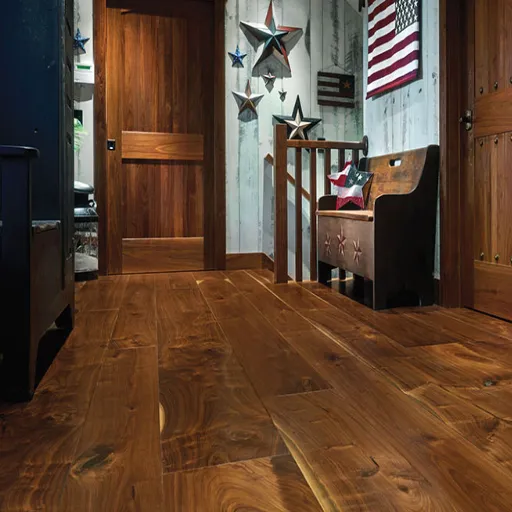
The sustainability story is not as simple as “solid is natural, engineered is glue.”
A 3 mm wear layer uses roughly 16 percent of the walnut volume of a 19 mm solid board; 6 mm about 32 percent; 0.6 mm about 3 percent. Veneer yield is lower than lumber yield, so treat these as directional, but the direction is clear: engineered stretches a scarce species.
Black walnut is under 5 percent of the U.S. hardwood resource and commands the highest per-board-foot export price of any widely traded American hardwood. Using it as a veneer is a material-efficiency decision, not just a cost decision.
Black walnut is not CITES-listed and is IUCN Least Concern. The real compliance load is Lacey Act due care and a PPQ 505 declaration on imports, plus destination rules such as the EUDR. FSC and PEFC certification are available. Ask for chain-of-custody documentation, not just a logo.
Engineered products contain more adhesive, so specify a core and adhesive that meet CARB/EPA TSCA Title VI and look for FloorScore or GREENGUARD. Solid contains more wood and fewer adhesives. Neither is automatically greener. Specify certified veneer, certified core, and low-VOC adhesive, then judge the lifecycle.
How to Choose: Engineered Walnut vs Solid Walnut
- Check the subfloor and grade. Concrete, basement, or radiant heat means engineered. An above-grade wood subfloor means either.
- Check the humidity. Stable 35 to 55 percent relative humidity favors solid; a seasonal cabin or wide swings favors engineered.
- Decide how long you will stay. A forever home can justify solid; a condo, rental, or 10-year horizon often favors engineered.
- Set the wear layer. For most homes, at least 3 mm; for a forever floor, 4 to 6 mm; 2 mm is a budget or rental choice.
- Compare installed cost. Get quotes that include subfloor prep, underlayment, transitions, trim, stairs, and disposal.
- Read the warranty. Check exclusions for moisture, radiant heat, wide planks, and commercial use.
Choose engineered walnut if: you have a concrete slab, basement, or radiant heat; you want wide planks; you live in a condo with acoustic requirements; you want the lowest upfront cost at a 2 to 3 mm wear layer; or you want to stretch a scarce species.
Choose solid walnut if: you have an above-grade wood subfloor; your indoor humidity is stable; you plan to stay for decades; you value the solid feel and deep refinishing life; or you need full-thickness boards for stairs and millwork.
Bring this spec-sheet checklist to any showroom:
- Wear layer thickness in millimeters, not “premium.”
- Core type: plywood, HDF, or lamellar.
- Species: Juglans nigra for American black walnut, Juglans regia for European.
- Grade and acceptable sapwood allowance.
- Finish system and sheen.
- Warranty length and exclusions.
- FSC or PEFC chain-of-custody, and CARB/EPA TSCA Title VI compliance.
Ready to compare specifications? Contact our team for samples, certifications, and a quote on engineered or solid walnut.
FAQ
Is engineered walnut real wood?
Yes, if the wear layer is real walnut. Engineered walnut uses a real walnut veneer over a plywood, HDF, or lamellar core. It is not laminate, vinyl, or SPC. Check the wear layer thickness and species name on the spec sheet.
Which lasts longer, engineered or solid walnut?
Solid walnut usually lasts longer. A 3/4-inch board can be refinished 3 to 5 times and last 50 to 100+ years. Engineered lasts 10 to 25 years at 2 mm, 25 to 40 years at 3 to 4 mm, and 40 to 60+ years at 6 mm or more.
Can engineered walnut be refinished like solid walnut?
Only within its wear layer. Under 2 mm, screen-and-recoat only. At 2 mm, one careful full sand.
At 3 to 4 mm, one to three refinishes. At 6 mm or more, three to five. Solid supports 3 to 5 full refinishes, sometimes more.
Is engineered walnut cheaper than solid walnut?
At 2 mm, yes. At 3 to 4 mm, installed costs overlap. At 4 to 6 mm, engineered can cost as much as or more than solid. Compare installed cost and wear layer, not the label.
Does engineered walnut dent less than solid walnut?
No. Both use the same walnut surface, and black walnut has a Janka hardness of about 1,010. Engineered construction adds stability, not hardness. If dent resistance is the priority, choose oak or hickory.
Can solid walnut be installed over concrete or radiant heat?
No, not recommended. Solid walnut needs a wood subfloor, above grade, with stable humidity. Engineered is the appropriate choice for concrete slabs, basements with moisture mitigation, and radiant heat.
How thick should the walnut wear layer be?
For most homes, at least 3 mm. For a forever floor, 4 to 6 mm. A 2 mm wear layer allows one careful sand and suits a budget or rental. Under 2 mm, plan on screen-and-recoat only.
Conclusion
When you compare engineered walnut vs solid walnut, both are real walnut. The choice isn’t about authenticity. It is about the room, the subfloor, the climate, and how long you plan to stay.
Engineered wins on stability, placement flexibility, wide planks, and upfront cost at thin wear layers. Solid wins on refinishing depth, solid feel, detail work, and long-term value in a stable, above-grade home. At 4 to 6 mm, engineered is a premium product that can cost as much as solid, so compare installed cost and wear layer rather than the label.
The one thing that does not change is the wood. Walnut is soft, beautiful, and prone to lightening. Engineering can keep it flat. It cannot make it hard.
Next step: Contact VitalWood Global for samples, certification documents, and a quote on engineered or solid walnut. Tell us the subfloor, the room, and the wear layer you need, and we will help you specify the right construction.