
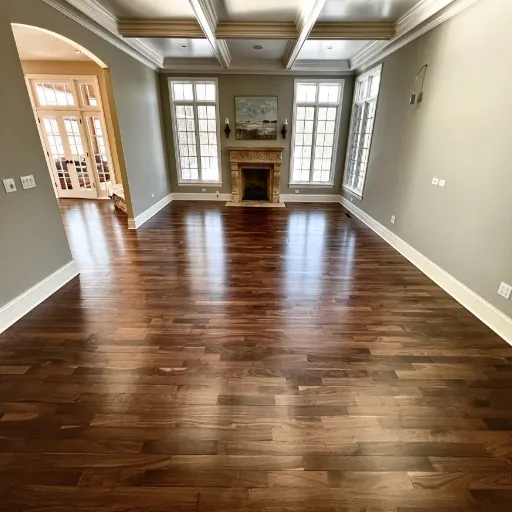
Refinishing Walnut Floors: Dents, Wear Layers & Color
Refinishing walnut floors works if at least 2.4 mm of wear layer remains after sanding. Solid walnut takes three to five full sands over its life. Engineered walnut takes one to three, depending on veneer thickness, and anything under 2 mm should be recoated rather than sanded.
That is the short answer. The long answer about refinishing walnut floors starts with a warning about the sander.
Walnut is the softest wood most homeowners will ever put under a drum sander. At 1,010 on the Janka scale, it dents under a chair leg and cuts faster than the abrasive moving over it. A pass that leaves a faint haze on oak can leave a pale swirl across walnut.
If you have been told your floor needs refinishing, you’re really choosing between a recoat, a full sand, and replacement. This guide covers the tests that separate them, the grit sequence that keeps walnut flat, the wear-layer math for engineered boards, and what the work costs in 2026.
Key Takeaways
- Walnut can be refinished, but only if 2.4 mm (3/32 inch) of wear layer survives the sanding pass. Under 2 mm, recoat or replace.
- One full sand removes 0.75 to 1 mm of wear layer. A dent is a fraction of a millimetre deep, so repair dents before you sand the whole floor.
- Walnut’s soft earlywood and harder latewood sand at different rates. Light passes with a random-orbital sander beat a drum sander every time.
- Freshly sanded walnut looks lighter and grayer than the finished floor. Water-based finishes keep it cool, oil-based finishes warm it, and UV lightens it over the first three to six months.
- Screen and recoat runs $1.50 to $3.00 per square foot. A full refinish runs $3 to $8. Replacement runs $8 to $25.
Why Refinishing Walnut Floors Is Different
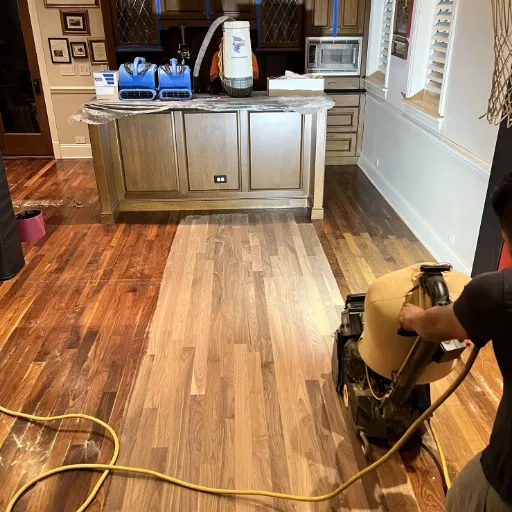
Walnut isn’t oak with a darker stain. It behaves differently under an abrasive, which changes almost every decision.
Black walnut rates about 1,010 on the Janka hardness scale. Red oak sits at 1,290, white oak at 1,360, and hard maple at 1,450. That softness is why walnut dents instead of gouging. It is also why a heavy sanding pass removes more material than you expect.
The bigger issue is grain structure. Walnut has soft earlywood bands next to harder latewood bands. A drum sander cuts the soft wood first, so the surface ends up slightly wavy. Under a dark finish, that wave reads as a series of shallow ripples.
For the full picture of how the species behaves at home, our guide to is walnut flooring durable covers denting, pets, and wear layers in detail.
Color adds a second problem. Walnut hides dirt better than pale maple, but it shows swirl marks and cross-grain scratches as white lines.
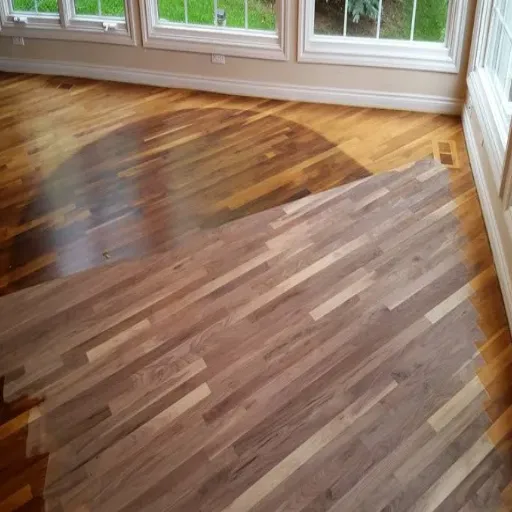
Then there is the color reset. Aged walnut is warm and chocolate brown; freshly sanded walnut is lighter, flatter, and slightly gray. The finish brings depth back, and UV exposure continues the shift for months.
If you’re still choosing a floor rather than restoring one, our engineered walnut flooring guide explains veneer thickness, core construction, and the wear layers that make refinishing possible in the first place.
Refinish, Recoat, or Replace? Start With Three Tests
Before anyone books a sander, run three tests. They take about twenty minutes and they can save thousands.
The water-bead test. Drop a teaspoon of water on the finish in three spots. If it beads and sits, the film is intact. If it soaks in within a minute, the finish has failed and the floor needs more than a recoat.
The raking-light test. Put a lamp on the floor and look along the surface at a low angle. Raking light shows dish-out, chatter, swirl marks, and the traffic lanes you can’t see from standing height.
The nickel test. A U.S. nickel is about 1.95 mm thick. Hold it against the edge of the wear layer, under a floor vent or at a transition strip. If the veneer looks thinner than the coin, don’t let a sander touch it.
Dents deserve their own test. A full sand removes 0.75 to 1 mm of wear layer. A heel mark or chair-leg dent is usually a fraction of a millimetre deep. Sanding an entire floor to remove one dent spends roughly ten times the material the repair actually needs.
That arithmetic changed Dana’s project in Columbus. Her 1920s house had engineered walnut with a 2 mm wear layer and a dull, scratched finish. One contractor quoted a full sand at $5,200.
The nickel test showed the veneer was too thin to survive it. She chose a screen and recoat with a bonding system instead, paid about $1,650 for 700 square feet, and kept the floor intact for another decade.
Not sure which side of that line your floor is on? Send us a photo under raking light and your wear-layer spec. Our team will tell you whether it can be sanded before you book anyone. Talk to our team.
Screen and Recoat vs. Full Sand-and-Refinish
Before refinishing walnut floors, decide whether the film needs refreshing or removing. A recoat refreshes it. A full sand removes it and takes a thin layer of wood with it. The choice comes down to how much finish and wear layer you can spend.
| Screen and recoat | Full sand and refinish | |
|---|---|---|
| Best for | Dull finish, light scratches, intact film, thin veneers | Worn-through finish, deep scratches, dents, color change |
| Cost per sq ft | $1.50 to $3.00 | $3.00 to $8.00 |
| Time | About one day | Three to five days |
| Dust | Low | High without containment |
| Removes | Surface scratches and dullness | Finish, stains, shallow dents, previous color |
| Wear layer used | None | 0.75 to 1 mm per pass |
| Changes color | No | Yes |
Screen and recoat walnut floors only when the film is intact. Even then, most factory-finished walnut carries a UV-cured urethane with aluminum oxide, which is roughly ten times more abrasion-resistant than a standard finish. That hardness also makes it hard to key. A new coat can peel if the surface isn’t abraded and primed with the finish maker’s bonding system.
Always run a test patch in a closet, let it cure, and scratch it with a fingernail. If the coat lifts, stop. Our guide to recoating a factory-finished floor walks through the bonding products and the test procedure.
Can Engineered Walnut Floors Be Refinished?
Yes, if the wear layer is thick enough. The veneer is the whole budget. Once it’s gone, the core is exposed and the floor can’t be saved. The wear-layer rule matches the one behind refinishing engineered hardwood floors; the difference is how gently walnut has to be sanded.
| Wear layer | What is safe | Typical service life |
|---|---|---|
| Under 2 mm | Recoat only, no full sand | 10 to 25 years |
| 2 to 2.4 mm | Borderline, at most one cautious professional pass | 15 to 20 years |
| 3 to 4 mm | One to three refinishes | 25 to 40 years |
| 4 to 6 mm | Two to three refinishes | 30 to 50 years |
| 6 mm and up | Three to five refinishes | 40 to 60 years and beyond |
The National Wood Flooring Association rule is simple. At least 2.4 mm, or 3/32 inch, must remain after sanding. If the math doesn’t work, stop and recoat.
Core material matters too. Plywood cores tolerate a careful sand. HDF cores don’t.
They swell when wet and can’t be sanded flat, so an HDF-backed floor is recoat-or-replace no matter how thick the veneer looks. Our comparison of engineered walnut vs solid walnut breaks down the construction differences and the fifty-year cost.
Check the spec sheet, measure a spare plank, or lift a transition strip. Do not trust “refinishable” without a millimetre figure.
How to Refinish Walnut Floors, Step by Step
The sequence below covers refinishing walnut hardwood floors, whether solid or engineered with at least 3 mm of wear layer. If yours is thinner, stop at the recoat section.
- Clear and contain. Remove furniture, seal doorways and vents, and set up dust containment. Bag walnut dust rather than composting it; black walnut contains juglone, which can harm garden plants.
- Repair before sanding. Steam shallow dents with a damp cloth and a warm iron for 10 to 20 seconds, repeating up to four times. Set protruding nails, fill only the gaps that need filling, and replace split boards.
- Strip only if needed. Start at 36 to 40 grit only when the old finish is thick or failed. Otherwise begin at 60.
- Work up through the grits. Move 60, then 80, then 100, then 120. For a film finish, stop at 120. For hardwax oil, go to 150 or 180.
- Keep the machine moving. Never let a sander sit in one spot. Walnut burnishes and dishes quickly, and the marks show under finish.
- Edge and corner by hand. Match the grit of the field sanding. Keep edges level with the field or you will see a halo at the walls.
- Vacuum and tack. Remove every trace of dust, then inspect under raking light before any finish goes down.
- Finish in thin coats. Apply two or three coats, buffing between, and follow the manufacturer’s cure schedule.
The grit endpoint is where most DIY jobs go wrong. Coarser paper leaves scratches the finish can’t fill, and paper finer than 180 burnishes the surface. Cut fibers and cracked finish won’t respond to steam, and those are the dents that justify a board replacement.
Choosing the Best Finish for Refinishing Walnut Floors
Finish choice controls color, durability, and how visible the next scratch will be. There is no universal best finish, only a best finish for how you want the floor to age.
Water-Based Polyurethane
Water-based keeps the cool, chocolate tone of fresh walnut. It doesn’t amber, it dries fast enough for multiple coats in a day, and it has low VOC. On very fresh walnut it can read slightly gray, so a seal coat helps.
Oil-Based Polyurethane
Oil-based warms the wood immediately and deepens the grain. It is durable and forgiving to apply, but it ambers over time and carries a stronger solvent odor.
Hardwax Oil and Natural Oil
Hardwax oil leaves a matte, repairable surface that hides dents and patina better than a glossy film. It needs a maintenance routine, and it works best when the floor is sanded to 150 or 180 so the oil can penetrate.
Sheen matters as much as chemistry. Matte and satin finishes scatter light and soften swirl marks. Gloss amplifies every imperfection on a dark floor. If your walnut is soft and lived on, choose the lower sheen.
Will Refinishing Change the Color of My Walnut Floor?
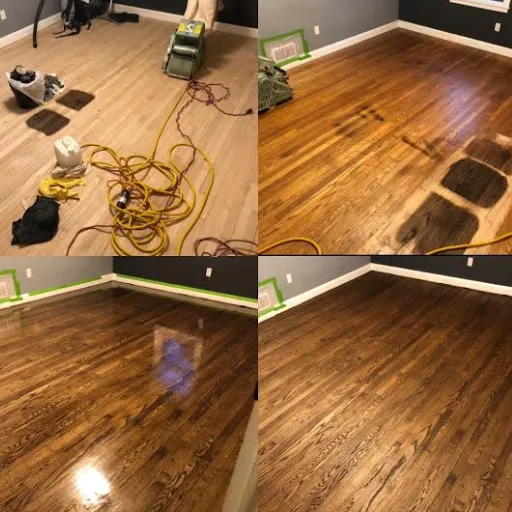
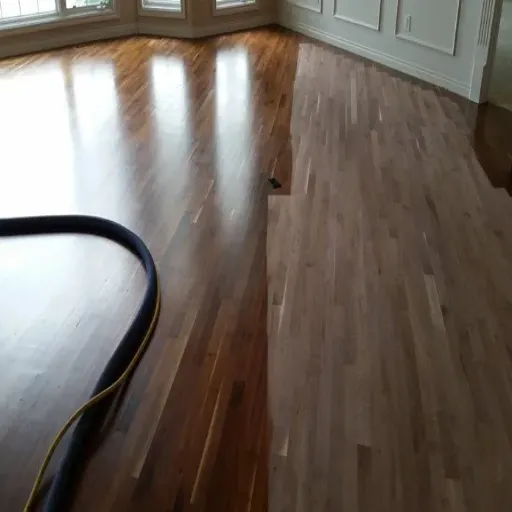
Yes, at least temporarily. Sanding removes the aged finish and the oxidized surface, so the floor comes up lighter and flatter than the color you lived with. The new finish restores depth, and UV exposure continues the change for three to six months.
Water-based finishes keep the color cool and close to freshly sanded walnut. Oil-based finishes add amber warmth immediately. If you want the floor darker than it is, you’re choosing a stain, not a finish.
Staining walnut floors is usually a mistake. The Wood Database notes that walnut is rarely stained. The open grain takes pigment unevenly, the figure goes muddy, and the natural contrast between earlywood and latewood disappears. If you must darken it, use a dye or gel stain with a conditioner, and test on a spare board first.
Sapwood is the exception you can’t fix. The cream-colored outer wood stays cream, and it won’t stain to match the heartwood. A heavy sapwood allowance will show through no matter what color goes on top.
Elena learned this in Portland. Her solid walnut floor had two dogs, nineteen visible dents, and a finish worn through in the kitchen. She wanted a darker, more uniform floor.
After steaming twelve dents and sanding to 120, the natural color came back so strongly that she skipped the stain entirely. The 620-square-foot job ran about $4,100 with a matte hardwax oil, and the dents that remained read as patina rather than damage.
What Refinishing Walnut Floors Costs in 2026
Walnut floor refinishing cost depends on square footage, wear layer, finish system, and how much repair happens before the sander starts.
| Service | Professional | DIY supplies |
|---|---|---|
| Screen and recoat | $1.50 to $3.00 per sq ft | $0.50 to $1.50 per sq ft |
| Full sand and refinish | $3.00 to $8.00 per sq ft | $1.50 to $3.00 per sq ft |
| Dent and board repair | $75 to $250 per board | $20 to $60 in materials |
| Replacement | $8.00 to $25.00 per sq ft installed | Not a DIY project |
Walnut doesn’t carry the density premium that maple does, because soft wood sands faster. The cost pressure comes from removing an aluminum oxide factory finish and from the extra prep a dark floor demands.
A 500-square-foot room is a useful benchmark. A recoat runs about $750 to $1,500. A full refinish runs about $1,500 to $4,000. Replacement runs about $4,000 to $12,500.
Refinishing also returns roughly 147 percent of its cost at resale, according to the National Association of Realtors Remodeling Impact Report.
DIY walnut floor refinishing saves money, but the risk is concentrated. Swirl marks on dark walnut are hard to undo, and a drum sander in unpracticed hands can dish a soft floor in one pass. Walnut dust is also a sensitizer that can irritate eyes and skin. If the floor is pre-1978, professional crews must follow the EPA’s Renovation, Repair and Painting rule.
Planning a multi-unit or commercial refinish? Wear-layer choices made at specification time decide how many sands the floor gets later. We supply certified walnut and can help you plan for two refinishes instead of one. Request a quote.
Why Refinishing Beats Replacement for a Scarce Wood
According to the American Hardwood Export Council, walnut is under 5 percent of the U.S. hardwood resource and carries the highest per-board-foot export price of any widely traded American hardwood. Replacing a floor sends a scarce material to landfill and buys new material at a premium.
Refinishing walnut floors keeps the existing wood in service and preserves the carbon already stored in it. It also avoids the manufacturing and transport footprint of a new floor. Choosing a low-VOC, FloorScore-compatible finish reduces indoor air impacts at the same time.
The sustainability case is also a maintenance case. A recoat every five to ten years and a full refinish every ten to fifteen years will keep a walnut floor in service for decades. That schedule is cheaper than replacement and it keeps the patina that makes walnut worth buying.
A 14-unit loft project in Denver made that trade explicitly. The developer specified 4 mm wear layers instead of 2 mm and scheduled a recoat at year seven. The thicker veneer bought the building a second full sand decades later.
Walnut Refinishing FAQ
Can walnut floors be refinished?
Yes, if enough wear layer remains. Solid walnut can be sanded three to five times. Engineered walnut can be sanded once or twice depending on veneer thickness, and floors with less than 2.4 mm remaining after sanding should be recoated instead.
How many times can you refinish walnut floors?
Solid walnut typically takes three to five full refinishes, or five to eight in ideal conditions with a careful operator. Engineered walnut takes one to three, based on wear layer. Any specific number you read online without a millimetre figure attached is a guess.
What grit should I sand walnut floors to?
Work through 60, 80, 100, and stop at 120 for film finishes. Go to 150 or 180 for hardwax oil. Don’t jump grits, and don’t finish finer than 180, because over-sanding burnishes the surface.
Why does my walnut floor look gray after sanding?
Freshly sanded walnut is lighter and grayer than aged walnut because the oxidized surface and old finish are gone. The new finish restores depth, and UV exposure warms the wood over the next three to six months. A water-based finish can also read slightly cool on fresh wood.
Can I make my walnut floor darker or lighter when refinishing?
Lighter is easy: sand back to bare wood and use a water-based finish without stain. Darker is harder. Walnut blotches when stained, so use a dye or gel stain with a conditioner and test on a spare board. Sapwood won’t match no matter what you apply.
Can I screen and recoat a factory-finished walnut floor?
Sometimes. Aluminum oxide finishes resist mechanical keying, so you need to abrade the surface and use the finish manufacturer’s bonding system. Always run a closet test patch and scratch it after curing. If it lifts, the floor needs a full sand or replacement.
How much does it cost to refinish walnut floors?
Expect $1.50 to $3.00 per square foot for a screen and recoat and $3.00 to $8.00 per square foot for a full sand and refinish. A 500-square-foot room typically runs $750 to $4,000 depending on the method and the amount of repair.
Final Thoughts
Refinishing walnut floors is less about muscle and more about restraint. Repair the dents before you sand. Take light passes.
Stop at 120 for a film finish. Choose a matte sheen and a finish that supports the color you want.
The wear-layer math decides everything else. If 2.4 mm will remain, the floor has a future. If it won’t, a recoat buys years without spending material you can’t replace.
Walnut is a scarce, beautiful wood, and the floors that survive longest are the ones that were maintained rather than replaced. If you’re planning a refinish or specifying walnut for a project, our team can review your wear-layer numbers and finish schedule before the first pass. Get in touch, and we’ll help you keep the floor, and the wood, in service.
For a species comparison, see our guide to refinishing maple floors, where density rather than softness drives the sanding strategy.