
Engineered Wood Flooring Cost: 2026 Pricing and Budgeting Guide
Engineered wood flooring costs $7 to $20 per square foot installed in the United States in 2026. Materials alone range from $3 to $16+ per square foot, while professional labor adds another $3 to $8 per square foot. A typical 1,000 square foot project runs between $7,000 and $20,000.
That range is wide on purpose. The final price depends on wear layer thickness, core construction, wood species, plank dimensions, finish, installation method, and how much prep work your subfloor needs. Most cost guides stop at materials and labor. They skip the hidden line items that turn a $10,000 quote into a $14,000 invoice. This guide breaks down the full picture: material tiers, installation methods, hidden costs, regional pricing, and long-term value.
In this guide, you’ll learn how to budget accurately, what questions to ask a contractor, how to compare engineered wood against solid hardwood and laminate, and where certifications fit into the cost equation.
Key Takeaways
- U.S. installed cost: $7–$20/sq ft; materials alone: $3–$16+/sq ft.
- Labor ranges by method: floating $3–$5, glue-down $5–$8, nail-down $4–$7, herringbone $8–$16+ per sq ft.
- Hidden costs include subfloor leveling, moisture barriers, old floor removal, trim, and a 10% wastage allowance.
- Engineered wood is usually cheaper upfront than solid hardwood but has a shorter lifespan (20–40 years vs. 50–100+ years).
- Certified products may cost more upfront but can reduce replacement cost and support responsible forestry.
What Drives Engineered Wood Flooring Cost?
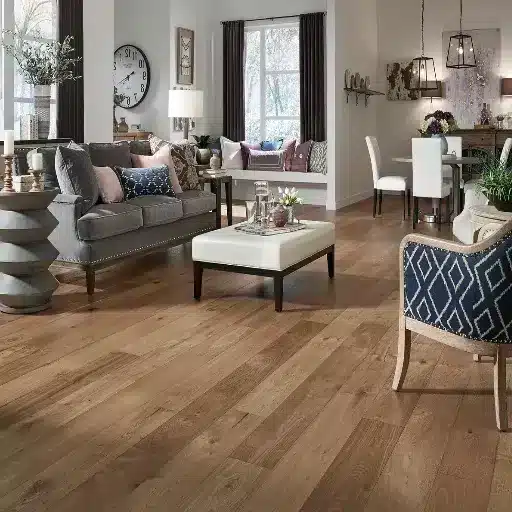
The price of engineered wood flooring is not arbitrary. It reflects material quality, structural engineering, finish durability, and supply chain transparency. Understanding each driver helps you decide where to spend and where to save.
Wear Layer Thickness
The wear layer is the real-wood veneer on top. Thicker layers can be sanded and refinished more times, which extends the floor’s life.
- 0.6–1 mm: Budget products; cannot be refinished.
- 2 mm: One light sanding possible.
- 3–4 mm: 2–3 sandings; standard for quality residential floors.
- 5–6 mm: Comparable to solid wood; premium residential and commercial grade.
Each millimeter of wear layer adds cost but also adds years of useful life. For a home you plan to own for decades, 3 mm is a practical minimum.
Core Construction
Plywood cores are more stable and moisture-resistant than high-density fiberboard (HDF) cores. They also cost more. Some premium products use engineered solid-wood cores for maximum dimensional stability. If you are installing over concrete or below grade, a plywood core is worth the upgrade.
Wood Species and Grade
Oak, maple, and hickory are common mid-range species. Walnut, teak, and exotic species carry a premium. Higher grades with fewer knots and more consistent color cost more than rustic grades. Oak remains the most cost-effective choice for many homeowners because it balances hardness, stability, and availability. Maple and hickory offer more durability for slightly higher engineered hardwood flooring prices.
Plank Width, Length, and Pattern
Wide planks and long boards use more raw material and create more waste during cutting. Patterns like herringbone and chevron require more labor and increase material waste by 10–15%. If you are considering wide planks, our wide plank engineered wood flooring guide explains the trade-offs.
Finish and Warranty
Aluminum oxide and UV-cured polyurethane finishes add durability but also cost. Longer warranties usually indicate higher-grade finishes and thicker wear layers.
Certifications
FSC, PEFC, FloorScore, GREENGUARD, and EPA TSCA Title VI compliance add traceability and testing costs. Certified products may cost 5–15% more, but they reduce the risk of buying inferior or environmentally damaging material.
Order Volume and Origin
Large commercial orders can access wholesale pricing. Imported material introduces freight, duty, and tariff considerations. For example, standard European oak engineered flooring from China runs about $20–$25 per square meter FOB for 1,000 m²+ orders, according to Duramagicfloor.
Engineered Wood Flooring Cost by Quality Tier
Use this table as a quick reference when comparing quotes.
| Tier | Material $/sq ft | Total Installed $/sq ft | Typical Use |
|---|---|---|---|
| Budget | $2–$5 | $7–$10 | Rentals, low-traffic rooms, short-term ownership |
| Mid-range | $5–10 | $10–$16 | Most residential projects |
| Premium | $10–$16+ | $16–$22+ | Long-term homes, commercial spaces |
| Rare/Custom | $16–$30+ | $22–$40+ | Exotic species, wide/long planks, custom finishes |
These engineered hardwood flooring prices reflect retail material cost only. Mid-range products balance cost and durability with plywood cores and 3–4 mm wear layers. Premium tiers add thicker veneers, better finishes, and stronger warranties.
Need help matching a tier to your project? Contact our team for a tailored quote.
Engineered Wood Flooring Installation Cost by Method
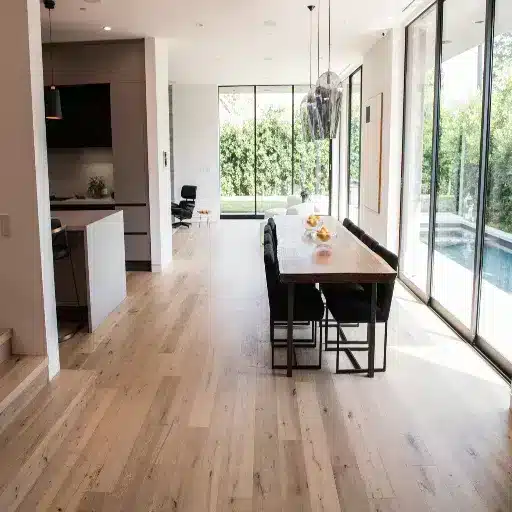
Labor is the second-biggest driver when estimating the cost to install engineered hardwood floors. The installation method you choose affects both price and performance.
Floating / Click-Lock
Labor runs $3–$5 per square foot. This is the most DIY-friendly method. Planks click together over an underlayment without glue or nails. It works well over concrete and radiant heat but may feel slightly less solid underfoot.
Glue-Down
Labor runs $5–$8 per square foot. This method bonds the planks directly to the subfloor with adhesive. It creates a solid feel and is ideal for concrete slabs and radiant heat. It also adds adhesive and moisture-barrier costs.
Nail-Down / Staple-Down
Labor runs $4–$7 per square foot. This requires a wood subfloor. It is fast and produces a traditional hardwood feel. For a full breakdown of installation best practices, read our engineered wood flooring installation guide.
Herringbone and Patterned Layouts
Labor runs $8–$16+ per square foot. Intricate patterns require more cutting, planning, and waste. They can add 25–40% to total labor compared to straight plank installation.
Hidden Costs That Inflate Your Budget
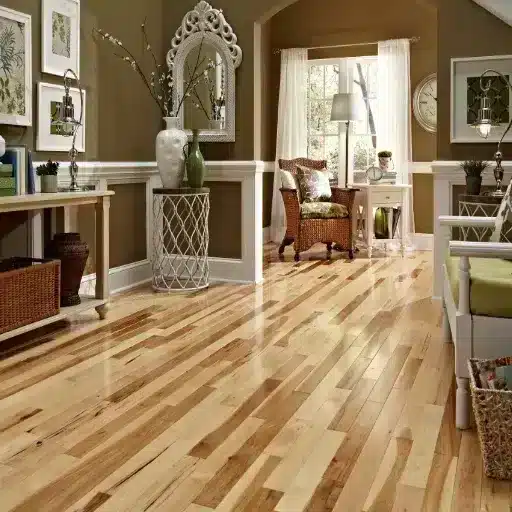
Many buyers focus on the per-square-foot material price and miss the line items that add up quickly. Here are the most common hidden costs.
Old Floor Removal and Disposal
Removing and disposing of old flooring typically costs $1–$4 per square foot. Carpet and vinyl are usually cheaper to remove than glued-down tile or existing hardwood.
Subfloor Preparation
A subfloor must be clean, dry, and level. Subfloor leveling costs $1–$2 per square foot. Repairs for water damage or rot run $2–$7 per square foot or more if joists are involved. Ignoring subfloor issues can void your warranty.
Moisture Barrier and Underlayment
A moisture barrier costs $0.50–$1.50 per square foot. It is essential over concrete slabs, below-grade areas, and crawl spaces. Underlayment for floating floors adds another $0.50–$2 per square foot.
Trim, Transitions, and Molding
Baseboards, shoe molding, and transition strips often cost $1–$3 per linear foot. Removing and reinstalling existing trim can reduce this cost.
Wastage Allowance
Order 10% extra material for straight installs and 15% for patterned layouts. This covers cutting waste, defects, and future repairs.
Delivery, Taxes, and Permits
Delivery fees vary by distance and order size. Sales tax applies to materials in most jurisdictions. Some areas require permits for renovation work, especially in commercial settings.
When Priya renovated her 900 sq ft beach rental in Sarasota, her contractor’s initial quote covered only materials and basic labor. After adding a moisture barrier, subfloor leveling, baseboard replacement, and 10% wastage, the total climbed from $9,500 to $13,200. The surprise was not price gouging; it was incomplete budgeting.
Engineered Wood Flooring Cost vs. Alternatives
Understanding how engineered wood compares to solid hardwood, laminate, and LVT helps you justify the investment.
Engineered vs. Solid Hardwood
Engineered wood is usually cheaper to buy and install than solid hardwood. However, solid hardwood lasts longer, often 50–100+ years versus 20–40 years for engineered. Solid hardwood can also be refinished many more times.
For a deeper comparison, read our engineered hardwood vs solid hardwood guide.
Engineered vs. Laminate and LVT
Laminate and luxury vinyl tile (LVT) are generally cheaper than engineered wood. Laminate starts around $1–$3 per square foot for materials. LVT starts around $2–$5 per square foot. Neither is real wood, though high-quality LVT can mimic wood convincingly.
If you want real wood at a lower price than solid hardwood, engineered wood sits in the sweet spot. For more detail, see our engineered wood flooring vs laminate comparison.
Engineered Wood Flooring Cost Calculator by Project Size
Use the table below as a simple engineered wood flooring cost calculator for common project sizes.
| Room / Area | Size | Budget Total | Mid-range Total | Premium Total |
|---|---|---|---|---|
| Small bedroom | 120 sq ft | $840–$1,200 | $1,200–$1,920 | $1,920–$2,640 |
| Living room | 300 sq ft | $2,100–$3,000 | $3,000–$4,800 | $4,800–$6,600 |
| Open-plan area | 800 sq ft | $5,600–$8,000 | $8,000–$12,800 | $12,800–$17,600 |
| Whole house | 1,500 sq ft | $10,500–$15,000 | $15,000–$24,000 | $24,000–$33,000 |
These totals include materials and labor but do not include hidden costs like subfloor prep or old floor removal.
Regional Pricing Snapshot
Prices vary significantly by region due to labor rates, material availability, and import costs.
| Region | Typical Installed Cost | Notes |
|---|---|---|
| United States | $7–$20/sq ft | Wide range between big-box and specialty suppliers |
| United Kingdom | £50–£95/m² | Higher in London and the Southeast |
| Europe | €53–€158/m² | Strong regional variation |
| Australia | A$125–$230+/m² | High labor and material transport costs |
| India | ₹75–₹190/sq ft | Local species cheaper; imported oak premium |
| China wholesale FOB | $15–$35/m² | Factory pricing for large orders |
ROI and Resale Value
Flooring is one of the few home improvements that can pay back more than it costs. New engineered hardwood floors recover roughly 70–80% of their cost at resale, according to industry data cited by ListWithClever. Hardwood floors can add 2–5% to a home’s sale price.
The best return comes from mid-range to premium engineered products with thick wear layers. Thin, budget products that cannot be refinished may need replacement before you sell, reducing ROI.
Refinishing existing hardwood delivers even stronger returns. The National Association of Realtors estimates a 147% ROI for hardwood refinishing projects.
How to Get the Best Value
Price matters, but the cheapest option is rarely the best value. Here is how to maximize what you get for your budget.
- Match wear layer to ownership length. If you plan to move in 5 years, 2 mm may be fine. If you plan to stay 20 years, choose 3–4 mm minimum.
- Buy certified products. FSC, PEFC, FloorScore, and GREENGUARD certifications reduce the risk of premature failure and environmental harm.
- Get three itemized quotes. An itemized quote reveals where contractors differ on prep, labor, and materials.
- Plan a 10–15% contingency. Unexpected subfloor issues are common in older homes.
- Consider total cost of ownership. A premium floor that lasts 30 years can cost less per year than a budget floor replaced twice.
Marcus, a builder in Seattle, learned this on a basement fitness studio. He chose a budget engineered product with an HDF core to save $1,200. Within six months, slight cupping appeared near an exterior wall. The fix required removing part of the floor, adding a moisture barrier, and reinstalling. The “savings” cost him nearly $4,000.
FAQ
Is engineered wood cheaper than solid hardwood?
Yes, engineered wood is generally cheaper to buy and install. However, solid hardwood lasts longer and can be refinished more times.
Can I install engineered wood myself to save money?
Yes, especially click-lock floating systems. DIY installation can save $3–$8 per square foot in labor. Glue-down and nail-down methods are usually better left to professionals.
How much does it cost to refinish engineered wood?
Refinishing costs $3–$8 per square foot, but only if the wear layer is thick enough. A 2 mm layer supports one light sanding. A 3–4 mm layer supports 2–3 sandings.
Do certifications increase the price?
Certified products may cost 5–15% more upfront. The premium covers auditing, testing, and chain-of-custody documentation. It often pays back through longer product life and easier specifications for green building projects.
What is the cheapest way to buy engineered wood flooring?
The cheapest way is usually a budget click-lock product from a big-box store installed as a floating floor. However, this only works if your subfloor is level, dry, and in good condition. Skipping moisture protection or subfloor prep usually leads to expensive repairs.
How much does engineered wood flooring installation cost?
Installation typically costs $3–$8 per square foot for standard methods. Patterned layouts and glue-down installs cost more.
What is the engineered wood flooring cost per square foot?
Installed cost ranges from $7 to $20 per square foot in the U.S. Materials alone range from $3 to $16+ per square foot.
Are there hidden costs in engineered wood flooring?
Yes. Common hidden costs include old floor removal, subfloor leveling, moisture barriers, underlayment, trim, transitions, delivery, taxes, and a 10% wastage allowance.
Conclusion
Engineered wood flooring cost in 2026 ranges from $7 to $20 per square foot installed, with materials accounting for roughly half to two-thirds of the total. The final number depends on quality tier, installation method, wood species, plank dimensions, finish, certifications, and hidden prep work.
The smartest approach is not to chase the lowest per-square-foot price. It is to match the product to the project and budget for the full scope. A mid-range engineered oak with a 3–4 mm wear layer, plywood core, and proper moisture protection usually delivers the best balance of upfront cost, durability, and resale value for most homeowners.
At VitalWood Global, we help architects, builders, designers, and homeowners source certified, custom-engineered wood flooring that fits both performance goals and budget constraints. If you are comparing quotes and want help interpreting wear layers, certifications, or landed costs, contact our team for a personalized estimate.
Want to keep planning? Read our complete engineered wood flooring guide, compare engineered hardwood vs solid hardwood, or review engineered wood flooring installation methods before your project starts.