
Prefinished Wood Flooring Finishes: Sheen, Texture & Grade
Prefinished wood flooring finishes come down to three separate decisions: sheen, texture, and grade. Sheen controls how much light the surface reflects. Texture controls the physical relief you feel underfoot. Grade controls how much natural character shows through the boards. Choose all three with your space in mind and the floor looks intentional for years. Miss one, and you’ll notice it every day.
If you have ever stood in a showroom holding two wood samples and struggled to tell them apart, you’re in good company. When Dana chose a satin white oak floor for a bright, south-facing living room, the showroom sample looked soft and even under fluorescent light. Six months after installation, low afternoon sun raked across the boards and the floor read shinier than she remembered. Nothing was defective. She had picked a sheen under the wrong light.
This guide covers the three finish decisions that change how a prefinished floor looks and lives. You’ll get sourced gloss numbers, the honest trade-off behind each choice, three comparison tables you can bring to a client or a contractor, and a simple sample-and-lighting method. We write this as a wood manufacturer, so we’ll also tell you when the premium choice is not worth it.
Ready to see these finishes in your own light? Request sheen, texture and grade samples from our flooring team.
Key Takeaways
- “The finish” is three independent choices: sheen, texture, and grade. A prefinished floor carries all three at once.
- Sheen is a look, not a protection tier, and on a prefinished floor it is set at the factory in the final coat.
- Matte hides scratches and dust best (roughly 10 to 20 gloss units); semi-gloss reveals them. The trade-off is that matte holds grime and can burnish.
- Textured surfaces (wire-brushed, hand-scraped) hide wear better than smooth, but they clean harder.
- Grade describes character and price, not durability. Waste factors run from about 5% at clear grade to 15% at rustic.
The Three Finish Decisions (And Why They Are Separate)
It helps to separate three things that buyers usually collapse into one word. Sheen is how reflective the topcoat is. Texture is the physical shape of the wood surface. Grade is the amount of natural character the manufacturer allows into the boards. A single plank carries all three at once. A smooth, matte, clear-grade maple floor and a wire-brushed, matte, character-grade oak floor look and behave very differently.
This is why the finish is the most misunderstood part of buying a prefinished floor. The boards arrive finished from the factory, so sheen, texture, and grade are locked in before they reach your site. You gain factory consistency and a dust-free install; you give up changing your mind on-site.
It also matters which finish question you’re asking. To understand what the coating is made of, start with our guide to aluminum oxide floor finish. To weigh one coating system against another, see UV oil vs aluminum oxide flooring. This article owns the third question: how the floor should look. For the full construction and finish-method picture, see our prefinished engineered wood flooring pillar.
Sheen Levels: Matte, Satin, Semi-Gloss and Gloss
Sheen is the fastest way to change how a finished floor reads, and it’s the decision buyers most often make by accident. The table below maps the common sheen levels to gloss units, what each one hides, and where it belongs.
| Sheen | Gloss units (60°) | Light reflection | Hides scratches & dust | Room effect | Best for |
|---|---|---|---|---|---|
| Ultra-matte / Raw | ~5–10 | Minimal | Best | Softest, most natural | Contemporary, Japandi, coastal looks |
| Matte / Flat | ~10–20 | Low | Very good | Muted and natural | Most modern homes, high-traffic areas |
| Satin | ~25–40 | Soft | Good | Balanced and timeless | The all-round residential default |
| Semi-gloss | ~45–65 | Noticeable | Fair | Brighter and more formal | Formal and heritage rooms |
| Gloss | ~70–90+ | High | Poor | Mirror-like and expansive | Gymnasiums and specialty commercial |
How Sheen Is Measured (Gloss Units at 60°)
Sheen is measured with a gloss meter on a 0 to 100 gloss unit (GU) scale, read at a 60° angle, against a black-glass standard. A perfect mirror would read 100. The ranges above come from flooring technical guides, and published ranges disagree: some retailers quote matte as low as 5 GU and others as high as 35 GU. Ask how any number was measured and at what angle. Sheen is a range, not a precise point.
Sheen Is a Look, Not a Protection Tier
Here is the manufacturing fact that changes the whole decision. With modern waterborne finishes, the sealer and build coats are identical across sheens. Only the final coat carries the flattening agent that sets the gloss level, so choosing matte instead of semi-gloss doesn’t make your floor less durable.
This was not always true. On older oil-based finishes, flattening agents could compromise the film, so high gloss really was tougher, and that legacy is why the myth survives. On today’s finishes, sheen is a look, not a grade of protection.
The Honest Downside of Matte
A matte surface scatters light in every direction, so a scratch has almost nothing to contrast against; on a semi-gloss or gloss floor, the same scratch reads as a dull line across a mirror. That is why matte and low-sheen finishes dominate residential flooring today. But matte is not free. Be honest about the trade-offs:
- Matte can hold grime. Lower reflectivity means less visual contrast, and less incentive to wipe.
- Matte can burnish. Friction can polish a matte finish into shinier patches in high-traffic doorways.
- Dark stains and ultra-matte can look flat. Below about 10 GU, some water-based lacquers scuff visibly.
- Flattening additives can read hazy in certain light, and some homeowners notice skin oils more on very flat finishes.
None are deal-breakers. They are the price of the look, and you should know it going in rather than discover it later.
Surface Textures: Smooth, Wire-Brushed and Hand-Scraped
Texture is the second axis, independent of sheen: a board can be wire-brushed and matte, or smooth and satin. Texture changes how the floor feels and how well it hides everyday wear.
| Texture | Surface & feel | Look & style | Hides wear | Cleaning | Relative cost | Best for |
|---|---|---|---|---|---|---|
| Smooth | Flat, uniform, sanded even | Classic, modern, formal | Least forgiving | Easiest to sweep | Lowest | Contemporary, lower-traffic rooms |
| Wire-brushed | Soft grain removed, hard grain left proud; subtle linear relief | Rustic yet refined | Good (light to medium scratches) | Slightly more effort | Moderate | Active homes, pets, high traffic |
| Hand-scraped | Irregular undulations, grooves, character marks | Old-world, rustic, farmhouse | Best (dents and scratches) | More effort in the grooves | Highest | High-traffic, rustic interiors |
| Distressed | Deliberate dents and worn marks | Weathered, reclaimed look | Very good | More effort | High | Rustic and industrial schemes |
| Smoked | Heat-treated for deeper, darker tone | Deep and dramatic | Depends on the finish above it | Same as base texture | Moderate to high | Contemporary, dramatic palettes |
Smooth, Clean and Least Forgiving
A smooth floor reflects light evenly, so it looks bright and expansive, and it is the easiest to sweep and the most affordable texture. It is also the least forgiving: dust, pet hair, and fine scratches show up quickly, especially under any sheen above matte.
Wire-Brushed, The Forgiving Middle Ground
Wire-brushing removes the softer grain and leaves the harder grain slightly proud, creating a subtle, linear texture. It reads as real wood to the touch, offers better traction, and disguises everyday wear. For most active households it is the best wear-hiding choice and the most popular texturing treatment today.
When Elena’s two retrievers turned a smooth oak floor into a mess of light scratches within a year, she replaced it with a wire-brushed matte oak. Two years later, the same claw traffic was invisible against the grain relief. The dogs did not become gentler; the floor stopped advertising every mark. If pets are driving your decision, our guide to the best prefinished flooring for dogs goes deeper on selection for busy homes.
Hand-Scraped and Distressed, Maximum Character, Maximum Cost
Hand-scraped floors carry irregular undulations and tool marks, and they hide dents and scratches better than any other texture. They are also the most labour-intensive and the most expensive. One caveat: if you ever sand a hand-scraped floor smooth, you lose the texture.
Texture and sheen stack. The standard recommendation for a busy home is a textured surface plus matte plus a character grade, because each one hides a different kind of wear.
Flooring Grades and Character: Clear, Select, Character, Rustic
Grade is the third axis and the one most likely to surprise a buyer. It describes how much natural character appears in the wood: knots, mineral streaks, colour variation, and heartwood. It doesn’t describe quality or durability.
| Grade (common names) | Character permitted | Colour variation | Waste factor | Relative price |
|---|---|---|---|---|
| Clear / Prime / First | Few or no knots, minimal marks | Most consistent | ~5–8% | Highest |
| Select / Classic / Select & Better | Minimal knots, limited marks | Slight variation | ~8–10% | High |
| Character / #1 Common | Visible knots, mineral streaks | Moderate to high | ~10–15% | Mid |
| Rustic / #2 Common / Natural / Builder’s | Prominent knots, worm holes, heartwood | Highest | ~15% | Lowest |
Grade Describes Character, Not Quality
An antique-grade floor is just as structurally sound as a select-grade floor; the difference is purely visual. Buyers often assume “clear” means “better built,” but it only means “cleaner looking,” and it costs more because a higher share of the timber cannot be used. In the US market, #1 Common, sold as Character grade, is the most widely used grade, and for many buyers it hits the sweet spot between cost and character.
There Is No Single Standard, and Waste Drives Cost
There is no single global grading standard. Manufacturers largely set their own systems. The National Wood Flooring Association (NWFA) publishes recommended guidelines, and terms like “select,” “natural,” and “rustic” are common shorthand, but the exact rules vary by maker. Flooring grades also differ from NHLA lumber grades such as FAS and #1 Common, which were designed for the furniture trade. Always ask which standard applies to the product in front of you.
Grade moves the installed price mainly through waste, not the wood itself. Roughly 5% to 8% of a clear-grade order is waste, 8% to 10% at select, 10% to 15% at character, and up to 15% at rustic. Because a higher grade rejects more of each tree, compare quotes on the waste allowance as well as the unit price.
Not sure which grade suits your project? Talk to our flooring team about character tolerances and a sample set for your space.
How to Combine Prefinished Wood Flooring Finishes
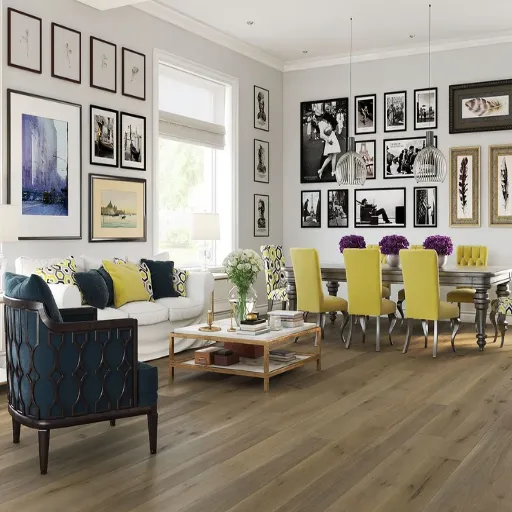
Once you see the three axes separately, you can combine them for a specific room. These pairings are starting points, not rules. (Our note on wide plank formats explains how board width changes the same look.)
- Modern or minimalist, lower traffic: smooth surface, satin or matte sheen, select grade.
- Active family home with pets and kids: wire-brushed surface, matte sheen, character grade.
- Rustic, traditional, or farmhouse: hand-scraped surface, matte sheen, character or rustic grade.
- Formal or heritage rooms: smooth surface, semi-gloss sheen, clear or select grade.
- Commercial floor plates: smooth or lightly textured surface, satin sheen, a tightly controlled grade for consistency across lots.
That last pairing is where appearance becomes a specification. When a developer specified a large office floor plate, the risk was not the look of one board but the consistency of thousands: a fixed gloss range, a defined grade tolerance, and a single lot for the project separated a seamless floor from a patchwork. Appearance choices become tolerance decisions at scale, and our guide to commercial engineered wood flooring covers how that specification works.
Choosing and Verifying Your Prefinished Wood Flooring Finishes
The three tables above help you shortlist. Verifying the choice takes a little more work, because showroom lighting lies.
A Sample-and-Lighting Protocol
Follow this before you commit:
- View the sample in the actual room, not just in the store.
- Check it in morning and evening light. Warm LED light at night tells a different story again.
- Look at a raking angle, low along the floor, as well as straight down, because scratches and sheen reveal themselves at an angle.
- View the sample dry, and against your cabinetry and wall colours, since contrast changes how the grain reads.
Can You Change Sheen After Installation?
A prefinished floor’s sheen is set at the factory, because the sheen lives in the final coat. The escape hatch is a buff-and-recoat, which adds a new topcoat in a different sheen without sanding to bare wood. This works only if the existing finish accepts a recoat, and some factory aluminum oxide finishes resist recoating, so confirm compatibility before you buy. Our guides to refinishing prefinished engineered hardwood and to prefinished vs unfinished hardwood flooring cover when a site-finished floor gives you more sheen control from the start.
Read the Spec Sheet, and Specify the Tolerance
When you compare products, look for three lines: the gloss unit range for the sheen, the grade standard the product is graded to, and the finish system and texture named explicitly. If a spec sheet omits all three, treat the marketing language around it with caution.
For architects, builders, and contractors, appearance is a submittal item. Specify an acceptable gloss range, an acceptable grade of character, and a single lot to cover the run wherever consistency matters, then request a physical sample you approve and retain.
Maintenance Implications
Sheen and texture change your cleaning routine, not just your look. Matte floors tend to need more frequent cleaning to stay uniform, and textured floors hide wear but collect dust in the grooves. Keep to the cleaner that matches your finish system, and never use steam, wax, or oil soaps on a film finish. For the full routine, see our wood floor cleaning guide and, for factory-finished specifics, our prefinished flooring maintenance guide.
FAQ
What are the different finishes for prefinished wood flooring?
Prefinished wood flooring finishes are best understood as three separate choices: sheen, texture, and grade. Sheen sets how reflective the surface is, texture sets the physical relief, and grade sets how much natural character shows. The protective coating itself is a separate question.
Does matte or satin hide scratches better?
Matte hides scratches and dust best, because it already scatters light so a scratch has nothing to contrast against. Satin hides them reasonably well. Semi-gloss and gloss reveal them most, because the surface acts like a mirror. For busy homes, matte or satin is the practical choice.
What gloss level is matte flooring?
Matte flooring generally falls around 10 to 20 gloss units on a 0 to 100 scale read at 60°, though published ranges vary and some products read lower as ultra-matte. Satin sits higher, around 25 to 40 gloss units.
What is the difference between smooth, wire-brushed and hand-scraped flooring?
All three are surface textures, separate from the finish. Smooth flooring is sanded even and hides wear least. Wire-brushed flooring removes the soft grain to leave a subtle linear texture that hides everyday scratches. Hand-scraped flooring has irregular tool marks that hide dents and scratches best but costs the most.
What does character grade hardwood flooring mean?
Character grade flooring allows visible knots, mineral streaks, and moderate-to-high colour variation. It is the same grade as #1 Common and is the most widely used grade in the US market. It describes appearance, not structural quality, and clear grade is not stronger, only cleaner looking and more expensive.
What texture is best for pets and kids?
Wire-brushed or lightly textured surfaces in a matte sheen are the best combination for pets and kids. The texture hides physical marks, and the matte sheen hides the reflections that make scratches visible.
Choose the Look You Will Still Love in Five Years
The finish decision is not one choice. It is three: sheen, texture, and grade. Separate them and the whole thing gets simpler.
Here is what to hold onto. Sheen is a look, not a protection tier, and it is set at the factory in the final coat. Matte hides scratches and dust best, at the cost of holding grime and burnishing over time. Texture hides physical wear, and wire-brushing is the forgiving middle ground for active homes. Grade describes character and price, not quality, and it moves cost mainly through waste.
Choose your prefinished wood flooring finishes by how the room will be lived in and by the light it sits in, not by a showroom sample under fluorescent tubes. Test the sample in your own space, at the angles and hours that matter, before you commit.
Ready to choose with confidence? Request sheen, texture and grade samples from our flooring team and see them in your own light, or ask us about specification support for your project. We work with homeowners, designers, builders, and distributors to get the look and the specification right the first time.