
Purple Heart Wood Color & Properties: The Complete Reference
Purple heart wood is a tropical hardwood from the Peltogyne genus that turns a vivid eggplant purple within days of being cut, and it’s one of the hardest, densest, and most durable woods commercially available, with a Janka hardness around 2,520 lbf. Here’s everything you need to know about its color and physical properties before you buy, work with it, or choose it for a project.
Few materials in the timber trade change appearance as dramatically as purple heart. You can order a board that looks like plain gray-brown lumber and watch it transform into a rich violet within a week. The color story draws people in, but the properties keep them coming back: this is one of the toughest species on the market, showing up everywhere from fine furniture to outdoor decking to knife handles.
Search for purple heart online and you’ll find databases full of numbers, retailer pages that oversell the color, and forum threads arguing about whether it “stays purple.” The information is fragmented and contradictory. This guide fixes that. You’ll leave knowing what purple heart looks like, why its color changes, and what its properties mean for your project.
We’ll walk the color timeline, break down the full spec table, and translate every number into plain-English guidance, with honest trade-offs too, because the purple does fade and the wood isn’t easy to work. Let’s dig in.
Key Takeaways
- Purple heart wood (Peltogyne spp.) arrives gray-brown and oxidizes to a vivid eggplant purple within 3 to 10 days, then deepens to reddish-brown over years of UV exposure unless protected.
- It’s exceptionally hard at a Janka rating around 2,520 lbf, roughly 36% harder than white oak, with a dried weight near 895 kg/m³ (about 4.9 lb per board foot).
- Friction browning from sanding or cutting is temporary and reverses within a day or two, but UV browning is permanent without a UV-inhibiting finish.
- Water-based finishes hold the purple longer; oil-based finishes and direct sunlight speed the fade to brown.
- The wood is very durable and rot-resistant, but it’s brittle, dulls tooling quickly, and its dust is a known skin and respiratory sensitizer.
What Is Purple Heart Wood?
Purple heart wood, also known as purpleheart, amaranth, violet wood, morado, roxinho, or pau roxo, comes from roughly 23 species in the Peltogyne genus, a member of the legume family. These large tropical trees grow from southern Mexico through the Amazon basin to southeastern Brazil, and much of the commercial supply is harvested in the Brazilian Amazon.
The tree itself is a heavyweight. Peltogyne species can reach 150 feet tall with trunks up to five feet in diameter, producing long, straight logs that yield excellent lumber. The heartwood is the star; the sapwood is a pale cream band that contrasts sharply with the purple core.
What makes this wood distinctive is the combination of beauty and brawn. Plenty of species are pretty, and plenty are hard. Almost none are both to this degree, which is why purple heart keeps showing up in statement pieces.
Purple Heart Wood Color: Why It Changes (and What to Expect)
Here’s the honest answer to the question everyone asks: purple heart does not stay purple forever. The vivid violet you see in showroom photos is a stage, not a permanent state. Here’s the full timeline so you know exactly what to expect.
The Color Timeline
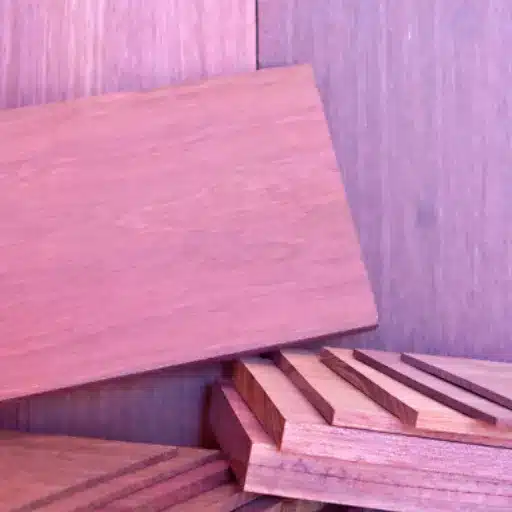
Freshly cut purple heart is not purple at all. Straight off the saw, the heartwood is a dull gray-brown, sometimes described as purplish-brown or even salmon-colored. It can look disappointingly plain.
Within 3 to 10 days of exposure to air and light, the wood oxidizes and turns its characteristic deep eggplant purple. This is the stage you see in most product photos, and it’s gorgeous.
Over months and years, continued UV exposure keeps working on the pigments. The purple gradually deepens into crimson, then a dark reddish-brown with only hints of the original violet. Outdoors, exposed to the full sun, the wood eventually grays like most timber. Indoors, out of direct sun, the purple can hold for years before it settles into that rich brown.
Here’s a detail that surprises a lot of woodworkers. If your purple heart looks brown right after you sand or cut it, that’s not the same as long-term fading. Friction from tools heats the surface and temporarily turns it brown, and the purple typically returns within a day or two as the surface re-oxidizes. A lot of beginners panic, thinking they ruined their board, when the fix is simply patience.
“The purple heart board in our shop turned brown overnight after we sanded it, and I nearly refunded the customer,” a furniture maker once told us. “The next morning it was back to vivid purple. Friction heat had just darkened the surface temporarily.”
The Chemistry Behind the Purple
The signature color is not a dye or a treatment. It’s the tree’s own chemistry, driven by natural pigments called neoflavonoids, compounds related to those found in rosewood. When the freshly exposed wood meets oxygen and UV light, these pigments react and produce the purple color.
That chemistry is also why the color is so sensitive to light. The same UV that turns the wood purple will, over time, keep oxidizing the pigments and shift the color toward brown.
Heat Browning vs. UV Browning
This distinction matters, and most sources blur it. There are two different ways purple heart turns brown:
- Heat browning happens when sanding or cutting friction overheats the surface. It’s temporary. The purple returns within a day or two as the surface re-oxidizes. No action needed beyond waiting.
- UV browning happens over months or years as sunlight keeps oxidizing the pigments. It’s essentially permanent. The purple can only return if you sand off the oxidized surface layer and then protect it quickly with a UV-inhibiting finish.
Understanding the difference saves you from two mistakes: throwing away a perfectly good board because of temporary friction browning, and expecting a decades-old, sun-exposed piece to spring back to purple on its own.
Why Some Pieces Stay Purple Longer
Not every piece of purple heart behaves the same. Pigment content varies by species and growing conditions, and woodworkers notice real differences. Some boards turn a brilliant, deep violet and hold it for years. Others arrive a lighter purple and shift toward brown sooner.
A few species stand out: Peltogyne paniculata is known for deep purple color and excellent durability, while Peltogyne venosa tends toward a reddish-brown hue with purple undertones. Ask your supplier which species you’re getting, because it affects the color you’ll live with.
Managing the Color
You can slow the fade, though you can’t stop it entirely. A UV-inhibiting finish, ideally water-based, does the most to keep the purple vivid. Oil-based finishes and varnishes tend to amber and speed the shift toward brown. Keeping finished pieces out of direct sunlight also helps, since even indoor daylight carries UV.
For the full step-by-step on protecting and restoring the color, our guide on how to finish purple heart wood walks through finish selection, the test-on-offcut protocol, and how to bring a faded board back to life.
Purple Heart Wood Properties and Specs
If you’re evaluating purple heart for a project, start with the numbers. Here’s the complete spec table, based on the The Wood Database’s purpleheart reference and supplier technical data.
| Property | Value |
|---|---|
| Scientific name | Peltogyne spp. (about 23 species) |
| Family | Fabaceae (Leguminosae) |
| Distribution | Southern Mexico to southeastern Brazil |
| Janka hardness | ~2,520 lbf (some sources list 1,860-2,520 lbf across species) |
| Average dried weight | ~895 kg/m³ (54-56.5 lb/ft³) |
| Weight per board foot | ~4.9 lb |
| Specific gravity (basic) | 0.76 |
| Specific gravity (12% MC) | 0.87-0.90 |
| Radial shrinkage | 3.2-4.6% |
| Tangential shrinkage | 6.1-6.7% |
| Volumetric shrinkage | 10.6-11.2% |
| Modulus of rupture | ~21,300-22,000 psi |
| Modulus of elasticity | ~2.4-2.9 million psi |
| Crushing strength | ~11,600-12,140 psi |
| Durability | Class 1; very durable (25+ years in ground contact) |
| Rot/insect resistance | High; termite and marine-borer resistant |
| Grain | Straight to wavy or interlocked; fine-to-medium texture |
| Odor | Mild, distinctive when worked |
What the Numbers Mean
The headline number is the Janka hardness. At roughly 2,520 lbf, purple heart is about 36% harder than white oak (~1,360 lbf) and sits in the same neighborhood as hickory and pecan. It resists scratches, dents, and wear extremely well, which is why it’s a favorite for flooring.
Here’s the nuance most people miss: hardness is not the same as impact resistance. Because purple heart is somewhat brittle, a hard, sharp impact can cause it to crack or chip where a softer but tougher wood would flex and survive. For floors, that means it wears beautifully underfoot but can dent if you drop something heavy.
It’s also dense, weighing about 4.9 pounds per board foot compared to roughly 3.7 for white oak and 2.5 for pine. That weight makes it feel substantial in the hand, a plus for tool handles and solid furniture. The trade-off is that dense wood is harder to machine and costlier to ship.
Dimensional Stability
On stability, purple heart behaves well. Its shrinkage values are moderate, with a tangential-to-radial ratio around 1.5 to 1.7, indicating a low risk of cupping and warping once properly dried. In practice, well-seasoned purple heart moves less than many domestic hardwoods, which is why it works so well for cutting board accents and inlays.
Purple Heart Wood Durability, Stability, and Movement
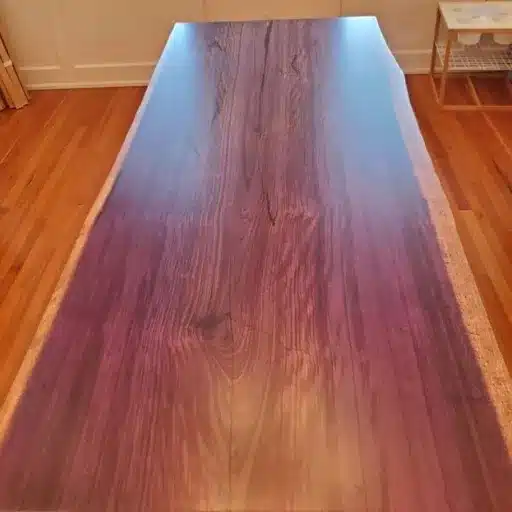
Durability is where purple heart truly earns its keep. It’s rated Class 1, the highest durability class, meaning it can survive ground contact for 25 years or more without treatment. It resists decay, fungi, dry-wood termites, and even marine borers, which is why it’s been used in boatbuilding and dock work for generations.
It’s also acid-resistant enough to have served in chemical vats and labs. Combined with its dimensional stability, that makes purple heart a genuinely low-maintenance species once it’s in place.
For outdoor use, the trade-off is purely aesthetic. The wood will last, but the color will gray under the sun. If you’re choosing purple heart for a deck, railing, or exterior accent, plan for the silver-gray patina rather than expecting the violet to endure.
What These Properties Mean for Working With It
The same hardness that makes purple heart durable makes it demanding in the shop. It dulls cutting edges quickly, so carbide tooling is essentially non-negotiable, and interlocked grain can cause tear-out when planing.
It’s brittle too, so pre-drilling before fastening is a hard rule; screws driven without pilot holes will split the wood. Gluing can be tricky because natural oils on the surface weaken bonds, and a quick solvent wipe before clamping makes a real difference.
And the dust is a known skin and respiratory sensitizer. Repeated exposure can cause contact dermatitis, eye and nasal irritation, and sometimes nausea, so wear an N95 or P100 respirator and use dust collection. Our guide to working with purple heart wood covers tooling, gluing, sanding, and safety in detail, and our piece on is purple heart wood toxic separates real risks from myths.
What Is Purple Heart Wood Used For?
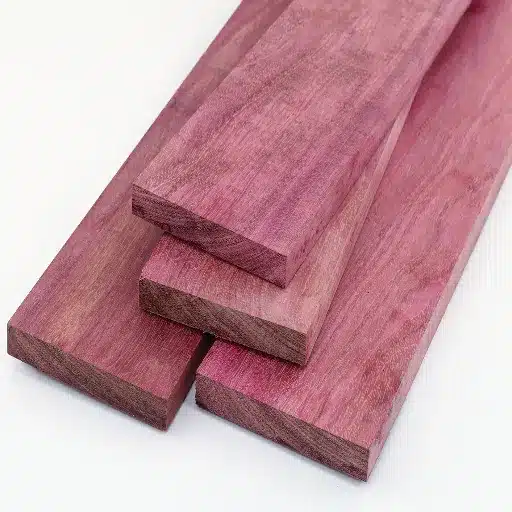
Given its color and toughness, purple heart shows up in a surprisingly wide range of projects. You’ll find it as accent strips and inlays in cutting boards, where its violet contrasts beautifully with maple, walnut, and cherry. Furniture makers use it for table legs, drawer fronts, and banding. Turners love it for bowls, pens, and bottle stoppers. It appears in guitar fretboards, knife handles, tool handles, and billiard cues, and its hardness and durability make it a candidate for flooring, decking, and architectural millwork.
The properties we’ve covered explain why. The color makes it a design statement, the hardness makes it practical, and the durability means it outlasts the project around it.
Purple Heart Wood as Veneer
Because solid purple heart is expensive and hard to work, veneer is often the smart way to use it. A thin layer over a stable substrate delivers the striking color and grain at a fraction of the cost and weight of solid stock, and it behaves far better on large flat surfaces like panels, doors, and tabletops.
The color behavior we described applies to veneer too: it arrives gray-brown, oxidizes to purple, and fades toward brown under UV. But veneer lets you use this dramatic material in interior design without the machining headaches or the budget of solid exotic timber.
Is Purple Heart Wood Sustainable?
This is the question that matters most to us, and it’s the one most color and properties articles ignore. The Peltogyne genus is not currently listed on the CITES appendices or the global IUCN Red List. However, the picture is more nuanced than that. Peltogyne purpurea is assessed as Vulnerable in parts of its range, including Costa Rica, Panama, and Colombia, where it’s also legally protected.
The bigger concerns are habitat loss and the risk of illegal logging in parts of the Amazon. That’s why how you buy matters as much as what you buy. Look for FSC-certified purple heart, verify the chain of custody, and work with suppliers who can document legal harvest. At VitalWood Global, we source only from certified sustainable forests, so you can enjoy the beauty of purple heart knowing you’re supporting responsible forestry rather than contributing to its decline.
Frequently Asked Questions
What color is purple heart wood?
Purple heart wood is a deep eggplant purple in its familiar form, but it starts gray-brown. Freshly cut heartwood oxidizes to vivid violet within 3 to 10 days, then deepens to a dark reddish-brown over years of UV exposure unless protected by a UV-inhibiting finish.
Does purple heart wood change color?
Yes, dramatically. It goes from gray-brown to vivid purple within days, then slowly fades toward deep crimson and dark brown over time as UV light continues to oxidize its natural pigments.
Why does purple heart wood turn brown?
There are two causes. Temporary friction browning happens when sanding or cutting heats the surface, and the purple returns within a day or two. Permanent UV browning happens over months or years of sun exposure and can only be reversed by sanding off the oxidized layer and applying a UV-protective finish.
Does purple heart wood stay purple?
Not forever. A UV-inhibiting, water-based finish and keeping the piece out of direct sunlight will preserve the purple for years, but the wood will eventually settle into a rich reddish-brown. That’s the natural aging process, not a defect.
How hard is purple heart wood?
Purple heart has a Janka hardness around 2,520 lbf, about 36% harder than white oak and comparable to hickory and pecan. Some species and sources range lower, around 1,860 lbf, so exact figures vary.
Is purple heart wood a hardwood?
Yes. It’s a tropical hardwood from the legume family, and one of the hardest and densest commercial species available.
How much does purple heart wood weigh?
About 4.9 pounds per board foot at 12% moisture content, with an average dried weight around 895 kg/m³. That’s noticeably heavier than white oak and much heavier than pine.
Does purple heart wood shrink or warp much?
No. Its shrinkage values are moderate and its tangential-to-radial ratio is low, so properly dried purple heart is dimensionally stable with a low risk of cupping or warping.
Is purple heart wood good for outdoor use?
Yes, it’s very durable and rot-resistant, with Class 1 durability and 25+ years of ground-contact survival. The catch is aesthetic: outdoors, the purple fades to a gray-silver patina over time.
Does purple heart wood need to be pre-drilled?
Yes, always. Purple heart is hard but brittle, and driving screws without pilot holes will likely split the wood.
Conclusion
Purple heart wood is a study in contrasts: a striking, unforgettable color wrapped around a wood that’s hard, dense, durable, and demanding. The purple is real chemistry, the neoflavonoid pigments reacting to oxygen and light, and it will fade to a rich reddish-brown over time unless you protect it. The physical properties are exceptional, with a Janka hardness near 2,520 lbf and Class 1 durability, but that toughness means carbide tooling, pre-drilling, and respect for its dust.
The key takeaways are simple. Expect the color to change, and manage it with a water-based, UV-inhibiting finish. Choose it for projects where hardness and durability earn their keep. Work it with sharp tools and patience. And buy it responsibly, from certified sustainable sources, so the beauty you enjoy today doesn’t cost the forest tomorrow.
At VitalWood Global, we’re here to help you choose the right sustainably sourced wood for your next project, whether that’s solid purple heart lumber or purple heart veneer. Contact us for a quote, and explore our purple heart wood guide for the complete picture from tree to finished project.