
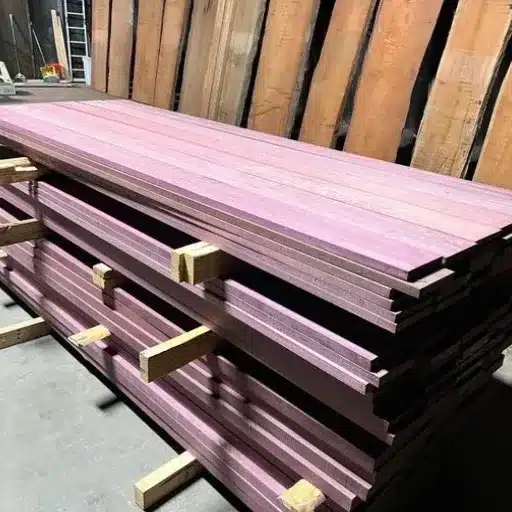
What Is Purple Heart Wood Used For? 7 Uses and the Real Limits
Purple heart wood is used for statement furniture accents, high-end flooring and stair parts, cutting-board stripes, turned bowls and pens, musical instrument parts, decorative inlays and veneer, and durable outdoor pieces, but it shines as an accent and high-wear specialist rather than a budget workhorse. Here’s where it genuinely performs, the trade-offs you need to know, and when to reach for walnut, padauk, or maple instead.
That deep, almost electric violet is what stops people mid-aisle. Walk into any hardwood supplier and the purple heart boards get the attention, a rich eggplant color that no other timber can fake. What surprises most people is that the color is the least interesting thing about it. This is one of the hardest, densest, and most naturally durable woods you can buy, which is why it keeps showing up in projects that need to look striking and survive real use.
But here’s the tension. Purple heart is expensive, it’s hard on tools, and its color slowly changes in sunlight. Used the right way, it’s stunning. Used the wrong way, it’s a frustrating, costly mistake.
This guide gives you the decision-ready answer to what is purple heart wood used for. We’ll walk through the seven proven uses, what each one does well, and the honest limits, so you pick the right species for the job the first time.
New to the species? Our purple heart wood complete guide walks you from tree to finished project. Here, we’re focused on applications.
Key Takeaways
- Purple heart wood’s best uses are accent and high-wear surfaces: furniture accents, flooring and stair parts, cutting-board stripes, turning, instruments, inlays, and outdoor pieces.
- Its Janka hardness of roughly 2,520 lbf and Class 1 durability make it a genuine workhorse, but that toughness comes with real trade-offs.
- Expect color change: the vivid purple fades to reddish-brown indoors and silver-gray outdoors under UV light unless you protect it with a finish.
- Cutting boards should use purple heart as accent stripes, not the whole surface, because its hardness blunts knives.
- Use it sparingly and deliberately. When the project calls for warmth or budget, walnut, padauk, or maple is often the smarter pick.
First Things First: What Makes Purple Heart Different?
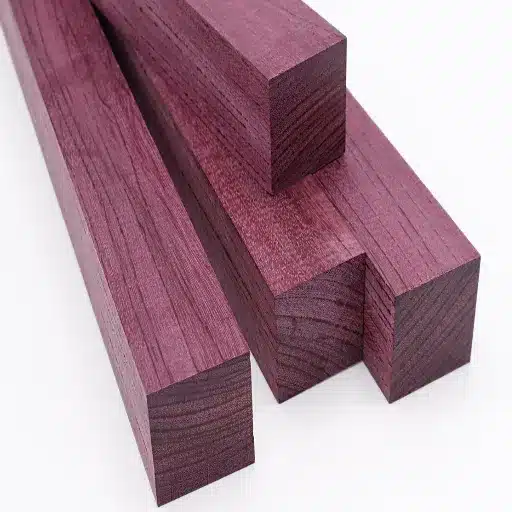
Before choosing a use, it helps to understand what you’re working with. Purple heart, sometimes called purpleheart or amaranth, comes from roughly 23 species in the Peltogyne genus, tropical hardwoods native from southern Mexico through the Amazon basin to southeastern Brazil.
Two traits drive almost every decision about it. First, it’s extraordinarily hard and dense, with a Janka rating around 2,520 lbf, about 36% harder than white oak and in the same league as hickory and pecan, according to The Wood Database’s purpleheart reference. Second, it’s naturally durable, rated Class 1 for rot and decay resistance, and it stands up to termites and even marine borers.
That combination of beauty and toughness is rare. Plenty of woods are pretty. Plenty are hard. Almost none are both to this degree, which is why purple heart keeps appearing in projects that need a striking look and genuine longevity.
The catch is that all that density makes the wood demanding. It dulls cutting edges fast, so carbide tooling is essentially required. It’s somewhat brittle, so it can crack under sharp impact and must be pre-drilled before fastening. And its dust is a known skin and respiratory sensitizer, so you’ll want proper dust collection and a respirator when machining it.
Those three realities, the hardness, the durability, and the difficulty, are why each use below works the way it does.
The 7 Most Common Uses for Purple Heart Wood
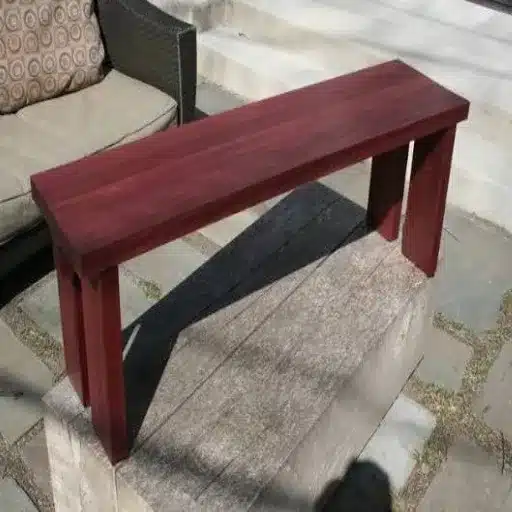
Across workshops, flooring projects, and specialty makers, purple heart reliably shows up in seven places:
- Statement furniture and accent pieces
- High-end flooring and stair parts
- Cutting boards, serving boards, and kitchen accents
- Turned bowls, pens, and decorative work
- Musical instrument parts, cues, and specialty goods
- Inlays, stripes, and contrast details
- Outdoor pieces where durability really matters
Each one works for a reason, and each has a watch-out. Let’s go through them.
1. Statement Furniture and Accent Pieces
Purple heart makes its boldest statement in furniture, but almost never as a whole tabletop. You’ll see it as table legs, bench framing, drawer fronts, bed rails, and accent banding, paired with lighter species like ash, maple, or white oak.
Marcus, a furniture maker outside Portland, built a client’s dining table with an ash top and purple heart legs and edge banding. The legs looked like they’d been dipped in violet, and because they were small pieces, the cost and the tool wear stayed manageable. Two years later it’s still the centerpiece, and the color is barely changed.
The pattern holds across the trade: use purple heart where a small amount delivers maximum visual impact. If you love the color on a full surface, veneer is the smarter route, since solid stock is heavy and pricey at tabletops scale.
2. High-End Flooring and Stair Parts
Purple heart’s extreme hardness makes it a genuine candidate for flooring, stair treads, and other high-traffic surfaces. It resists scratches and wear far better than white oak, and its Class 1 durability means it shrugs off moisture and decay for decades.
There are two honest caveats before you commit. First, hardness is not impact resistance. Drop a heavy object on a purple heart floor and the wood can dent or chip rather than flex. Second, sunlight changes the color.
A sunny room will gradually shift the floor from violet toward a rich reddish-brown unless you use a UV-inhibiting finish. Some homeowners love that aged look. Others are surprised by it, so plan for it.
Installation is also tougher than with domestic species. The density demands carbide blades, pilot holes for every fastener, and careful acclimation. For the full breakdown of costs, installation traps, and whether it’s right for your space, our guide to purple heart wood flooring covers it in depth.
3. Cutting Boards, Serving Boards, and Kitchen Accents
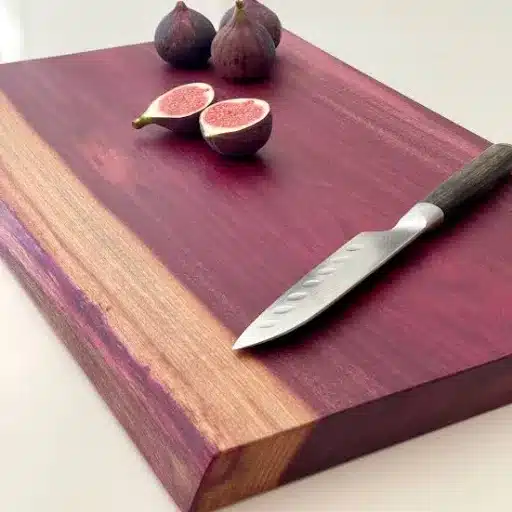
Cutting boards are where most woodworkers meet purple heart, and the expert consensus is clear: use it as accent stripes and borders, not the whole surface. A maple field with purple heart stripes is a classic, and for good reason. The wood is hard, stable, and food-safe once finished with a board oil or wax, and it resists the knife scars and water exposure that punish softer woods.
Here’s the trade-off that surprises people: the same hardness that makes purple heart durable also blunts knives. On a full-surface board, especially with thin Japanese blades, you’ll feel the difference quickly. As a narrow stripe between softer woods, it adds the color without wrecking your edge.
Color is the other thing to plan for. The vivid stripes will mellow toward brown over years of light exposure, which is a natural aging process, not a defect. For a full rundown of the safety questions and finish choices, read our article on is purple heart wood food safe. And for an independent take on exotic woods in cutting boards, Wood Magazine’s guidance is a helpful reference.
4. Turned Bowls, Pens, and Decorative Work
If you turn wood, purple heart is one of the most rewarding species you can put on the lathe. With sharp carbide tools, it cuts cleanly, sands to a beautiful sheen, and holds fine detail without tearing, which is why turning blanks are among the most popular ways purple heart is sold.
Bowl turners love the way the grain plays with light, and pen makers use it constantly for a striking, one-of-a-kind look. A set of purple heart pens and bottle stoppers was what hooked Priya on the species; she’d read that it was difficult to work, but on the lathe, with sharp tools, it behaved beautifully and polished to a glossy finish with just a friction polish.
There’s a learning curve. The wood dulls high-speed steel tools quickly, it can burn if you let friction build, and the dust is a sensitizer. But for small, detailed projects, the payoff is worth it. Our guide to purple heart wood turning covers technique and finish in detail.
5. Musical Instrument Parts, Cues, and Specialty Goods
Purple heart has earned a genuine place in the instrument world. Its stiffness and tonal character make it useful for guitar fretboards, and luthiers use it as reinforcing strips in laminated necks because it adds stability that helps keep a neck true across seasons and humidity changes.
It also shows up in violin and mandolin inlay, custom billiard cue butts, knife handles, tool handles, and even diving boards. If a project needs something that is strong, stable, and visually unmistakable, purple heart gets the call, a pattern confirmed across the Woodcraft WoodSense spotlight on purpleheart.
The watch-out is weight. Purple heart is roughly 30% heavier than mahogany, so a solid purple heart guitar neck can suffer from neck dive. That’s why it typically appears as part of a laminated construction rather than a solid piece. For the same reason, keep handles and small components, where the heft reads as quality, and avoid oversized solid pieces that just feel heavy.
6. Inlays, Stripes, and Contrast Details
Wherever makers need a dramatic accent, purple heart delivers. It’s a staple for marquetry, banding, chessboards, jewelry boxes, and any project that pairs a deep violet stripe with lighter woods. The color contrast with maple, holly, or yellowheart is one of the most striking combinations in woodworking.
Because these uses need only small amounts of lumber, they’re also the most economical way to enjoy the species. A little purple heart goes a long way, and using it as inlay or veneer sidesteps most of the machining difficulty and cost of solid stock.
7. Outdoor Pieces Where Durability Really Matters
For outdoor projects, purple heart is a legitimate heavyweight. Its Class 1 durability, meaning it can survive ground contact for 25 years or more, and its resistance to rot, termites, and marine borers make it a proven choice for decking, benches, boardwalks, and even dock and boat work.
There’s one non-negotiable expectation to set before you build: the color will not survive the sun. Outdoors, purple heart weathers from violet to brown and then to a silver-gray patina over months. It will still be standing, and still be structurally excellent, decades from now. It just won’t be purple.
That’s why outdoor use is a durability decision, not a color decision. If you want the wood to stay purple outside, you’d need a UV-protective finish reapplied regularly, which most owners find isn’t worth it on a deck. Design for the silver-gray end state and let the wood do what it does best: last.
Purple Heart Wood Uses at a Glance
If you’re deciding fast, here’s the whole article in a table.
| Use | Why It Works | Watch-Outs |
|---|---|---|
| Furniture accents | Vivid color, hardness | Color fades under UV; pricey |
| Flooring and stairs | Extreme wear resistance | Dents on impact; hard to sand |
| Cutting and serving boards | Durable, stable accent stripes | Blunts knives; heavy |
| Turned pieces | Holds detail, polishes well | Needs sharp carbide tools |
| Instruments | Stiff, stable tonewood | Heavy; tough to machine |
| Inlays and veneer | Dramatic contrast, economical | Expensive as solid stock |
| Outdoor and marine | Class 1 rot and insect resistance | Grays to silver outdoors |
Is Purple Heart Wood Good for Everyday Use Items?
It depends on the item, and the answer usually comes down to how much surface area the purple heart occupies and how it will be hit, cut, or scraped.
How It Handles Wear, Dents, and Scratches
For wear, purple heart is outstanding. Its hardness means it resists scratches and abrasion far better than most domestic hardwoods, which is exactly why it works for flooring, workbench accents, and tool handles that take a beating.
For impact, it’s a different story. Because the wood is dense and somewhat brittle, a hard blow can cause it to chip or crack where a tougher wood like ash or hickory would absorb the hit. So keep purple heart for surfaces that slide and scrape, like floors and handles, and be cautious about pieces that will take repeated blunt impacts.
Food-Contact Questions: Cutting Boards and Serving Platters
The food-safety question comes up constantly, and the short answer is yes, purple heart is safe around food once it’s finished with a food-safe oil or wax. The longer answer involves its status as a mild sensitizer for some people and the knife-blunting behavior we covered above, which is why the general advice is to use it as accent material in boards rather than the entire cutting surface.
If you’re weighing a full cutting board or charcuterie project, those details make the difference between a piece you love and one you regret. Check the dedicated food-safety guidance before you build.
Working With Purple Heart: What Woodworkers Need to Know
Purple heart demands respect in the shop, and the properties that make it durable are the same ones that make it hard to work.
It dulls tooling quickly, so carbide blades and router bits are the practical minimum, and its interlocked grain can tear out when you plane it. Keep cuts light and tools sharp, and you’ll avoid most of the burning and tear-out that frustrates beginners.
Gluing needs one extra step: a quick wipe with solvent or a light sanding before clamping, because natural oils on the surface can weaken the bond. And always pre-drill before driving screws, since this brittle wood splits easily without pilot holes. Finishing it well is its own skill, and the color-preservation techniques make a real difference to the final look.
Choosing Purple Heart or a Different Species
The best way to use purple heart is to choose it for the right project, and to know when another species will serve you better.
When Purple Heart Is the Right Choice
Pick purple heart when you want an unmistakable color accent, a surface that will take years of wear, or a piece that will live outdoors and needs to last. Think statement furniture accents, high-traffic flooring, cutting-board stripes, turning projects, instrument components, inlays, and outdoor structures where longevity is the priority.
When to Reach for Walnut, Padauk, or Maple Instead
The honest flip side matters just as much. Choose walnut when you want warm, rich brown tones that age gracefully and are far easier to work. Choose padauk when you want a vivid orange-red accent with similar exotic appeal but slightly easier machining. Choose maple when you need a light, hard, affordable workhorse for full-surface boards and furniture.
Skip purple heart entirely for budget projects, for large low-light flat surfaces where the violet will fade to brown anyway, for pieces that will take repeated sharp impacts, and for any application where the cost of solid exotic stock can’t be justified. Veneer or a different species is usually the answer in those cases.
Purple Heart Wood Uses: Frequently Asked Questions
What is purple heart wood used for most?
Purple heart is used most as accent material: cutting-board stripes, inlays, furniture accents, and turned pieces like pens and bowls. Its hardness and durability also make it a strong choice for flooring, stair parts, and outdoor projects.
Is purple heart wood good for furniture?
Yes, for accent and statement pieces like table legs, drawer fronts, banding, and bench framing. It’s less practical for large, solid tabletops because of cost, weight, and color change, where veneer is often the better option.
Can I use purple heart for cutting boards?
Yes, it’s food-safe once finished, and it makes excellent accent stripes and borders. It’s best used as a contrast material rather than the whole board surface, because its hardness blunts knives.
Is purple heart wood suitable for flooring?
Yes, it’s extremely wear-resistant and durable, with a lifespan that can reach decades. The main considerations are UV color change in sunny rooms, some impact denting, and harder installation than domestic species.
Can purple heart wood be used outdoors?
Yes, it’s one of the most durable woods available, with Class 1 rot and insect resistance. Expect the color to fade to a silver-gray patina outdoors; the wood itself will last for decades.
Is purple heart wood good for guitars and instruments?
It’s a stiff, stable tonewood used for fretboards and laminated neck reinforcement. It’s not ideal for a solid neck or body because of its weight, which can cause neck dive.
Does purple heart wood stay purple?
Not forever. Indoors, a UV-inhibiting finish keeps the violet vivid for years before it settles into a reddish-brown. Outdoors, the color grays over time.
Is purple heart wood expensive?
It’s a premium exotic hardwood, more expensive than domestic species, which is why it’s usually used sparingly as accents and high-wear surfaces rather than for entire large projects.
Is purple heart wood toxic?
The wood isn’t toxic to touch, but its dust is a known skin and respiratory sensitizer. Wear a respirator and use dust collection when sanding or machining it.
Conclusion
Purple heart wood is a specialist, and that’s why it earns its reputation. Use it for statement furniture accents, high-end flooring, cutting-board stripes, turned pieces, instrument components, inlays, and outdoor builds where durability matters. In each role, a small amount delivers outsized visual impact backed by genuine toughness.
The limits matter just as much. The color fades toward brown indoors and silver-gray outdoors unless you protect it. The hardness that makes it durable also dulls tools and blunts knives. And its density makes it demanding to work and expensive to buy, so matching the species to the project is the whole game.
Used well, purple heart rewards you with a piece that looks unlike anything else and lasts for generations. At VitalWood Global, we help you choose the right sustainably sourced wood for your project, whether that’s solid purple heart, purple heart veneer, or a better-matched species. Contact us for a quote.