
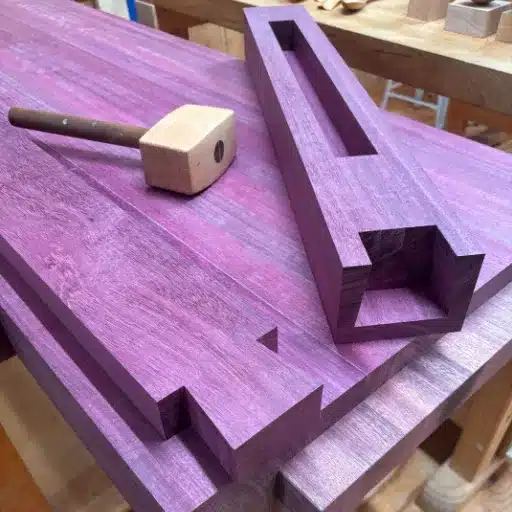
Working With Purple Heart Wood: The Complete Machining Guide
Working with purple heart wood is genuinely hard. It is one of the hardest, densest woods you will ever machine, with a Janka hardness around 2,520 lbf and high silica content that dulls blades in minutes. It burns easily, tears out in interlocked grain, and throws needle-sharp splinters. But here is the good news: with sharp carbide tooling, light passes, and steady feed rates, purple heart is very workable, and the payoff is a color no other wood can match.
In this guide, you will learn how to work with purple heart wood operation by operation, from tooling and cutting to gluing, sanding, and dust safety. We have pulled together the scattered forum wisdom and contradictory advice into one repeatable system, so you can machine this beautiful exotic wood without fighting it.
Key Takeaways
- Purple heart wood is hard to work: Janka ~2,520 lbf, high silica content, prone to burning, tear-out, and splintering.
- Carbide tooling is non-negotiable; sharp tools, light passes, and steady feed rates prevent burning and tear-out.
- Always pre-drill for screws and nails, round over sharp edges, and wear a P100 dust mask (it is a sensitizer).
- Glue freshly machined surfaces, solvent-wipe before PVA glues, use Titebond II/III or slow-cure epoxy, and clamp longer than normal.
- Buy kiln-dried, responsibly sourced purple heart at 6-8% moisture content so movement and stress do not fight you.
Why Purple Heart Wood Is Hard to Work (and Why It’s Worth It)
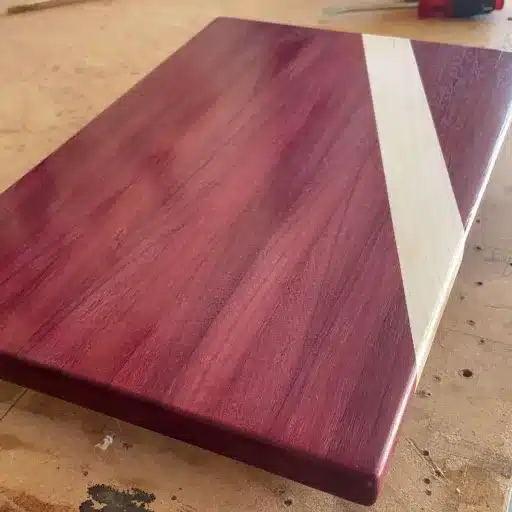
Purple heart, also known as purpleheart or amaranth, comes from Peltogyne trees native to Central and South America. Before you buy your first board, understand what you are getting into. At around 2,520 lbf on the Janka scale, it is harder than hickory and about 36% harder than white oak. It weighs roughly 56 lb per cubic foot, so a small plank feels surprisingly heavy. That density and its high silica content are what make it so punishing on tools.
The grain is usually straight, which machines beautifully, but it can also be wavy or interlocked. When it is, expect tear-out and a surface that catches at the grain. Silica acts like sandpaper in reverse, blunting edges fast. One woodworker on WoodworkingTalk reported his HSS planer knives were shot after about five feet of cutting. That is not an exaggeration.
So why bother? Because nothing else looks like fresh-cut purple heart, and the color deepens from gray-brown to vivid violet within days of exposure to air and UV light. It resists rot, decay, and insects, and it is stable enough for cutting boards, furniture accents, flooring, instrument necks, and purple heart wood turning projects. For an overview of its full range of uses, our guide to what is purple heart wood used for is a good next stop.
Tools and Tooling for Working With Purple Heart Wood
The single biggest mistake with purple heart is using the wrong tools. High-speed steel (HSS) will not survive contact with this wood. Plan on carbide, and for production runs, diamond.
- Carbide-tipped blades and bits are the default. A 40-tooth-plus carbide blade on a table saw, carbide router bits, and carbide planer knives all make the work dramatically easier.
- A spiral or helical cutterhead (Shelix-style) is worth every penny. It nearly eliminates tear-out on reversing and interlocked grain, which is purple heart’s biggest failure mode.
- Down-cut router bits prevent the top edge from chipping out. Up-cut bits pull fibers up and cause significant tear-out on this wood.
- Sharp hand planes and card scrapers can tame purple heart, but only with high cutting angles, a bevel-up smoother set at 38-50 degrees, and a card scraper for stubborn spots.
- Keep spares. Purple heart dulls tooling so fast that you want a second blade or bit ready before you start.
Sharpen early and often. A strop loaded with green chromium oxide between sharpenings extends edge life. And test every setup on scrap first, because a full-depth cut on your project piece is the expensive way to learn.
Tooling Cheat Sheet
Tool Recommended Setup Why Table saw Carbide-tipped, 40T+ Resists silica dulling, cleaner cuts Planer Helical/spiral cutterhead Nearly eliminates tear-out Router/CNC Down-cut spiral bits Prevents top-edge chip-out Hand plane Bevel-up smoother, 38-50° High angle controls tear-out Scraper Card scraper Handles dense, reversing grain Drill Sharp brad-point bits Clean holes, less blowout
How to Cut Purple Heart Wood Without Burning
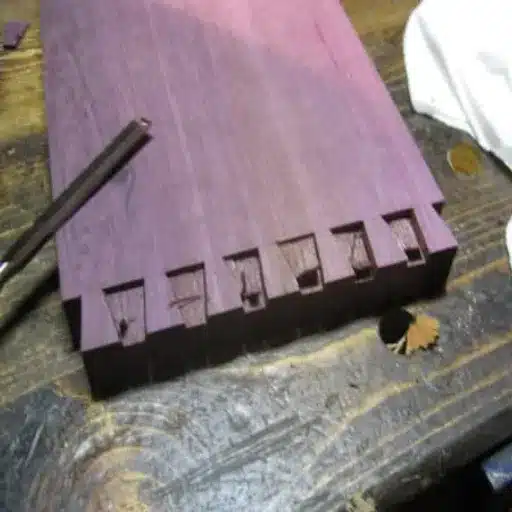
Burning is the #1 complaint from anyone working with purple heart. It burns really well, and once a dark scorch appears, it is difficult to remove without sanding through your surface. The good news is the burn rule is simple: sharp tools plus a steady, fast-enough feed rate, and never, ever pause a blade or bit while it is in contact with the wood.
On a table saw, use a sharp carbide blade and push the stock through at a steady, confident pace. Too slow and the blade rubs, generating heat and burn marks. Too fast and you invite tear-out. Find the middle, and do not stop mid-cut.
On a bandsaw, the same rule applies. Use a sharp blade with enough teeth and keep the feed even. If the saw starts to labor, slow your feed rather than forcing it.
Planing deserves its own section because it is where most people give up. Take extremely light passes, 1/64 to 1/128 of an inch. A straight-knife planer can chip and tear the surface on reversing grain, so a helical head is strongly recommended. If you do not have one, plane close to your final thickness and finish with a drum sander, starting at 80 grit and finishing at 120, to avoid tear-out altogether. Always start with stock thicker than you need so you have room to remove any damage.
Routing and CNC Machining Purple Heart Wood
Routing and CNC work on purple heart is very doable, but the technique is different from softer woods. Use a down-cut bit for the top pass so the top edge stays clean. For the finish pass, a light 1/64-inch cut at a quick feed rate removes any burn marks and leaves a crisp edge. Climb-cutting a cleanup pass is a common pro technique on this wood.
The other critical rule: keep the bit moving. If you pause or linger, the bit sits in one spot and burns the wood instantly. Sweep the bit side to side in a “cutting the grass” pattern when routing bowls or dishes, taking modest depth steps, and make the final pass feather-light. Sealing the surface with a coat of dewaxed shellac before routing also reduces chip-out on sharp corners.
Here is a reference starting point for CNC feeds and speeds. Dial in your machine with scrap first, because every router and spindle behaves differently.
CNC Reference Settings
Toolpath Depth Per Pass Feed Rate Notes Profiling (Shapeoko-class) 0.025″ 30-50 (machine units) Go slow, but not so slow it burns Profiling (high-RPM) 0.15″ 110-115″/min XY, 45″/min Z Around 16,000 RPM 3D / bowl work 1/8″ or less Moderate, steady Sweep side-to-side, never plunge
If you already have tear-out, do not panic. A hand plane with a high cutting angle, or a card scraper, will fix most of it. A card scraper is especially effective on this dense wood, because it shears the fibers cleanly instead of levering them up.
Sanding Purple Heart Wood (and the Temporary Brown Phase)
Sanding purple heart is straightforward but slow, because it clogs sandpaper like nothing else. Expect to change paper frequently, and if you use a belt sander, air-cool the belt at the point of contact so it does not load up and burn.
Work up through the grits progressively to 600-800 for the best figure. If you are drum sanding, start at 80 grit in light passes and finish at 120. The wood responds well to a fine finish, and the effort is worth it on the final piece.
One thing you should know before you start: sanding and heat temporarily turn purple heart brown. The friction and oxidation strip away the vivid violet, leaving a dull, brownish surface. This is normal, and the purple returns within a few days of exposure to air and sunlight. Do not panic and start re-sanding. If you want to speed the recovery, a brief sun exposure helps. For a deep dive on preserving the color once you are done, see our guide on how to finish purple heart wood.
Drilling, Fastening, and Gluing Purple Heart Wood
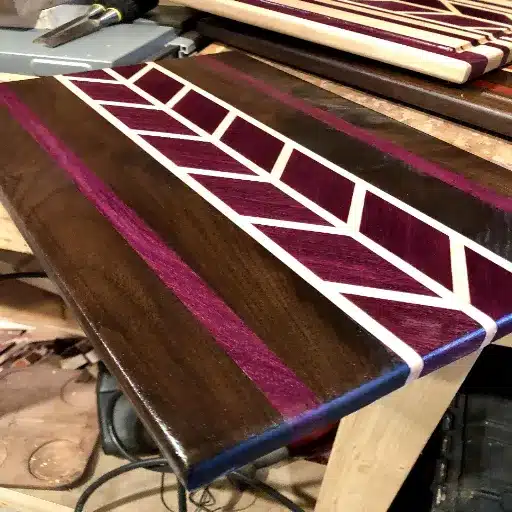
Purple heart is brittle and splinter-prone, especially near edges. This is where many joints fail, so take the extra minute to set up correctly.
Always Pre-Drill
Do not drive screws or nails into purple heart without pre-drilling. The wood will split, often at the worst possible moment. Use a sharp brad-point bit sized for your fastener, and support the work on the exit side to prevent blowout. Green purple heart is reportedly so dense that it bent three nails for every one driven. Round over sharp edges whenever you can, because purple heart throws needle-sharp splinters.
How to Glue Purple Heart Wood Without Joint Failure
Gluing is where the forum advice gets genuinely contradictory, and here is why: there are around 20 species sold under the name purple heart, and some are oily while others are not. Some makers have glued thousands of board feet with zero failures; others see a slick, oily film develop on warm surfaces and watch joints let go. Both are telling the truth, about different wood.
The reliable system is a decision tree, not a single answer:
- Glue freshly machined surfaces quickly. Oils rise to the surface with time and heat, so glue within an hour of planing or cutting when possible.
- For PVA glues like Titebond II or III, wipe the mating surfaces with acetone or denatured alcohol first. Titebond II and III both outperform Titebond I on oily exotics.
- For very oily stock or problem joints, use a slow-cure epoxy. Gap-filling epoxy bonds even when surface oils would starve a PVA joint.
- Polyurethane glue (like Gorilla) works for some makers and requires dampening the wood, but results are mixed, so test on scrap first.
- On end grain, apply a coat of glue and let it set slightly to fill the pores before the final glue-up. Add splines or dowels for mitered corners.
- Clamp longer than normal. Resin-rich, dense wood dries slowly and can still feel wet overnight. Clamp a test piece beside your project so you know when it is safe.
When Marco, a hobbyist woodworker, built his first purple heart charcuterie board, he glued the strips right after jointing and used a standard PVA glue with no surface prep. A week later, two joints failed clean, with the glue stuck to only one side. On his second attempt, he wiped the faces with acetone, glued the freshly machined surfaces, and clamped overnight. The board has survived three years of daily use, and he has not had a single joint failure since. The fix was simple, and it is the same one you should use: clean, fresh surfaces and a glue that can handle the resin.
Movement, Stress, and Drying
Purple heart holds internal stress, and it moves as it acclimates. After jointing or planing stock, let it sit for about a week before gluing up a panel. This lets the wood release stress and settle, so your joints do not pull apart later. If you are buying stock rather than milling it yourself, buy kiln-dried material at 6-8% moisture content. Purple heart is moderately difficult to dry, and thick stock is prone to checking if it dries too fast, so buying pre-dried, stable material is the safer route for most projects.
Working With Purple Heart Veneer
If the cost or the machining challenge of solid purple heart feels like too much, purple heart veneer gives you the same vivid color at a fraction of the price and weight. Veneer is ideal for panels, cabinetry, inlays, and edge banding, and it lets you use this dramatic wood without wrestling a dense 8/4 plank through the shop.
The same working rules apply, on a thinner scale. Use sharp knives, take light passes, and be careful not to sand through the veneer on edges. Match your veneer leaves so the color ages in sync, since purple heart darkens with light exposure. And because veneer hides the internal stress of solid wood, it is a forgiving way to get the look in larger panels. If you are considering veneer for a project, our veneer panel content covers the basics of choosing and working with it.
Dust and Safety: Working With Purple Heart Responsibly
Purple heart dust is a known sensitizer. That means repeated exposure can make you more sensitive over time, and even a first exposure can trigger a reaction in some people. Symptoms include skin rashes, sometimes after as little as 45 minutes of unprotected contact, plus eye irritation, a runny or irritated nose, and nausea from inhaling dust.
The precautions are simple and worth taking seriously:
- Wear a P100 respirator for sanding, or at minimum an N95 mask, and use dust collection at the source.
- Wash your hands promptly after handling the wood, before you touch your face or eyes.
- Purple heart dust stains like purple ink. Use a dedicated dust collector and clean up before you go inside, so you do not track it through the house or contaminate family members.
For a fuller look at the health side of this species, our article on is purple heart wood toxic separates the real risks from the myths, without the fear-mongering.
Sourcing Purple Heart Wood You Can Actually Work
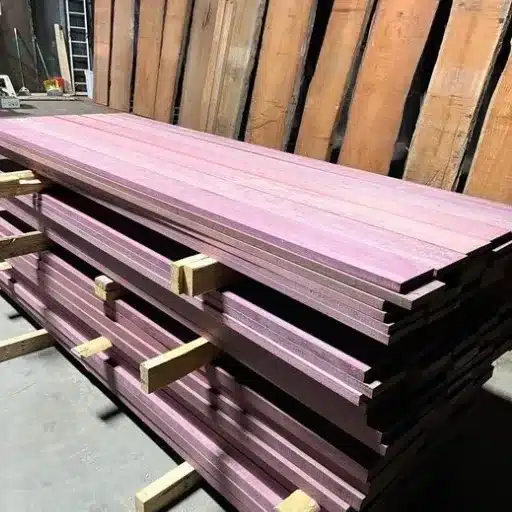
Half of successfully working with purple heart is starting with good stock. Buy kiln-dried lumber at 6-8% moisture content so movement does not fight you. If you have a choice, request straight-grain or quartered boards, which machine much more easily than wild, interlocked grain. And because purple heart comes from tropical rainforests, buy responsibly. Look for FSC-certified or legally harvested material, verify the supplier’s chain of custody, and ask where the wood was sourced. It protects the forests that produce this remarkable species, and it protects you from poor-quality or illegally logged stock.
At VitalWood Global, we source exotic wood and veneer from certified sustainable forests, and we verify certification and legal harvest for every species we supply. It is part of our commitment to sustainable forestry, and it means the wood you work with is stable, legal, and built to perform.
Ready to work with responsibly sourced purple heart? Explore our sustainably sourced exotic wood and veneer and get expert guidance on the right stock for your project.
Frequently Asked Questions
Is purple heart wood hard to work with?
Yes. It is one of the hardest, densest woods you will machine, with a Janka hardness around 2,520 lbf and high silica content that dulls blades quickly. It burns easily, tears out in interlocked grain, and is splinter-prone. With sharp carbide tooling, light passes, and steady feed rates, it becomes very workable.
Do you need carbide tools for purple heart?
Yes. Carbide is the practical minimum because the wood’s silica content dulls HSS tooling extremely fast. A helical cutterhead for your planer and down-cut router bits make the biggest difference in reducing tear-out.
Why does purple heart wood burn so easily?
Purple heart generates heat quickly under friction, and it scorches at a lower threshold than most woods. Sharp tools, a steady feed rate, and never pausing a blade or bit in contact are the main defenses.
Is purple heart wood oily?
Some purple heart is oily and some is not, because around 20 species are sold under the name. The reliable approach is to glue freshly machined surfaces, wipe with acetone or denatured alcohol before PVA glues, and use slow-cure epoxy for problem joints.
Do you need to predrill purple heart wood?
Yes, always. Purple heart is brittle and splinter-prone, especially near edges. Pre-drill with a sharp brad-point bit and support the exit side to prevent blowout.
Is purple heart wood dust toxic?
Purple heart dust is a sensitizer. It can cause skin rashes, eye irritation, respiratory irritation, and nausea with exposure. Wear a P100 mask, use dust collection, and wash your hands after handling it.
Conclusion
Working with purple heart wood takes more care than almost any other species you will meet, but the results are worth the effort. The four rules to remember: use sharp carbide tooling, take light passes with a steady feed rate, glue freshly machined surfaces with the right adhesive, and always pre-drill and protect your lungs. Start with kiln-dried, responsibly sourced stock at 6-8% moisture content, and the wood will reward you with a color no other material can deliver.
If you are ready to build, we would love to help. Contact VitalWood Global for sustainably sourced, kiln-dried purple heart wood and veneer, or explore our purple heart wood complete guide. And when you are ready to finish your piece, our purple heart wood finishing guide will help you keep that violet color for years to come.