
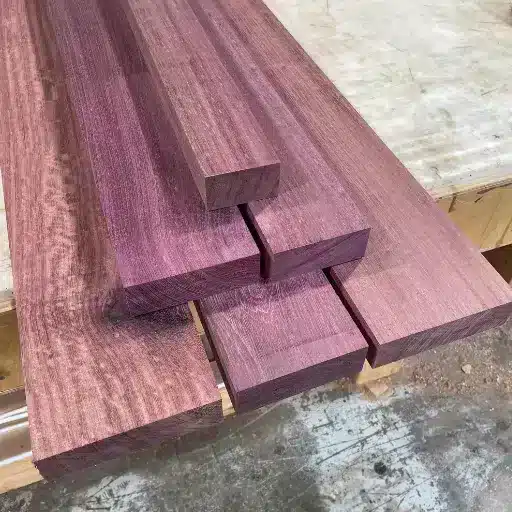
Purple Heart Wood: The Complete Guide To Properties, Uses & Projects
Purple heart wood is the vivid violet heartwood of Peltogyne trees, a tropical hardwood native to Central and South America that’s prized for its striking color, extreme hardness (Janka around 2,520 lbf), and natural rot resistance. This guide covers everything you need to know, from the tree and its properties to working with it, finishing it, flooring economics, food safety, pricing, and responsible sourcing.
Imagine ordering a board that arrives looking like plain gray-brown lumber, then watching it transform into a rich eggplant purple within days. That’s the magic of purple heart wood, and it’s why this exotic species has become a favorite among woodworkers, furniture makers, and designers who want a material that makes a statement.
We get it: the information you’ll find online about purple heart is all over the place. One article says it’s toxic, another says it’s great for cutting boards. Retailers rave about it, while forum threads warn about gummy resin and dulled tools. It’s confusing, and a mistake here is costly. This guide clears it all up.
By the end, you’ll know exactly what purple heart wood is, whether it fits your project, how to work and finish it, what it costs, and how to buy it responsibly. We’ll separate fact from fear, and we’ll be honest about the trade-offs too.
Key Takeaways
- Purple heart wood (Peltogyne spp.) is one of the hardest commercial hardwoods at ~2,520 lbf Janka, roughly 36% harder than white oak, and it’s naturally rot-resistant for outdoor use.
- Fresh-cut purple heart arrives gray-brown and turns vivid purple within days, then deepens to crimson and brown indoors or grays outdoors under UV light.
- Work it with sharp carbide tooling, wipe joints with solvent before gluing, always pre-drill for fasteners, and wear dust protection because it’s a known skin and respiratory sensitizer.
- Use water-based or UV-inhibiting finishes to keep the purple color longer; oil-based finishes and direct sunlight speed the fade to brown.
- Expect to pay roughly $9-$15 per board foot for kiln-dried 4/4 stock in 2026, with FSC-certified material commanding a 25-40% premium. The genus isn’t listed by CITES, but one species (Peltogyne purpurea) is Vulnerable, so buy certified.
What Is Purple Heart Wood?
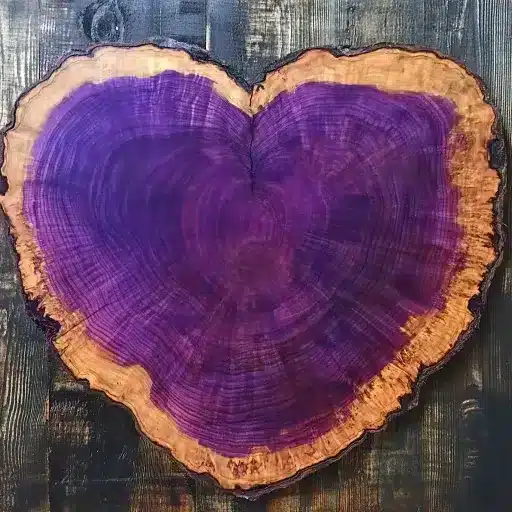
Purple heart wood, also known as purpleheart, amaranth, violet wood, morado, or pau roxo, comes from roughly 23 species in the Peltogyne genus, a member of the legume family (Fabaceae/Leguminosae). These large tropical trees grow from southern Mexico through the Amazon basin to southeastern Brazil, with much of the commercial supply harvested in the Brazilian Amazon.
The tree itself is impressive. Peltogyne species can reach 150 feet tall with trunks up to five feet in diameter, and they produce long, straight, relatively clear logs that yield excellent lumber. The heartwood is what we use; the sapwood is a pale, cream-colored band that contrasts sharply with the purple core. If you want the botanical and sourcing details, our guide to the purple heart wood tree goes deep on species, native range, and conservation status.
What makes purple heart so distinctive isn’t just the color, though. It’s the combination of beauty and brawn: few woods this striking are also this hard, dense, and durable. That’s why it shows up everywhere from fine furniture to outdoor decking to knife handles.
Purple Heart Wood Properties and Specs
If you’re evaluating purple heart wood for a project, start with the numbers. Here’s the short version of what the wood science says.
| Property | Value |
|---|---|
| Scientific name | Peltogyne spp. (about 23 species) |
| Family | Fabaceae (Leguminosae) |
| Janka hardness | ~2,520 lbf (some species 1,860-2,520 lbf) |
| Density | ~880-960 kg/m³; specific gravity ~0.87 |
| Weight | ~4-5 lb per board foot |
| Color | Fresh: gray-brown; oxidizes to vivid purple, matures to crimson/brown |
| Grain | Usually straight, sometimes wavy, roey, or interlocked |
| Texture | Medium to fine, with natural luster |
| Durability | Class 1, highly rot- and insect-resistant |
| Movement | Low to medium; dimensionally stable when properly dried |
| Odor | Mild when being worked |
The headline number is the Janka hardness. At roughly 2,520 lbf, purple heart is about 36% harder than white oak (~1,360 lbf) and lands in the same neighborhood as hickory and pecan. That hardness translates to excellent resistance to scratches and wear, which is why it’s a top choice for flooring and high-traffic surfaces.
It’s also dense, weighing about 4-5 pounds per board foot compared to roughly 3.7 for white oak and 2.5 for pine. Heavier wood feels substantial in hand, which is a plus for tool handles and furniture that needs solid presence. The downside: dense wood is harder to work and costs more to ship.
One more property worth knowing is its natural durability. Purple heart is rated Class 1, meaning it can survive ground contact for 15-25 years untreated, on par with teak or ipe. It shrugs off decay, fungi, and dry-wood termites, and it has enough acid resistance to have been used in chemical vats. If you want a deeper look at the specs and how the color behaves, our breakdown of purple heart wood color and properties has the full table.
Purple Heart Wood Color: Why It Changes (and How to Manage It)
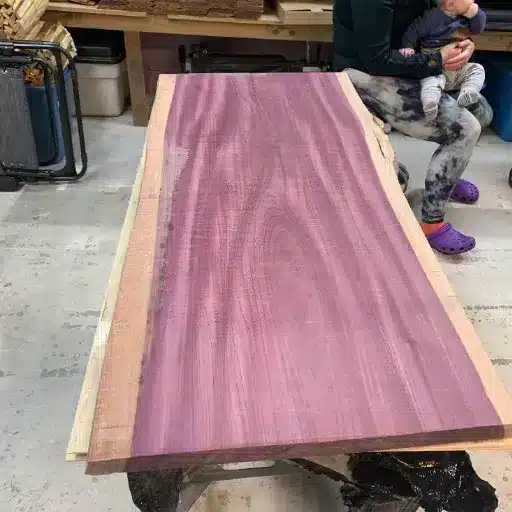
Here’s the thing people love and hate about purple heart: the color isn’t stable, and understanding that is the difference between a successful project and a disappointing one.
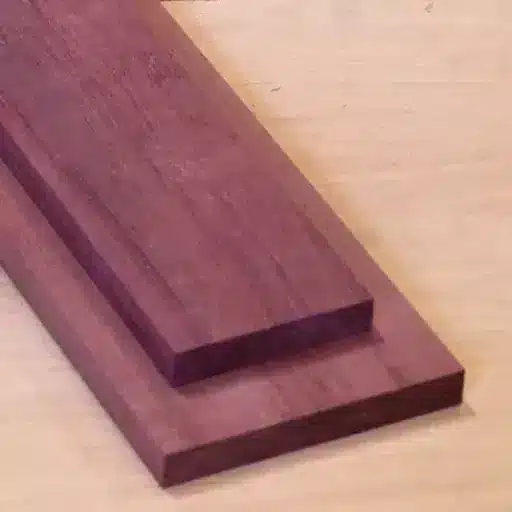
When freshly cut, purple heart looks like a dull, mousey gray-brown. Expose it to air and sunlight, and the natural pigments oxidize rapidly, turning a vivid eggplant purple within a few days. Over years, the color matures to a deep crimson and then darkens toward chocolate brown indoors. Outdoors, UV light does the opposite, bleaching it toward silver-gray.
Can you stop the change? Not entirely, but you can slow it dramatically. The two levers are light and finish. Keep purple heart out of direct sunlight, and apply a finish with UV inhibitors to delay the shift. Water-based finishes tend to hold the purple better than oil-based ones, which can cause the color to bleed and fade back toward brown.
Some makers use a trick to force the color early: expose the wood to strong sunlight or heat before final finishing so it oxidizes to the deep purple shade it will eventually reach, then seal it. Baking small pieces at around 150-175°C for 20-30 minutes can stabilize the color shift, though this is best reserved for small turning blanks, not large panels.
First CTA: Want to see how purple heart behaves in real projects before you buy? Explore our sustainably sourced wood options and get a quote →
Purple Heart Wood vs. Other Woods
How does purple heart compare to the other woods you’re considering? Here’s a quick reference, and we dig into the full matchup in our purpleheart vs padauk comparison.
| Wood | Janka (lbf) | Color | Workability | Typical Use |
|---|---|---|---|---|
| Purple heart | ~2,520 | Vivid purple, fades | Moderate-hard; carbide tooling | Accents, flooring, boards, instruments |
| Padauk | ~1,725 | Orange-red, fades | Easy-moderate | Accents, inlays, boards |
| Wenge | ~1,630 | Dark brown/black | Difficult, splinters | Furniture, flooring, accents |
| Walnut | ~1,010 | Rich brown | Easy | Furniture, cabinetry, gunstocks |
| Hard maple | ~1,450 | Cream/light brown | Moderate | Flooring, cutting boards, butcher block |
| Cherry | ~950 | Warm red-brown | Easy | Furniture, cabinets |
Against walnut, purple heart is much harder and far more colorful, but walnut is warmer, easier to work, and cheaper. Against maple, purple heart is darker, denser, and more dramatic, but maple is lighter and better for large, uniform surfaces. Padauk is the closest visual cousin with its vivid orange-red color, and it’s easier to work, but it fades even faster than purple heart.
The practical takeaway: purple heart shines as an accent, contrast stripe, or statement piece. It pairs beautifully with walnut, cherry, maple, and ash in cutting boards, furniture, and inlays. For large, flat, budget-conscious surfaces, a softer domestic hardwood is usually the smarter pick.
What Is Purple Heart Wood Used For?
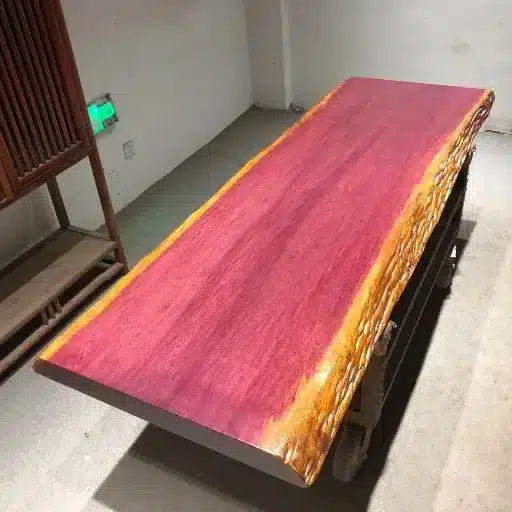
Purple heart wood earns its keep across a wide range of projects. Here are the most common purple heart wood uses, and our full guide to what purple heart wood is used for covers each one in depth.
- Cutting boards and charcuterie boards: Excellent for contrast strips and accents paired with maple, walnut, cherry, and ash. It’s food-safe once finished, though its hardness blunts knives faster than softer boards.
- Furniture accents: Table legs, drawer fronts, inlays, banding, and feature panels against walnut or cherry carcasses.
- Flooring: Dramatic edgings, inlays, and parquet, plus full flooring in its native countries.
- Turning: Bowls, pens, bottle stoppers, and chess sets that show off the color and figure.
- Musical instruments: Guitar fretboards and bodies, where its density and tonal character shine.
- Knives and tools: Knife scales, tool handles, and billiard cue butts.
- Epoxy projects: River boards, serving boards, and wall art, where the purple pops against clear or black resin.
- Outdoor applications: Decking, marine trim, and garden furniture, thanks to its rot resistance.
- Veneer and architectural panels: Bookmatched purple heart veneer brings the color to tabletops, wall panels, and cabinetry at a fraction of the cost of solid stock.
One thing we should say plainly: purple heart is not the wood to buy for cheap, large-scale builds. It’s expensive, hard on tools, and heavy. It’s a premium material for pieces that deserve the drama. If you’re deciding between it and another species, think about what you want the finished piece to say.
Working With Purple Heart Wood
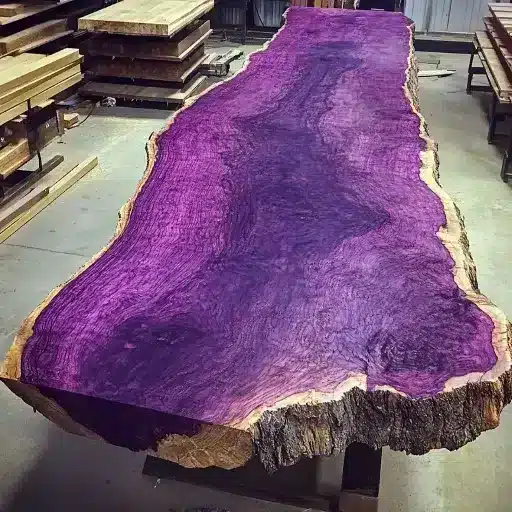
Now for the part that separates the pros from the frustrated. Working with purple heart wood is doable, but it demands respect. Our detailed guide on working with purple heart wood walks through the full machining workflow; here are the essentials.
Use carbide tooling, and keep it sharp. Purple heart is dense and often contains silica, which chews through high-speed steel quickly. Carbide or diamond-tipped blades and router bits last far longer. And sharpen often; a dull edge generates heat that makes the wood exude a gummy resin that clogs tools and causes burning that’s nearly impossible to remove.
Take shallow cuts and go slow. Interlocked and irregular grain can cause tear-out. Light passes with sharp blades produce clean results.
Wipe joints before gluing. The wood’s natural oils and density can weaken glue bonds. Lightly sand the surfaces and wipe them with a solvent like acetone before applying glue, or use a polyurethane adhesive. Titebond III and polyurethane both work well with proper prep.
Always pre-drill for fasteners. Nails and screws can split this dense wood. Pre-drilling is non-negotiable.
Control the dust. Purple heart dust is a known irritant. Wear an N95 or P100 respirator, use a good dust collector, and work in a ventilated space. We cover the health details below and in our guide to purple heart wood safety and toxicity.
Let it acclimate. Like any dense hardwood, purple heart needs to adjust to your shop’s humidity before you mill it. Buying kiln-dried stock at 6-8% moisture content and giving it a few days to acclimate prevents warping and cracking later.
Here’s a real-world example. When Dana, a custom furniture maker in Portland, switched from walnut to purple heart for a line of dining tables, her first weekend was a disaster. Dull planer blades burned the stock, and her glue joints failed on two pieces. She swapped to carbide inserts, started wiping joints with acetone, and pre-drilled every fastener. Two months later, she told us the color and durability sold the tables, and she’d never go back. The lesson: purple heart rewards preparation.
Finishing Purple Heart Wood (and Keeping It Purple)
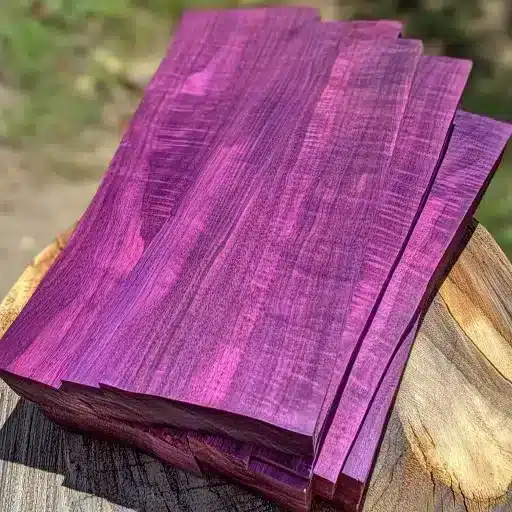
Finishing is where purple heart decisions get made, because the wrong finish can erase the color you paid for. The most complete walkthrough lives in our guide on how to finish purple heart wood; here’s the short version.
Prefer water-based finishes. They hold the purple tone far better than oil-based finishes, which can cause color bleed and accelerate the fade back to brown. A water-based polyurethane or lacquer with UV inhibitors is the go-to for furniture and trim.
Use UV-inhibiting finishes for light exposure. If the piece will sit near a window or outdoors, choose a finish with UV blockers. Nothing stops the color change entirely, but UV protection dramatically slows it.
Match the finish to the project.
- Cutting boards and charcuterie boards: food-safe board oil or wax (see the food-safety section).
- Furniture: water-based polyurethane with UV inhibitors.
- Turning and small projects: CA glue (cyanoacrylate) finishes, which give a glossy, durable coat.
- Epoxy projects: clear epoxy over a sealed surface.
Seal before topcoating. This dense wood can raise the grain badly with water-based finishes. A thin coat of dewaxed shellac or a sanding sealer first gives you a smooth base.
Always test on an offcut. Before finishing the real piece, run your finish schedule on a scrap. You’ll see exactly how the color shifts and whether the finish works with the wood. It takes ten minutes and saves a project.
Try the sun trick. If you want the deep purple now, expose the finished piece to sunlight briefly to accelerate oxidation, then apply the UV-protective topcoat. Test first, because overexposure pushes it toward brown.
Purple Heart Wood Flooring: Pros, Cons, and Cost
Purple heart flooring is striking, but it’s not for everyone. Our dedicated guide to purple heart wood flooring covers the full decision, and here’s the honest assessment.
The pros: Extreme hardness resists scratches and wear, so a purple heart floor can last 30-50 years with proper care. Its natural rot resistance makes it suitable for areas with moisture risk. And visually, a purple heart floor is unforgettable.
The cons: Hardness is not the same as dent resistance. Purple heart is prone to denting from sharp impacts (a dropped pan leaves a mark). The color fades toward brown in sun-drenched rooms, which surprises homeowners. And it’s expensive: expect installed costs in the $12-$25+ per square foot range, before you factor in the challenge of installation.
Installation challenges: The wood must acclimate carefully, carbide blades are essential, and the hardness makes nailing and sanding more demanding. This is not a DIY-friendly floor for a first-timer.
The verdict: Purple heart flooring shines in accent strips, borders, and inlays, or in full floors where the owner understands and embraces the color shift. If you want a stable, uniform, low-maintenance floor, a domestic oak or an engineered hardwood is usually the better value. Our engineered wood flooring guide is a good place to compare options.
Is Purple Heart Wood Food Safe?
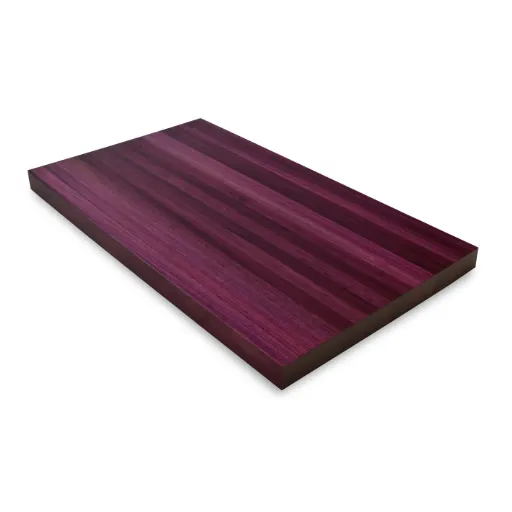
Yes, purple heart wood is food safe for cutting boards and charcuterie boards once it’s finished with a food-safe oil or wax. The complete answer, including what to do and what to avoid, is in our guide on purple heart wood food safety.
Here’s what you need to know. Purple heart is frequently used in cutting boards, mainly as accent strips or edge-grain borders paired with lighter woods like maple. When sealed with a food-safe finish (mineral oil, walnut oil, or a food-safe wax), it’s perfectly safe for food contact.
Two caveats matter. First, purple heart is a known sensitizer in its raw dust form, which causes skin and respiratory irritation in some people. Once the board is sealed with a finish, the sensitizing dust isn’t a concern for food contact, but it’s a reason to finish thoroughly and to wear dust protection when sanding. Second, purple heart is hard, so an all-purple-heart board will dull your knives faster than maple or walnut. Most makers use it for contrast stripes, not the entire board.
Take it from Rosa, a charcuterie board maker in Austin. She resisted purple heart for months after reading scare stories online. When she finally tried accent strips on a maple board, her customers started asking about the purple within a week. She now finishes every board with food-safe mineral oil and says the purple sells the product. The key was separating the “raw dust is a sensitizer” fact from the myth that the finished wood is unsafe.
Purple Heart Wood Price and Where to Buy
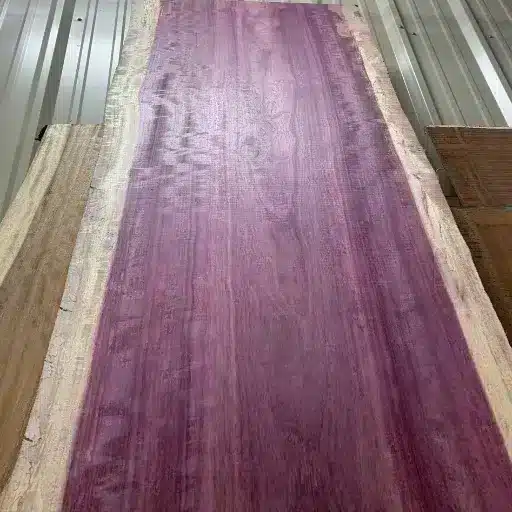
Purple heart wood is a premium product, and the price reflects it. Our current guide to purple heart wood price and where to buy has up-to-date ranges and a buying checklist; here’s the overview.
In 2026, expect to pay roughly $9−$15 per board foot for typical kiln-dried 4/4 (one-inch) stock. Prices vary by grade and preparation:
- Rough-sawn 4/4: roughly $5.50-$13 per board foot
- Surfaced or planed 4/4: $6.50-$12 per board foot
- FAS (First and Second) grade: $16-$22 per board foot
- Select-grade or figured stock: $15-$25+ per board foot
- Live-edge slabs: $60-$150+ per board foot
What drives the price? Purple heart is a rainforest hardwood harvested mostly in the Brazilian Amazon, so sourcing, export logistics, and transport all add cost. FSC-certified wood runs 25-40% more than wild-harvested stock, a premium worth paying for the assurance of legal, sustainable sourcing.
Buying checklist:
- Look for kiln-dried stock at 6-8% moisture content.
- Ask for FSC certification and legal-harvest documentation.
- Request photos and moisture readings before you buy online.
- Buy thicker stock for furniture and statement pieces; thinner boards for cutting boards, inlays, and boxes.
- Order a little extra; matching color across boards is easier when they’re from the same source.
Is Purple Heart Wood Sustainable and Eco-Friendly?
This is the question we get most, and it’s the one most competitors ignore. The honest answer is nuanced. Our full breakdown is in the guide to is purple heart wood endangered and sustainable, but here’s the straight talk.
The Peltogyne genus as a whole is not listed on the CITES Appendices or the global IUCN Red List. That’s good news for availability. But it’s not the whole story. Peltogyne purpurea, a notable species in Costa Rica, Panama, and Colombia, is assessed as Vulnerable, is legally protected in Costa Rica, and faces illegal logging pressure. Overharvesting has driven declines in parts of the range.
What does this mean for you as a buyer? It means the responsible choice is to buy certified wood from sources with verifiable chain-of-custody. FSC certification signals that the harvest was legal, sustainable, and socially responsible. At VitalWood Global, we source all our wood products from sustainably managed forests, and we can provide the certifications for each product. Buying certified is how you keep the color without the guilt.
Here’s the thing about sustainability that matters: when you choose certified, responsibly sourced purple heart, you’re supporting forestry that protects habitat and communities rather than the illegal logging that threatens Vulnerable species. It’s a small choice at checkout, and it’s one of the biggest differences you can make.
Purple Heart Wood Safety and Health
Purple heart wood is not toxic in the sense of being poisonous, but it is a known sensitizer, and that distinction matters. Our guide to is purple heart wood toxic covers the details; here’s what you need to protect yourself.
The wood’s dust and, less commonly, the raw wood itself can cause skin irritation (contact dermatitis), eye stinging, and respiratory irritation or nausea in sensitive individuals. These are sensitizer reactions, meaning some people can develop a reaction after repeated exposure. Severe reactions are uncommon, but they happen.
Protect yourself:
- Wear an N95 or P100 respirator when sanding or machining.
- Use a dust collector and work in a ventilated space.
- Wear gloves when handling raw, unfinished wood if your skin is sensitive.
- Keep the finish on the piece; a sealed surface poses no dust risk.
There’s a parallel here with the food-safety question. The dust from raw, unfinished purple heart is the concern; a finished, sealed piece is safe. Once you understand that, the wood is no more intimidating than any other exotic hardwood, and far less risky than many.
Purple Heart Wood Projects to Try
If you’re looking for a first purple heart project, the good news is that it’s easier to enjoy than to fear. Our guide to purple heart wood turning and projects is full of ideas; here are the best places to start.
A turned pen or bottle stopper is the perfect introduction. Small, manageable, and it shows off the color beautifully with a CA glue finish. A cutting board with purple heart accents pairs the drama with practicality and gives you a food-safe project you’ll use daily. A knife handle is another great use, leveraging the hardness for a durable, striking grip. A guitar fretboard shows the wood’s tonal character, though it’s a more advanced build.
Project-selection workflow:
- Start small. The color and hardness are easy to love on a pen or board.
- Buy stock to match the project: thinner boards for boards and inlays, thicker for furniture.
- Prep properly: sharp carbide tooling, solvent-wiped glue joints, pre-drilled fasteners.
- Finish for the application: food-safe oil for boards, UV-protective water-based poly for furniture, CA glue for turning.
Every maker we talk to who starts with a small purple heart project ends up planning a bigger one. The wood does that to you.
Frequently Asked Questions
Does purple heart wood stay purple?
Not permanently. Purple heart naturally shifts from vivid purple to deep crimson and then brown over years indoors, and to silver-gray outdoors under UV light. UV-inhibiting finishes and keeping it out of direct sunlight slow the change significantly, but they don’t stop it.
Is purple heart wood toxic?
It’s a sensitizer, not a poison. Its dust can cause skin, eye, and respiratory irritation in sensitive people. Wear a respirator and use dust collection when working with it. A finished, sealed piece poses no health risk.
Is purple heart wood food safe?
Yes, once finished with a food-safe oil or wax. It’s commonly used for cutting board accents. Its hardness means it blunts knives faster than softer woods, so most makers use it for stripes, not whole boards.
Is purple heart wood endangered?
The genus isn’t on CITES or the global IUCN Red List, but Peltogyne purpurea is Vulnerable and legally protected in Costa Rica. Buying FSC-certified wood supports legal, sustainable harvesting.
How hard is purple heart wood?
Its Janka hardness is about 2,520 lbf, roughly 36% harder than white oak and comparable to hickory. It resists scratches well but can dent from sharp impacts.
Does purple heart wood need predrilling?
Yes. Always pre-drill for nails and screws to prevent splitting this dense wood.
Can you use purple heart outdoors?
Yes. Its Class 1 natural durability means it survives ground contact for years. Outdoors, the color fades to gray, so many makers treat it as a structural or accent wood rather than a color piece.
How does purple heart compare to walnut?
Purple heart is much harder and more colorful; walnut is warmer, easier to work, and cheaper. Choose purple heart for drama and durability, walnut for warmth and value.
Is purple heart wood expensive?
It’s a premium exotic. Expect roughly $9-$15 per board foot for kiln-dried 4/4 stock, with FSC-certified and select grades costing more.
Where does purple heart wood come from?
It grows in Central and South America, from southern Mexico to southeastern Brazil, with much of the commercial supply from the Brazilian Amazon.
Conclusion
Purple heart wood is one of the most striking hardwoods on the planet, and now you know the full picture. It arrives gray-brown and turns vivid purple in days. It’s extraordinarily hard at around 2,520 lbf Janka, naturally rot-resistant, and built to last. Work it with sharp carbide tooling, glue it after wiping the joints, and always pre-drill. Finish it with water-based, UV-inhibiting products to hold the color, and use food-safe oils for boards. Budget $9-$15 per board foot, and buy FSC-certified to protect the species and the forests it comes from.
Whether you’re planning a cutting board, a statement table, a floor, or a turned pen, purple heart will make the piece memorable. The wood rewards preparation, and it rewards makers who understand its quirks.
Ready to start your project? Contact VitalWood Global for a quote on sustainably sourced purple heart wood and other exotic species →