
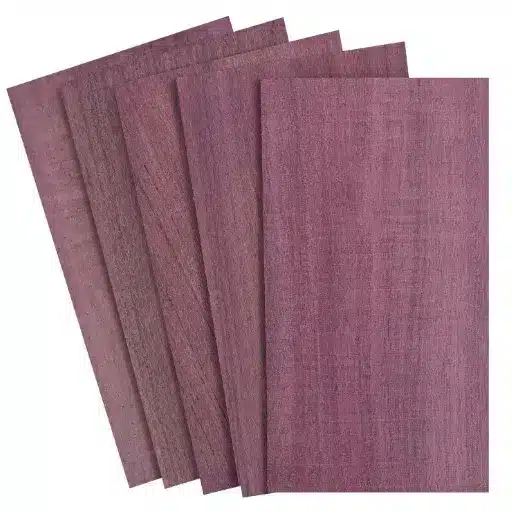
Purple Heart Wood Price: Cost Per Board Foot & Where To Buy (2026)
Purple heart wood costs $9 to $14 per board foot for typical kiln-dried stock in 2026, with rough-sawn 4/4 ranging from $5.50 to $13 and select-grade FAS reaching $15 to $22 per board foot. Live-edge slabs run $60 to $150 per board foot, and FSC-certified lumber carries a 25-40% premium over wild-harvested. This guide breaks down the purple heart wood price by grade, explains what drives it, and shows you where to buy responsibly.
Here’s the honest version: purple heart is an investment, not a bargain. It costs two to three times more than red oak, and the price tag is only part of the story. Buyers who go in without a budget plan are the ones who get sticker shock when the sawmill adds milling, kiln drying, and shipping. The buyers who walk away happy understand that grade, moisture content, thickness, and quantity move the price more than any single factor.
Most pricing advice online is thin. The pages that rank for “purple heart wood price” are short cost estimators that never name a single supplier, never explain what FAS actually means, and never mention the FSC-certified premium. We’ll fix that. By the end of this guide, you’ll know exactly what purple heart costs in 2026, why some boards are $6 and others are $22, and how to buy it without overpaying or unknowingly supporting irresponsible logging.
Key Takeaways
- Purple heart wood averages $9 to $14 per board foot in 2026; rough-sawn 4/4 runs $5.50-$13, planed $6.50-$12, kiln-dried $7-$15, and select-grade FAS $15-$22.
- Live-edge slabs are the premium tier at $60-$150 per board foot, with premium figured slabs topping $200, while project packs and veneer offer budget-friendly paths.
- Volume pricing matters: the same 4/4 stock drops roughly 31% from about $14.70 to $10.15 per board foot when you order 1,000+ board feet.
- FSC-certified purple heart costs 25-40% more than wild-harvested, and that premium is the price of knowing your wood was legally and sustainably sourced.
- Purple heart is 2-3x the cost of red oak ($4-$6.10/bf) and comparable to black walnut ($10-$16.50/bf), making it a premium choice best used in accents and high-visibility projects.
Purple Heart Wood Price Per Board Foot
Let’s answer the question directly. The typical purple heart wood price in 2026 is $9 to $14 per board foot for standard kiln-dried stock. The full market range is wider, from about $6 per board foot for rough-sawn stock bought in volume to more than $22 for select-grade, fully kiln-dried boards. A board foot is a board 12 inches long, 12 inches wide, and 1 inch thick, or the equivalent volume.
What you pay depends mostly on how the lumber is prepared and graded. Here’s the current picture by grade, compiled from 2026 supplier pricing.
| Form / Grade | Price Per Board Foot |
|---|---|
| Rough-sawn 4/4 (green or air-dried) | $5.50 – $13 |
| Planed / surfaced 4/4 (S2S) | $6.50 − $12 |
| Kiln-dried standard stock | $7 − $15 |
| Select-grade FAS, fully kiln-dried | $15 − $22 |
| Premium widths or figured grain | $20 − $25 |
| 8/4 (2-inch) thick stock | $13.75 − $16 |
Price by Grade and Preparation
The grade is the biggest single driver. FAS, or “First and Second,” is the highest lumber grade: long, clear boards with minimal defects that yield long, clean cuts. Select & Better is a slightly lower tier that still delivers excellent quality for most projects. Lower grades like #1 Common have more knots and waste but cost meaningfully less.
Preparation matters just as much. Rough-sawn lumber is exactly what it sounds like, straight off the mill with a rough surface you’ll plane yourself. It’s the cheapest per board foot because you’re doing the finishing work. Planed or surfaced lumber (S2S) has the faces smoothed and costs more. Fully kiln-dried stock, dried to a stable 6-8% moisture content, commands the highest standard price because it won’t warp or move after you build with it.
If you’re comparing prices, always compare the same thing. A $6 rough board and a $22 FAS board are both “purple heart,” but they’re not the same product. When you see a price, ask: what thickness, what grade, what moisture content, and how many board feet before the discount kicks in?
How Much Does Purple Heart Wood Cost?
The short answer: expect to budget $9 to $14 per board foot for most projects in 2026, and add $0.50 to $4 per board foot for milling, $2 to $4 for kiln drying if it isn’t already dried, and $25 to $200 for delivery depending on distance. For a typical furniture or cabinetry build, plan on $9 to $14 per board foot as your real working number.
Here’s a quick way to think about it for a few common projects:
- A cutting board with a purple heart accent strip uses about 2 to 3 board feet, so roughly $20 to $45 in material.
- A dining table in 8/4 stock needs 30 to 60 board feet, so $270 to $840 in material before slabs or premium grades.
- A full live-edge table built from a slab, not dimensional lumber, jumps to $1,600 to $5,000 because slabs are priced per board foot at $60 to $150.
The mistake most buyers make is pricing only the wood. A board foot of purple heart at $12 becomes $15 to $18 by the time it’s milled, dried, and delivered. Budget a 20% buffer for add-ons, and you won’t be caught off guard at checkout.
Why Is Purple Heart Wood So Expensive?
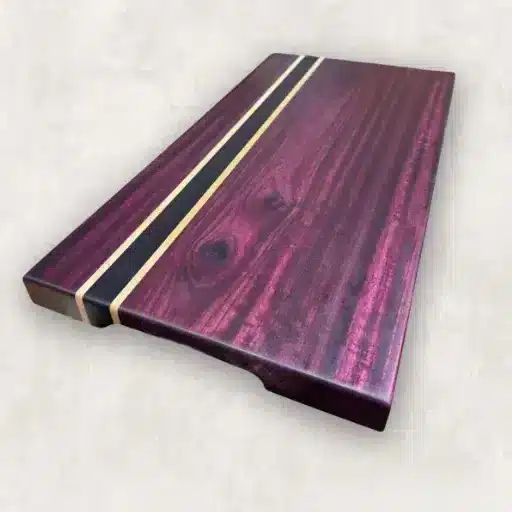
Purple heart costs more than most woods for real, structural reasons. Understanding them helps you judge whether a price is fair or inflated.
- It’s a tropical import. Purple heart comes from *Peltogyne* trees native to Central and South America. It has to be logged, milled, exported, and shipped thousands of miles, and export restrictions in parts of its range tighten supply.
- It’s heavy. At 4.5 to 5.5 pounds per board foot, purple heart is about 40% heavier than red oak. Shipping a pallet of dense tropical hardwood costs noticeably more than a pallet of domestic oak.
- It’s hard to dry. Thick purple heart stock is prone to checking and splitting during kiln drying, which drives up the cost of good, stable material and the price of kiln drying itself ($2 to $4 per board foot).
- Supply is limited. It’s not grown in volume like oak or maple. Every board comes from rainforest harvest or certified plantations, and responsible sourcing adds cost.
- Grades and thickness demand premiums. FAS and wider boards command more, and 8/4 or 12/4 stock takes longer to grow and dry, so it costs more per board foot.
None of these are excuses; they’re the actual economics of the wood. When a price looks too high, ask whether the material is kiln-dried to spec, graded honestly, and legally sourced. When a price looks suspiciously low, ask what you’re not getting.
Purple Heart Wood Price by Form: Slabs, Veneer, and Project Packs
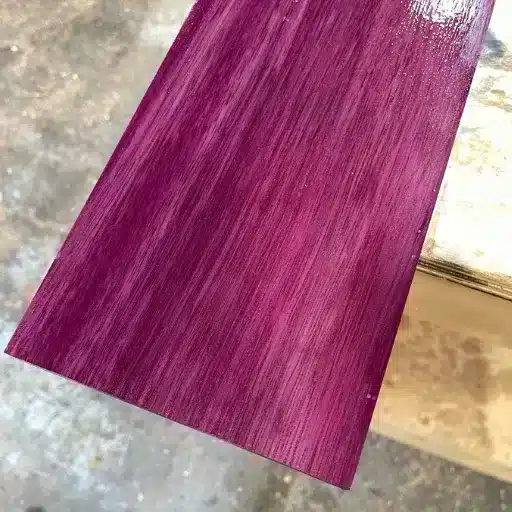
Beyond dimensional lumber, purple heart comes in other forms with very different economics.
Live-Edge Slabs
Live-edge slabs are where the purple heart price climbs into a different league. Standard slabs run $60 to $150 per board foot, averaging around $95, and premium figured slabs can exceed $200 per board foot. A finished 6-foot by 18-inch by 1.5-inch slab runs $1,600 to $2,800, while an 8-foot by 24-inch slab runs $3,000 to $5,000. You’re paying for the width, the figure, the drying, and the labor of flattening a massive piece of dense tropical hardwood. Slabs make stunning tables, but they’re the premium tier for a reason.
Veneer
If you love the purple but the price of solid lumber is too steep, purple heart veneer is your friend. Veneer is thin slices of wood glued to a substrate, so you get the look of solid purple heart at a fraction of the cost per square foot. It’s ideal for panels, wall cladding, and furniture faces. For most interior projects, a purple heart veneer panel delivers the visual impact of the solid wood at a dramatically lower price point.
Project Packs
Retailers like Bell Forest sell pre-packaged board-foot lots. A 10-board-foot pack runs about $249 (roughly $24.90 per board foot) and a 20-board-foot pack about $449 (roughly $22.45 per board foot). You pay a convenience premium for hand-picked, matched boards, but for a small project where you don’t need a full pack, it’s often the most practical way to buy. The math changes if you need volume, which brings us to wholesale pricing.
Purple Heart Wood Wholesale & Volume Pricing
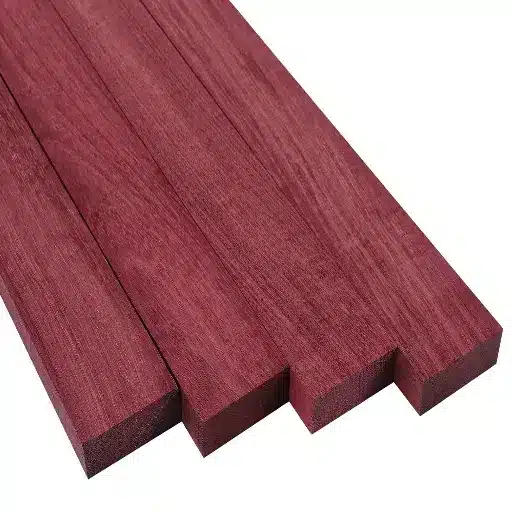
For anyone buying in bulk, volume is the lever that moves the purple heart wood price most. Suppliers discount heavily as quantity climbs, and the discount usually starts at 100 board feet.
Here’s a concrete 2026 example from Wood Vendors. Their 4/4 purple heart runs $14.70 per board foot for 100 to 249 board feet, but drops to $10.15 per board foot at 1,000+ board feet. That’s a roughly 31% saving, or about $4,550 on a 1,000-board-foot order. Langevin Forest follows a similar tiered structure: $12 per board foot, dropping 5% at 100+ board feet, 10% at 250+, and 15% at 1,000+.
The B2B play is straightforward: if you’re a shop, builder, or manufacturer, buy rough-sawn 4/4 or 8/4 in bulk, mill it yourself, and bank the difference. For a small order under 100 board feet, you’ll pay retail pricing, which is why project packs and local lumberyards make sense for hobbyists.
Ready to price a larger order? For commercial quantities with verified FSC sourcing, contact our sourcing team and we’ll work out volume pricing that fits your build.
Purple Heart Wood Price vs. Other Woods
How does purple heart compare to the competition? Here’s a 2026 cost snapshot that keeps the numbers honest.
| Wood Species | Price Per Board Foot | Janka Hardness |
|---|---|---|
| Red Oak | $4 – $6.10 | ~1,290 lbf |
| Hard Maple | $7.25 – $8.35 | ~1,450 lbf |
| Purple Heart | $9 – $14 (up to $22 FAS) | ~2,520 lbf |
| Black Walnut | $10 – $16.50 | ~1,010 lbf |
| Bloodwood | ~$20 | ~2,910 lbf |
| Cocobolo | $89+ | ~2,960 lbf |
Purple heart sits in a middle tier among exotics: more than red oak and maple, comparable to black walnut, and far cheaper than premium exotics like bloodwood and cocobolo. What you’re paying for is hardness (roughly double oak) plus a natural color no stain can replicate. If you want the full technical data sheet, The Wood Database keeps the industry-standard reference on purpleheart.
Here’s the honest advice: if you need a large, flat surface on a budget, red oak or maple will save you thousands and take a finish beautifully. If you want a striking accent, a purple heart inlay, border, or feature piece delivers the wow at a manageable cost.
Where to Buy Purple Heart Wood

Where you buy determines both what you pay and whether you get what you paid for. The reliable channels are:
- Specialty exotic-wood retailers. Shops like Wood Vendors, Ocooch Hardwoods, Bell Forest, Exotic Wood Zone, and Woodworker’s Source stock purple heart in multiple grades and thicknesses, publish current prices, and ship nationwide. They’re the best starting point for small to medium orders.
- Local hardwood dealers and lumberyards. A specialty dealer lets you hand-pick boards, check the figure in person, and avoid shipping costs. Call ahead, since most big-box stores don’t carry it.
- Mills and online marketplaces. Direct-from-mill sellers (like Hearne Hardwoods and Teh Woods) can offer better volume pricing, but vet them on grading and moisture content. Read reviews and ask for specs before ordering.
Whatever channel you choose, look for these signals on the product page: thickness and grade stated clearly, moisture content (kiln-dried, 6-8%), volume-discount tiers, and shipping limits. Purple heart is dense, so parcel carriers often cap board length at 7 to 8 feet; longer stock ships by freight, which costs more.
FSC-Certified Purple Heart Wood: The Price of Buying Responsibly
This is the part most pricing articles skip, and it’s the part that matters most. Purple heart is a tropical hardwood, and while the Peltogyne genus isn’t on CITES appendices, Peltogyne purpurea is assessed as Vulnerable in parts of its range in Costa Rica, Panama, and Colombia, and it’s legally protected in Costa Rica. In the Amazon, illegal logging remains a real risk. How you buy determines whether you fund responsible forestry or not.
FSC certification is the gold standard for responsible tropical sourcing. Expect to pay 25 to 40% more for FSC-certified purple heart than for wild-harvested wood. That premium is the price of certainty: certified stock comes with a documented chain of custody proving it was legally and sustainably harvested. The Forest Stewardship Council sets the standard for that certification.
“Eco-friendly” claims on a retailer’s site aren’t the same as certification. When you buy certified, ask for the FSC certificate number or chain-of-custody documentation. When you buy uncertified, ask for the harvest permit and country of origin. A supplier who can’t answer those questions isn’t worth your money, no matter how low the price. If you want to understand the full conservation picture, our guide to is purple heart wood endangered covers the species status and sourcing rules in depth.
At VitalWood Global, our sourcing team verifies FSC chain-of-custody before any exotic wood ships, so you’re not left guessing. That’s a promise, not a slogan.
Purple Heart Wood Buying Checklist
Use this checklist before you commit to an order:
- Confirm the grade and thickness. FAS vs. Select & Better vs. Common changes the price and the yield.
- Ask for kiln-dried stock at 6-8% moisture content. Wet wood moves after you build with it.
- Request FSC or third-party documentation for any “sustainable” claim.
- Order samples first for a large project. Color varies between boards and suppliers.
- Check volume tiers. Discounts often start at 100 board feet.
- Account for shipping weight and length. Dense wood is heavy, and parcel length limits matter.
- Budget 20% for add-ons. Milling, drying, and delivery add up fast.
How to Save Money on Purple Heart Wood
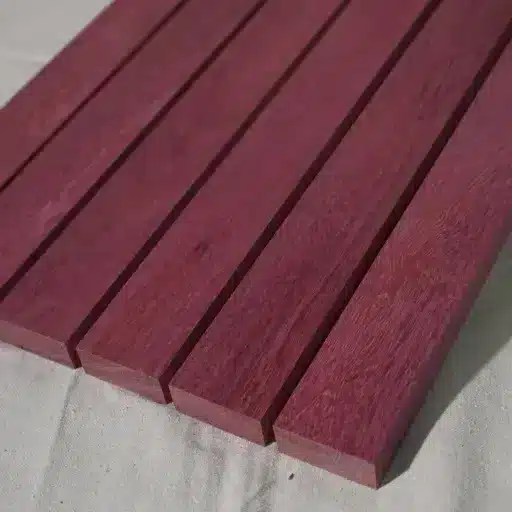
Purple heart will always be a premium wood, but you can keep the cost reasonable without compromising on quality:
- Buy 4/4 rough and mill it yourself. You save 10 to 25% over surfaced stock, assuming you have access to a jointer and planer.
- Buy in bulk or split a board. Volume discounts start at 100 board feet, and a group buy spreads the savings.
- Use veneer for large surfaces. Reserve solid lumber for edges and accents.
- Shop accent-scale projects. A purple heart inlay or feature strip delivers the color at a fraction of the cost of a full-field installation.
- Time your purchases. Many suppliers run seasonal sales, and pre-bundled project packs offer hand-picked boards at a predictable price.
The goal isn’t to buy the cheapest purple heart. It’s to buy the right amount, at the right grade, from a source you can trust, and to spend your money where the color will actually be seen.
Frequently Asked Questions
How much does purple heart wood cost?
Purple heart wood typically costs $9 to $14 per board foot in 2026, with rough-sawn 4/4 starting around $5.50 and select-grade FAS reaching $15 to $22.
How much is purple heart wood per board foot?
Most buyers pay $9 to $14 per board foot for standard kiln-dried stock. Live-edge slabs are priced much higher, at $60 to $150 per board foot.
Why is purple heart wood so expensive?
It’s an imported tropical hardwood that’s dense and heavy to ship, hard to kiln dry without defects, and available in limited supply. Grade, moisture content, and volume also move the price significantly.
Is purple heart wood cheaper than walnut?
The ranges overlap. Purple heart runs about $9 to $14 per board foot (up to $22 FAS), while black walnut runs about $10 to $16.50. In practice they’re comparable in price; the choice usually comes down to color and hardness.
Is FSC certified purple heart wood worth the extra cost?
Yes. The 25-40% premium buys documented proof that your wood was legally and sustainably harvested, which matters for a tropical hardwood with Vulnerable species in parts of its range.
Does the price drop in bulk?
Yes. Volume discounts typically start at 100 board feet, and large orders (1,000+ board feet) can cut the per-board-foot price by roughly 30%.
Conclusion
Purple heart wood in 2026 runs $9 to $14 per board foot for typical stock, up to $22 for select FAS, and $60 to $150 per board foot for live-edge slabs. Grade, moisture content, thickness, and volume move the price more than anything else, and responsible FSC-certified sourcing adds 25 to 40% on top. It’s two to three times the cost of red oak, comparable to walnut, and worth every dollar when used where its hardness and one-of-a-kind color can shine.
Buy the right grade for your project, order samples before you commit, and always ask for the sourcing paperwork. When you buy responsibly, you’re not just buying wood, you’re funding the forests that produce it.
Ready to build with responsibly sourced purple heart? Get a quote from our sourcing team → and explore our complete guide to purple heart wood to see where this remarkable species fits in your next project.