
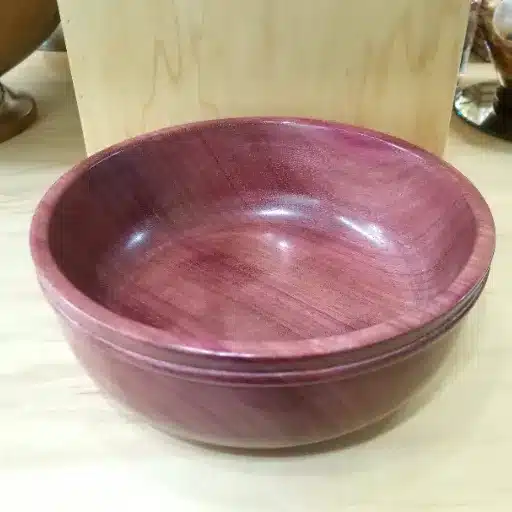
Purple Heart Wood Turning: Projects, Tools & Techniques
Yes, purple heart wood turns well with sharp tools, light cuts, and the right lathe speed. It is hard, dense, and brittle, so it punishes dull edges, but the vivid color and extreme durability make it one of the most rewarding exotics you can put on a lathe. This purple heart wood turning guide walks you through projects from pens to bowls to segmented rings, and it solves the problem every first-time turner hits: the wood comes off the lathe brown, not purple.
Picture this. Dan bought a purple heart pen blank for $8, mounted it, and turned it to a perfect slimline profile. When he stopped the lathe, the blank was dull gray-brown. He had read about purple heart, so he knew the color should be there. What he did not know was that fresh-cut purpleheart is naturally brown, and the vivid violet only returns after exposure to air and light. He finished the pen in CA glue anyway, sealed the brown in, and only later learned the fix.
That story plays out in shops every week. The good news is that the color trick, the tooling, and the speeds are all simple once you understand them. By the end of this guide, you will know exactly which projects suit your skill level, what tools and speeds to use, how to keep the purple from turning brown, and where to find responsibly sourced turning blanks.
Key Takeaways
- Purple heart turns well with sharp tools and light cuts; its Janka hardness of roughly 2,520 lbf means dull edges cause tear-out and burning.
- Freshly turned purpleheart looks brown because oxidation and UV light are what restore the purple; expose the piece to sunlight or heat, and finish with a UV-resistant coat.
- Do not apply a CA finish immediately after turning, because it seals the surface and can lock in the brown. Let the color return first, or sun-restore the finished piece.
- Pens are the easiest turning project because they cut on edge grain; bowls, segmented rings, and epoxy casts are progressively harder.
- Keep lathe speeds moderate: roughly 1,800-3,000 RPM for pens and 300-1,000 RPM for bowls, guided by the rule of thumb that RPM times blank diameter should stay around 6,000-9,000.
Project quick-pick guide:
| Project | Skill Level | Time to First Piece | Key Challenge |
|---|---|---|---|
| Pen | Beginner | 1-2 hours | Sealing the color before it turns brown |
| Bottle stopper | Beginner | 1-2 hours | Even spindle cuts |
| Spiral or lidded box | Intermediate | 2-4 hours | Hollowing and fit-up |
| Bowl | Intermediate | 3-5 hours | End grain, tear-out, wall thickness |
| Segmented or epoxy cast | Advanced | 4-8 hours | Glue-ups and color matching |
Why Turn Purple Heart? (And Why It Comes Off the Lathe Brown)
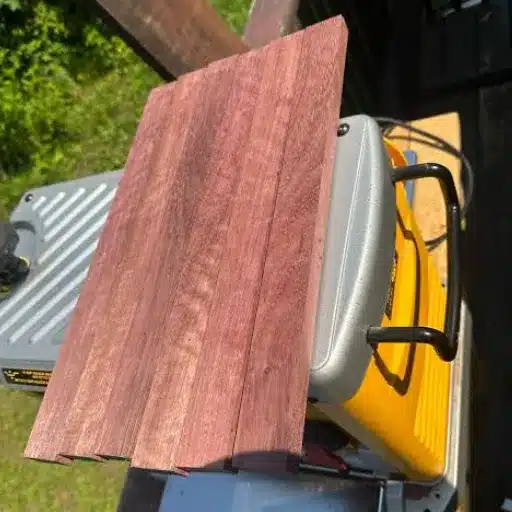
Purple heart, or purpleheart (Peltogyne spp.), is a tropical hardwood native to Central and South America. It is prized for a heartwood that is bright violet when fresh, and it delivers a combination of hardness, rot resistance, and insect resistance that few woods match. According to The Wood Database, purpleheart has a Janka hardness around 2,520 lbf, which puts it harder than hickory and most domestic hardwoods, with a density near 56 lb/ft3 and a specific gravity between 0.8 and 1.0.
That hardness cuts both ways. It is why a turned purple heart bowl feels like it will outlast everything else in the house. It is also why the wood is brittle, splinter-prone, and quick to dull your tools. One turner on WoodworkingTalk described it as “attractive but brittle and hard to deal with,” and warned that it can be dangerous with dull tools or aggressive cuts.
The Brown Phase, Explained
Here is the part nobody tells you before you buy the blank. Freshly cut, planed, sanded, or turned purpleheart is a dull gray-brown. The purple you see in product photos develops after the surface is exposed to oxygen and UV light, usually over a period of hours to days. Friction heat from turning or sanding makes the brown phase last longer, and a premature finish can seal the brown in.
The fix is simple. Let the turned piece sit in bright light, ideally indirect sunlight, and rotate it occasionally. The purple returns. If you are in a hurry, a heat gun or light friction burnishing can speed the process, though heat needs care on thin pen walls. A full explanation of the chemistry and the finishes that preserve it lives in our guide on how to finish purple heart wood and keep it purple.
Tools for Turning Purple Heart Wood
Purple heart wood turning rewards a clean, simple tool kit. You do not need exotic gear, but you do need tools that hold an edge and a sharpening routine you actually follow.
Carbide vs. Traditional HSS Tools
Two schools dominate the forums. Traditional high-speed steel (HSS) gouges and skews, sharpened to a proper bevel, give the finest finish on this dense wood. They need frequent sharpening, because the silica content in purpleheart wears edges fast. Carbide insert tools are easier and more forgiving, especially for beginners, and they dramatically reduce tear-out. Their trade-off is that carbide rarely leaves a finish good enough to skip sanding.
Most turners end up with a mix. A 3/8-inch spindle gouge and a 1/2-inch bowl gouge in HSS cover most spindle and bowl work. A skew chisel handles clean cuts on spindles, and a scraper is handy for hollowing and final shaping. Add a 4-jaw chuck, a parting tool, and a strop or sharpening jig, and you have a complete purpleheart kit.
Sharpening Discipline
Sharp is not optional with purpleheart. One turner on penturners.org credited a razor-sharp skew honed on 8,000-grit water stones for the difference between tear-out and a clean cut. Sharpen before the final pass or two, keep a strop nearby, and use a slightly sharper gouge angle, around 40 degrees instead of the common 55, for a cleaner cut on this brittle wood.
One technique matters more than any tool choice: cut with the grain and take light passes. Shear scraping, which works on many softwoods, does not help on purpleheart. Positive tooling and a gentle hand are the answer.
| Tool | Recommended Setup | Best For |
|---|---|---|
| Spindle gouge | 3/8-inch, HSS, sharpened 40-degree bevel | Pens, spindles, small turnings |
| Bowl gouge | 1/2-inch, HSS, swept-back grind | Bowl roughing and finishing |
| Skew chisel | 3/4-inch, razor sharp | Clean spindle cuts, beads, coves |
| Scraper | Round-nose, burr turned | Hollowing and final shaping |
| Carbide insert tool | Round cutter for interiors | Beginners, tear-out control |
| Parting tool | 1/8-inch, sharp | Tenons and parting-off |
Purple Heart Wood Lathe Speeds (RPM by Project)
Speed for purple heart is a matter of blank size, not a fixed number. The widely used rule of thumb is that RPM times the diameter of the piece in inches should stay around 6,000 to 9,000. A 2-inch pen blank turns comfortably at 3,000 RPM, while a 12-inch bowl wants roughly 500 to 750 RPM.
Start lower than you think you need and increase only when comfortable. Many experienced turners rarely exceed 750 RPM, and large bowls run below 450. Burning is the main risk at high speed, because friction heat both scorches the surface and deepens the brown phase. Keep the tool moving and never let it dwell in one spot.
| Project | Blank Size | Recommended RPM | Notes |
|---|---|---|---|
| Pen | 0.75-1 inch | 1,800-3,000 | Light cuts of 0.005-0.015 inch |
| Bottle stopper | 2-3 inches | 1,200-2,000 | Smooth spindle work |
| Bowl outside | 8-12 inches | 600-1,000 | Rough at about 800 |
| Bowl inside | 8-12 inches | 300-500 | Hollow slowly, cut rim to center |
| Spiral box | 3-5 inches | 1,500-1,800 | Slow to 400 for detail passes |
| End-grain milling | Any | 200-300 | Add a cutting angle to reduce burn |
These numbers are consistent with the guidance in the Toolsradar guide to bowl turning with exotic woods and the Woodcraft spiral turned box project, both of which recommend moderate speeds and light passes for dense exotics like purpleheart.
How to Turn a Purple Heart Bowl
A bowl is where purple heart wood turning gets serious, because the end grain of the rim is the hardest part to cut cleanly. Approach it in stages, and the process is forgiving.
Blank Prep and Moisture Content
Start with a kiln-dried blank at 6 to 12 percent moisture content, with 8 percent as the ideal target. High moisture content causes cracks mid-turn, and a $40 bowl blank is painful to lose to a split. Acclimate the blank in your shop at 45 to 55 percent relative humidity for about two weeks before mounting. Bandsaw the blank to size, core out the center waste, and drill a tenon or cut a chucking recess for a secure mount. Straight-grained stock turns the easiest, so choose that when you can.
Turning and Hollowing
Rough the outside at about 800 RPM with light passes, then finish the exterior at 600 to 1,000 RPM. Hollow the inside at 300 to 500 RPM, cutting from the rim toward the center while you keep extra mass in the middle to reduce rim flex. Keep the cutter at centerline with the handle elevated, and use a bowl gouge rather than a scraper on the interior, because scrapers catch more easily in this brittle wood.
Leave the walls thicker than instinct suggests. When tear-out happens, and it will on some pieces, thick walls give you material to correct it. One turner on SawMillCreek described purpleheart as wood that “turns like pine and yet chips like petrified coal.” His advice, echoed across the forums, was patience, light cuts, and generous wall thickness.
A cautionary story. A member of the WoodworkingTalk community tried to take too much off the inside of a purpleheart bowl with a scraper. The gouge caught, and the bowl split apart and flew across the shop. The salvage job involved gluing purpleheart patches back in and re-turning, and it taught him the one rule that matters: on purpleheart, you cannot rush a cut.
Purple Heart Pen Turning: The Most Popular Project
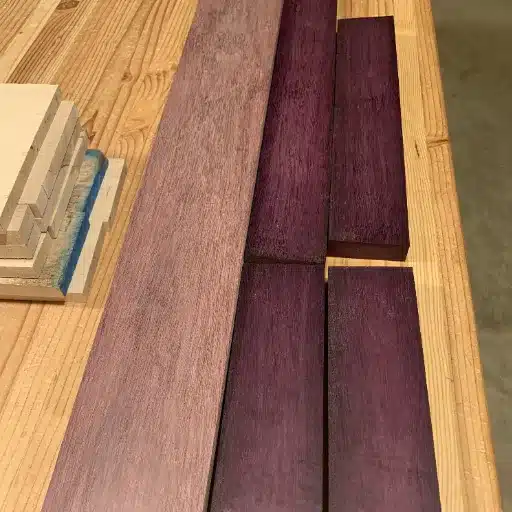
Pens are the most popular purple heart turning project, and for a good reason. Every cut on a pen is edge grain, which turns far more easily than the end-grain faces of a bowl. That makes pens the ideal first project while you learn the color workflow.
The Pen-Turning Color Sequence
Turn and sand the blank to about 400 to 600 grit. It will look brown. That is normal. Let the blank sit unsealed overnight, or in bright light for a few hours, until the purple returns before you apply the CA finish. Finishing too soon seals the brown in, which is exactly what happened to Dan in the opening story.
If you already finished a brown pen, it is not too late. Set it in sunlight for a few hours and rotate it every 30 minutes. Several members of penturners.org confirmed that the purple returns through the CA finish, just more slowly. One turner reported a finished pen going from brown to vivid purple in about two hours of sun.
When the color is where you want it, apply thin coats of CA glue with accelerator between coats, then wet-sand through micromesh up to 12,000 grit and polish. The result is a glossy, durable finish that shows the purple at its best.
Heat Restoration, With Caution
If you want to speed the color change, a heat gun, light friction from a cloth, or even a short oven bake can work. Keep heat gentle on pens, because the wood is thin over the tube and can crack or dry out. Never bake a blank with a brass tube installed, and never leave a flame in one spot. Heat is a convenience, not a requirement; sun and time do the job without risk.
Bottle Stoppers, Spindles, and Small Turnings
Between pens and bowls sit the small spindle projects that make excellent practice pieces: bottle stoppers, tool handles, ornaments, and small boxes. Cut from wider to narrower diameter on the spindle, keep the tool moving, and use moderate speeds around 1,200 to 2,000 RPM depending on the blank.
These small pieces are a great place to practice the color workflow because they are cheap to replace if you experiment with heat or finish timing. Sand to 400 to 600 grit, use a sanding sealer to tame the grain before finishing, and finish with CA glue or a friction polish for a quick, durable result. Turned stoppers and kitchen handles fall under the food-safe guidance covered in our food safety guide for purple heart.
Segmented Turning and Epoxy Casting with Purple Heart
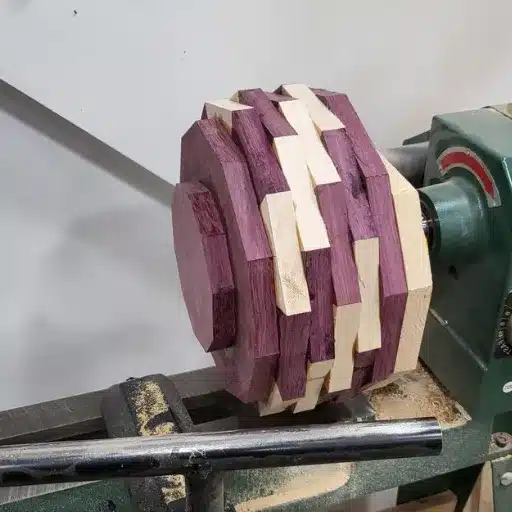
Purpleheart is a classic accent wood for segmented turning, where it is paired with maple, cherry, or walnut to create contrast rings and feature bands. The striking violet against a light wood is one of the most popular looks in the craft.
For segmented work, cut and test your segment angles on cheap pine first, because the angle is the most important step and mistakes are costly on expensive blanks. Keep moisture content below 8 percent so seasonal movement does not split your glue lines, and stagger the segment joints by about 1/32 inch. Wipe oily joints with acetone just before gluing, and use yellow glue such as Titebond for face-to-face joints, because it flexes with the wood. Never glue warm segments, since the glue sets too quickly.
Epoxy casting is another strong use. Purpleheart is described as very good for epoxy projects, whether you fill a decorative ring with colored resin or cast a turned piece in a full resin block and re-turn it. Pour epoxy in thin layers, no more than about a quarter-inch, to avoid exothermic heat cracks. Use a slow-set epoxy so bubbles can escape, fold the resin and hardener together gently, and seal the wood with a finish first to stop the epoxy from blotching into the grain.
For accent wood choices and comparisons, see our purpleheart vs padauk comparison, which also covers wenge and walnut as pairing options.
Beyond the Lathe: Knife Handles and Fretboards
The turning skills you build on the lathe carry over to flat projects that buy purpleheart in thin stock. Knife handles and scales are a favorite use, because the wood holds crisp detail, polishes to a smooth finish, and is exceptionally durable. Grain-fill the surface with pumice mixed with oil or turpentine, and finish with a wiping varnish or a marine oil that includes UV protection to slow the drift toward brown.
Guitar fretboards and necks are a rarer but prized use. Purpleheart offers good resonance and dimensional stability, though it is an expensive wood often reserved for smaller projects. Luthiers keep the wood at 40 to 55 percent relative humidity to prevent cracking and warping. If you want to compare purpleheart with other exotic woods for a build, our exotic wood comparison guide covers the strengths and trade-offs of each.
Sanding and Finishing Turned Purple Heart (and Keeping It Purple)
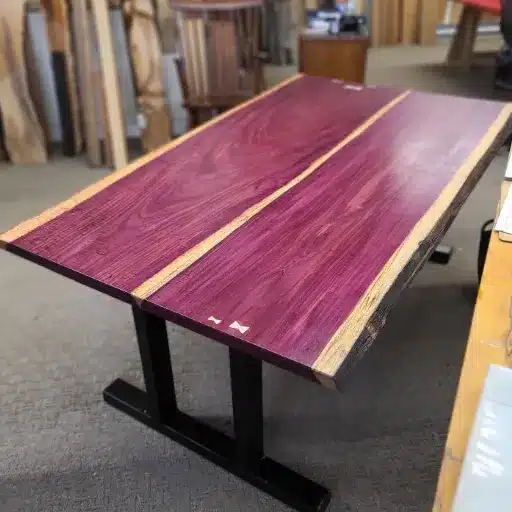
Sanding on the lathe is straightforward if you respect one rule: do not sand for too long. Purpleheart develops end checks, small cracks, from sanding heat more easily than most woods. Progress through 80, 220, 320, 400, and 600 grit, keep the paper moving to avoid grooves, and let the lathe spin at a moderate speed.
For the stringy grain that leaves scratch marks, sand with the grain with the lathe off. It takes longer, but it removes the scratches that spin sanding misses. Many turners finish at 600 grit and get a smooth, satin result that needs little more than wax.
Preserving the Purple
The finish you choose decides how long the purple lasts. Oil and wax alone will not hold the color, and tung oil actively browns the wood, so avoid it if you want the violet. A UV-resistant finish is the reliable choice: lacquer, shellac, or a UV-inhibited polyurethane, applied in thin coats, locks in the color and slows the inevitable darkening to brown. Shellac and lacquer are the finishes turners most often recommend for vivid purple.
For the full breakdown of finish compatibility by project, including food-safe options for bowls and pens, read our complete purple heart wood finishing guide.
Dust and Safety: Turning Purple Heart Responsibly
Purpleheart dust is a known sensitizer. The dalbergione compounds in the wood can irritate your skin, eyes, and respiratory tract, and some turners report nausea after extended exposure. Splinters are another hazard, and several forum members note that purpleheart splinters are notorious for how easily they go septic.
Wear a P100 dust mask, or at minimum an N95, when sanding, and use dust collection at the source. A face shield is non-negotiable on the lathe, because hot chips fly off this dense wood at speed and can burn bare skin. Wash up promptly after turning, and keep purpleheart dust out of shared living spaces, because the dust stains like purple ink.
Sourcing Purple Heart Wood Turning Blanks
The quality of your blank determines how pleasant the turning experience is. Buy kiln-dried blanks at 6 to 12 percent moisture content, with 8 percent ideal, so movement does not fight you mid-project. Request straight-grained stock, because it machines far more cleanly than figured or interlocked grain. Expect to pay in the range of $5 to $15 for pen blanks and $35 to $45 for bowl blanks, and budget for waste on your first few projects.
Buying responsibly matters as much as buying well. Purpleheart is a tropical hardwood, and the most sustainable choice is stock from forests certified by the Forest Stewardship Council (FSC) or an equivalent body, with verified legal harvest and a clean chain of custody. At VitalWood Global, we select and supply kiln-dried exotic turning stock and veneer from certified, responsibly managed forests, so your project starts with material you can feel good about.
Frequently Asked Questions
Does Purple Heart Wood Turn Well?
Yes. Purple heart turns well with sharp tools and light cuts. It is hard, dense, and brittle, so it punishes dull edges, but careful technique produces clean surfaces and a striking finish.
Is Purple Heart Wood Good for Woodturning?
Very good, especially for pens, bowls, bottle stoppers, and segmented accents. It is demanding but rewards the effort with vivid color and extreme durability.
Why Does Purple Heart Wood Turn Brown?
Fresh-cut purpleheart is naturally brown. Oxidation and UV light restore the purple over hours to days. Heat from turning or sanding, and a finish applied too soon, can lock the brown in.
How Do You Keep Purple Heart Purple When Turning?
Expose the turned piece to sunlight or heat until the purple returns, then apply a UV-resistant finish such as lacquer or shellac. Avoid tung oil, which browns the wood.
What Lathe Speed Do You Use for Purple Heart?
Use the rule of thumb that RPM times blank diameter stays around 6,000 to 9,000. That works out to roughly 1,800 to 3,000 RPM for pens and 300 to 1,000 RPM for bowls.
What Is the Best Finish for Turned Purple Heart?
A UV-resistant finish such as lacquer, shellac, or a UV-inhibited polyurethane preserves the purple best. Oil and wax alone will not hold the color.
Is Purple Heart Wood Dust Toxic When Turning?
Purpleheart dust is a known sensitizer that can irritate skin, eyes, and airways. Wear a P100 or N95 mask, use dust collection, and protect your skin.
Conclusion
Purple heart wood turning rewards preparation over raw skill. Keep your tools sharp, take light cuts, and choose speeds by blank size, and the wood behaves well. The two surprises, the brown phase and the easy burning, both come from the same place: fresh-cut purpleheart is brown until light and air restore it, and friction heat works against you. Plan for the color, let it return before you finish, and use a UV-resistant coat to keep it.
Start with a pen to learn the workflow, move to a bowl to build your skills, and save segmented and epoxy pieces for when you want a challenge. Buy kiln-dried, straight-grained, responsibly sourced blanks, and you remove most of the friction before you ever switch on the lathe.
Ready to turn? Contact VitalWood Global for sustainably sourced, kiln-dried purple heart turning stock and veneer. For the full picture, start with our purple heart wood complete guide, then explore how to work with purple heart wood for machining and gluing, or our guide to finishing purple heart wood to keep the color for years.