
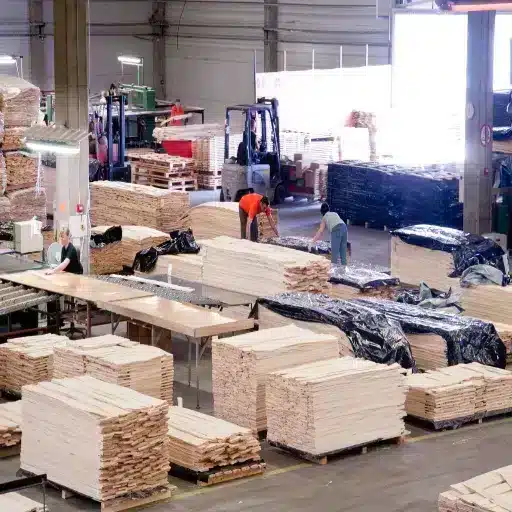
Wood Veneer Manufacturer: How to Choose the Right Partner
The best wood veneer manufacturer combines certified sustainable sourcing, advanced production technology, and reliable supply chain management to deliver consistent, high-quality veneer sheets for commercial projects. Choosing the wrong partner can mean inconsistent grain patterns, delayed deliveries, and certifications that don’t hold up under scrutiny.
Maria Chen learned this the hard way. As a procurement manager for a boutique hospitality design firm in Chicago, she sourced walnut veneer from a new supplier for a 200-room hotel project. The first shipment looked perfect. The second? Completely different color tones, grain patterns that wouldn’t match the original panels, and moisture content that caused warping within weeks. The replacement order pushed the project timeline back six weeks and added $45,000 in unexpected costs.
That single experience taught her what every specifier eventually learns: a wood veneer manufacturer is not just a vendor. They are a long-term partner whose standards directly impact your project’s success, your client’s satisfaction, and your professional reputation.
This guide breaks down exactly what to look for in a wood veneer manufacturer. From certification verification to production technology, from pricing structures to logistics reliability, you will learn how to evaluate, compare, and partner with the right supplier for your next project.
Key Takeaways
- The best wood veneer manufacturers hold FSC or PEFC Chain of Custody certification and can provide complete documentation for every shipment.
- Automated optical grading and AI-powered defect detection can reduce defective products by up to 30%, saving thousands in replacement costs.
- Reconstituted (engineered) veneer produces 18-35% lower CO₂ emissions than harvesting old-growth exotic hardwoods, making it ideal for large-scale sustainable projects.
- Always request batch samples and technical specification sheets before placing a production order — never rely on catalog photos alone.
- Delayed veneer shipments increase emergency sourcing costs by an average of 15%, so lead time reliability matters as much as product quality.
What Does a Wood Veneer Manufacturer Actually Do?
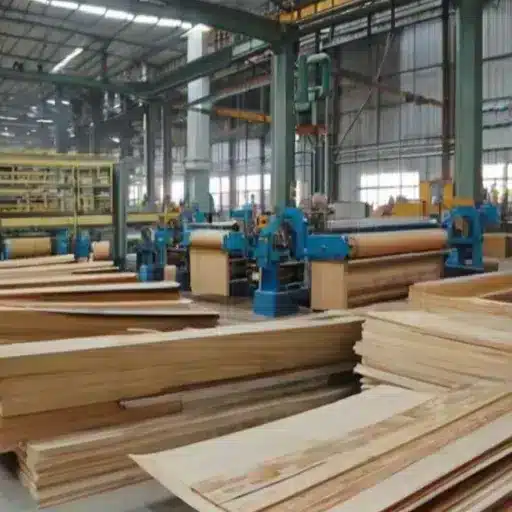
A wood veneer manufacturer transforms raw logs into thin sheets of wood used to cover furniture, wall panels, cabinetry, and architectural millwork. These sheets — typically 0.3mm to 0.6mm thick — deliver the beauty and warmth of solid wood while using a fraction of the timber.
Understanding the wood veneer production process helps you evaluate whether a manufacturer has the capabilities your project demands. The manufacturing process spans seven distinct phases:
- Log selection — choosing species, diameter, and quality based on end-use requirements
- Conditioning — steaming or soaking logs to prepare them for slicing
- Slicing/peeling — cutting veneer sheets using rotary, flat, quarter, or rift methods
- Drying — reducing moisture content to 6-12% for dimensional stability
- Grading — sorting by visual quality (AA, A, B, C, D)
- Splicing/matching — assembling sheets into standard panel sizes with book-matched or slip-matched patterns
- Backing/finishing — bonding to paper, fleece, or phenolic substrates; applying protective coatings
One cubic meter of log yields up to 1,000-2,000 square meters of veneer surface. That is roughly 40 times more usable material than traditional solid lumber. This efficiency makes veneer one of the most resource-conscious choices in modern woodworking.
Manufacturer vs. Supplier vs. Distributor
Not every company selling veneer actually manufactures it. Understanding the difference protects your project from misaligned expectations:
- Manufacturer — owns production facilities, controls slicing, drying, grading, and finishing. Direct quality control. Typically, higher minimum order quantities (MOQs).
- Supplier — sources from multiple manufacturers, adds value through curation, custom matching, or local stocking. Broader selection but less control over production variables.
- Distributor — resells existing inventory with minimal value-add. Lowest prices for standard items, but limited custom capabilities and no production oversight.
For architects and builders specifying custom species, grain matching, or large commercial volumes, working directly with a manufacturer — or a supplier with deep manufacturer relationships — provides the control your project demands. Our guide to the differences between manufacturers, suppliers, and distributors breaks down when each option makes sense.
5 Critical Factors to Evaluate in a Wood Veneer Manufacturer
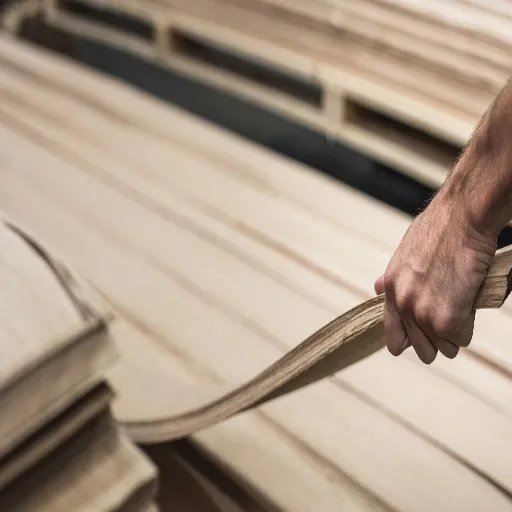
When David Torres, a sustainable architecture firm principal in Austin, needed black walnut veneer for a LEED Platinum office complex, he evaluated four manufacturers using a simple framework. Three years later, that framework has become his firm’s standard practice. Here is what he looks for:
1. Quality and Batch Consistency
Veneer quality isn’t just about looks. It is about whether the sheets you receive today will match the sheets you receive in six months when phase two of your project begins.
Look for manufacturers who document and maintain:
- Grading standards — AA (premium, flawless), A (minor imperfections), B (some defects, suitable for painted or low-visibility applications), C and D (structural or hidden uses)
- Moisture content — consistently between 6% and 12%, verified per batch
- Thickness tolerance — ±0.1mm or better
- Color and grain uniformity — documented with reference samples for future orders
The best manufacturers use automated optical grading systems with machine vision and AI-powered defect detection. These systems analyze each sheet in real time, flagging inconsistencies that human inspectors might miss. According to industry data, this technology can reduce defective products by up to 30%. Learn more about wood veneer quality control standards and how they protect your investment.
2. Sustainability and Certifications
Over 60% of wood veneer manufacturers have adopted sustainable sourcing practices in the last three years. But adoption is not the same as verification. Any manufacturer can claim sustainability. The ones worth partnering with can prove it.
Demand documentation for:
- FSC (Forest Stewardship Council) Chain of Custody certification — tracks wood from certified forest to finished product
- PEFC (Programme for the Endorsement of Forest Certification) — European equivalent with global recognition
- CARB Phase 2 or EPA TSCA Title VI compliance for formaldehyde emissions
- Low-VOC or zero-formaldehyde adhesive specifications
Ask for the certificate number. Verify it on the certifying body’s website. A legitimate manufacturer will welcome this scrutiny.
Sustainability also extends to production efficiency. Modern dryers with heat recovery systems reduce energy consumption by up to 30%. Closed-loop water systems in steaming and conditioning phases minimize waste. These practices matter because they directly reduce the environmental footprint of your project. See our sustainable wood veneer sourcing guide for a full certification checklist and LEED documentation requirements.
3. Manufacturing Technology and Innovation
The veneer industry is not the low-tech sector many assume it to be. In 2026, leading manufacturers operate with:
- High-speed peeling lathes — achieving speeds over 150 meters per minute with computerized blade monitoring
- SCADA systems — centralized control rooms that monitor temperature, humidity, and slicing parameters in real time
- Digital moisture control — ensuring every sheet meets specification before it leaves the drying line
- Laser-guided cutting — precision trimming that reduces material waste by 15-20%
When evaluating a manufacturer, ask about their technology investments. A facility still relying entirely on manual grading and dial-gauge moisture meters may produce beautiful veneer, but they cannot guarantee the consistency that large commercial projects require.
4. Customization and Product Range
Every project has unique requirements. The right manufacturer should accommodate:
- Species selection — from domestic staples (oak, maple, walnut, cherry) to exotic options (teak, mahogany, sapele, anigre)
- Cut options — rotary (broad, swirling grain), flat/plain slice (traditional cathedral pattern), quarter slice (straight grain with ray fleck), rift cut (most uniform, minimal cathedral)
- Backing types — paper-backed (flexible, lightweight), fleece-backed (conformable to curves), phenolic-backed (durability for high-wear applications), PSA (pressure-sensitive adhesive for easy installation)
- Matching techniques — book-matching (mirror-image pairs), slip-matching (sequential sheets), random matching (natural variation)
- Custom dimensions — non-standard widths, architectural lengths (4×10, 4×12), specific thicknesses
For large architectural installations, flitch matching — maintaining sequential sheets from the same log section — creates visual continuity across dozens of panels. Not every manufacturer can deliver this. Ask before you specify, and review custom wood veneer manufacturing capabilities to understand what is possible for your project.
5. Logistics and Customer Support
Veneer is delicate. It warps if humidity shifts. It cracks if handled roughly. It stains if packaged with incompatible materials. The manufacturer’s logistics capabilities are as important as their production quality.
Evaluate:
- Lead times — standard production schedules vs. rush capabilities
- Packaging standards — moisture-barrier wrapping, edge protection, flat stacking
- On-time delivery rate — request historical data; aim for 95%+
- Technical documentation — spec sheets, care instructions, warranty terms
- After-sales support — replacement policies, batch-matching for future orders, troubleshooting
Delayed shipments do not just inconvenience your schedule. They increase emergency sourcing costs by an average of 15%. When you are managing a phased construction timeline, that premium can erase any savings from choosing a cheaper manufacturer. For a deeper look at packaging standards, regional lead times, and disruption mitigation, see our guide to wood veneer supply chain management.
Understanding Wood Veneer Manufacturer Pricing and Cost Structures
Veneer pricing follows predictable patterns once you understand the drivers. Here is what moves the needle:
| Cost Factor | Impact on Price | What to Ask |
|---|---|---|
| Species rarity | High | Is this species available from sustainable plantations, or only from old-growth harvests? |
| Certification premium | Medium | What is the price difference between FSC-certified and non-certified of the same species? |
| Custom vs. standard | Medium-High | What are your MOQs for custom dimensions, and how do unit costs change at volume? |
| Backing type | Low-Medium | Which backing option provides the best value for my specific application? |
| Cut method | Low | Does quarter slicing cost more than flat slicing for this species? |
| Volume/MOQ | High | What pricing tiers exist at 500 sq ft, 2,000 sq ft, and 10,000+ sq ft? |
| Logistics | Medium | Are shipping costs included, or calculated separately based on destination? |
Most manufacturers structure pricing with tiered volume discounts. A typical progression might look like:
- Sample/prototype quantities — 10-50 sq ft at retail-equivalent pricing
- Standard commercial orders — 500-2,000 sq ft with 15-25% volume discount
- Large project orders — 5,000-20,000 sq ft with 30-40% volume discount
- Ongoing partnership rates — negotiated annual contracts for repeat clients
The cheapest quote is rarely the best value. A manufacturer pricing 20% below market may be cutting corners on drying time, using lower-grade logs, or skipping certification audits. Always compare the total cost of ownership, including replacement risk, delivery reliability, and documentation quality. For a detailed breakdown of cost drivers by species, certification, and volume, see our wood veneer manufacturer pricing breakdown.
Sustainability and Ethical Sourcing to Demand from Your Manufacturer
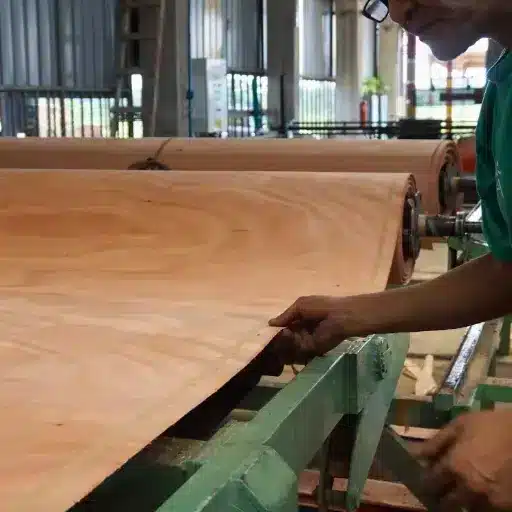
The veneer industry sits at a crossroads. Global demand for wood products continues to grow — the market reached USD 17.14 billion in 2026 and is projected to hit USD 21.42 billion by 2034. At the same time, pressure for deforestation-free supply chains has never been higher.
Leading manufacturers respond with transparency. They provide:
- Chain of Custody documentation — every shipment includes a certificate tracing the wood back to a certified forest
- Species origin disclosure — exact country and region of harvest, not vague “imported” labels
- Harvest method transparency — selective harvesting vs. clear-cutting, replanting commitments
- Waste reduction data — byproduct recycling into particleboard, bioenergy, or other products
For projects pursuing LEED v4.1 certification, veneer sourcing contributes to multiple credit categories:
- MRc3: Building Product Disclosure and Optimization — Environmental Product Declarations (EPDs)
- MRc4: Building Product Disclosure and Optimization — Sourcing of Raw Materials
- EQc2: Low-Emitting Materials — formaldehyde and VOC emissions
Your manufacturer should understand these requirements and provide documentation in the format your certifier expects. If they cannot explain how their product contributes to LEED credits, they may not be the right partner for a certified project.
Reconstituted Veneer: The Sustainable Alternative
Reconstituted veneer — also called engineered or recon veneer — deserves special attention. It is manufactured from fast-growing, renewable species (poplar, ayous, eucalyptus), dyed and reassembled to mimic the grain patterns of rare exotic woods.
The environmental case is compelling:
- 18-35% lower CO₂ emissions compared to harvesting old-growth exotic hardwoods
- Greater consistency — no natural defects, uniform color, predictable grain
- Scalability — unlimited supply for large projects that would exhaust natural stocks
- Cost efficiency — typically 30-50% less expensive than equivalent natural exotic species
For commercial specifiers, reconstituted veneer offers a path to dramatic visual impact without the environmental guilt or supply uncertainty of rare natural species. The best manufacturers offer both natural and reconstituted options, helping you choose based on project requirements rather than inventory limitations. Compare production methods, emissions, and cost in our guide to reconstituted vs natural veneer.
Manufacturing Technology That Signals a Premium Partner
Walk through a modern veneer facility, and you will see equipment that rivals aerospace manufacturing for precision. Here is what to look for during a factory tour or virtual audit:
Automated Peeling and Slicing Lines
Computer-controlled lathes adjust blade angle, feed rate, and log rotation in real time based on wood density and moisture readings. This produces sheets of uniform thickness even when the raw log has internal inconsistencies.
Machine Vision Grading Systems
High-resolution cameras scan every sheet at production speed, identifying and categorizing defects — knots, mineral streaks, cracks, color variations — with accuracy exceeding human inspection. The system sorts sheets into grade bins automatically.
Digital Drying Control
RF (radio frequency) and vacuum dryers with IoT sensors monitor moisture content continuously. If a batch approaches the upper tolerance limit, the system adjusts temperature and airflow automatically. No more overdried, brittle sheets. No more damp, unstable inventory.
Heat Recovery Systems
Modern dryers capture waste heat from the exhaust stream and redirect it to preheat incoming air or water. This reduces total energy consumption by up to 30% — a cost saving that manufacturers can pass to clients or reinvest in further quality improvements.
Cloud-Based Production Monitoring
Some facilities now offer clients real-time visibility into their order status — which phase of production, estimated completion, and quality checkpoint results. This transparency builds trust and helps you coordinate your own project timeline with precision.
How to Vet a Wood Veneer Manufacturer: Factory Audit Checklist
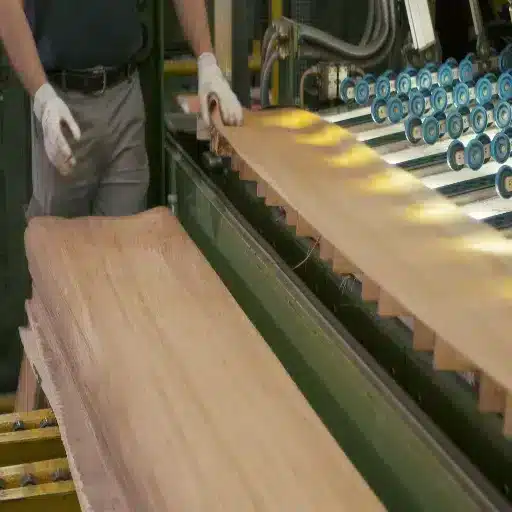
Before committing to a manufacturer for a major project, conduct due diligence. Use this factory audit checklist during a virtual or in-person facility review, or expand it into a full vendor assessment with the detailed framework in our dedicated vetting guide:
Documentation Review
- FSC/PEFC Chain of Custody certificate (current, not expired)
- Quality management certification (ISO 9001 or equivalent)
- Environmental management certification (ISO 14001)
- Technical specification sheets for your target species and backing
- Warranty terms and replacement policy
Production Observation
- Log yard: Are logs stored under water spray or climate control?
- Conditioning: Are steaming/cooking times documented by species?
- Slicing: Is blade maintenance scheduled and recorded?
- Drying: Are moisture readings taken per batch, not just spot-checked?
- Grading: Is there a documented standard with photographic references?
- Backing: Are adhesive types and application parameters recorded?
Sample Verification
- Request production samples from the exact batch or flitch you will receive
- Verify grain, color, and thickness match your specification
- Test flexibility and backing adhesion with your intended application method
- Check moisture content with a calibrated meter
10 Questions Every Specifier Should Ask
- What certifications do you hold, and can I verify them independently?
- What is your on-time delivery rate over the last 12 months?
- How do you ensure batch consistency for multi-phase projects?
- What is your defect rate, and how do you handle replacements?
- Can you provide Chain of Custody documentation for every shipment?
- What technology do you use for grading and quality control?
- What are your standard and rush lead times?
- Do you offer custom matching, and what are the MOQs?
- How do you handle moisture-sensitive species in varying climates?
- Can you provide references from architects or builders with similar projects?
Red Flags to Watch for When Vetting a Supplier
Even experienced specifiers can miss warning signs. Watch for these indicators that a manufacturer may not meet your standards:
Vague or Missing Certification Claims
“Our wood is sustainably sourced” without a certificate number is not a claim. It is marketing. Demand documentation.
Inability to Provide Batch Samples
A manufacturer who cannot or will not send samples from current production may be concealing quality inconsistencies.
Excessively Long or Unpredictable Lead Times
Occasional delays happen. Chronic unpredictability suggests poor production planning or reliance on third-party subcontractors.
No After-Sales Support
If something goes wrong, you need a responsive partner. A manufacturer who disappears after delivery is a liability.
Price That Seems Too Good to Be True
Unusually low pricing often signals lower-grade logs, shortened drying times, skipped quality checks, or undisclosed certification gaps. The cost of fixing these issues on-site always exceeds the initial savings.
Inconsistent Communication
Slow responses to pre-sale inquiries predict even slower responses when problems arise. Test responsiveness before you commit.
Building a Long-Term Partnership with Your Manufacturer
The most successful architects and builders do not treat veneer sourcing as a transaction. They treat it as a partnership that evolves with each project.
Start with transparency. Share your project timeline, your sustainability goals, and your quality expectations upfront. A good manufacturer will reciprocate with honest assessments of feasibility, lead times, and cost. If you are evaluating partners across regions, our guide to global wood veneer manufacturing hubs explains where quality, speed, and sustainability converge.
Communicate early and often. If your project timeline shifts, notify your manufacturer immediately. If your specification changes, discuss implications for matching, lead time, and pricing before finalizing.
Request reference projects. The best manufacturers maintain portfolios of completed installations — hotels, corporate offices, residential towers — and can connect you with specifiers who have used their products in similar contexts.
Finally, align your sustainability goals. If your firm has committed to net-zero projects, share that commitment. The right manufacturer will help you select species, cuts, and backing options that minimize environmental impact while maximizing aesthetic impact.
At VitalWood Global, we have built our business on this partnership model. We work closely with architects, builders, and designers from initial specification through final installation — not because we have to, but because we believe the best projects emerge from genuine collaboration.
Frequently Asked Questions
What does a wood veneer manufacturer do?
A wood veneer manufacturer transforms raw logs into thin sheets of wood through processes including log selection, conditioning, slicing or peeling, drying, grading, and finishing. These sheets are used to cover furniture, wall panels, cabinetry, and architectural millwork, providing the appearance of solid wood with greater resource efficiency.
How do I choose a wood veneer manufacturer?
Evaluate manufacturers across five key areas: quality and batch consistency, sustainability certifications, manufacturing technology, customization capabilities, and logistics reliability. Request samples, verify certifications independently, and ask for references from similar projects.
What certifications should a veneer manufacturer have?
Look for FSC or PEFC Chain of Custody certification, ISO 9001 quality management, and compliance with CARB Phase 2 or EPA TSCA Title VI for formaldehyde emissions. For LEED projects, request documentation formatted for MRc3, MRc4, and EQc2 credit categories.
How much does custom wood veneer cost?
Pricing varies by species, certification, cut method, backing type, and volume. Standard commercial orders (500-2,000 sq ft) typically receive 15-25% volume discounts. Large project orders (5,000+ sq ft) may qualify for 30-40% discounts. Reconstituted veneer is typically 30-50% less expensive than equivalent natural exotic species.
What is the difference between a veneer manufacturer and a supplier?
A manufacturer owns production facilities and controls the entire process from log to finished sheet. A supplier sources from multiple manufacturers and adds value through curation, custom matching, or local stocking. Manufacturers offer more control; suppliers offer broader selection.
How long does wood veneer production take?
Standard lead times range from 2-8 weeks, depending on species, custom requirements, and order volume. Rush orders may be possible at a premium. Always confirm lead times in writing and build buffer time into your project schedule.
Is wood veneer environmentally friendly?
Yes, when sourced responsibly. One cubic meter of log produces up to 40 times more usable surface area as veneer compared to solid lumber. FSC-certified sourcing, energy-efficient production, and reconstituted veneer options further reduce environmental impact.
What is reconstituted wood veneer?
Reconstituted veneer is manufactured from fast-growing, renewable species that are dyed and reassembled to mimic the grain patterns of rare exotic woods. It offers greater consistency, lower cost, and 18-35% lower CO₂ emissions compared to harvesting old-growth exotic hardwoods.
Conclusion
Choosing the right wood veneer manufacturer is one of the most consequential decisions in a commercial interior project. The right partner delivers consistent quality, verified sustainability, reliable logistics, and responsive support. The wrong partner delivers cost overruns, timeline delays, and compromised aesthetics.
Focus your evaluation on what matters: batch consistency you can verify, certifications you can independently confirm, technology that ensures precision, customization that matches your vision, and logistics that respect your timeline. Use the factory audit checklist. Ask the hard questions. And remember — the cheapest quote is rarely the best value.
Wood veneer offers the beauty of natural wood with a fraction of the environmental footprint. When you partner with a manufacturer who shares your commitment to quality and sustainability, every sheet becomes a statement about what your project stands for.
Ready to source sustainable wood veneer for your next project? Contact VitalWood Global to discuss your specifications, request samples, or schedule a consultation with our team.