
Purpleheart vs Padauk: Which Exotic Wood Is Better?
Purpleheart is the harder, denser wood, while padauk is easier to work with and generally less expensive. Choose purpleheart when you need maximum dent resistance and love its violet color; choose padauk when you want easier machining, a warm orange-red tone, and a lower price. In this purpleheart vs padauk guide, we compare hardness, density, color stability, workability, price, safety, and sustainability so you can pick the right one for your cutting board, guitar, flooring, or turning project.
Ask any woodworker which exotic species stops them mid-aisle, and purpleheart and padauk are almost always the answer. One blooms purple, the other burns orange-red, and both demand attention. But beneath the color, they behave very differently. The choice usually comes down to how much you value hardness versus how much you enjoy sanding. We will show you exactly where each one wins, where it compromises, and how to buy responsibly.
Key Takeaways
Key Takeaways
- Purpleheart (Janka ~2,220–2,520 lbf) is about 25–30% harder and noticeably denser than padauk (~1,710–1,970 lbf), making it more dent-resistant but harder to machine.
- Padauk is significantly easier to work and finish (5/10 vs 2/10 workability), and typically costs less per board foot.
- Neither wood keeps its fresh color: purpleheart fades from violet to brown, and padauk darkens from orange-red to deep crimson.
- For cutting boards, both are best used as accent strips; padauk is friendlier to knives, while purpleheart resists wear.
- Buy certified exotic wood (FSC, legal harvest) from a responsible supplier for the most sustainable choice.
Purpleheart vs Padauk at a Glance
| Property | Purpleheart | Padauk (African) |
|---|---|---|
| Scientific name | Peltogyne spp. | Pterocarpus soyauxii |
| Janka hardness | ~2,220–2,520 lbf (8,051 N) | ~1,710–1,970 lbf (7,250–7,606 N) |
| Density | ~880–960 kg/m³ (~4–5 lb/bf) | ~700–770 kg/m³ (~3.75 lb/bf) |
| Workability | Hard (2/10) | Easier (5/10) |
| Fresh color | Gray-brown, blooms to violet | Vivid orange-red |
| Aged color | Deep brown/purple, gray outdoors | Deep crimson, reddish-brown |
| Rot resistance | Very high | Very high |
| Dimensional stability | Low movement (3.9% tangential) | Excellent (~5.2 rating) |
| Price (per board foot) | ~$15–30 | ~$12–20 |
| Availability | Common | Common (African); rare (Andaman) |
| Best for | Flooring, inlays, heavy use | Cutting boards, furniture, instruments |
This table is the short answer. The rest of this guide explains the why behind every row.
Which Is Harder: Purpleheart or Padauk?
The Janka Hardness Numbers
Purpleheart is the harder wood. It measures roughly 2,220–2,520 lbf on the Janka scale depending on the species, while African padauk ranges about 1,710–1,970 lbf. That puts purpleheart in the same league as hickory, and padauk closer to hard maple or slightly above it. In practical terms, purpleheart resists dents and wear better, which is why it shows up in heavy-use floors, high-traffic commercial spaces, and boatbuilding.
Harder is not always better, though. Extreme hardness often comes with brittleness. Purpleheart can split or crack if you drive fasteners without pre-drilling, and it will dull your tooling far faster than padauk. Many woodworkers describe purpleheart as similar to ebony to machine, which is a warning and a compliment at the same time.
Density and Weight
Purpleheart is also the heavier wood. It runs about 880–960 kg/m³ with a specific gravity near 0.87, which translates to roughly 4–5 lb per board foot. Padauk is lighter at about 700–770 kg/m³ and around 3.75 lb per board foot. For a cutting board or a small box, the difference barely matters. For a full guitar body or a large tabletop, it matters a lot.
Here is a story that shows the trade-off in real life. Tom, a luthier in Portland, built his first purpleheart guitar neck in early 2024. He loved the color, but the blank was so heavy and dense that he had to reshape his chambering plan. “It is gorgeous, but it is not a beginner wood,” he said later. When he switched to padauk for his next build, the machining felt effortless by comparison. Both necks held their tuning, but the padauk project took him about half the shop time. That is the difference between these two species in one paragraph: same stunning result, very different effort.
Color: Purple vs Orange-Red (and Which Keeps Its Color)
How Each Wood Ages
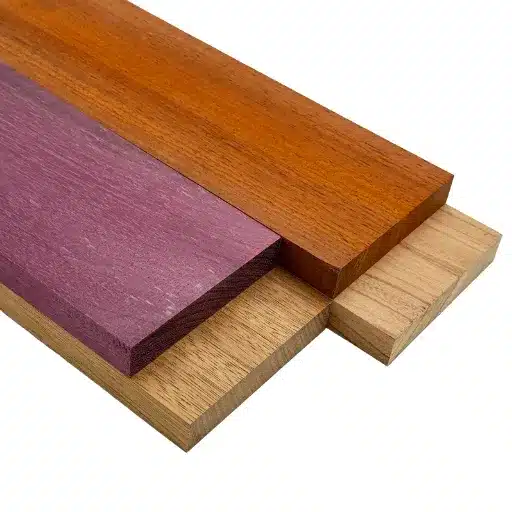
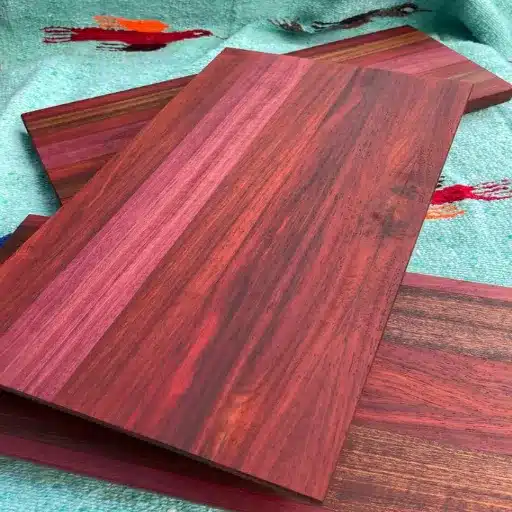
This is where both woods surprise first-time buyers. Purpleheart is not born purple. Freshly cut heartwood is a dull gray-brown, and only after a few days of air and UV exposure does it bloom into that deep eggplant violet. Over months and years, continued light pushes it toward dark brown, and outdoors it grays to a silver-brown. Heat can temporarily deepen the purple, which is why some turners use a gentle heat gun to intensify the color before finishing.
Padauk starts vivid and stays warm, but it also changes. Fresh-cut African padauk is a bright, almost neon orange-red. Within months, it deepens to a rich crimson, and eventually settles into a reddish-brown or dark burgundy. Some pieces can bleach or fade in strong direct sunlight. Both woods are honest about their instability: what you buy is not what you will see five years later.
The Honest Color-Stability Verdict
Neither wood keeps its fresh color, no matter what you do. A UV-inhibiting, water-based finish will slow the change dramatically, while oil-based finishes tend to amber both woods and speed the darkening. Set your expectations now: purpleheart eventually drifts to brown, and padauk drifts to deep red. If you want the color to last, plan the finish before you cut, not after.
Workability: Why Padauk Is Easier to Machine
What the Workability Ratings Really Mean
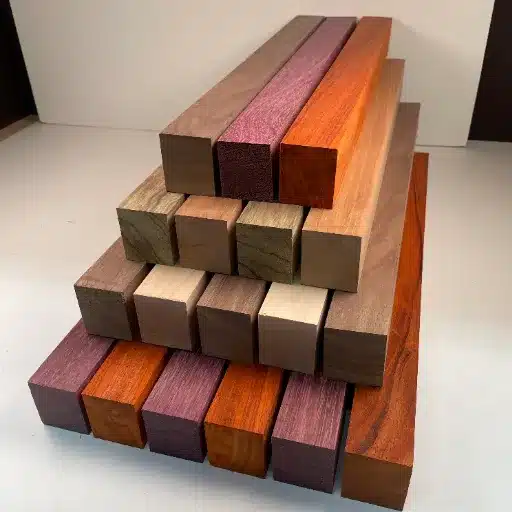
Ratings like “2/10” for purpleheart and “5/10” for padauk hide a lot of nuance. Here is what they actually describe:
- Tooling: Purpleheart blunts cutting edges quickly. Carbide is essential, and you will sharpen more often. Padauk machines cleanly with sharp carbide and is far more forgiving.
- Heat and resin: Purpleheart burns easily when sawing or sanding, and heat makes it exude an oily resin that ruins glue joints. Padauk has a high oil content too, but it causes fewer burning problems.
- Tear-out: Both have interlocked or wavy grain that can tear out, but padauk’s straight-to-interlocked grain is generally easier to plane cleanly.
- Gluing: You must wipe purpleheart with solvent or lightly sand it before gluing, or the oily residue weakens the bond. Padauk also benefits from a degrease before glue-up.
- Finishing: Padauk finishes more easily. Its oil content can slow oil-based finish cure, so water-based or conversion varnishes are the safer bet.
One woodworker on the ProjectGuitar forums summed it up well: “Padouk is much easier to work with than Purpleheart or Hard Maple. It is more akin to Black Walnut in terms of workability.” If you are new to exotics, padauk is the gentler introduction.
Safety Note When Machining
Both species are sensitizers, so dust control is not optional. Purpleheart dust can cause respiratory irritation and flu-like symptoms, and padauk dust sensitizes roughly 15% of users and stains everything orange. Wear an N95 or P100 mask, use dust collection, and wash your hands before touching your face.
Purpleheart vs Padauk for Cutting Boards
Knife-Friendliness: The Real Trade-Off
Cutting boards are where this comparison gets personal, because the data sources genuinely conflict. Some woodworkers report that purpleheart’s extreme hardness dulls thin Japanese knives quickly; one review described dulling an $80 chef’s knife after slicing ten tomatoes. Others rate purpleheart as surprisingly knife-friendly for its hardness. Padauk is generally easier on knives, and one builder’s padauk board survived two years of daily use without deep scars.
A useful rule of thumb: keep board density under about 0.8 g/cm³ to protect thin knives. Padauk qualifies; purpleheart sits at or above the line. If you use expensive Japanese knives and want the wood as the main board surface, padauk is the safer choice.
End-Grain vs Edge-Grain, and the Accent-Strip Verdict
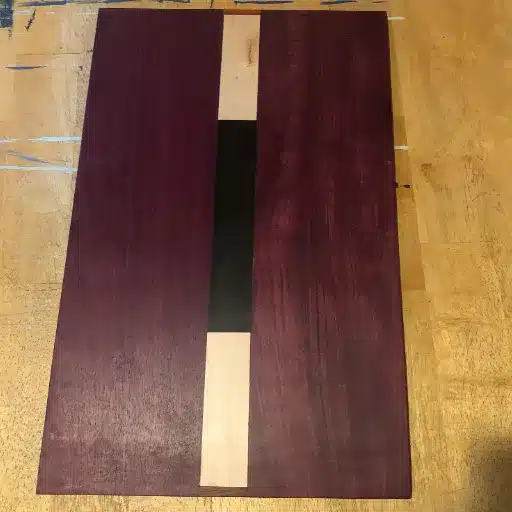
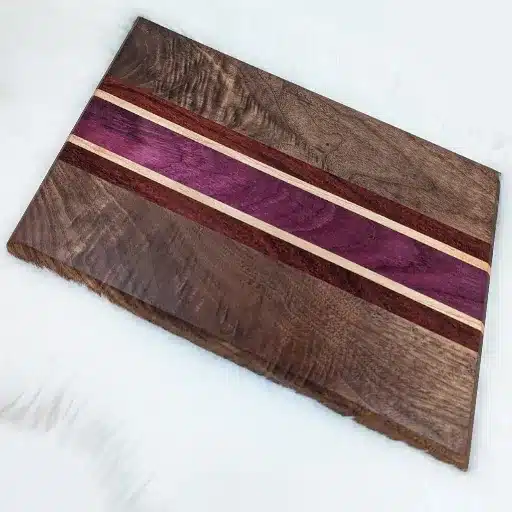
There is one point nearly every source agrees on: use these woods as accent strips, not the whole board. Purpleheart’s low movement (about 3.9% tangential) makes it good for end-grain boards that self-heal knife scars, and its antibacterial properties are a genuine bonus. But a full purpleheart board is heavy, hard on knives, and will drift brown over time. A full padauk board can literally sweat an oily film onto food, so experienced builders keep padauk to a splash of color rather than the main surface.
Pair them with maple, walnut, or cherry for maximum contrast, and you get the best of both worlds. Before you build, read our guide to is purple heart wood food safe for finish and food-contact details.
Purpleheart vs Padauk for Guitars and Instruments
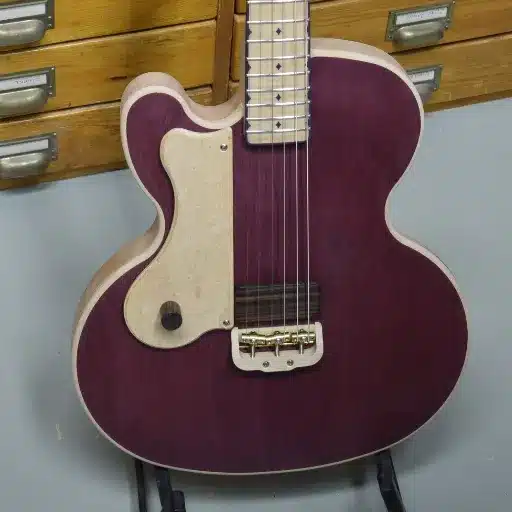
For instrument builders, the choice is as much about tone as appearance. Purpleheart is described as clear and bright with some high-frequency damping, giving a deeper, more resonant voice than hard maple. Padauk sits closer to mahogany in character, with a warm and articulate sound. Both are harder and stronger than maple, so either can work for a neck.
The weight warning applies here. A full guitar body from either species will be heavy, and purpleheart is the heavier of the two. Chambering or pairing with lighter woods is the standard fix. For neck blanks, purpleheart is known to stay stable once acclimated; one builder reported his purpleheart neck never shifted or twisted out of tune. If you plan to turn pens, knife handles, or bottle stoppers, both species behave beautifully on the lathe with sharp carbide. Our guide to purple heart wood turning covers projects and tooling in depth.
Purpleheart vs Padauk Price and Availability
Price is where the SERP leader gets it wrong, so let us give you real numbers. As of 2026, purpleheart typically runs about $15–30 per board foot, with common kiln-dried 4/4 stock around $15–22 and premium grades higher. FSC-certified purpleheart can command a 25–40% premium over wild-harvested stock. Good news for buyers: 2026 purpleheart prices have been easing, driven by improved South American shipping and more certified supply.
Padauk usually costs less, around $12–20 per board foot. African padauk is the common commercial variety; Andaman padauk is rarer and can cost more. Availability for both is generally good, but grades and certification vary widely between suppliers.
Purpleheart vs Padauk vs Wenge vs Walnut: The Wider Field
If you are weighing more than two species, here is how the broader field stacks up. Walnut is the softest and cheapest of the group, easy to work, with a stable brown color and a refined look. Wenge is extremely hard and dark, with a striking coarse grain, but it splinters badly and leaves painful splinters in your hands. Purpleheart is the hardest and most dent-resistant, ideal for wear surfaces. Padauk is the easiest to work among the exotics and the most knife-friendly, with the warmest color.
| Wood | Janka (lbf) | Workability | Color | Best For |
|---|---|---|---|---|
| Purpleheart | ~2,220–2,520 | Hard | Violet to brown | Flooring, inlays, heavy use |
| Padauk | ~1,710–1,970 | Easier | Orange-red to crimson | Cutting boards, furniture, instruments |
| Wenge | ~1,630 | Hard, splinters | Dark brown/black | Accents, veneer, flooring |
| Walnut | ~1,010 | Easy | Rich brown | Furniture, cabinetry, gunstocks |
The honest verdict: there is no wrong answer. The right species depends on your project’s needs and your tolerance for sanding.
Are Purpleheart and Padauk Sustainable?
This is the question most comparison pages skip, and it matters. The Peltogyne genus that produces purpleheart is not listed on the CITES Appendices, but the species Peltogyne purpurea is assessed as Vulnerable in parts of Costa Rica, Panama, and Colombia, and it is legally protected in Costa Rica. Some Pterocarpus species that yield padauk face regional pressure too. In short: source carefully.
The responsible buying checklist is simple. Look for FSC certification, confirm legal harvest and chain-of-custody documentation, request kiln-dried lumber at a stable moisture content, and buy from a supplier that can show you where the wood came from. That is exactly how we source every exotic species we supply at VitalWood Global.
Which Should You Choose? A Decision Guide
Here is the quick version you can take to the lumber yard:
- Choose purpleheart if you need maximum hardness and dent resistance, love the violet color, and accept difficult machining, pre-drilling, and a higher price.
- Choose padauk if you want easier workability, a warm orange-red tone, lower cost, and better knife-friendliness for cutting boards.
- Choose both as paired accent stripes for maximum contrast in a mixed-species board.
- Choose neither as the main surface of a cutting board; both shine as accents.
When Maya started her charcuterie business in 2025, she nearly built every board from purpleheart for its dramatic look. Two weeks and three dulled knives later, she switched to padauk and maple accents on a walnut base. “The boards still turn heads,” she said, “but now my knives stay sharp and my arm does not ache.” That is the practical lesson this entire comparison comes down to: pick the wood for how it performs, not just how it photographs.
Frequently Asked Questions
Which is harder: purpleheart or padauk?
Purpleheart is harder, at roughly 2,220–2,520 lbf on the Janka scale, versus about 1,710–1,970 lbf for African padauk. That makes purpleheart more dent-resistant but more difficult to machine.
Is padauk easier to work than purpleheart?
Yes. Padauk is significantly easier to cut, sand, and finish than purpleheart, which blunts tools quickly, burns easily, and exudes resin when heated.
Does padauk cost more than purpleheart?
Usually the opposite. Padauk typically runs about $12–20 per board foot, while purpleheart runs about $15–30. Rarer padauk varieties like Andaman can cost more.
Which keeps its color longer, purpleheart or padauk?
Neither. Purpleheart fades from violet to brown, and padauk darkens from orange-red to deep crimson. UV-inhibiting water-based finishes slow both changes but do not stop them.
Which is better for a cutting board: purpleheart or padauk?
Padauk is friendlier to knives and easier on thin blades, but both are best used as accent strips rather than the main board surface.
Is padauk toxic?
Padauk dust is a sensitizer that can cause skin and respiratory irritation in some people, and it stains everything orange. Always wear a mask and use dust collection.
Conclusion
Purpleheart and padauk are two of the most striking exotic hardwoods you can buy, and now you know exactly how they differ. Purpleheart gives you more hardness, density, and dent resistance, at the cost of difficult machining and a higher price. Padauk gives you easy workability, a warm orange-red color, and better knife-friendliness, at the cost of some durability. Both change color over time, and both are best used as accents in mixed-species projects.
Buy certified, kiln-dried stock from a responsible supplier, plan your finish before you cut, and let the color surprise you in the best way. If you want guidance on sourcing, contact VitalWood Global for responsibly sourced exotic wood and veneer, and explore our complete purple heart wood guide to go deeper into working with this remarkable species.