
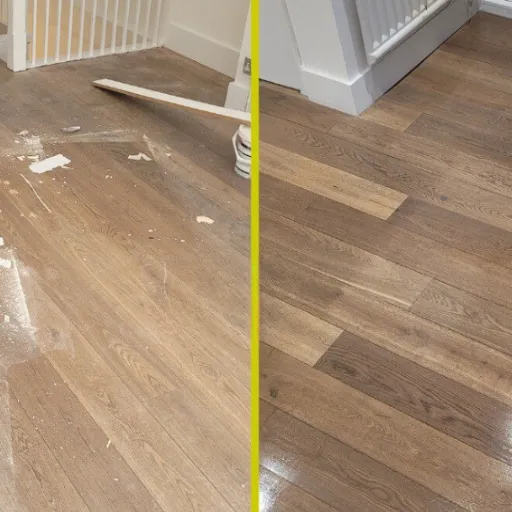
Refinishing Engineered Hickory Flooring: What Works
Refinishing engineered hickory flooring depends on wear layer, factory finish and density. Check what your floor allows, plus costs, grits and when to replace.
Yes, you can refinish engineered hickory flooring, but only when the real-wood wear layer is thick enough to survive sanding: about 2.5 mm on a factory-finished product, or 2 mm for one careful professional pass. Hickory adds a second constraint. At roughly 50 lb/ft³ and 1,820 to 1,880 Janka, it dulls abrasives faster and tears out more readily than oak or maple, so the job runs slower and costs more.
This guide covers the wear-layer test, the sanding sequence, the texture decision that cannot be reversed, and when replacement is the better spend. For the general process, our guide to refinishing engineered hardwood floors covers every engineered species.
Key Takeaways
- The wear layer decides whether refinishing is possible at all. NWFA sets 2.5 mm as the minimum for factory-finished engineered products and 3/32 in (2.4 mm) as the sanding guideline. Below about 1 mm, recoat or replace.
- Hickory’s density is a cost driver. Expect more abrasive changes, slower passes and a price near the top of the $3 to $8 per sq ft full-refinish range.
- A screen-and-recoat often fails on factory aluminum oxide. Test a closet patch before committing the whole floor.
- Hand-scraped and wire-brushed hickory is a one-way decision. Sanding flattens the texture permanently.
- Staining hickory rarely produces an even colour. Natural or light, with a large test patch, is the honest recommendation.
Can You Refinish Engineered Hickory Flooring?
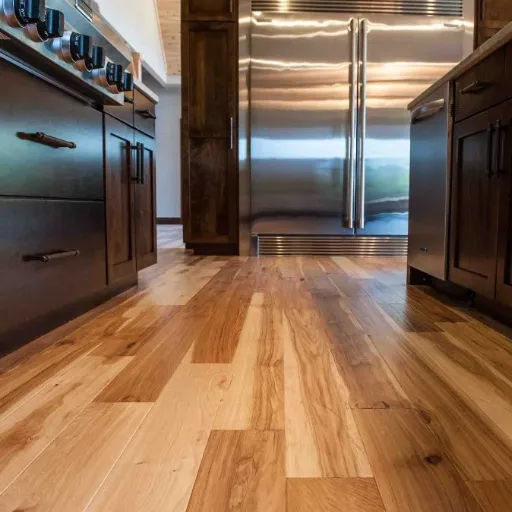
You can refinish engineered hickory when two tests pass. The wear layer must be thick enough to lose material and still protect the core, and the floor must be flat, dry and structurally sound.
Test one is thickness. Engineered hickory carries a real hickory face over a plywood, HDF or lamellar core. Only the face can be sanded. Cut through it and the board is finished.
Test two is condition and coating. Cupping, delamination, water damage or a hollow core will not be fixed by sanding. Neither will a factory finish that refuses to abrade evenly.
The NWFA Refinishable Program sets 2.5 mm for factory-finished engineered products and 3.2 mm for unfinished ones. The sanding guideline separately requires 3/32 in (2.4 mm) above the tongue. Treat 2.5 mm as the safer threshold near the line.
If a sander cuts through the face, you expose the core. That board cannot be repaired by refinishing. It has to be replaced, and a patch can be blended in a variegated floor, but it will not be invisible.
The Engineered Hickory Wear Layer Decides Everything
Wear layer is the thickness of real hickory above the core. It is stated in millimetres on the specification and ranges from about 0.6 mm to 6 mm on sawn-face premium planks.
How to Measure It Without Ruining a Board
Read the specification sheet. The product name, order record or box label usually carries the figure.
Look at a cut edge. Pull a floor vent or lift a threshold. The cross-section shows face veneer and core; a caliper against that edge gives you a real measurement.
Use the nickel test. A US nickel is about 1.95 mm thick. If the veneer at the vent looks thinner than the edge of a nickel, do not sand it.
If the floor has already been sanded once, assume one cycle has been spent.
Wear Layer to Refinishing Cycles
| Wear Layer | Can It Be Sanded? | Realistic Cycles | What to Do |
|---|---|---|---|
| 0.6 to 1 mm | No | 0 | Screen-and-recoat only, or replace |
| 2 mm | Borderline | 1 careful pass | Professional only; test a hidden area |
| 2.5 to 3 mm | Yes | 1 to 2 | Standard full refinish |
| 4 mm | Yes | 2 to 3 | Full refinish, stain options open |
| 6 mm+ | Yes | 3 or more | Behaves close to solid hickory |
The cycle count is not a warranty. Deep bevels or previous repair can use up the margin faster, and engineered hickory vs solid hickory covers the rest.
Have a wear-layer figure but no floor in front of you? Send the product specification, square footage and subfloor type to our team and we will help you interpret what the number allows. Request a specification review.
Why Hickory Sands Differently From Oak or Maple
Hickory is the hardest common domestic flooring species. That’s a selling point: it resists dents better than red oak, white oak or hard maple, which is why is hickory flooring good for dogs turns on the finish. The same property makes refinishing more demanding.
| Species | Janka (lbf) | Average Dried Weight | Sanding Behaviour |
|---|---|---|---|
| Shagbark hickory | 1,880 | ~50 lb/ft³ | Dulls abrasives quickly; tearout risk |
| Pecan (sold as hickory) | 1,820 | ~46 lb/ft³ | Similar; slightly lighter |
| Hard maple | 1,450 | ~44 lb/ft³ | Hard but more uniform |
| White oak | 1,360 | ~47 lb/ft³ | Moderate; forgiving grain |
| Red oak | 1,220 | ~44 lb/ft³ | Easiest of this group to sand |
Species figures from The Wood Database’s shagbark hickory entry.
Density dulls abrasives faster. Denser wood does more work per pass, heats the abrasive and dulls it sooner. A belt that would finish an oak room may need replacing before the hickory room is done, and a contractor who doubles the paper budget will price the job accordingly.
Interlocked grain tears out. Interlocked grain plus extreme hardness is a recipe for tearout when tooling is dull; the surface chips or tears rather than cutting cleanly. It’s also why so much hickory is sold wire-brushed or hand-scraped: texture hides minor tearout.
Light colour shows every mark. Sapwood is creamy to white; heartwood runs medium to dark brown, sometimes with mineral streaks. That light background makes chatter, swirl marks and dished soft streaks unusually visible, so machine control matters more than speed.
Burnishing is the quiet failure. Burnishing polishes the surface so smooth that stain or finish cannot key into it. It happens when the final pass is too fine or the machine is moved like a buffer. Stop at 120 grit; 150 or 180 closes the grain and creates adhesion problems.
For comparison, our notes on refinishing maple floors cover a tighter, more uniform grain that hides less.
Screen and Recoat Engineered Hardwood Floors vs. Full Sand
A screen-and-recoat abrades the existing finish lightly and applies a new protective coat. It removes almost no wood, which makes it the only option on a thin wear layer. A full sand removes the finish to bare wood and allows a colour change.
The distinction matters more on hickory because so much prefinished hickory carries an aluminum oxide factory finish. Aluminum oxide sits at roughly Mohs 9, second only to diamond among common abrasive minerals. Factory finishes load it into the top coats, and the result outlasts site-applied polyurethane.
It also resists preparation for a new coat. A fine screen under a buffer may barely scratch it, and factory coatings can carry high surface tension and additives such as Teflon or Scotchgard that repel a fresh finish.
The reliable route is a manufacturer’s recoat-adhesion system, paired with its approved topcoat, plus a test patch. Coat a closet area, let it cure, then try to scratch it off with a fingernail. If it lifts, stop. Our explainer on aluminum oxide floor finish covers why.
Hand Scraped Hickory Refinishing: A One-Way Decision
Sanding a textured hickory floor flattens it. You can’t sand out the texture and then put it back. That gives you three options:
- Keep the texture and recoat. Lowest material removal, but the recoat must bond to the factory finish.
- Sand it flat and accept a smooth floor. A permanent change in character that also takes extra material.
- Replace it with the texture you actually want. Usually the honest answer when the wear layer is thin.
Decide before the first pass. A contractor who starts sanding “to see how it looks” has already spent part of your wear layer.
Refinishing Engineered Hickory Flooring: The Sanding Sequence
This sequence is for a full sand on a floor with enough wear layer, an empty room and fasteners set below the surface.
- Confirm the wear layer and moisture. Measure at a vent or threshold. Check indoor relative humidity; hickory pages on this site use a 35 to 55 percent target. Do not sand a floor holding excess moisture.
- Remove the factory finish with 36 or 40 grit. This is the slowest pass on aluminum oxide. Diamond-embedded abrasives may be needed. Keep the machine moving.
- Level with 60 grit. This removes chatter and machine marks from the first pass. Do not skip it.
- Refine with 80 grit. Hickory’s light colour will show any scratch left by a skipped grit.
- Finish at 100 to 120 grit. Stop at 120. Do not polish the surface.
- Vacuum thoroughly. Dust left in the grain becomes a finish defect.
- Water-pop the grain. Wipe with a damp cloth, let it dry, then make a light 120 grit pass. This raises crushed grain so the finish does not dry rough.
- Stain if required, then seal and finish. Two to three coats, following the manufacturer’s system.
Three things matter more on hickory than on oak: do not skip grits, keep the machine moving, and use sharp, fresh abrasives. NWFA guidance on sanding limits explains how much material a pass should remove.
Staining and Colour: Why Hickory Blotches
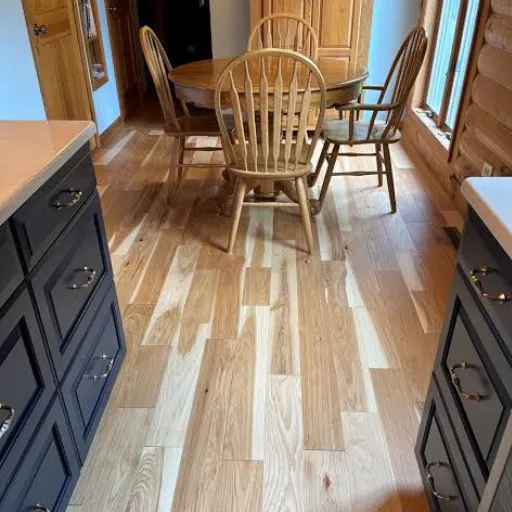
Hickory’s colour variation is not a defect. It is the species. Sapwood is light, heartwood is dark, and mineral streaks run through both. Density also varies between those zones, and stain absorbs differently into dense and less dense wood.
The result is blotching. A dark stain does not even out a calico hickory floor; it makes the contrast look muddy. Keep the floor natural or go light, and approve a large test patch before ordering stain.
If you want a darker tone, water-pop first, then use a pre-conditioner or gel stain. Both slow absorption and reduce blotching; neither eliminates it. Test on a 3 ft by 3 ft area, because a small sample will not show how stain behaves across sapwood, heartwood and mineral streak. Use a clear, non-yellowing finish: oil-based polyurethane yellows the light sapwood and increases contrast over time.
Refinishing cannot make a Natural or Rustic grade floor look like Select grade. If the variation is the problem, the grade is the cause, and our guide to hickory flooring colour variation explains what each grade contains.
Repair Before You Refinish
Refinishing is the right moment to fix damage that sanding alone will not remove. It is also when a bad repair becomes permanent, so sequence the work correctly; hickory flooring problems covers the diagnosis.
Dents. A dent that hasn’t broken the finish can sometimes be raised with steam: a damp cloth and a warm iron, held briefly, repeated. This works best on raw wood. On a finished floor, the finish may crack and leave a mark sanding won’t remove.
Scratches. Surface scratches can be touched up or removed by a recoat. Scratches that have cut into the wood need sanding, and deep gouges may need a colour-matched filler.
Board replacement. A damaged board is cut out, the tongue is removed, and a replacement is glued or splined in. In a variegated hickory floor, a new board blends better than in uniform maple because the eye expects variation. The limits are lot matching and age: a new board may be lighter, and its sheen will differ until the floor is recoated.
Cupping and crowning. Fix the moisture source before sanding. Sanding a cupped floor removes more material from the high edges and can thin the wear layer unevenly.
What It Costs in 2026
Costs vary by region, access and condition. These ranges are for planning, not for a quote.
| Approach | Typical Cost per Sq Ft | Best For |
|---|---|---|
| DIY screen-and-recoat | $0.50 to $1.50 | Thin wear layers, confident DIYers |
| Professional screen-and-recoat | $1 to $3 | Light wear, no bare wood, bonded finish |
| Professional full refinish | $3 to $8 | Wear layer 2.5 mm+, colour change, repairs |
| Full replacement | $8 to $25 | Thin wear layer, core damage, texture change |
For an 800 sq ft main floor, a professional recoat runs about $800 to $2,400, a full refinish about $2,400 to $6,400, and replacement about $6,400 to $20,000. That gap is why an accurate wear-layer measurement matters more than a second opinion on stain colour.
Hickory lands at the top of the full-refinish range because of more abrasive consumption, slower passes and more careful edge work. A quote much cheaper than the local range usually has not accounted for the paper. Add stain, board replacement, furniture moving, dust containment and, in pre-1978 homes, lead-safe practices.
The resale case is real but should be dated honestly. The National Association of Realtors’ 2022 Remodeling Impact Report put cost recovery at 147 percent, the highest of the interior projects it tracked. That reflects professional work, not a DIY recoat. For material and installed cost by grade, see our hickory flooring cost guide.
DIY or Professional?
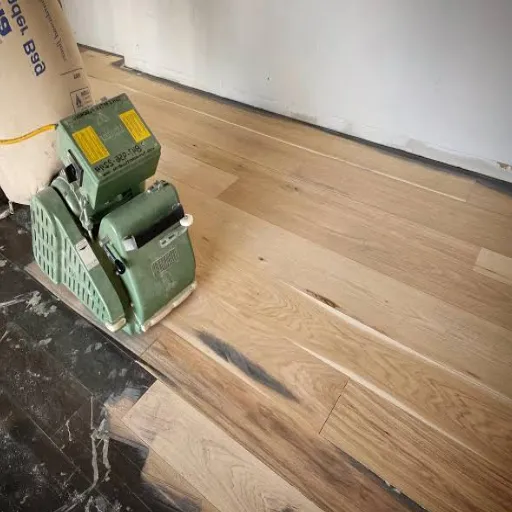
DIY can work on a thick wear layer, a single room and a floor that needs only a light sand or a recoat. It rarely works on a thin wear layer, a colour change or a textured floor.
DIY makes sense when the wear layer is 3 mm or thicker, you have used a floor sander before, the floor needs only a recoat, you can dedicate three to five days to prep and curing, and you have dust containment.
Hire a professional when the wear layer is 2 mm or less, the floor is large or textured, you want to change the stain colour, the floor is cupped or delaminating, the home was built before 1978, or you cannot afford to replace the floor if the sand goes through.
A professional carries insurance for sand-through. A DIYer carries the replacement cost. On a 2 mm hickory floor, one careless pass near a doorway can turn a $500 rental into a five-figure replacement.
When Refinishing Engineered Hickory Flooring Is Not Worth It
Refinishing is the wrong answer when the wear layer is 1 mm or less and the finish has worn through; boards are cupping, crowning or delaminating; the core has moisture damage, swelling or mould; the floor has already been sanded and little face remains; the texture is the reason you bought the floor; you want a different species, plank width or grade; or the manufacturer’s warranty excludes site refinishing or recoating.
Check that last point before the sander arrives. Some engineered hardwood warranties exclude owner- or contractor-applied refinishing and recoating from finish coverage, and some thinner products have no sand-and-refinish allowance. Shaw, for example, limits its sand-and-refinish warranty to 3/4 in products and excludes non-factory finishes from finish-wear coverage. Read your own warranty.
Frequently Asked Questions
Can you refinish engineered hickory flooring?
Yes, if the wear layer is thick enough. Factory-finished engineered products need about 2.5 mm; 2 mm allows one careful professional pass. Below 1 mm, recoat or replace.
How many times can you refinish engineered hickory?
A 2.5 to 3 mm wear layer usually allows one to two full sandings; 4 mm allows two to three. A 6 mm or thicker sawn face can take three or more.
Can you screen and recoat engineered hickory?
Sometimes. It works on a lightly worn floor with no bare wood. Aluminum oxide can reject a recoat even after screening, so test a closet patch first.
Can you stain engineered hickory a different colour?
Only if the wear layer allows sanding to bare wood. Hickory stains unevenly, so natural or light tones are more reliable; dark tones need a pre-conditioner or gel stain and a large test patch.
Why does my hickory floor blotch when stained?
Sapwood and heartwood differ in density, so stain absorbs at different rates. Mineral streaks add to it. Water-popping, pre-conditioner or gel stain reduce blotching but do not eliminate it.
Can you refinish hand-scraped hickory?
You can sand it, but the hand-scraped texture is gone permanently. If you want to keep it, a recoat is the only option; if the wear layer is thin, replacement may be better.
Is it cheaper to refinish or replace engineered hickory?
Usually. A full refinish runs $3 to $8 per sq ft; replacement runs $8 to $25. The gap narrows when the wear layer is too thin or the core is damaged.
Conclusion
Refinishing engineered hickory flooring is a thickness decision first and a species decision second. Measure the wear layer, confirm the floor is sound, and decide what to do about texture before anyone touches it with sandpaper.
At 2.5 mm or more, a full refinish is realistic. At 2 mm, one careful professional pass is the limit. Below 1 mm, recoat or replace.
Then plan for hickory: more abrasive changes, a slower sequence, and a final pass that stops at 120 grit. Keep the colour natural or light unless you have tested a dark stain on the actual floor. Check the warranty too, because a finish warranty and a refinishing allowance are not the same thing.
If you are specifying a new floor, start with construction: wear layer, core and finish system. Our engineered hickory flooring guide covers those choices. Send your specification or request a sample and we will confirm what applies to your order.