
Hickory Flooring Problems: Causes, Fixes and Prevention
Most hickory flooring problems are moisture, not the species. Hickory moves more than oak, maple or walnut, so a house with dry winter air shows up first as gaps in the hickory floor, and a wet season shows up as cupped edges. The rest of this page is how to confirm that, what each symptom means, and which problems a filler will never fix.
Key Takeaways
- Shagbark hickory shrinks about 10.5% tangentially, against 8.6% for red oak and 9.9% for hard maple. The tangential figure is what opens a gap across the board width.
- Gaps that close in the humid season are normal. Gaps that stay open year-round usually mean compression set, and filler won’t fix those.
- Cupping has two opposite causes: too much moisture from below, and air dry enough to shrink the face faster than the back.
- Hold indoor relative humidity at the manufacturer’s stated range year-round. Most hickory products publish 35% to 55%; NWFA’s baseline is 30% to 50% at 60°F to 80°F.
- Repair is worth doing while it stays under roughly 30% to 40% of replacement cost. Past that line, buy a new floor.
Still deciding whether hickory is the right species at all? The engineered hickory flooring guide covers grades, core construction and wear layers.
Why Hickory Shows Problems First
Wood moves because it takes on and releases moisture, and hickory does that more than the species it gets compared to. The Wood Database publishes shrinkage from green to oven-dry, and hickory sits at the top of the group.
| Species | Radial | Tangential | Volumetric | Janka (lbf) |
|---|---|---|---|---|
| Shagbark hickory | 7.0% | 10.5% | 16.7% | 1,880 |
| Pignut hickory | 7.2% | 11.5% | 17.9% | 2,140 |
| Pecan | 4.9% | 8.9% | 13.6% | 1,820 |
| Hard maple | 4.8% | 9.9% | 14.7% | 1,450 |
| White oak | 5.6% | 10.5% | 16.3% | 1,350 |
| Red oak | 4.0% | 8.6% | 13.7% | 1,220 |
Source: . Figures vary by specimen and source, so treat them as close approximations.
One honest complication belongs next to that table. White oak’s tangential figure, 10.5%, matches shagbark hickory’s exactly. Hickory isn’t uniquely unstable in every direction.
What makes it visible is that hickory is commonly sold wide and plain-sawn, which puts more tangential movement across more board width. Its pale-to-dark color range makes any shadow line easier to see. The tangential number is the one that matters, because boards are flat-sawn and the width you walk on follows that direction.
Put a number on it. Hickory’s dimensional change coefficient is about 0.00411, and JLC’s worked example applies it this way: a 5 in. flat-sawn board moves roughly 3/32 in. across a 4% swing in moisture content. Across an 8 ft room, that swing adds up to almost 1 3/4 in.
It’s calculated from a coefficient, not measured, and assumes every board moves together. It still explains why a dry February opens gaps a spotlight can find.
Hardness is a separate issue. At a Janka of 1,880 to 2,140, hickory blunts cutting edges and resists dents, which is good for a floor’s life and hard on the installers.
Is Hickory Flooring Gapping Normal?
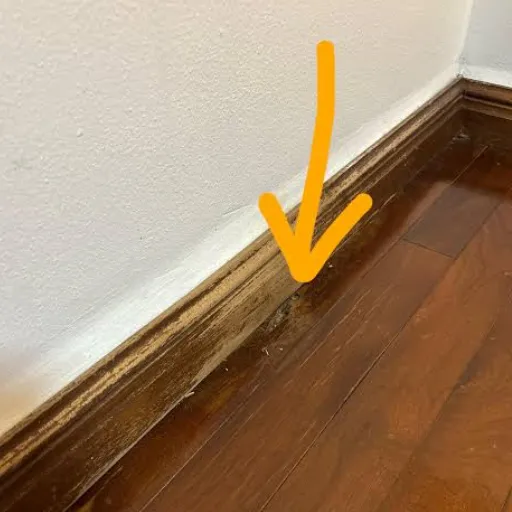
Seasonal gapping in hickory is normal, and it is the most common hickory flooring problem reported. Boards lose width as indoor air dries, and the gaps close when humidity returns. Normal gapping closes in the humid season, distributes evenly, and scales with board width; it appears along the long edges first and is widest in the driest month.
As a scale reference, a documented oak case in the Journal of Light Construction ran most hardwood floor gaps at 3/64 in. at 20% to 30% indoor humidity, and the gaps closed once humidity was brought back to 40% to 50%. That was oak. Expect hickory to run wider at the same humidity, and don’t use an oak number as a pass-fail threshold.
The four-point test
Take four readings before you book anyone. They cost nothing and they decide most cases.
- Relative humidity indoors, logged over 24 to 48 hours with a hygrometer.
- Moisture content of the boards and the subfloor, with a pin or pinless meter, same day.
- Gap width in millimeters and inches, at the widest point with a feeler gauge, plus whether the gaps are even across the room.
- Whether the gaps close. Compare with the end of the humid season.
A floor that gaps at 25% indoor humidity and closes at 50% needs a humidifier, not a repair. A floor that gaps at 45% has something else going on.
What is not normal
Six symptoms cover most hickory flooring problems. Read the middle column before you call anyone.
| Symptom | Usually normal when | Points to a problem when |
|---|---|---|
| Edge gaps | Close by the end of the humid season, even distribution | Stay open year-round, or one side of a room only |
| Edges higher than centers | Nothing, this is never normal | Cupping: check moisture from below and above |
| End cracks or splits | Very fine surface checks that don’t catch a fingernail | A split you can feel, or one through the board |
| Popping underfoot | Occasional noise in the first heating season | Repeats in the same spot, or sounds like a gunshot |
| Color differences between boards | The full range is a grade decision | A single board changes color after installation |
| Finish scratches | Light scratches in the coating | Wear through to bare wood in traffic lanes |
The one you can’t fix with filler is compression set. It runs on a schedule you can date. A floor goes down in a wet season against a building schedule that is behind. The HVAC isn’t running yet, so nobody controls the humidity. The boards take on moisture, expand, press against each other edge to edge, and crush the wood fibers at the joints.
By the time the house dries out for its first winter, those edges can’t spring back. The boards are permanently narrower than the space they occupy, and the gaps don’t close in any season.
JLC describes the mechanism in Coping with Shrinking Wood Callbacks. The consequence is unwelcome: the floor has to come up and be relaid or replaced. Filling it hides the gap until the filler shrinks out again, which it will.
Hickory Cupping and Buckling: Why the Edges Lift
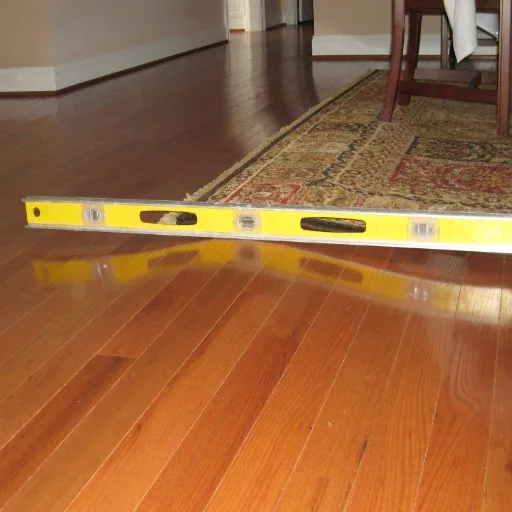
Cupping means the edges of each board sit higher than the center, so the floor reads as shallow troughs. It is the other hickory flooring problem a moisture test can separate, after gapping, and it happens when the bottom of the board holds more moisture than the top: the bottom swells, the top doesn’t, and the difference has to go somewhere.
- From below. A slab without a tested vapor barrier, a damp crawlspace, or an unchecked subfloor. This is the most common cause on grade and below, and our guide to engineered wood flooring for basements covers the barrier and testing requirements.
- From above. A spill, a leak, a wet mop left standing, or a humid season with the air conditioning off. The face swells and the board crowns.
- From dry air. This one surprises people. In very dry conditions the face shrinks faster than the hidden back, so the edges lift. Inspectors call it dry cupping, and it’s a humidity problem, not a leak.
An inspection report in Hardwood Floors magazine shows how wide the failure window actually is. In August 2022, Nathan Carter, an NWFA-certified installer, sander, finisher and inspector, inspected two failed engineered hickory floors in the same week.
The first sat above 60% relative humidity against a warranty range of 30% to 50%. The second sat below 20%, against a range of 35% to 55%. Neither owner had been told the humidity range at the point of sale. His former employer stopped selling engineered hickory in Alaska and Montana because the failure rate was too high. The full report is worth reading whole.
Two floors, one species, one week, opposite extremes, and neither was a manufacturing fault. What gets called a hickory defect is often a climate mismatch, and the fix is a humidifier or a dehumidifier, not a claim.
Crowning is the sequel. A floor that cups after a water event and then dries under traffic can end up with centers high and edges low. That surface has already been compressed.
Sanding recovers light cupping if enough wear layer is left. On solid hickory that means at least 3/32 in. (2.4 mm) of wood above the tongue. On engineered it depends on the wear layer, and below about 2 mm there’s nothing to take a cut. The generic diagnostic sequence for engineered assemblies is in prefinished engineered hardwood problems, which never mentions hickory.
Splits, End Cracks and Popping
A check is a split along the grain, usually at an end and usually shallow. A crack goes deeper, sometimes through the board. One is cosmetic and the other is structural.
Checks come from the surface drying faster than the interior, which is why they appear at board ends. Splits running from a fastener are installation, not climate: hickory is dense enough that nailing it without adjusting splits tongues and ends. Pre-drill at board ends, and size fasteners and pressure for a hard wood. The field test is whether you can feel it through the finish.
Popping is usually a moisture differential at installation. Boards installed at 6% to 7% moisture content over a subfloor at 12% to 14% take on moisture and swell once the house is occupied. The swelling shears fasteners or pulls them through, the board lifts, and every step flexes it. The noise is the board moving, not the wood failing.
Wide planks make it worse. The trade fix is glue assist: adhesive in the groove or on the subfloor alongside the fasteners, generally once planks pass about 4 in. See wide plank engineered flooring for the construction side.
Walk the floor in socks and mark where it moves, then press the spot. A board that deflects isn’t attached. Isolated hollows can be injected; a floor popping across a whole room usually can’t be fixed from above.
Color and Finish Wear: Two Problems That Aren’t Defects
Two of the most common complaints aren’t damage, and separating them from real hickory flooring problems saves inspection fees.
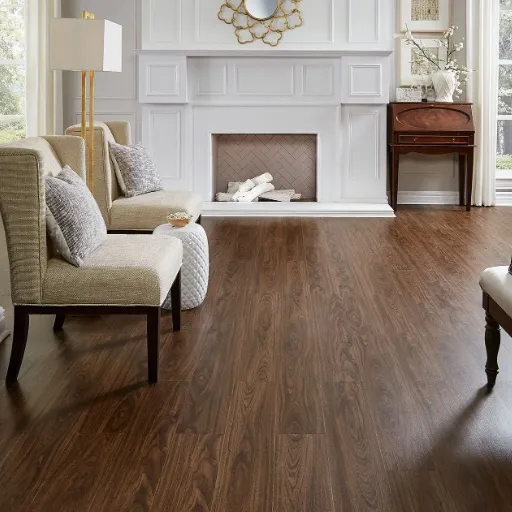
Boards ranging from pale cream to dark brown is what hickory looks like. Select grade sorts out most of the contrast, Natural or Character grade keeps the calico mix, and Rustic adds knots. If it’s more variation than you want, the answer is a different grade next time, not a claim on this floor. Our guide to hickory flooring color variation covers where that line falls.
Hardness protects the wood, not the coating. Hickory resists dents better than oak. It doesn’t resist scratches, and high contrast makes them visible because a light scratch in dark heartwood shows while the same scratch disappears in pale sapwood. That’s why a dog’s claws produce two different problems on one floor, and why is hickory flooring good for dogs comes down to finish choice and sheen rather than species.
Fixing Hickory Flooring Problems: What Each Remedy Costs
These are 2026 market ranges for repair, not prices. Verify locally, and ask bidders to itemize the abrasive surcharge, because a dense species is slower to sand. Not every hickory flooring problem is worth fixing at these prices.
| Remedy | Typical cost | Best for |
|---|---|---|
| Color-matched filler, up to the bevel | $50 to $200 per room in materials | Small, stable gaps |
| Adhesive injection per hollow | $30 to $150 per spot | Isolated hollow spots and popping |
| Single-board replacement | $150 to $400 per board, installed | Overwood, delamination or a failed joint |
| Professional screen-and-recoat | $2 to $4 per sq ft | Worn finish on a sound, thick wear layer |
| Professional full refinish | $3 to $8 per sq ft | Deep wear, only if the wear layer allows |
| Partial tear-out | $5 to $12 per sq ft | One room or one failed zone |
| Full tear-out and replacement | $8 to $25 per sq ft | Failure across the floor, or a spent wear layer |
Many contractors stop recommending repair once it reaches roughly 30% to 40% of replacement cost. On a thin engineered wear layer a full refinish quote often lands close to a replacement quote, and when the numbers converge, replace.
Hickory tops every sanding range because the wood is dense, so each pass removes less and takes longer. That’s also why 5% to 10% spare boards from the same lot are worth the small extra cost. Where the wear layer allows it, screen-and-recoat is the cheapest way to add years, and refinishing engineered hardwood floors explains how to tell whether yours has enough left. For the species-specific version, refinishing engineered hickory flooring has its own constraints. For material and installed pricing, see hickory flooring cost.
Replacing rather than repairing? Send us the plank width, the core type and the substrate, and we’ll confirm which constructions suit the climate the floor will live in. Request a quote.
Preventing Hickory Flooring Problems
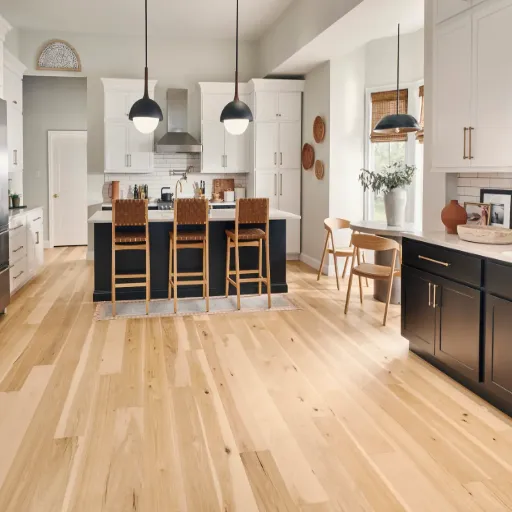
Almost every hickory flooring problem here traces back to moisture and installation, and both are controllable before the floor goes down.
Hold humidity in range, year-round. Use the manufacturer’s stated range, commonly 30% to 55% overall, with 35% to 55% the figure most hickory products publish. NWFA’s baseline is 30% to 50% relative humidity at 60°F to 80°F. Ranges differ by product, so the warranty number governs.
Acclimate, and record it. Measure moisture content in the boards and subfloor before installation and keep the readings. Hickory is commonly installed at 6.5% to 7.5%, with board and subfloor within 2 to 4 points.
Leave the right expansion gap. For solid hickory the perimeter allowance is roughly the thickness of the board, commonly 3/4 in. for a 3/4 in. plank. Most engineered products specify 1/4 to 1/2 in. A gap that’s too small is a buckling risk in the first humid season.
Test the subfloor properly. Flatness to 3/16 in. in 10 ft, and a moisture test suited to the assembly. On concrete that means an in-situ relative humidity probe or a calcium chloride test, not a plastic sheet taped down overnight.
For specifiers and distributors, put five things in the submittal: the required indoor relative humidity range, the moisture content required at delivery, the perimeter gap allowance, the spare-board percentage, and a named party responsible for humidity control after handover.
FAQ About Hickory Flooring Problems
Does hickory flooring have problems?
Hickory’s main issues are movement, color variation and hardness. It shrinks and swells more than oak, maple or walnut, so it gaps and cups more visibly. Its two-tone coloring is a grade characteristic, not a defect.
Is hickory floor gapping normal?
Seasonal gapping is normal. Boards lose width as indoor air dries, gaps open in winter, and they close when humidity returns. It’s a problem when gaps stay open year-round, appear on one side of a room only, or come with lifted edges.
Why is my hickory floor separating in winter?
Dry air. Indoor relative humidity drops when heating runs, and the boards shrink across their width. Hickory’s tangential shrinkage, about 10.5%, exceeds red oak’s 8.6%, so the same dry air opens a wider gap. A humidifier set to 35% to 55% usually resolves it.
Why is my hickory floor cupping?
The board’s underside holds more moisture than its face, so the edges rise. Common causes are a slab without a working vapor barrier, a damp crawlspace, a leak, or the opposite extreme: air dry enough to shrink the face. A moisture meter tells you which.
Can a gapped hickory floor be filled?
Small, stable gaps can be filled with color-matched filler. Gaps from compression set cannot: the board edges were crushed, the floor keeps moving, and the filler will crack out.
Can a cupped hickory floor be fixed without replacing it?
Sometimes. Light cupping on solid hickory can be sanded out if at least 3/32 in. of wood remains above the tongue. On engineered it depends on the wear layer, and below roughly 2 mm there isn’t enough material. Fix the moisture source first either way.
Why does my hickory floor pop or sound like gunshots?
Usually a moisture differential at installation, or wide planks nailed without glue assist. Boards installed dry over a wet subfloor swell after occupancy, shear their fasteners, and move underfoot. Isolated spots can be injected; a whole room usually can’t.
Does hickory flooring need a humidifier?
In most heating climates, yes. Hold indoor relative humidity in the manufacturer’s stated range, commonly 35% to 55%, through the heating season. A hygrometer settles the question faster than guessing.
Is hickory floor color variation a defect?
No. Hickory ranges from cream sapwood to dark heartwood, and how much contrast appears is set by grade. Select grade is calm; Natural or Character grade is the classic calico look. A single board that changes color after installation is the hickory flooring problem worth checking.
The Short Version
Hickory flooring problems follow one pattern: the species moves more than most, so humidity shows up earlier and more visibly than it would in oak. Gaps in winter that close in summer are normal. Year-round gaps usually mean compression set, and filler isn’t the answer.
Two outcomes can’t be reversed. Compression set needs the floor lifted and relaid. A spent wear layer can’t be sanded, whatever the finish looks like. Everything else is measuring first, treating the cause, and spending repair money only while it stays under roughly 30% to 40% of replacement cost.
If you’re specifying hickory rather than repairing it, put the humidity range and the moisture content at delivery in writing. Send your specification for a quote with the substrate, the plank width and the climate the floor will live in, and we’ll confirm what the construction can carry.