
Commercial Hickory Flooring: A Specifier’s Guide
Specify commercial hickory flooring with confidence: venue suitability, wear layers, grade and lot control, 2026 costs, submittals and wholesale sourcing.
Commercial hickory flooring is a heavy-traffic specification, not a residential upgrade with a commercial price. Hickory rates 1,820 to 2,140 on the Janka scale, higher than red oak, white oak, or hard maple, so dent resistance is rarely the problem. Consistency is.
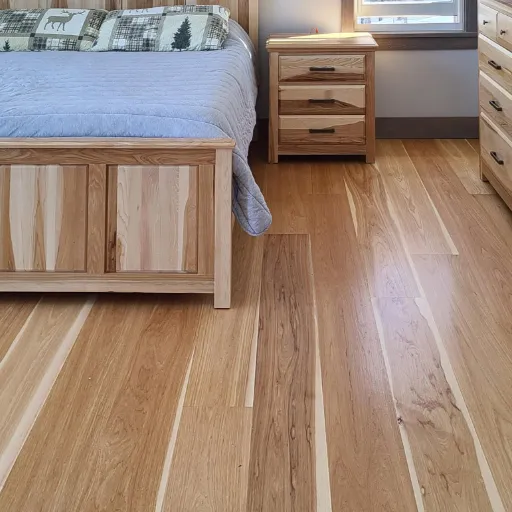
The same species produces cream sapwood and dark heartwood, sometimes in the same box. On a 10,000 sq ft floor plate, that range magnifies.
You’re not buying “hickory.” You’re buying a grade, a wear layer, a finish, a batch, and a moisture plan. Get those five right and the species performs. Get them wrong and the hardest floor on the market still fails inspection.
This guide gives you the venue test, the five specification decisions, the 2026 cost picture, the submittal package, and the questions to ask a wholesale supplier. It’s written for architects, contractors, distributors, and facility managers who have to defend the choice after the floor is installed.
Key Takeaways
- Hickory’s Janka of 1,820 to 2,140 qualifies it for heavy commercial traffic. The commercial risk is color variation, grade, and moisture, not dent resistance.
- Use 3 mm wear layer for light commercial, 4 mm for standard hospitality and office work, and 5–6 mm for heavy circulation. The NWFA refinishable minimum is 2.5 mm for factory-finished products.
- Specify grade as numbers: maximum sapwood percentage, acceptable color range, mineral streak allowance, and knot limits. “Character” alone is not a specification.
- Reserve one batch, approve a 20–30 sq ft mockup under final lighting, and buy 5–10% attic stock. On a large plate, those controls matter more than Janka.
- A commercial warranty must name commercial use. AC ratings are laminate classes and do not apply to engineered hardwood.
Is Hickory Flooring Suitable for Commercial Spaces?
Yes. Hickory flooring for commercial spaces works in most interiors where the design can accept natural color variation. Hickory is the hardest of the common North American flooring species, and its density gives it excellent resistance to dents, dropped tools, and concentrated loads. It’s a credible choice for hotel suites, multifamily amenity areas, offices, retail boutiques, and education or healthcare reception zones.
Hardness is not the same as scratch resistance. The Janka test measures the force required to embed a steel ball into the wood. A commercial floor takes most of its visible damage at the finish, not in the wood.
A hard species with a thin or soft coating will still show scratches, scuffs, and wear patterns. Finish system and maintenance matter as much as species.
| Species | Janka hardness (lbf) | Commercial position |
|---|---|---|
| Pecan (sold as hickory) | ~1,820 | Heavy commercial |
| Shagbark hickory | 1,880 | Heavy commercial |
| Pignut hickory | 2,140 | Heavy commercial |
| Hard maple | 1,450 | Heavy commercial, sports |
| White oak | 1,360 | Standard to heavy commercial |
| Red oak | 1,220 | Standard commercial |
| Black walnut | ~1,010 | Light commercial, feature areas |
Janka values from the Wood Database and pignut hickory entries. Hickory density runs about 50 to 52 lb/ft³, compared with roughly 44 lb/ft³ for hard maple and 43.8 lb/ft³ for red oak.
The species group matters. “Hickory” is a commercial label that can include true hickories such as shagbark and pignut, and pecan hickories such as pecan. Their density and hardness overlap.
Finished boards usually can’t be identified to species by eye. Ask for the scientific name on the specification, not just the trade name. For construction and residential buying, see our engineered hickory flooring guide.
Have a floor schedule open? Send it to our technical team and ask which rooms warrant a different species before the specification is issued.
Where Commercial Hickory Flooring Works, and Where It Doesn’t
Suitability is a function of traffic, moisture, and design intent, not the word “commercial.” Hickory can carry heavy foot traffic. It can’t carry standing water, and it is a poor fit where a perfectly uniform field is the design goal.
| Venue | Traffic level | Hickory suitability | Minimum specification |
|---|---|---|---|
| Hotel guest rooms and suites | Light | Yes | 3 mm wear layer, matte finish |
| Hotel lobby and lounge | Medium to high | Yes, with grade control | 4–6 mm, one batch, mockup |
| Hotel corridors and lift lobbies | High | Yes | 5–6 mm, textured finish |
| Restaurant dining room | Medium | Yes | 4 mm, finish with spot repair |
| Restaurant kitchen and bar back | High, wet | No | Porcelain or resilient |
| Office and boardroom | Light to medium | Yes | 3–4 mm, acoustic underlayment |
| Retail boutique | Light | Yes | 3–4 mm |
| Retail concourse or mall | High | Conditional | 5–6 mm, dark or character grade |
| Multifamily amenity lounge | Light to medium | Yes | 3–4 mm |
| Multifamily corridor | High | Yes | 5–6 mm, batch reservation |
| Education corridors and classrooms | High | Yes, with maintenance plan | 5–6 mm, aluminum oxide finish |
| Healthcare patient rooms | Medium | Conditional | 4–6 mm, emissions documentation |
| Gym, sports hall, wet room | High or wet | No | Maple sports floor, porcelain, or resilient |
Hospitality, Multifamily and Offices
Hickory works in hotel suites and multifamily amenity spaces because the species gives a residential warmth that porcelain and LVT can’t match. Corridors are the harder test. Cart traffic, luggage, and cleaning equipment concentrate wear in the same lanes, so specify a 5–6 mm wear layer and a finish that can be recoated without a full sand.
Consider a 140-key hotel where the design team wants hickory throughout. The suites and lounge can carry it. The back-of-house, kitchen, and service corridors cannot.
A common resolution is hickory in the guest-facing rooms, a darker character grade in the corridors, and resilient flooring behind the line. One batch reservation covers the hickory areas. The corridor grade is chosen to hide scuffs rather than to match the suites exactly.
Retail, Education and Healthcare
Retail boutiques and school reception areas are a good fit. Hickory’s hardness handles rolling fixtures, chairs, and the general abuse of a public floor. A matte or wire-brushed finish hides the everyday scuffs that a glossy finish amplifies.
Healthcare needs a more careful review. Hickory isn’t inherently antibacterial, and seams and joints can trap soil. Specify a cleanable finish, confirm the emissions documentation, and expect the maintenance team to follow a written protocol. In patient rooms and wet clinical areas, resilient flooring is usually the better answer.
Where Hickory Should Not Be Used
Don’t specify hickory in kitchens, dishwash areas, bar service zones, restrooms, saunas, or any room with standing water or frequent spills. Hickory’s heartwood is rated non-durable to perishable in ground contact, and the floor depends on a dry interior and a maintained finish. Don’t use it as a gym or sports floor; hard maple is the standard for those systems.
Where a uniform field is mandatory, choose white oak or hard maple. Hickory’s natural color range is the species’ defining look. If the design can’t accept that range, the species is the wrong choice, not the grade.
For the broader venue and standards framework, see our guide to commercial engineered wood flooring.
The Real Commercial Risk: Color Variation at Scale
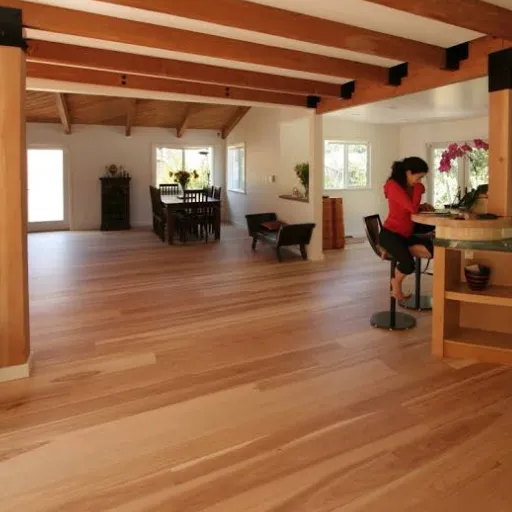
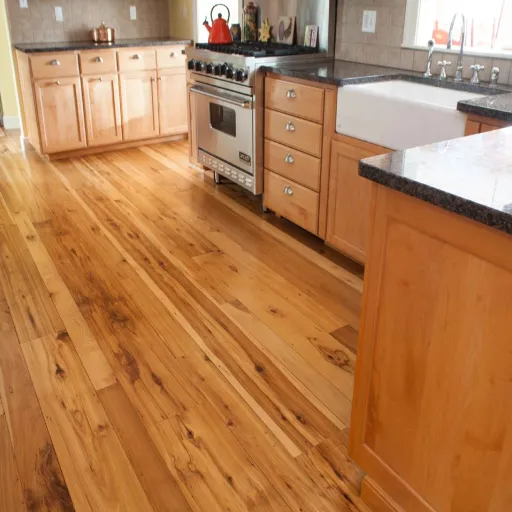
Hickory has the widest natural color range of the common domestic flooring species. Sapwood is cream to pale yellowish brown. Heartwood is light to medium brown with a reddish hue. Mineral streaks add blue-black lines, and boards that mix sapwood and heartwood produce the look the trade calls “calico.”
On a 200 sq ft residential room, that variation reads as character. On a 12,000 sq ft office plate, it reads as patchwork unless the grade and lot are controlled. The difference is not luck. It is specification.
Grade Is a Specification, Not an Adjective
Grade names vary by manufacturer. Select, Natural, Character, and Rustic may describe different things from one supplier to the next. Don’t accept a grade name without a written description. Specify the measurable criteria:
- Maximum sapwood percentage by face area.
- Acceptable heartwood color range, with a physical reference.
- Mineral streak allowance, including maximum length and frequency.
- Knot size and frequency limits.
- Filler and defect allowances.
- Whether the grade is assessed on the face, the back, or both.
A supplier who can’t put numbers or a physical reference against those items has not specified the grade. They have named it.
Mockup, Batch and Attic Stock
Three controls do most of the work on a large project. First, approve a mockup of 20 to 30 sq ft under the final lighting, not a single board in a showroom. Second, reserve one production batch or lot for the whole project. Third, buy 5% to 10% attic stock and store it on site under the same conditions as the installed floor.
Consider a 12,000 sq ft office fit-out where the design team approves a single hand sample. The sample is a mid-brown board with modest grain. The delivered floor includes cream sapwood and dark heartwood in adjacent rows. Under the 4000K ceiling lights, the reception area looks striped.
The fix is not a new species. It’s a written grade with a sapwood maximum, a mockup under the actual lighting, and a batch reservation before the order is released.
For the full color and grade guide, see hickory flooring color variation.
Specifying Commercial Hickory Flooring: Five Decisions
The commercial specification has five decisions that change performance, appearance, and cost. The species name is not one of them.
1. Wear Layer: 3 mm, 4 mm or 5–6 mm
The wear layer is the wood above the tongue and groove. It sets how many times the floor can be sanded. The NWFA Engineered Wood Flooring Refinishable Program sets a minimum of 2.5 mm for factory-finished products and 3.2 mm for unfinished engineered flooring. Its sand-and-finish guidance treats 3/32 in (2.4 mm) as the practical floor for sanding.
For commercial work, use the NWFA minimum as a floor, not a target.
| Commercial tier | Wear layer | Typical refinish potential |
|---|---|---|
| Light commercial | 3 mm | One light sand |
| Standard commercial | 4 mm | One to two sands |
| Heavy commercial | 5–6 mm | Two to three sands |
These tiers are project guidance, not an industry standard. Some commercial suppliers recommend 5–6 mm for heavy traffic. A master specification may call for 4 mm.
Confirm the wear layer in millimeters, with tolerance, on the submittal. Reject a “commercial grade” claim that doesn’t state a number.
2. Grade and Sapwood Allowance
Use the grade criteria in the previous section. On a commercial plate, a stated sapwood maximum is more useful than a poetic grade name. If the design wants the calico look, say so and set the range. If it wants a quieter field, specify a tighter grade or choose oak.
3. Core Construction
Commercial engineered hickory flooring usually uses a plywood, HDF, or lamellar core. Plywood is the most forgiving for commercial work. It holds fasteners, handles minor moisture swings, and glues down well over concrete.
HDF is stable and flat but more sensitive at edges and in wet cleaning conditions. A lamellar core is the premium option for wide planks and long lengths.
SPC and WPC cores are not wood floors. They can’t be sanded or refinished like a hardwood floor. If the project needs a waterproof product, specify a waterproof product and stop calling it hardwood. The construction choice is covered in more detail in engineered hickory vs solid hickory.
4. Finish System
| Finish system | Best for | Repair approach | Trade-off |
|---|---|---|---|
| Aluminum oxide | Hotels, offices, retail | Screen and recoat | Hard to spot-repair |
| UV oil | Restaurants, hotel lounges | Spot repair | More frequent maintenance |
| Hardwax oil | Feature areas, lower traffic | Spot repair | Needs a disciplined cleaning protocol |
Aluminum oxide gives the best abrasion resistance and the lowest routine maintenance. A cured film is hard to spot-repair, so damage usually means a screen and recoat of the whole area. UV oil and hardwax oil penetrate the wood instead of forming a film. They suit restaurants and lounges where spot repair matters, but they need a more frequent maintenance cycle.
Matte and textured finishes hide wear better than gloss. On hickory, a wire-brushed or lightly scraped surface also softens the color contrast between sapwood and heartwood. Confirm the sheen and the recoat interval in writing.
5. Format, Fixing and Installation
Wide and long planks look generous and move more with humidity. Herringbone and chevron increase waste and installation time. For commercial work, a 150 mm to 220 mm (about 6 in to 8.7 in) plank is a practical range.
Glue-down is the default over concrete. It’s quieter, more stable, and easier to detail at thresholds. Nail or staple over plywood where the substrate allows. Floating is acceptable only where the manufacturer’s commercial warranty covers it.
Acclimation, expansion gaps, and moisture testing are covered in the next section. Don’t skip them because the product is engineered.
For a comparison with a softer species, see how commercial walnut flooring handles the same venue decisions.
Movement, Moisture and Acclimation at Commercial Scale
Hickory moves more than oak or maple. Shagbark hickory shrinks about 7.0% radially and 10.5% tangentially, with 16.7% volumetric movement. Pignut runs about 7.2%, 11.5%, and 17.9%.
Red oak, the usual benchmark, sits at 4.0%, 8.6%, and 13.7%. Those figures come from the Wood Database.
That movement is why engineered construction matters more for hickory than for calmer species. A cross-ply core resists the seasonal swell and shrink that a solid board expresses as gapping, cupping, or checking. The core does not make the floor waterproof. It manages movement.
Specify the moisture plan before installation:
- Test the slab with ASTM F2170 (in-situ relative humidity) or ASTM F1869 (calcium chloride). Confirm the flooring manufacturer’s acceptance thresholds; they vary by product and adhesive.
- Acclimate the flooring to the building’s normal occupied conditions. Engineered products still need acclimation.
- Maintain indoor relative humidity around 35% to 55%. Commercial HVAC schedules often run drier in winter and wetter in summer than a residential system.
- Leave expansion gaps at perimeters, columns, and penetrations, and follow the manufacturer’s details.
- Protect the floor from standing water and prolonged damp cleaning. Hickory heartwood is not a decay-resistant species.
For the failure modes and fixes, see hickory flooring problems.
Commercial Hickory Flooring Cost in 2026
Commercial hickory costs more than residential hickory. The wear layer is thicker, the grade is tighter, and the documentation is more complete. Public benchmarks put residential hickory material at $4.15 to $7.15 per sq ft. Engineered hardwood installation runs $8 to $14 per sq ft, and high-grade projects reach $12 to $25 per sq ft, according to Fixr.
The table below is a planning estimate for 2026 U. S. commercial projects, not a quotation. Project pricing depends on grade, wear layer, finish, quantity, freight, and destination.
| Commercial tier | Material ($/sq ft) | Installed ($/sq ft) | Typical use |
|---|---|---|---|
| Light commercial, 3 mm | $6–$10 | $10–$16 | Boutiques, offices, suites |
| Standard commercial, 4 mm | $8–$13 | $13–$20 | Restaurants, hotel feature areas |
| Heavy commercial, 5–6 mm | $11–$17 | $17–$27 | Corridors, retail, education |
Those figures assume glue-down over a prepared slab. Add moisture mitigation, subfloor repair, transitions, stair work, mockup, attic stock, and freight separately.
Life-cycle cost is where a thicker wear layer earns its price. A 4 mm floor can be screened and recoated on a maintenance cycle and sanded once or twice over its life. A 6 mm floor supports more cycles. A 2.5 mm floor is a recoat-only product.
The difference is not cosmetic. It decides whether the floor can be renewed or must be replaced.
For residential pricing and a worked example, see hickory flooring cost.
Submittals, Warranties and Compliance
A commercial submittal is not a product brochure. It’s the evidence package that lets the architect, contractor, and owner agree on two things: what will be installed, and what happens if it isn’t.
The Submittal Package
- Species and scientific name, including whether the product is a true hickory or a pecan hickory.
- Grade, sapwood allowance, and the written grade criteria.
- Wear layer thickness in millimeters, with tolerance, and total thickness.
- Core construction and ply count.
- Finish system, sheen, and abrasion test data.
- Plank dimensions, batch or run number, and the attic stock quantity.
- FSC or PEFC chain-of-custody documentation where claimed, Lacey Act documentation including the PPQ 505 declaration, and EUDR due diligence for EU-destined projects.
- Fire test report to ASTM E84 or EN 13501-1.
- Slip resistance data to ASTM D2047 or DIN 51130.
- Emissions documentation to CDPH v1.2-2017 or FloorScore.
- Commercial warranty terms in writing.
- Installation method, adhesive specification, moisture test results, approved mockup, and spare stock.
What a Commercial Warranty Must Say
The warranty must name commercial use. Residential warranties are often voided by commercial installation. It should state the traffic level, the finish system covered, the maintenance requirement, and the exclusions. Ask for the warranty before the order, not after the floor fails.
Standards That Apply
Moisture: ASTM F2170 or ASTM F1869. Fire: ASTM E84 or EN 13501-1. Slip: ASTM D2047 or DIN 51130.
Abrasion: ASTM D4060. Emissions: CDPH v1.2-2017 or FloorScore. Confirm the exact edition and acceptance criteria with the project specifier and the local authority.
One correction worth making in any submittal review: AC ratings are EN 13329 classes for laminate flooring. They don’t apply to engineered hardwood. If a supplier quotes AC3 or AC5 for a hickory floor, ask for the test standard behind the claim.
For sourcing and legality, see our guide to FSC-certified wood veneer panels. For sustainable hickory flooring, FSC-certified options are available by product and species; confirm certificate scope and the document set your destination requires before ordering.
Buying Commercial Hickory Flooring Wholesale
Buying wholesale hickory flooring is a project-order exercise, not a catalog purchase. The supplier needs to reserve stock, match a batch, and document the shipment. The buyer needs to ask better questions than “what is your best price.”
Eight Questions to Ask a Supplier
- What is the exact species and scientific name?
- What is the wear layer thickness in millimeters, with tolerance?
- What grade criteria apply, including maximum sapwood percentage?
- Will you provide a commercial warranty in writing, and what does it exclude?
- Can you supply FSC or PEFC chain-of-custody, Lacey Act, and EUDR documentation where applicable?
- What are the fire, slip, and emissions test reports?
- Can you reserve one batch and supply 5% to 10% attic stock?
- What is the landed cost, which Incoterms apply, and what is the production and delivery schedule in writing?
Add a ninth question if the project includes matching wall panels, doors, or millwork: can the same species, grade, and finish be matched across the floor and the panel package? That’s a separate specification, and it’s easier to resolve before the floor order is released.
Red Flags
Be careful when a supplier advertises commercial grade hickory flooring without a wear layer number. Be careful when “hickory” appears without a scientific name. Be equally careful when a 30 mil LVT product is presented as equivalent to a 4 mm wood floor.
A 30 mil wear layer is about 0.76 mm. A 4 mm wood wear layer is about 157 mil. The numbers are not comparable.
Other warning signs: a warranty that excludes commercial use, no batch or lot commitment, no mockup allowance, and a price that is materially below the market without a specification explanation.
Batch, Spare Stock and Schedule
Reserve one batch or run for the whole project. Approve the mockup under the final lighting. Buy 5% to 10% attic stock and store it on site in the same conditions as the installed floor. On a phased project, the second phase will not match the first unless the stock was reserved at the start.
Project orders take longer than stock items. Confirm the production, inspection, and delivery schedule in writing before releasing the order. Build the mockup and attic stock into the program, rather than treating them as contingencies.
Ready to price a project? Send your specification for a quote with the square footage, venue type, wear layer, grade, and target installation date.
FAQ About Commercial Hickory Flooring
Is hickory good for commercial flooring?
Yes. Commercial hickory hardwood flooring suits most interiors where natural color variation is acceptable. Hickory’s Janka of 1,820 to 2,140 makes it one of the hardest common domestic species, so it handles heavy foot traffic and concentrated loads. The limits are standing water, wet rooms, and designs that require a uniform field.
What wear layer do I need for commercial hickory flooring?
Use 3 mm for light commercial, 4 mm for standard hospitality and office work, and 5–6 mm for heavy circulation. The NWFA refinishable minimum is 2.5 mm for factory-finished products and 3.2 mm for unfinished engineered flooring. Below 2.4 mm, do not plan on sanding.
Is hickory too busy for a commercial interior?
It can be. Hickory’s sapwood and heartwood contrast is the widest of the common domestic species. On a large floor plate, specify a maximum sapwood percentage and approve a mockup under the final lighting. If the design needs a quiet, uniform field, choose white oak or hard maple instead.
Can engineered hickory go over concrete?
Yes, with a moisture test and the correct adhesive or floating system. Test the slab with ASTM F2170 or ASTM F1869 and confirm the manufacturer’s thresholds. Engineered construction manages movement; it doesn’t replace a moisture barrier or a dry slab.
How much does commercial hickory flooring cost?
Plan on roughly $6 to $17 per sq ft for material and $10 to $27 per sq ft installed in 2026, depending on wear layer, grade, and format. Add moisture mitigation, subfloor prep, transitions, mockup, attic stock, and freight. These are planning estimates, not quotations.
Can commercial hickory flooring be refinished?
Yes, within the wear layer. A 4 mm layer supports about one to two sands; a 6 mm layer supports two to three. A 2.5 mm floor is a screen-and-recoat product. Hickory is dense and difficult to sand, so use a contractor with species experience and sharp tooling.
Is LVT hickory the same as hickory hardwood?
No. LVT is a vinyl product with a printed image. A 30 mil LVT wear layer is about 0.76 mm, while a 4 mm wood wear layer is about 157 mil. LVT can’t be sanded or refinished like wood, and the numbers are not comparable.
Conclusion
Commercial hickory flooring succeeds when the specification treats consistency as the main risk. Hickory already has the hardness. What it needs is a written grade, a wear layer that matches the traffic, and a finish that can be maintained. Add a batch reservation and a moisture plan.
The decision rules are simple. Use hickory where the design wants character and the traffic is heavy. Use 3 mm for light commercial, 4 mm for standard work, and 5–6 mm for heavy circulation.
Specify sapwood and color as numbers, not adjectives. Approve a mockup, reserve one batch, and buy attic stock.
Where the design needs a uniform field, choose white oak or hard maple. That’s not a failure of hickory. It’s a specification that respects what the species does well.
Next step: Send your specification to Vital Wood Global for a technical review, samples, certification documents, and a project quote. Include the venue, square footage, wear layer, grade, and target installation date, and we will confirm what can be supplied against the schedule.