
Hickory vs Pecan Flooring: Is Your Hickory Really Hickory?
Hickory vs pecan flooring: pecan is a hickory, and mills mix them. What the label covers, how Janka and movement range across the group, and what to specify.
Pecan is a hickory. Not a cousin and not a lookalike. It sits inside the same genus, Carya, as one of four pecan hickories, while shagbark, pignut, mockernut and shellbark make up the true hickories.
That one fact explains a strange experience a lot of buyers have with hickory vs pecan flooring. The boards on the same pallet vary wildly in weight, color and how they take a dent.
Nothing is wrong with the shipment. The label on the carton stops at the genus, and flooring mills have always filled it from more than one species.
We buy, slice, grade and bond hardwood for a living, so this page stays with the numbers a specification can use. That means what the label covers, how far the hardness and movement ranges stretch, the one trade name that is a different tree, and the five questions to ask a supplier. For species background, start with our engineered hickory flooring guide.
Key Takeaways
- Pecan is inside the hickory group, not beside it: Carya illinoinensis is one of four pecan hickories.
- “Hickory” is a group label. Mills traditionally mix true and pecan hickory and sell the result as hickory.
- Janka hardness runs from 1,290 to 2,140 across the eight species, and density from 42 to 52 lb/ft³.
- Pecan is the most dimensionally stable member of the group, not the weakest. That reverses the usual assumption.
- “Brazilian Pecan” is a different wood with a different hardness. It is not Carya at all.
If you already have a sample and want the species confirmed before the order goes out, send it to our team for a specification review.
Are Hickory and Pecan the Same Wood?
Yes at the genus level, no at the species level. Hickory and pecan are both Carya, so they share a genus and a general character. Pecan is a distinct species, Carya illinoinensis, and it belongs to a subgroup the trade calls the pecan hickories.
The hickories most people picture when they hear the word, the ones with the shaggy bark and the heavy nut, are the true hickories.
If the question you typed was “is pecan hickory,” the short answer is yes. Pecan is also plainly a hardwood, so “is pecan a hardwood” is yes too.
The difference between hickory and pecan shows up in the numbers rather than the botany. Measured on Janka hardness, the group runs from about 1,290 to 2,140. Measured on density, from 42 to 52 pounds per cubic foot. On volumetric shrinkage, from 13.6% to 19.2%.
Those aren’t small margins when you’re choosing a floor for a wide-plank install over a concrete slab.
Here is the full set, using The Wood Database figures. Values marked with an asterisk are the database’s estimates from specific gravity rather than measured tests.
| Species | Group | Janka (lbf) | Density (lb/ft³) | Shrinkage R / T / V |
|---|---|---|---|---|
| Pignut hickory (C. glabra) | True | 2,140 | 52 | 7.2 / 11.5 / 17.9 |
| Mockernut hickory (C. tomentosa) | True | 1,970 | 51 | 7.7 / 11.0 / 17.8 |
| Shagbark hickory (C. ovata) | True | 1,880 | 50 | 7.0 / 10.5 / 16.7 |
| Pecan (C. illinoinensis) | Pecan | 1,820 | 46 | 4.9 / 8.9 / 13.6 |
| Shellbark hickory (C. laciniosa) | True | 1,810 | 48 | 7.6 / 12.6 / 19.2 |
| Water hickory (C. aquatica) | Pecan | 1,550* | 43 | V 13.6 |
| Bitternut hickory (C. cordiformis) | Pecan | 1,500* | 46 | V 13.6 |
| Nutmeg hickory (C. myristiciformis) | Pecan | 1,290* | 42 | No data |
| Red oak, for reference (Quercus rubra) | Other | 1,220 | 43.8 | 4.0 / 8.6 / 13.7 |
Read the hardness column. True hickories cluster at the top, which is what the reference literature says to expect. Species in the true-hickory group “tend to be slightly denser, and therefore a bit harder and stronger.” Pecan sits in the middle at 1,820, ahead of shellbark and well ahead of the other three pecan hickories.
Example, not a customer case. Imagine a specifier ordering 2,000 square feet of “natural hickory” for a clubhouse floor. Boxes arrive weighing noticeably different amounts. Boards run from pale straw to nearly chocolate.
A moisture meter reads across a wide band. None of it is a defect and none of it is a substitution. The order was filled from a group whose density spans 42 to 52 lb/ft³.
Knowing it in advance is the difference between a calm install and a dispute.
True Hickory and Pecan Hickory: The Two Groups
The division is real, and it isn’t a marketing distinction. It’s a botanical one, and it shows up in the wood.
What separates them
The true hickories are pignut (Carya glabra), shellbark (Carya laciniosa), shagbark (Carya ovata) and mockernut (Carya tomentosa). The pecan hickories are water (Carya aquatica), bitternut (Carya cordiformis), pecan (Carya illinoinensis) and nutmeg (Carya myristiciformis).
On endgrain, the two groups separate reliably. In pecan hickories the parenchyma bands appear in both the earlywood and the latewood. In true hickories those bands are absent from the earlywood.
Pecan hickory also leans semi-ring-porous, with a more gradual transition from the large earlywood pores to the smaller latewood pores.
One caution. Identifying a particular species within a group is usually not possible, especially on a finished floor. The group test works. The species test generally doesn’t, and weighing boards to sort them fails too because the density ranges overlap.
Why the label stops at the genus
Because the trade has never separated them at the counter. The combined label you will see on invoices and product lines, hickory pecan flooring, is the honest version: one name for a group. As The Wood Database puts it, the species of Carya “are typically mixed together and simply sold as Hickory.” The National Wood Flooring Association says the same thing from the flooring side: “Pecan and hickory are traditionally mixed by flooring mills.”
This changes what a label means. A carton marked hickory isn’t claiming Carya ovata. It’s claiming the hickory group, which legitimately includes pecan.
An independent sawing and drying expert, Gene Wengert, makes the same point. The species are “almost always sold as one,” and the labels “true hickory and pecan hickory” appear only when someone separates them.
So the honest framing is this. Hickory is a commercial group designation, not a single species, and it isn’t a bait-and-switch. What it doesn’t tell you is where in a 1,290 to 2,140 range your floor landed.
Hardness: The Hickory vs Pecan Janka Range
Janka hardness measures the force needed to embed a steel ball halfway into the wood. For flooring it’s the standard shorthand for dent resistance. Pecan Janka hardness is 1,820, and that single figure is where most comparisons begin and end.
The problem is that most retailers quote one figure for hickory, and that figure is usually 1,820. That happens to be pecan’s exact rating. Applied to the whole group, it flattens a spread of more than 800 lbf into a single value.
Here is the same range, ranked, with the caveat that the bottom three are estimates:
- Pignut hickory: 2,140
- Mockernut hickory: 1,970
- Shagbark hickory: 1,880
- Pecan: 1,820
- Shellbark hickory: 1,810
- Water hickory: about 1,550 (estimated)
- Bitternut hickory: about 1,500 (estimated)
- Nutmeg hickory: about 1,290 (estimated)
For context, red oak rates 1,220. Every member of the group is harder than red oak, though nutmeg’s margin is thin and estimated. Pecan beats red oak by 600 lbf, roughly half again as hard.
That’s the part most “is pecan a type of hickory” answers miss. Pecan isn’t the soft substitute. It’s squarely mid-pack, and it’s harder than shellbark, which is a true hickory.
What Janka does not measure
Three things, and all three matter more than the number on a sales sheet.
It doesn’t measure scratch resistance. Dents and scratches are different failures, and a harder wood can still show a sharp scratch under a soft finish.
It doesn’t measure stability. Hardness and movement are separate properties, and in this group they run in opposite directions.
It doesn’t measure the floor. A 2 mm wear layer over a soft core and a 6 mm wear layer over a stable core are different products at the same Janka rating.
Color, Grain and the Sapwood Convention
Hardness is what buyers ask about. Color is what they react to.
Pecan and hickory read differently on a floor
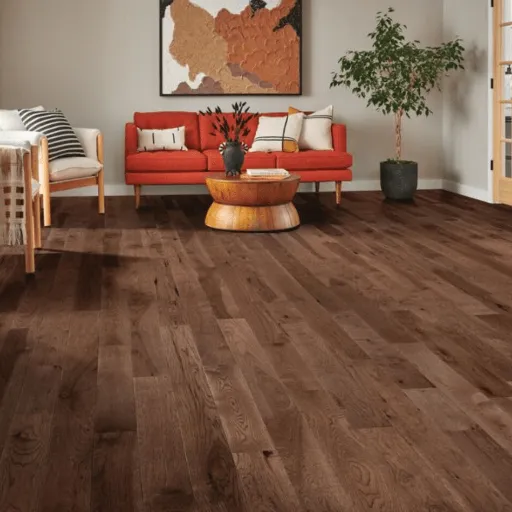
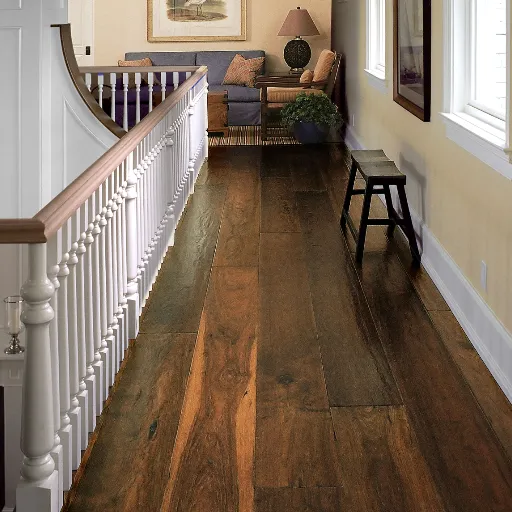
The NWFA’s own description separates them in language a buyer can use. Pecan heartwood is “reddish brown with dark brown stripes,” with sapwood “white or creamy white with pinkish tones,” and grain that is “open, occasionally wavy or irregular.” Hickory heartwood is “tan or reddish,” sapwood “white to cream, with fine brown lines,” and grain “closed, with moderate definition; somewhat rough-textured.”
Both show “pronounced differentiations in color between spring wood and summer wood.” That’s the mechanical reason a hickory floor looks the way it does: the earlywood and latewood in each ring take finish differently, so the contrast is in the growth ring, not just between boards.
Why your hickory floor has both
A blended hickory floor carries both color stories at once. Pecan’s darker striped heartwood sits beside hickory’s tan, beside the cream sapwood of either. If the result looks like three woods in one room, that’s what happened. For the full grade picture, including how Select and Rustic sort that contrast, see our guide to hickory flooring color variation.
There’s also a grading convention worth knowing, and it’s the opposite of what most people assume. In pecan, sapwood is usually graded higher than the darker heartwood.
On a hickory floor, the darker face is often the premium one. On a pecan floor, the lighter face can be.
“Brazilian Pecan” is not pecan
This is the trade name that causes real damage, and it comes up constantly on pecan hardwood flooring and Brazilian pecan flooring searches.
Brazilian Pecan is not Carya, and it is not American pecan. One national retailer lists its Bellawood Brazilian Pecan engineered floor with a species field reading Guajuvira, a South American hardwood in an entirely different family. A second supplier identifies Brazilian pecan as Caryocar villosum, sometimes sold as Sucupira preta, and states plainly that it “is not closely related to the American pecan tree.” The same source puts its Janka around 3,540, which is roughly twice red oak.
So a buyer who specifies Brazilian Pecan expecting the pecan look and the 1,820 Janka gets a different floor on both counts. The name was borrowed for the color. Ask for the botanical name on the species sheet, then read it.
Hickory vs Pecan Flooring Cost: Why Pecan Rarely Has Its Own Price
Here’s a useful test. Search for pecan flooring prices and notice what’s missing. Pecan almost never appears as its own price line, because it isn’t usually sold under its own name.
The dated benchmarks both list hickory and skip pecan.
| Benchmark | Date | Hickory material ($/sq ft) | Pecan listed? |
|---|---|---|---|
| Fixr, hardwood flooring cost | Updated January 31, 2025 | $4.15 to $7.15 | No |
| D&G Flooring, hardwood cost | Published March 24, 2026 | $4 to $9 | No |
| Solid Southern Pecan retail list | Published May 1, 2026 | not listed | Select $4.79 to $7.99; Character $4.49 to $7.29 |
Two independent cost benchmarks, one from 2025 and one from 2026, each cover hickory and each leave pecan out. That isn’t an oversight. It reflects how the wood is sold. Neither is a pecan price, and there’s no honest way to invent one.
The retail list is the closest thing to one, and it sits inside hickory’s range rather than above or below it. That’s what pooling at the mill predicts.
What actually moves the price isn’t the species. It’s grade, width, wear layer, core and finish. A 2 mm wear layer and a 6 mm wear layer can differ more in price than pecan and shagbark do.
Example, not a customer case. A homeowner collects two quotes, both labeled “hickory,” both within a dollar per square foot of each other. One mill runs mostly true hickory at 1,880 to 2,140. The other blends in pecan around 1,500 to 1,820.
Same word on the page, same price band, two different floors underfoot. The quote that names the species group is the one that tells you what you bought.
Hickory vs Pecan Flooring: What to Put on the Specification
The species question isn’t settled by the word hickory, and it isn’t settled by testing a finished board. It’s settled by what the supplier puts in writing.
Choose the pecan group if…
- You want the most dimensionally stable floor in the hickory family. Pecan shrinks 4.9% radially and 13.6% volumetrically, against 7.0% and 16.7% for shagbark.
- The install is wide plank, or over a slab, or in a room where humidity swings.
- You like the reddish-brown striped heartwood and the lighter sapwood face.
- You are content with roughly 1,820 Janka, which is still half again harder than red oak.
Choose true hickory if…
- Maximum dent resistance is the priority. Pignut at 2,140 and mockernut at 1,970 are the top of the group.
- You want the closed grain and the tan-to-cream palette the hickory look is known for.
- You accept more movement and will control indoor humidity accordingly.
- You are specifying a commercial floor where the density range should sit at the top end.
Example, not a customer case. A facilities manager specifies “Brazilian Pecan” for a 900 square foot lobby, expecting an American pecan floor at 1,820 Janka. The species sheet arrives saying Guajuvira, rated near 3,540, with movement figures that match nothing on the pecan table.
The floor isn’t a bad floor. It’s a different one, and the specification never said which wood it meant.
Five questions for a supplier
- What is the botanical name? One species, or a group designation.
- Which group, true hickory or pecan hickory? Either answer is legitimate. An evasive one is not.
- What grade, and under whose rules? Grade sets the color mix and the defect tolerance.
- What is the wear layer in millimetres, and what is the core? This decides sanding life more than species does.
- Can I see a species sheet and a physical sample from the actual lot? A sample from the run beats a photograph of a floor.
For the Janka context against the other common comparison, read hickory vs oak flooring. For the species properties across a wider set of hardwoods, the wood veneer species database lists them in one place.
FAQ About Hickory vs Pecan Flooring
Is pecan a type of hickory?
Yes. Pecan (Carya illinoinensis) is one of four pecan hickories, alongside water, bitternut and nutmeg hickory. Shagbark, pignut, mockernut and shellbark are the true hickories. Both groups are Carya, and flooring mills traditionally mix them and sell the blend as hickory.
Is pecan a good hardwood floor?
Yes. At 1,820 Janka, pecan is markedly harder than red oak, and its shrinkage, 4.9% radial and 13.6% volumetric, is the lowest published in the hickory group. It is a common flooring species, usually sold under the hickory label rather than its own.
Is pecan harder than hickory?
It depends on which hickory. Pecan rates 1,820; shagbark 1,880, mockernut 1,970 and pignut 2,140 sit above it, while shellbark at 1,810 and the remaining pecan hickories sit at or below. Pecan is mid-pack in a genuinely wide group, not the soft option.
Is pecan flooring expensive?
Usually it’s priced as hickory, so it carries hickory’s band rather than a premium. Published hickory material costs run $4.15 to $7.15 per square foot (Fixr, January 2025) and $4 to $9 (D&G Flooring, March 2026). A solid pecan retail list shows $4.49 to $7.99 by grade and width.
What color is pecan flooring?
Reddish brown heartwood with dark brown stripes, and sapwood that is white or creamy with pinkish tones. The contrast between earlywood and latewood is pronounced, so a pecan floor reads warmer and more striped than a tan hickory floor. In pecan, the lighter sapwood is often graded higher than the darker heartwood.
Is hickory or pecan more stable?
Pecan, by a clear margin. Pecan shrinks 4.9% radially, 8.9% tangentially and 13.6% volumetrically, against 7.0%, 10.5% and 16.7% for shagbark hickory. That radial difference of about a third matters most on wide planks and over concrete.
Conclusion
Hickory vs pecan flooring isn’t a contest between two materials. Pecan is inside the hickory group, the two are mixed by convention, and the label covers the genus rather than one species.
Four things are worth carrying into a purchase:
- Confirm which group you’re buying, because the range is 1,290 to 2,140 and it isn’t printed anywhere.
- Expect pecan to be the more stable choice, not the softer one.
- Treat “Brazilian Pecan” as a different wood until a species sheet says otherwise.
- Remember that the finish and the wear layer take the wear. The species only sets the ceiling.
If you are specifying for a project, send your specification and sample requirements to our team. Include the species group, the grade, the board width, the wear layer and the subfloor, and we will confirm what can be matched across the run before you commit. For the other comparisons in this family, read hickory vs maple flooring and hickory flooring pros and cons. On sourcing, sustainable hickory flooring is a documentation question.