
Purple Heart Wood Tree: Species, Range & Sustainability Guide
The purple heart wood tree is the source of the striking purpleheart lumber woodworkers love: roughly 23 species in the genus Peltogyne, tall tropical hardwoods native to the rainforests of Central and South America, prized for heartwood that turns vivid purple within days of being cut.
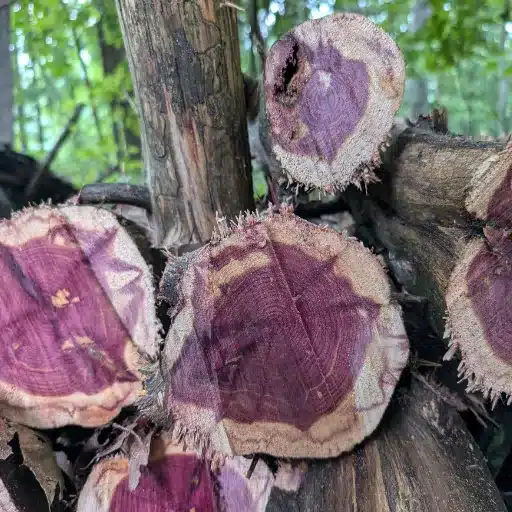
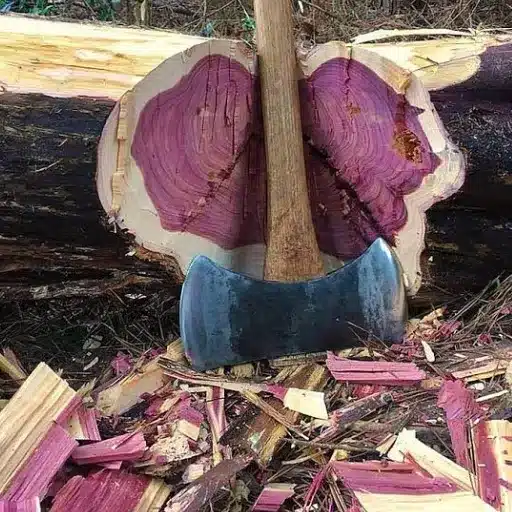
Cut into the trunk of a purple heart wood tree and you might think you grabbed the wrong log. The freshly exposed wood is a dull gray-brown, nothing special at all. Then something remarkable happens.
Within hours, the surface begins to shift. Within days, it’s a deep, eggplant purple so saturated it looks dyed. That single transformation is why this rainforest giant has earned its reputation as one of the most visually striking woods on earth, and why it’s become a favorite for everything from cutting boards to guitar fretboards.
But here’s what most articles never explain: the purple heart wood tree is not one tree. It’s a whole genus of trees, with species that grow in different countries, mature at different rates, and face very different conservation pressures. When you buy “purpleheart” lumber, you may be buying wood from any of them. Understanding the tree behind the timber changes how you buy, how you build, and how responsibly you source.
In this guide, you’ll learn what the purple heart wood tree actually is, how to identify it, where it grows, which species end up in your lumber, how the living tree becomes those deep-purple boards, and whether buying it is environmentally responsible. We’ll draw on botanical references and on our own experience sourcing certified hardwoods at VitalWood Global.
Key Takeaways
- The purple heart wood tree is a genus (Peltogyne) of roughly 23 tropical hardwood species in the legume family, native from Mexico through Central America to the Amazon Basin and southeastern Brazil.
- Purpleheart trees are rainforest giants that can reach 30 to 50 m (100 to 170 ft) tall, with straight boles and a signature color that only appears when the heartwood is cut and oxidizes.
- “Purpleheart” is a trade name that bundles many species; Peltogyne paniculata, P. purpurea, and P. venosa are the main commercial sources, and invoices rarely name the exact species.
- Commercial harvest is diameter-driven, not age-driven, with trees typically felled at 25 to 35 years or older when the purple heartwood core is large enough to yield useful boards.
- Conservation varies by species: Peltogyne purpurea is Vulnerable and legally protected in Costa Rica and Panama, while other species are unlisted, which makes verifying the scientific name and certification essential before you buy.
What Is the Purple Heart Wood Tree?
The purple heart wood tree belongs to the genus Peltogyne, a group of approximately 23 species of flowering trees in the legume family (Fabaceae), documented in the Encyclopedia of Life’s Peltogyne entry. It’s the same family that includes nitrogen-fixing plants like beans and acacia, and that ecological role matters: purpleheart trees enrich the soil around them, which makes them valuable members of the rainforest ecosystem, not just a source of pretty boards.
The trees go by many regional names, all of which point to the same striking color. Spanish speakers know them as palo morado or morado, the Portuguese call them pau roxo, and in French Guiana they’re amarante. Costa Ricans know Peltogyne purpurea as nazareno. In the timber trade, they’re most commonly sold as purpleheart, purple heart, amaranth, or violet wood.
How to Identify a Purple Heart Wood Tree
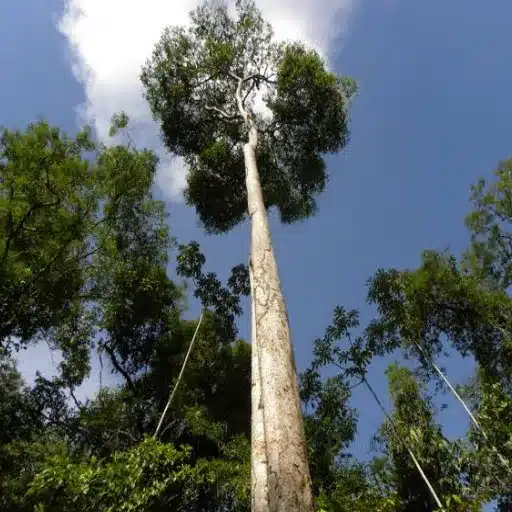
If you ever find yourself in a lowland rainforest, here’s how to spot one. These are medium-to-large canopy trees, typically reaching 30 to 50 m (100 to 170 ft) tall with trunk diameters up to about 1.5 m (5 ft). The trunk is straight and cylindrical, often clear of branches for 60 to 90 ft, with modest buttress roots at the base. The bark is smooth and light gray on older trees, distinctive enough that local foresters say you can recognize the species from a distance.
The leaves are alternate and pinnate, each divided into a single symmetrical pair of large leaflets, about 5 to 10 cm long and 2 to 4 cm broad. The flowers are small and white with five petals, carried in clusters called panicles. The fruit is a compressed, oval pod around 5 cm long that holds a single seed.
An Ecologically Important Legume
Here’s a fact most wood articles skip: purpleheart is a nitrogen-fixing tree. Like other legumes, it hosts bacteria in its roots that pull nitrogen from the air and convert it into a form plants can use, naturally fertilizing the surrounding soil. In the nutrient-poor soils of the Amazon, that’s a quiet but crucial job. It also grows as a canopy tree that does not tolerate shade, which means it needs intact forest with gaps of light to regenerate, one reason clear-cutting harms it so badly.
Marcos, a forest ranger who has mapped timber trees in the Brazilian Amazon for over a decade, puts it simply: “People see the purple and think of a product. We see the tree and think of the whole forest around it. Take out the purplehearts and the soil loses an ally too.” That perspective, from the people who live alongside the tree, is worth keeping in mind for the rest of this guide.
Where Do Purple Heart Wood Trees Grow?
The native range of the purple heart wood tree is a sweeping Neotropical belt, from the Pacific coast state of Guerrero in Mexico, down through Central America, and across northern South America to southeastern Brazil. The majority of Peltogyne species are concentrated in the Amazon Basin, particularly the north-central Brazilian Amazon, with significant populations in Brazil, Guyana, Suriname, French Guiana, Venezuela, Panama, Costa Rica, and Trinidad and Tobago.
If you’re wondering where the commercial lumber you see at a supplier actually comes from, the answer is most often the Guiana Shield and Amazon corridor: Brazil, Guyana, and Suriname supply the bulk of the world’s purpleheart.
Preferred Habitat
Purpleheart is a tree of the moist lowland rainforest. It prefers elevations below roughly 600 to 700 m, humid climates with annual rainfall of 2,500 to 5,000 mm, and steady temperatures between 23 and 27°C. It grows on well-drained soils, often on slopes or on the iron- and aluminum-rich red clay soils that are common across the Amazon. Long dry seasons are the enemy; this is a tree built for consistent moisture.
The Amazon and Guiana Shield as Commercial Heartland
Three regions dominate commercial supply:
- The Brazilian Amazon, especially the north-central states, where the greatest diversity of Peltogyne species is found.
- The Guiana Shield, including Guyana and Suriname, which export much of the internationally traded purpleheart.
- Central America, where Peltogyne purpurea (nazareno) grows, though it is now legally protected in key range countries.
For a closer look at where this wood fits in the broader exotic-hardwood landscape, our purple heart wood complete guide ties the tree’s story to properties, uses, and buying decisions end to end.
Purple Heart Wood Tree Species: What’s Actually in Your Lumber
Here’s the detail that surprises most buyers: when you purchase “purpleheart,” you usually don’t know which species you’re getting. Because the wood from different Peltogyne species is so similar, the lumber trade simply bundles them together under the label “Peltogyne spp.” That’s convenient for suppliers, but it hides information that matters for both quality and conservation.
| Species | Common / regional name | Native range | Conservation status | Notes |
|---|---|---|---|---|
| Peltogyne paniculata | Amarante, purpleheart | Brazil, Guiana Shield, Trinidad | Not assessed | The most common commercial species |
| Peltogyne purpurea | Nazareno, purpleheart | Costa Rica, Panama, Colombia | Vulnerable; harvest prohibited in Costa Rica and Panama | Legally protected; prized color |
| Peltogyne venosa | Purpleheart | Northern South America | Not assessed | Often grouped with P. paniculata |
| Peltogyne floribunda | Purpleheart | Brazil, Venezuela, Guyana, Trinidad | Not threatened (2024 Kew assessment) | Major commercial source |
| Peltogyne mexicana | Palo morado | Endemic to Guerrero, Mexico | Endangered (Mexico NOM-059) | Slow-growing geographic outlier |
| Peltogyne chrysopis, P. gracilipes | Purpleheart | Restricted ranges | Endangered | Small, fragmented ranges |
This is why the first question to ask any supplier is: which species is this, and where was it harvested? A responsible supplier can answer. A trade name without a scientific name is a red flag, not a convenience. Our guide to whether purple heart wood is endangered breaks down the species-level conservation picture in detail, including which species are protected and why certification matters.
How the Living Tree Becomes Purple Lumber
Understanding the tree explains a lot about the boards you buy, including why they’re expensive and why the color behaves the way it does.
Heartwood vs. Sapwood in a Real Log Cross-Section
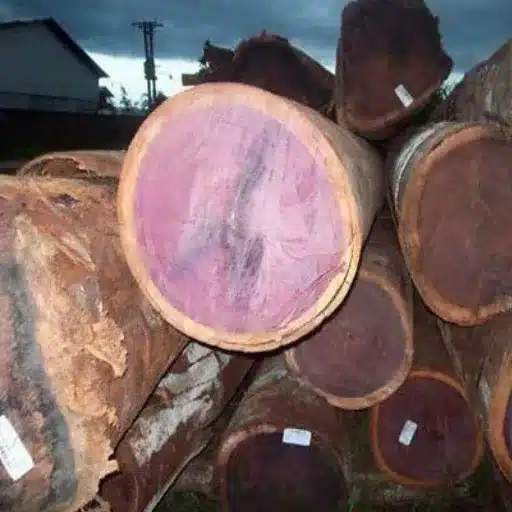
Cut across a mature purpleheart trunk and you’ll see two distinct zones. The sapwood, the living outer band, is a pale grayish or yellow-brown, usually only a few centimeters thick. The heartwood, the inner core, is a dull gray-purple or brown-violet with a fairly sharp transition line where the two meet. That contrast is a visual warning about yield: a small log has a thin purple core surrounded by lots of pale sapwood that has to be trimmed away, which is one reason small purpleheart logs are not economical to mill.
The Color Change: From Gray-Brown to Vivid Purple
The heartwood’s signature purple comes from natural pigments called neoflavonoids, related to compounds found in rosewood. Freshly cut, the wood is exposed to oxygen and the pigments react, deepening from gray-brown to rich purple over the course of days. Ultraviolet light continues the chemistry, gradually darkening the wood toward deep crimson, then brown indoors, and gray outdoors. The color is not a stain, it’s the tree’s own chemistry responding to air and light.
For a full breakdown of how the color shifts over time and how to manage it with finishes, see our guide to purple heart wood color and properties.
Growth Rate and Harvest Maturity
Growth rates vary by species. Peltogyne purpurea is described as very slow-growing, reaching 35 to 40 m and around 1 m in diameter at maturity. Peltogyne floribunda grows at a medium rate, topping out around 25 m. Site conditions matter too: a slow-grown tree on well-drained soil in northern Brazil can yield denser, finer-textured stock than a faster-grown cousin elsewhere.
Mills think in diameters, not ages. Log buyers set a minimum top-end diameter, below which the yield isn’t worth the cost of felling and transport. Usable purple heartwood only develops as the tree matures and inner growth rings convert to extractive-rich heartwood, so a small 25 to 30 cm log gives a thin purple core with heavy sapwood waste. In practice, commercial trees are typically felled at 25 to 35 years or older, when a cross-section yields broad, mostly purple boards edge to edge.
Lena, who has run a tropical lumber mill in Suriname for fifteen years, describes the trade-off bluntly: “The temptation is to cut young because the color is still there and the wood is easier to saw. But you end up with a stack of boards that are 60 percent pale sapwood. The trees that pay for themselves are the older ones, and the older ones are exactly the ones you have to manage carefully.”
Is the Purple Heart Wood Tree Endangered?
This is the question buyers ask most, and the answer has three layers. The purple heart wood tree as a group is not listed in the CITES Appendices, so there are no international trade permits required under that treaty, and the genus as a whole is not on the IUCN Red List. But “purpleheart” is not a single species, and the species-level reality is more complicated.
Here’s the honest picture:
- CITES: The Peltogyne genus is not listed, so purpleheart is not broadly regulated as an endangered species.
- IUCN: The genus isn’t uniformly listed, but several individual species carry Endangered or Vulnerable assessments, and many species simply haven’t been assessed at all.
- Real-world risk: Deforestation, overharvesting, and illegal logging are genuine pressures in parts of the native range. Some species that were once abundant are now scarce.
By country, the protections are significant. Peltogyne purpurea, known locally as nazareno, is assessed as Vulnerable in Costa Rica, Panama, and Colombia, and its harvest is prohibited by law in Costa Rica and Panama. Peltogyne mexicana is listed as Endangered in Mexico under NOM-059. In Guyana, some Peltogyne species are restricted-logging species.
Because the conservation status depends entirely on which species and which country, our species-by-species conservation breakdown walks through the species-by-species table and explains how to verify a responsible source. It’s the buying-focused companion to this botanical guide.
Responsible Sourcing: Buying From a Tree, Not Just a Lumber Pile
Once you understand the tree, responsible sourcing becomes straightforward. It comes down to three checks.
1. Ask for the scientific name and origin. Because “purpleheart” bundles many species with different statuses, a legitimate supplier should be able to tell you exactly which Peltogyne species you’re buying and from which country. This is the single most important verification step, and it’s one our sourcing team treats as non-negotiable.
2. Verify certification. Forest Stewardship Council (FSC) and PEFC certification, backed by a documented chain of custody, confirm the wood came from a responsibly managed forest. You can verify an FSC license code on the public FSC certificate database. Expect certified purpleheart to cost 25 to 40 percent more than wild-harvested stock; that premium is the price of verifiable sustainability, and it’s worth paying.
3. Watch for red flags. Be suspicious of any supplier who says the wood is “sustainably harvested” without a certificate number, who can’t name the species, or who won’t share origin documentation. If the paperwork is vague, the sourcing probably is too.
Priya, an architect who specifies exotic hardwoods for high-end commercial projects, learned this lesson the hard way. In 2023, she specified purpleheart flooring for a boutique hotel, choosing an unverified supplier to hit a tight budget.
The hotel later asked for sustainability documentation to apply for a green building certification, and the supplier had none. Priya had to re-source the entire flooring at a 30 percent premium, eating the cost and delaying the project by a month. Now her specification documents always require the scientific name, the country of origin, and an FSC chain-of-custody certificate before a single board is ordered.
That verification approach is exactly how we work at VitalWood Global. Every sustainable wood sourcing decision we make starts with documentation, not promises, so you can build with confidence.
When you want the material stretched further, consider purple heart wood veneer instead of solid lumber. A single cubic meter of log yields dramatically more finished surface as veneer than as solid boards, which reduces pressure on the resource while keeping the color you want.
What Is the Purple Heart Wood Tree Used For?
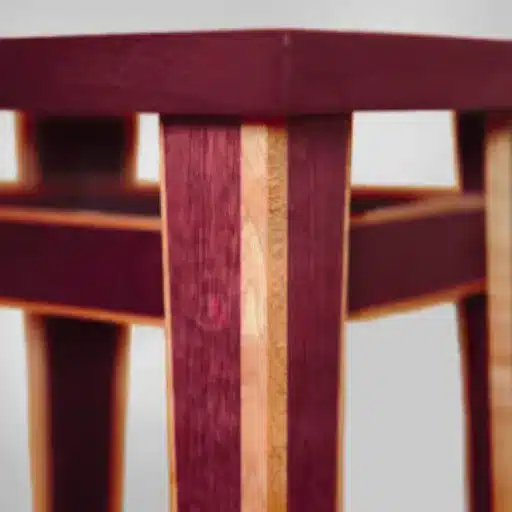
The tree’s wood is prized wherever hardness, durability, and visual drama matter. Because it’s exceptionally hard and rot-resistant, with a Janka hardness rating well above white oak, it shows up in heavy-duty and high-wear applications: flooring, decking, truck decking, dock pilings, and boatbuilding. Its vivid color and fine grain make it a favorite for furniture accents, inlays, marquetry, turning projects, and musical instruments, especially guitar fretboards, where its stiffness also gives it tonal value.
For a deeper look at where this wood shines and where it’s better to choose something else, our guide to what purple heart wood is used for covers the full range of applications, including cutting boards and food-contact use.
One practical note for woodworkers: the tree’s density and interlocked grain mean you’ll want carbide tooling and patience. Purpleheart dulls blades quickly, can gum up when heated by a dull cutter, and its sawdust can irritate skin, eyes, and lungs. Treat it with the same respect you’d give any exotic hardwood, and it will reward you.
Frequently Asked Questions
What is a purple heart wood tree?
The purple heart wood tree is any of roughly 23 species in the genus Peltogyne, tropical hardwood trees in the legume family native to Central and South America. They’re prized for heartwood that turns vivid purple when cut and exposed to air.
Where does purple heart wood come from?
Commercial purpleheart comes mostly from Brazil, Guyana, and Suriname, with additional species across Mexico, Central America, and northern South America. The genus ranges from Guerrero, Mexico, to southeastern Brazil.
Is the purple heart wood tree endangered?
Not as a genus, and the genus is not CITES-listed, but several individual species are Endangered or Vulnerable, including Peltogyne purpurea in Costa Rica, Panama, and Colombia, and P. mexicana in Mexico.
Is purpleheart a hardwood or softwood?
It’s a hardwood. Angiosperm trees like Peltogyne produce hardwood, and purpleheart is among the hardest, with a Janka rating around 1,860 to 2,520 lbf depending on the source, well above white oak.
Does the species change how the wood behaves?
Mostly no. Different Peltogyne species have similar wood properties, which is why the trade sells them together. The differences that matter are conservation status and origin, not how the wood cuts or finishes.
How old does a purpleheart tree get before harvest?
Commercial trees are typically felled at 25 to 35 years or older, when the purple heartwood core is large enough to yield useful boards. Harvest is decided by diameter, not age.
Can you grow or farm purpleheart trees?
Not commercially. Peltogyne species grow in primary rainforest and are generally not cultivated in plantations. They regenerate naturally and are harvested from managed natural forests.
How does the living tree influence the color change later?
The purple comes from natural pigments in the heartwood that react with oxygen and ultraviolet light. The tree builds these extractives over its lifetime, which is why mature trees produce the richest color.
Conclusion
The purple heart wood tree is a genus of roughly 23 tropical hardwood species that ranges from Mexico to the Amazon, reaches 30 to 50 m tall, and hides its signature purple until the heartwood is cut and hits the air. It’s not one tree but many, bundled under the trade name purpleheart, which is exactly why the details matter: which species you’re buying, where it grew, and whether the harvest was legal and certified.
The practical takeaway is simple. Ask for the scientific name, confirm the country of origin, and verify FSC or PEFC chain-of-custody documentation before you buy. Choose the mature, certified supply that keeps the forest healthy, and choose veneer where it stretches the resource further. The purple heart wood tree rewards the buyer who understands it, with boards that are as responsible as they are beautiful.
At VitalWood Global, we source certified, traceable exotic wood and veneer every day, and we’re happy to help you choose the right material for your project. Contact us for a quote and let’s build something that lasts, for you and for the planet.