
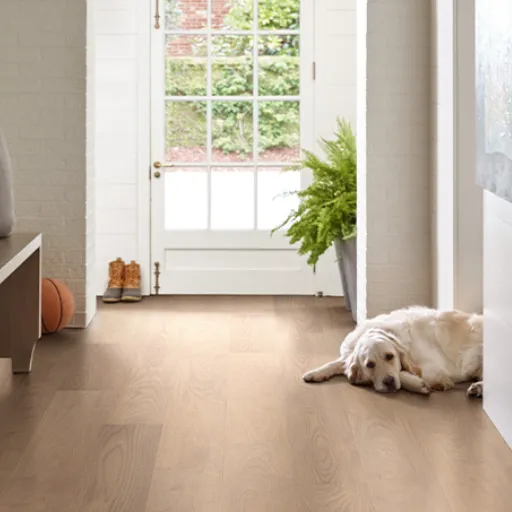
Best Prefinished Flooring for Dogs: What Actually Survives Claws
The best prefinished flooring for dogs is engineered oak or hickory in a wire-brushed, matte finish, with a 3 mm or thicker wear layer, and a finish system chosen by how you want damage to look rather than whether it will happen. Aluminum oxide resists abrasion hardest but shows scratches as bright white lines. A hardwax or UV oil blends scratches instead and can be spot-repaired. Either can work. The species matters less than most guides tell you.
That answer surprises dog owners who have spent a week comparing hickory against oak. It shouldn’t. Every “best flooring for dogs” list ends the same way: install vinyl. That advice is fine, but it ignores the reader who has already decided they want real wood and needs to know which specification survives a seventy-pound dog.
When Dana replaced the carpet in her 1960s ranch in March, she chose a hard maple floor in semi-gloss because maple is one of the hardest domestic species. By August she could map her Labrador’s route through the living room from the scratches alone. The species was never the problem. The sheen was. A hard floor still takes claw scratches in its finish, and a glossy finish turns every one of them into a highlight.
This guide gives you the five specifications that decide whether a prefinished floor survives a dog, in the order that matters. You will get a scratch-visibility matrix, a species table with real hardness numbers, the finish system that fits your household, and the honest limits no retailer will state out loud. If you are still comparing finish methods, our prefinished engineered wood flooring pillar covers the full specification picture first.
Not sure which specification your current floor has? Send us your product details and our team will read the wear layer and finish schedule for you.
Key Takeaways
- No wood floor is claw-proof. The goal is a floor whose damage is hard to see, not one that never marks.
- Scratch visibility matters more than scratch resistance. Matte sheen and a wire-brushed texture hide what hardness alone cannot stop.
- The finish system, not the species, is the pet decision. Aluminum oxide resists abrasion but shows white scratch lines; oil blends scratches instead.
- Specify 3 mm or more of wear layer in a pet home. Claw and accident damage make a future re-sand more likely, and thin veneers cannot be sanded at all.
- For chronic accidents, puppies or several large dogs, the honest answer is a waterproof rigid-core floor, not wood.
The Short Answer: What Is the Best Prefinished Flooring for Dogs?
For most dog households, the best prefinished floor is a wire-brushed engineered oak or hickory in a matte finish with a 3 mm or thicker wear layer. Choose aluminum oxide if you want the toughest abrasive wear and your dog is calm or senior. Choose a hardwax or UV oil if you would rather blend scratches than prevent them, which suits large, active dogs and owners who notice every mark.
Get those choices right and the exact species becomes almost a footnote. Get them wrong and even a dense Brazilian cherry will look worn inside two years.
The Five Specifications That Decide Whether a Floor Survives a Dog
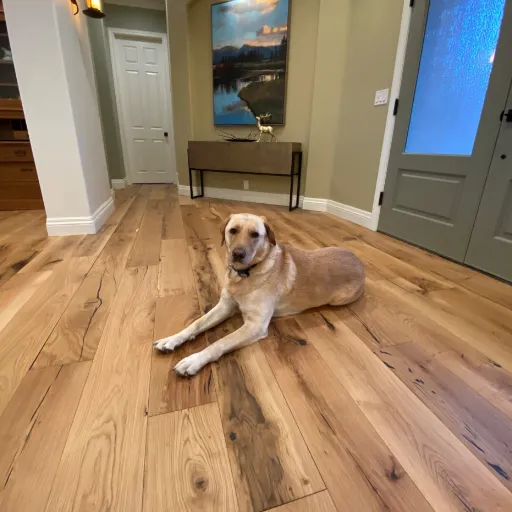
Pet durability is not one decision. It is a stack of five, and the finish you choose and the humidity you maintain matter more than the wood you point at. Here they are in priority order.
1. The Finish System (the decision most buyers make last)
The factory-applied finish is the surface your dog actually touches, so it takes the claw damage. Aluminum oxide, loaded into a UV-cured urethane, is the most abrasion-resistant option and the reason prefinished floors outlast site-applied polyurethane. The honest catch is how its scratches look. On a dark or glossy floor, AO damage reads as brilliant white lines. A hardwax or UV oil finish scratches more visibly at first and then blends back in, because you can spot-repair it without sanding the whole floor. We compare these systems in depth in our UV oil vs aluminum oxide flooring guide.
2. The Wear Layer (how much floor you have to give)
In a pet home, specify 3 mm or more. Here is why. A floor that lives with claws and the occasional accident is more likely to need a future re-sand than a pet-free floor, and the wear layer is the wood you have to sand. A 1.2 mm to 2 mm veneer cannot be sanded at all; it can only be screened and recoated. If long-term durability is your priority, our guide to how long prefinished engineered wood flooring lasts breaks down the wear-layer math.
3. Species Hardness (and why it matters less than you think)
Hardness affects denting, not the finish scratch your dog’s nails make. A hard species resists impact from dropped toys and furniture. It does not make the coating immune to claws. Pick a species for its hardness, yes, but understand that the finish is doing the scratch work.
4. Sheen and Texture (what actually hides claw marks)
Matte beats gloss, every time, and a wire-brushed surface beats a smooth one. Texture breaks up reflected light so scratches disappear into it. This is the single highest-leverage aesthetic choice a dog owner makes, and it is the one Dana missed. Our prefinished wood flooring finishes guide covers sheen levels and textures in full.
5. Humidity and the Home (the lever nobody mentions)
Hold indoor relative humidity between 35% and 55%. Most pet-floor complaints that get blamed on claws trace back to humidity instead. Dry winter air embrittles a finish and opens gaps; swings in either direction do more long-term damage than a dog’s nails ever will.
Scratch Visibility vs. Scratch Resistance: The Distinction That Matters
Most buyers confuse two different questions. Will the floor scratch? Yes. Will you see it? That depends on choices you control.
| What you choose | Resists claw scratches? | Hides them? | Verdict for a dog home |
|---|---|---|---|
| Semi-gloss sheen | Somewhat | No | Worst choice, every mark highlights |
| Matte sheen | Somewhat | Yes | Best choice, absorbs light and texture |
| Smooth texture | Somewhat | No | Shows scratch paths clearly |
| Wire-brushed texture | Somewhat | Yes | Best choice, breaks up scratches |
| Light tone | Somewhat | Partly | Hides hair, shows dark scratches |
| Mid tone | Somewhat | Yes | Most forgiving overall |
| Dark tone | Somewhat | No | Shows every pale scratch line |
A hard floor with a glossy, smooth finish will look worse than a softer floor with a matte, wire-brushed one. That is the counter-intuitive fact the species-first buying guides never tell you.
Species Hardness and Scratch Visibility Compared
Use this table to pick a wood that both resists dents and forgives the marks it will take. Janka hardness figures below follow the standard reference used across the industry, published by The Wood Database.
| Species | Janka hardness | Hides scratches? | Pet-home verdict |
|---|---|---|---|
| Hickory | ~1,820 | Yes, varied grain | Excellent, our top pick |
| Hard maple | ~1,450 | No, uniform grain | Hard but unforgiving |
| White oak | ~1,360 | Yes, open grain | Excellent balance |
| Red oak | ~1,290 | Yes, open grain | Very good value |
| Brazilian cherry | ~2,350 to 3,000 | No, dark tone | Hard, but shows marks |
| Black walnut | ~1,010 | Partly, dark tone | Soft, better in bedrooms |
| Eastern white pine | ~600 to 700 | No | Avoid in dog homes |
Notice the trap. Maple is harder than oak and hides scratches worse, because its uniform grain shows every mark while oak’s open grain conceals them. If you want oak or maple specifically, our engineered oak flooring and engineered maple flooring pages cover the options.
Which Finish System for Which Dog Household
Match the finish to the dog, not the other way around.
| Finish system | How claw marks look | Spot-repairable? | Recoatable? | Best for |
|---|---|---|---|---|
| Aluminum oxide | Bright white lines | Rarely | Often resists | Calm or senior dogs, maximum wear |
| Hardwax oil | Blend back in | Yes | Yes | Large active dogs, scratch-averse owners |
| UV oil | Softens over time | Yes | Yes | Family homes, DIY touch-ups |
| UV lacquer | Moderate | Limited | Usually | High-end renovations |
The trade-off is unavoidable: maximum durability or easy repair, not both. Aluminum oxide wins on abrasion and loses on blending. Oil finishes do the opposite. Choose which one you can live with, because your dog will test it either way.
This is where the factory finish earns its keep. A finish schedule is set before the plank ever ships, which is why our veneer finishing line matters to specifiers choosing pet-grade product.
Claws vs. Water: Two Different Problems
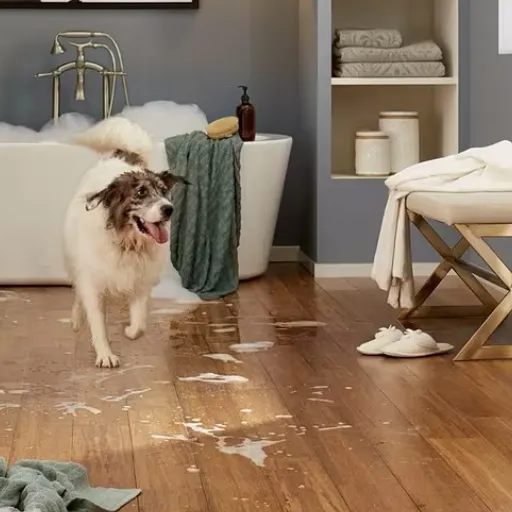
Owners lump every pet floor problem into “durability.” They are two separate problems with two separate solutions.
Claw damage is a finish problem. Scratches and abrasion live in the topcoat. You solve them with the finish system, sheen, texture and trimmed nails, not by buying a harder wood.
Accidents are a core-and-seam problem. Water reaches the seams and edges, not the surface. You solve that with core construction, edge sealing and prompt cleanup. Prefinished engineered floors handle this better than solid hardwood because the cross-ply core resists moisture movement, but wood is still not waterproof unless a product is specifically built and warranted for it. We cover the accident side in full on our waterproof engineered wood flooring page.
One more mechanism rarely explained: traction reduces scratching. A smooth, glossy floor gives a dog nothing to grip, so it digs in with its nails to walk. A textured, slip-resistant surface reduces that digging and helps senior dogs stay steady. Buying texture is a safety decision as much as an aesthetic one.
Reading “Dog-Proof Wood” Claims Honestly
You will see hardwood marketed as dog-proof, with figures like four times the scratch resistance and six times the dent resistance. Those products are real. Densified hardwood is compressed under heat and pressure until its hardness roughly doubles, and acrylic-infused top layers behave similarly.
But read the source. Those “four times” and “six times” numbers are manufacturer claims measured against typical hardwood, not independent test results. Both things can be true: the product genuinely outperforms standard oak, and the headline multiple deserves scrutiny. The trade-offs the marketing tends to omit are cost, limited availability, and how a densified or infused surface behaves years later if it needs refinishing.
Treat dog-proof wood as a premium upgrade with real benefits and real limits, not a guarantee that claws will bounce off.
How to Protect a Prefinished Floor From Dog Damage
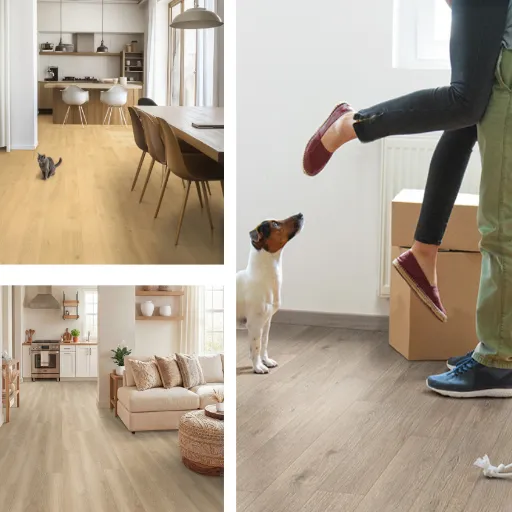
Most floor damage is preventable with habits, not products.
- Keep nails trimmed. The cheapest, most effective lever you own.
- Place mats at doors and under water bowls. They catch grit and drips before they reach the finish.
- Clean dry first, then damp. A pH-neutral cleaner and a damp, not wet, mop. Never steam.
- Wipe accidents and wet paws promptly. Minutes matter more than products.
- Add felt pads to every chair and furniture leg, and never drag a crate.
- Hold humidity between 35% and 55% year-round with a humidifier or dehumidifier.
- Keep spare boards from the original order so a damaged plank can be replaced later.
The two habits that outperform everything else are nail care and humidity control. Our prefinished engineered flooring maintenance guide goes deeper on the cleaning routine.
FAQ
What is the best prefinished flooring for dogs?
Wire-brushed engineered oak or hickory in a matte finish with a 3 mm or thicker wear layer, paired with a finish system chosen for your dog. Aluminum oxide suits calm or senior dogs; hardwax or UV oil suits large active dogs and owners who prefer repairable scratches.
Is prefinished hardwood good for dogs?
Yes, with the right specification. Prefinished engineered wood resists wear better than site-finished solid hardwood and handles moisture better, but no wood floor is claw-proof. It is a strong choice when you cannot accept vinyl and you control the humidity.
What finish hides dog scratches best?
A matte, wire-brushed hardwax or UV oil finish. The texture breaks up reflected light while the oil lets you blend scratches without sanding. Matte aluminum oxide also hides well, but its scratches read as bright white lines on darker floors.
Is aluminum oxide good for dog claws?
It is the most abrasion-resistant factory finish, so it resists claw wear best. The catch is visibility: AO scratches show as conspicuous white lines, and the finish often resists spot repair and recoating. It is a great choice if you accept that scratches will be visible.
What is the best hardwood for dogs that pee inside?
None. Chronic indoor accidents call for a waterproof rigid-core floor, not wood. If accidents are occasional and cleaned promptly, a prefinished engineered floor with sealed edges and a waterproof core handles them better than solid hardwood, but no wood product should be relied on for a puppy in training.
White oak or hickory for dogs?
Both work well. Hickory is harder at roughly 1,820 on the Janka scale and its varied grain hides marks well. White oak at roughly 1,360 has an open grain that conceals scratches and is the more consistent, easier species to match across a room. Red oak is a close, lower-cost third.
Should I choose matte or satin floors with dogs?
Choose matte. Satin and semi-gloss amplify every scratch under raking light, while matte absorbs light and makes marks far less visible. This is the single most impactful aesthetic decision for a dog home.
Do densified wood floors really resist dog scratches?
They outperform standard hardwood, and the compression process genuinely increases hardness. But the four-times and six-times figures are manufacturer claims, not independent results, and they come with higher cost and limited availability. Treat them as a real upgrade, not a guarantee.
The Bottom Line
The best prefinished flooring for dogs is a wire-brushed, matte-finish engineered oak or hickory with a 3 mm or thicker wear layer, matched to a finish system that reflects how you want damage to look. Get the finish, sheen, texture and humidity right, and the species becomes the last decision, not the first.
No wood floor is claw-proof. The honest goal is a floor whose damage blends in, stays repairable, and looks good for decades rather than months. Every choice above serves that one outcome, and it is why we specify finishes and wear layers before a single plank leaves our line.
Ready to choose a pet-friendly prefinished floor? Send us your room details and dog’s size and our team will recommend a wear layer and finish schedule that holds up, backed by responsibly sourced timber certified through programs like FSC. You get a floor built to last and a sourcing story you can stand behind.