
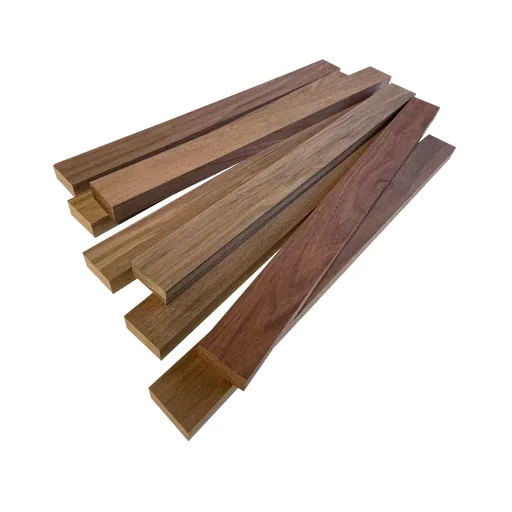
Peruvian Walnut vs Black Walnut: Which Should You Choose?
Peruvian walnut vs black walnut is a comparison of two different species, not two grades of the same wood. Peruvian walnut (Juglans spp., chiefly J. neotropica) is darker and more uniform, slightly softer, and often described as the lower-cost substitute. Black walnut (Juglans nigra) is the North American benchmark: more figure, more sapwood contrast, greater bending strength, and a far healthier conservation status.
The surprise is the price. In late 2026, clear 4/4 Peruvian walnut sold for $12.30 to $13.50 per board foot at two US retailers. Clear 4/4 black walnut started at $12.20. The “budget walnut” label is not reliable anymore.
Most comparisons stop at a Janka number and a color photo. This one covers mechanical properties, drying behavior, real prices, veneer performance, and the sourcing paperwork that separates a defensible specification from a risky one.
If you are sourcing veneer or panels, you can request samples and a quote at any point.
Key Takeaways
- Peruvian walnut is darker and more uniform; black walnut has more figure, more sapwood contrast, and greater strength.
- Janka hardness is nearly identical (960 vs 1,010 lbf), but Peruvian walnut is about 24% lower in bending strength and 33% lower in stiffness.
- Peruvian walnut is not reliably cheaper: clear 4/4 stock traded at $12.30 to $13.50 per board foot versus $12.20 for black walnut 4/4 in late 2026.
- Peruvian walnut moves less overall but has a higher tangential-to-radial shrinkage ratio, so drying and acclimation still matter.
- The biggest difference is conservation status: J. neotropica is IUCN Endangered; black walnut is Least Concern.
Peruvian Walnut vs Black Walnut at a Glance
Peruvian walnut is darker and more uniform, with Janka hardness of 960 lbf versus 1,010 lbf for black walnut. Black walnut is stronger and stiffer, and it is IUCN Least Concern, while the main Peruvian species is Endangered. Choose Peruvian for uniform dark faces; choose black walnut for strength and lower sourcing risk.
| Property | Peruvian walnut | Black walnut |
|---|---|---|
| Scientific name | Juglans spp., chiefly J. neotropica; also J. australis and J. olanchana | Juglans nigra |
| Trade names | Peruvian walnut, tropical walnut, South American walnut, nogal | Black walnut, American walnut, eastern black walnut |
| Native range | Southern Mexico, Central and South America | Eastern and central United States |
| Heartwood color | Deep chocolate brown, often purplish; lighter streaks possible | Pale to dark chocolate; gray, purple, or reddish undertones |
| Sapwood | Less contrast; generally more uniform | Creamy white to tan; strong contrast and more waste |
| Grain and figure | Usually straight; can be irregular; figure less common | Usually straight; can be figured; curl and burl more available |
| Average dried weight | 37 lb/ft³ (600 kg/m³) | 38 lb/ft³ (610 kg/m³) |
| Janka hardness | 960 lbf (4,250 N) | 1,010 lbf (4,490 N) |
| Modulus of rupture | 11,160 psi | 14,600 psi |
| Modulus of elasticity | 1.132 Mpsi | 1.68 Mpsi |
| Crushing strength | 6,550 psi | 7,580 psi |
| Shrinkage (R/T/V) | 3.6% / 7.5% / 11.4% | 5.5% / 7.8% / 12.8% |
| Decay resistance | Moderately durable; sapwood vulnerable to insects | Very durable; also vulnerable to insects |
| IUCN status | Endangered (J. neotropica) | Least Concern |
| CITES listing | Not listed | Not listed |
| Tangential/radial ratio | 2.1 | 1.4 |
| Typical 4/4 clear price | $12.30 to $13.50/bf | From $12.20/bf |
| Typical stock width | About 5 to 12 inches, clear | About 5 to 8 inches typical |
What “Peruvian Walnut” Actually Means
“Peruvian walnut” is a trade label, not a single species and not a guarantee of origin. The wood is usually Juglans neotropica, but Juglans australis and Juglans olanchana are also sold under the name. It doesn’t always come from Peru. “Tropical walnut” is more accurate.
It is a true walnut in the same genus as black walnut, and a hardwood like every Juglans species.
When you compare tropical walnut vs black walnut, the trade label matters. Two suppliers can quote “Peruvian walnut” and deliver different species with different color, density, and conservation status. Name the species and country of harvest in the spec.
Peruvian Walnut vs American Walnut: Same Thing?
No. “American walnut” is another name for black walnut, Juglans nigra. It isn’t a separate species, and it isn’t Peruvian walnut. When a quote says “American walnut,” read it as black walnut.
Hardness, Strength, and Stability: What the Numbers Say
Janka tells you how a small steel ball resists a dent. It does not tell you how a board behaves in a long span, a thin panel, or a steam-bent curve. The strength and shrinkage numbers matter more than most comparisons admit.
Janka Hardness: A 5% Gap, Not a Category Difference
Peruvian walnut hardness is about 960 lbf on the Janka scale. Black walnut rates about 1,010 lbf. That is roughly a 5% difference, which sits inside normal board-to-board variation.
Some suppliers publish a higher figure for Peruvian walnut, around 1,080 lbf. Published averages vary by sample, moisture content, and test method, so treat the numbers as a range.
Bending Strength and Stiffness: Where Black Walnut Pulls Ahead
The strength gap is the part most comparisons miss. Peruvian walnut has a modulus of rupture of about 11,160 psi, versus 14,600 psi for black walnut. That is roughly 24% lower bending strength. Its modulus of elasticity is 1.132 Mpsi versus 1.68 Mpsi, about 33% lower stiffness.
Black walnut has more margin in structural members, long spans, thin sections, and steam-bent parts. Peruvian walnut is fine for casework, drawer fronts, panels, and decorative frames where the wood is supported by a substrate or frame. Don’t substitute it blindly in a load-bearing or bent component.
Shrinkage and Seasonal Movement
Peruvian walnut has lower total shrinkage: 3.6% radial, 7.5% tangential, and 11.4% volumetric, versus 5.5%, 7.8%, and 12.8% for black walnut. On paper, that suggests a more stable wood.
The caveat is the tangential-to-radial ratio. Peruvian walnut’s ratio is 2.1, compared with 1.4 for black walnut. A higher ratio means the wood moves unevenly across the grain, which raises the risk of cupping if drying and acclimation are poor. Buy kiln-dried stock, acclimate it, and finish all faces.
Illustrative scenario: a two-person cabinet shop quotes a built-in bookcase. The owner assumes the Peruvian stock will be cheaper and orders it without comparing grade or moisture content.
The quote comes in close to black walnut, and two boards cup after delivery. The lesson is not that Peruvian walnut is bad. It is that price per board foot is not the same as cost per finished part.
Color, Grain, and Figure: The Real Practical Difference
Color is where the two species separate most clearly, and it is usually why a designer or client picks one over the other.
Peruvian Walnut: Darker, More Uniform, Fewer Surprises
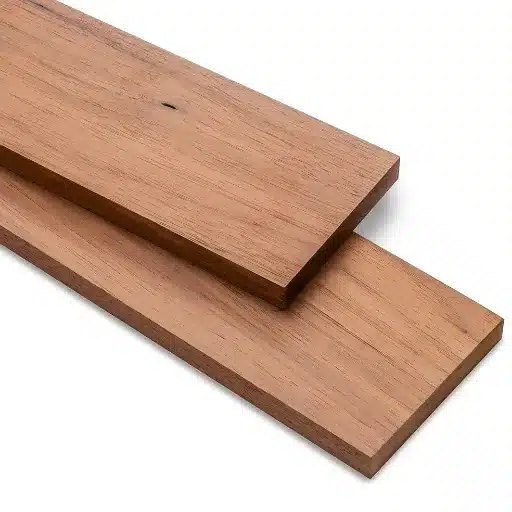
Peruvian walnut has deep chocolate-brown heartwood, often with a purplish cast. Lighter streaks can appear in stock that dried unevenly. Its sapwood contrast is lower than black walnut’s, so more of the board reads as usable dark face.
The grain is usually straight, though it can be irregular. The texture is medium to coarse with good natural luster. Figure such as curl, crotch, and burl is less common.
Black Walnut: More Figure, More Sapwood, More Waste
Black walnut heartwood ranges from pale brown to dark chocolate, with gray, purple, or reddish undertones. Its sapwood is creamy white to tan, and the contrast is strong. That pale sapwood is often excluded from clear faces, which increases waste and cost.
The payoff is character. Black walnut is more likely to show curl, crotch, burl, and dramatic cathedral figure. For a statement table, a feature wall, or a piece where the wood itself is the design, that variation is the point.
Will They Change Color Over Time?
Black walnut is well documented to lighten and mellow under ultraviolet light, especially in the first three to six months. Peruvian walnut starts darker, so a similar shift may be less obvious, but expect some change. Test a finished sample in the lighting where it will live.
If the project is color-critical, approve an aged sample, rotate rugs and furniture, and manage direct sun. For a deeper look at how walnut floors shift, see our guide on whether walnut flooring lightens.
Workability, Drying, and Finishing
Both species are pleasant to work when the grain is straight. The differences show up in figured stock, drying quality, and finishing discipline.
Machining and Tearout
Peruvian walnut machines well with sharp tooling. Its medium-to-coarse texture can dull edges faster, and planer tearout is possible on irregular grain. Light passes and a sharp plane reduce the risk.
Black walnut machines cleanly, glues well, and steam-bends better than most hardwoods. It can also tear out on figured stock.
Drying Defects and Mineral Streaks
Peruvian walnut has a reputation for difficult drying. Collapse, moisture pockets, and gray-green streaks can appear after planing. The streaks may not show in rough stock, which makes them a yield risk for wide panels and veneer faces.
If you are buying for a visible face, inspect a planed sample, ask about the drying method, and specify defect allowances in writing.
Illustrative scenario: a panel shop orders Peruvian walnut for a hotel lobby wall. The rough lumber looks clean. After planing, a run of boards shows pale streaks through the face.
The shop re-sequences the layon and pushes the delivery date. The material cost is not the problem. The surprise is.
Finishing and Blotching
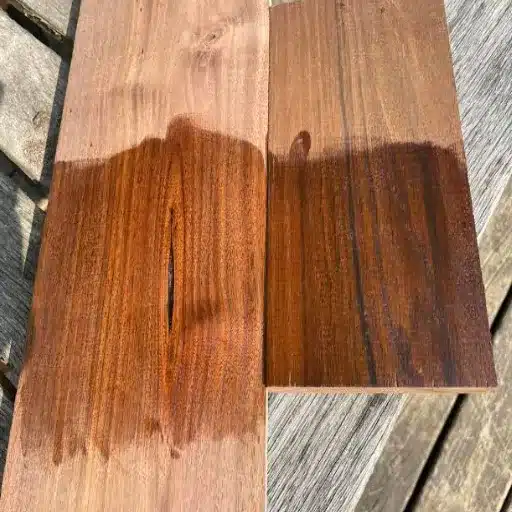
Both walnuts accept oil, lacquer, and conversion varnish. Both can blotch, especially on porous or uneven stock. A washcoat or sanding sealer, followed by a test panel, is the safe approach.
Peruvian walnut’s darker, more uniform color usually needs less toning. Black walnut’s sapwood often needs toning or glazing to produce a uniform face. Walnut dust is a known sensitizer, so use dust extraction, skin protection, and good ventilation.
Cost and Availability: Why Peruvian Walnut Is Not Always Cheaper
Many articles still call Peruvian walnut the budget option. In late 2026, clear-grade retail prices were much closer than that label suggests. These figures vary by grade, width, thickness, and region.
| Species and thickness | Retail price | Source and notes |
|---|---|---|
| Peruvian walnut, 4/4 | $12.30/bf | GPS Hardwoods; about 5 to 8 inches wide |
| Peruvian walnut, 4/4 | $13.50/bf | Advantage Lumber; 100% clear, 5 to 12 inches wide |
| Peruvian walnut, 8/4 | $13.60/bf | Advantage Lumber |
| Black walnut, 4/4 prime clear | From $12.20/bf | GPS Hardwoods |
| Black walnut, 6/4 prime clear | $13.20/bf | GPS Hardwoods |
| Black walnut, 8/4 prime clear | $14.70/bf | GPS Hardwoods |
At 4/4, the two species traded within about $1.30 per board foot. At 8/4, Peruvian was slightly cheaper. At some grades and widths, it can cost more.
Peruvian walnut lumber is imported, so supply varies by shipment, thickness, and grade. Black walnut is domestic and widely stocked, but wide clear boards carry a premium.
The Yield Math: Why Sticker Price Misleads
Price per board foot is only half the calculation. The other half is how much of the board you can use.
Black walnut sapwood is pale and often excluded from clear faces, and its boards tend to be narrower, commonly 5 to 8 inches. Peruvian walnut clear stock often runs 5 to 12 inches with more uniform heartwood. That can mean a higher percentage of usable dark face per board.
For a wide panel or matched doors, Peruvian walnut can be the more efficient buy even at a similar board-foot price. The advantage disappears if the stock has streaks, collapse, or inconsistent color. Veneer yield depends on log quality, slicing method, and layon matching, not board width. For veneered projects, start with our wood veneer cost guide.
Species Substitution Risk
“Peruvian walnut” can describe several Juglans species. That isn’t automatically a problem, but it is a specification risk.
Ask for the botanical name, the country of harvest, the grade, and the sapwood allowance. If the supplier cannot answer, the quote is not comparable. For veneer and architectural panels, also ask about sequencing and strike-off approval.
Sustainability and Sourcing: The Biggest Difference
If you care about responsible sourcing, this is the section that should decide the specification.
Is Peruvian Walnut Endangered?
Juglans neotropica, the main species sold as Peruvian walnut, is listed as Endangered on the IUCN Red List. Its population has declined by more than 50% over three generations, driven by habitat loss and exploitation.
Peruvian walnut is not CITES-listed. That means international trade is not automatically restricted. It also means the due-diligence burden falls on the buyer and importer.
A lack of CITES paperwork isn’t evidence of legality or sustainability. Other species sold under the Peruvian or tropical walnut label may have different statuses, so ask which species you are buying.
Black Walnut’s Domestic Supply Story
Black walnut is IUCN Least Concern and not CITES-listed. US supply is commercially managed, though premium wide and clear stock is limited and priced accordingly. Domestic sourcing shortens the supply chain and simplifies documentation. That doesn’t make every purchase sustainable, but it makes the paper trail easier to verify.
What to Ask a Supplier
Before you specify either species, request:
- The botanical name and country of harvest.
- The FSC or PEFC certificate number, if certification is claimed.
- The grade, sapwood allowance, and minimum clear-face percentage.
- The drying method and target moisture content.
- Lacey Act due-care documentation for US imports, and EUDR readiness for the EU.
- For veneer, the cut, thickness, sequencing, and strike-off approval process.
If you are buying flooring rather than veneer, the same questions apply to sourcing sustainable walnut flooring. Need to verify a species or request documentation? Talk to our team before you place the order.
Peruvian Walnut vs Black Walnut: Which Fits Your Project?
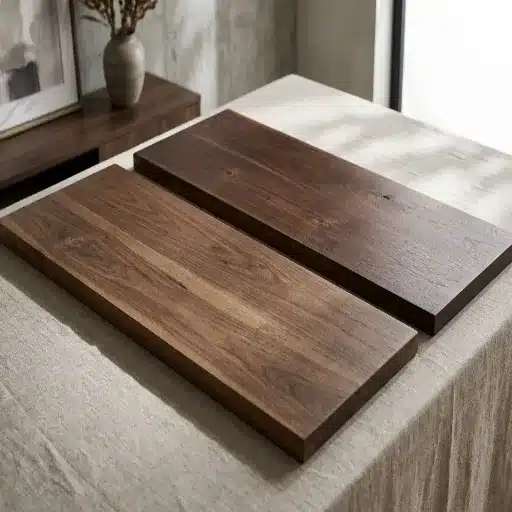
The right answer depends on the application, not on a universal winner.
For Veneer, Panels, and Architectural Millwork
Peruvian walnut suits large, quiet faces and consistent production runs. Its uniform color makes layon matching easier and needs less toning. Black walnut suits cathedral, crotch, and burl figure, and projects that want the traditional American look.
Either way, specify the face grade, cut, thickness, sapwood allowance, and sequencing. For a black walnut face, review our black walnut crown-cut veneer specifications and request a sample. For a broader species overview, see our guide to walnut veneer and our wood veneer species database.
For Flooring
Both are decorative, not high-traffic, flooring choices. Black walnut is harder and stronger. Peruvian is softer but more uniform.
For busy homes, pets, or commercial floors, consider oak or hickory. If you want walnut, an engineered format gives better stability over concrete, basements, and radiant heat. Start with our engineered walnut flooring guide.
Choose Peruvian Walnut If…
- You want a darker, more uniform face with less sapwood contrast.
- You need wide clear stock or consistent veneer color across a layon.
- You are building decorative casework, panels, or furniture where strength is not critical.
- You can verify the species, origin, and certification with your supplier.
Choose Black Walnut If…
- You want domestic provenance and the simplest documentation path.
- You need more strength, stiffness, or decay resistance.
- You want figure, character, and the traditional American walnut look.
- You are steam-bending, building structural members, or making gunstocks.
Frequently Asked Questions
Is Peruvian walnut the same as black walnut?
No. Peruvian walnut is a trade name for several tropical Juglans species, chiefly Juglans neotropica. Black walnut is Juglans nigra, native to eastern North America. They share a genus but differ in origin, color, strength, and conservation status.
Is Peruvian walnut harder than black walnut?
No, but the difference is small. Peruvian walnut rates about 960 lbf on the Janka scale; black walnut rates about 1,010 lbf, roughly 5%. Black walnut is materially stronger in bending and stiffer, so hardness alone understates the gap.
Is Peruvian walnut a hardwood?
Yes. All Juglans species are hardwoods in the botanical sense because they are flowering trees. Hardwood is a biological category, not a claim that the wood is harder than every softwood.
Is Peruvian walnut more expensive than black walnut?
Not reliably. In late 2026, clear 4/4 Peruvian walnut sold for about $12.30 to $13.50 per board foot, while clear 4/4 black walnut started around $12.20. At 8/4, Peruvian can be slightly cheaper. Grade, width, drying quality, and freight move the number more than species alone.
Is Peruvian walnut good for cutting boards?
Yes, when finished with a food-safe oil. It is softer than hard maple, so it works better as an accent wood or a serving board than as a primary chopping surface. Walnut dust can irritate skin and airways, so use dust collection.
Is Peruvian walnut endangered?
Juglans neotropica, the main species sold as Peruvian walnut, is listed as Endangered on the IUCN Red List, with a population reduction of more than 50% over three generations. It is not CITES-listed, so buyers should verify species, origin, and certification.
Conclusion
Peruvian walnut vs black walnut is not a contest with one winner. It is a specification decision.
Peruvian walnut gives you a darker, more uniform face, wider clear stock, and less sapwood waste. Black walnut gives you more strength, stiffness, figure, and a simpler domestic supply chain. The price gap is smaller than the label suggests, and the conservation gap is larger.
Choose Peruvian walnut when the look and face yield matter most, and verify species and origin in writing. Choose black walnut when strength, character, or domestic provenance matter most. If neither fits the project, choose a different species rather than forcing the wrong one.
If you are specifying walnut veneer, panels, or flooring, we can help you compare grades, request samples, and assemble the sourcing documentation your project needs. Request samples and a quote and we will walk through the options with you.