
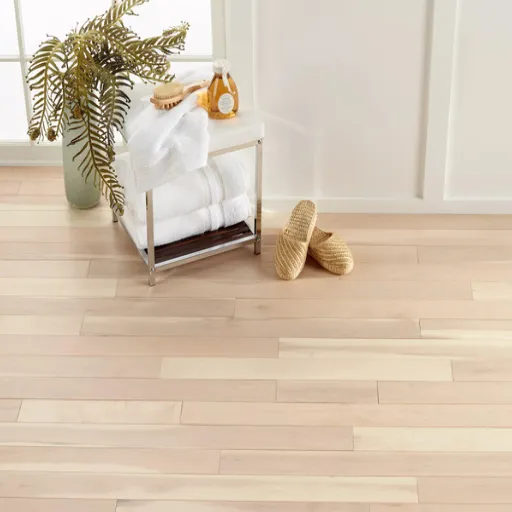
Hickory vs Maple Flooring: Hardness, Movement and Cost
Hickory is the harder floor. Hard maple is the more stable and more uniform one, and at material level it usually costs more.
That reverses two assumptions common in hickory vs maple flooring comparisons. The harder species isn’t automatically the more durable floor, and the calmer species isn’t automatically the cheaper one.
There’s a bigger problem underneath. These labels aren’t the same kind of thing. Hickory is a group of species with a hardness range wide enough to change how a floor performs. “Maple” on a carton is usually a trade grade tied to one species, and the same word also covers a softer group with roughly two thirds the hardness.
Once you separate those ideas, the rest is practical: movement, grade, cost, sanding life. We buy, slice, grade and bond hardwood for a living, so this guide stays with the numbers a specification needs. For species background, start with our engineered hickory flooring guide.
Key Takeaways
- Hickory rates 1,820 to 2,140 on the Janka scale; hard maple rates about 1,450, and soft maple about 950.
- Hard maple is the more dimensionally stable floor: 4.8% radial shrinkage against 7.0% to 7.2% for hickory.
- Hickory’s color variation is controllable through grade. Maple’s uniformity comes from the species, not from grading.
- Published benchmarks put maple above hickory at material level, $6.25 to $10 against $4.15 to $7.15 per square foot, though a 2026 retailer list shows them nearly level.
- On both species the finish takes the wear, so coating choice decides scratch visibility more than the wood does.
If you want the two surfaces side by side, request hickory and maple samples and tell us the room, the subfloor and the finish direction.
What “hickory” and “maple” actually mean on a carton
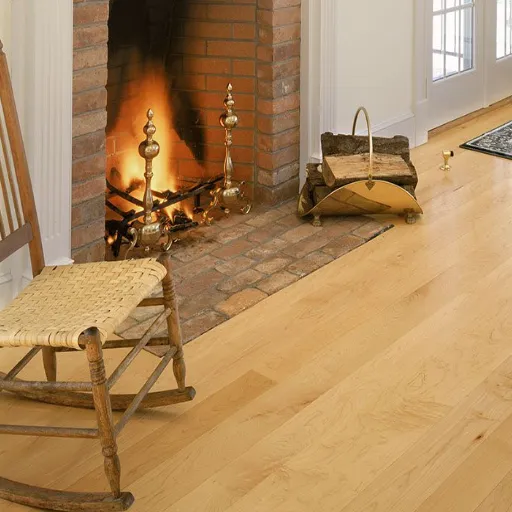
A species name on a carton is a purchasing label, not a botanical statement.
Hickory is a group. It covers the true hickories and the pecan hickories. Shagbark (Carya ovata) and pignut (Carya glabra) are the most quoted, but mockernut, shellbark and pecan move through the same channel.
The group isn’t uniform. Shagbark rates 1,880 on the Janka scale, pignut rates 2,140, and pecan sits near 1,820 but is routinely sold as hickory. One carton can hold cream sapwood, reddish-brown heartwood and blue-black mineral streaks. That’s the species, not a defect.
“Maple” is a grade standard. Most flooring sold as maple is hard maple: sugar maple (Acer saccharum) and black maple. The Maple Flooring Manufacturers Association grades it as Northern Hard Maple in five grades, from First to Utility. Those grades describe appearance, not strength; a Third grade board and a First grade board are the same wood.
Then there is the trap. Red maple rates about 950 on the Janka scale and is also sold as maple. Red, silver, boxelder and bigleaf maples all fall under the soft maple label, so a quote that says only “maple” doesn’t tell you which group you’re buying.
Specification check: name the species, botanical name, grade standard, wear layer in mm, finish type, and moisture content at dispatch. For maple, name Acer saccharum and the MFMA grade.
A supplier who can’t answer those six points isn’t ready to quote a project floor. Our guide to hard maple vs soft maple covers the verification test.
Hickory vs maple flooring at a glance
Four columns, because the maple column is where most comparisons go wrong.
| Factor | Hickory (shagbark / pignut) | Hard maple | Soft maple (red) |
|---|---|---|---|
| Janka hardness | 1,880 / 2,140 lbf | 1,450 lbf | 950 lbf |
| Density (oven-dry) | 50 / 52 lb/ft³ (800 / 835 kg/m³) | 44.0 lb/ft³ (705 kg/m³) | 38 lb/ft³ (610 kg/m³) |
| Shrinkage R / T / V | 7.0–7.2% / 10.5–11.5% / 16.7–17.9% | 4.8% / 9.9% / 14.7% | 4.0% / 8.2% / 12.6% |
| Grain | Bold, open, dramatic | Fine, closed, subtle | Fine, closed, some figure |
| Color range | Very wide, cream to dark brown | Cream to pale tan, uniform | Cream to light tan, gray streaks |
| Dent resistance | Highest of the three | High | Moderate |
| Staining behavior | Density varies between sap and heart | Blotches; needs pre-conditioner | Blotches; needs pre-conditioner |
| Workability | Difficult; blunts cutting edges | Fairly easy; burns at router speed | Easy |
| Material cost, 2026 | $4.15–$7.15/sq ft | $6.25–$10/sq ft | Not separately quoted |
Quick verdict: choose hickory for dent resistance and visual character, and accept its movement. Choose hard maple for a calm, uniform floor that stays flatter across seasons, and budget more for material. Choose neither if you can’t control indoor humidity, because both are solid hardwood.
Hardness: hickory wins by about a quarter
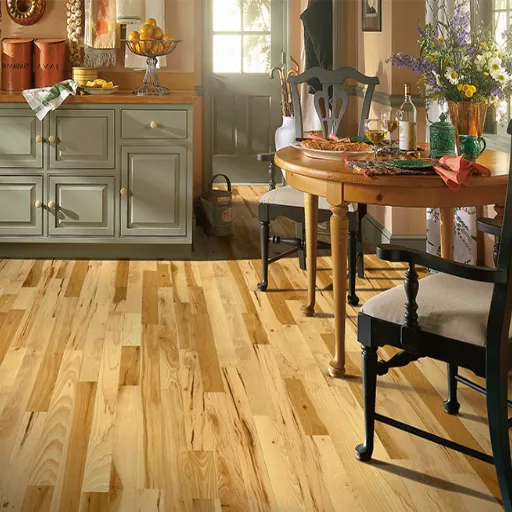
Hickory is roughly 26% harder than hard maple at the commercial average, 30% harder if the carton holds shagbark, and 48% harder if it holds pignut. Against soft maple the gap is close to double.
That means hickory resists dents from chair legs, dropped tools and large dogs better than any common domestic species. Hard maple is no slouch; it’s the wood behind most gymnasium floors.
Density tells the same story. Hickory runs 50 to 52 pounds per cubic foot against 44 for hard maple, so a hickory plank is 14% to 18% heavier for the same volume. That weight is why the species feels solid underfoot and why it fights a saw blade.
What Janka measures, and what it does not
Janka hardness measures the force needed to push a steel ball halfway into a wood sample. It predicts dents. It says nothing about scratches.
Scratches happen in the finish: aluminum oxide, UV-cured polyurethane, hardwax oil. A harder substrate doesn’t make the coating tougher, and hickory’s advantage disappears the moment a dog’s nail crosses the surface.
There is even a case against hickory on visible wear. Its faces alternate between pale sapwood and dark heartwood, so a fine scratch crossing a color boundary reads more clearly than the same scratch on a uniform maple board. Maple has its own problem: a pale surface that shows dust and dark marks readily. Choose a matte or wire-brushed finish on either, and put felt pads under the furniture.
Appearance: calico hickory vs uniform maple
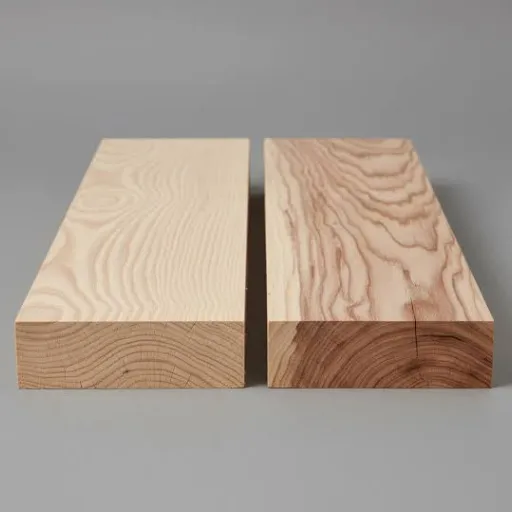
This is the difference buyers notice first, and the one that can’t be fixed later.
Hickory is a high-contrast floor. Pale sapwood sits beside medium and dark heartwood, often within one plank, plus mineral streaks that read almost black. The trade calls the result calico. There is no neutral hickory floor, and the pattern is why people either love the species or return the sample.
Hard maple is the opposite. The grain is fine and closed, the color runs cream to pale tan, and adjacent boards differ only slightly. Soft maple carries more figure and occasional gray streaks, one more reason to confirm the species rather than trust the word.
Grade is how you control hickory’s variation
- Select or Clear. The most uniform boards, highest cost, closest to a maple-like calm, and never entirely calm.
- Natural or Character. Mixed sapwood and heartwood, the classic calico look, and the grade most hickory floors are sold in.
- Rustic. Knots, checks and heavy character marks, the widest visual range.
Grade names aren’t standardized across mills, and one supplier’s natural is another’s character. Ask for a photograph of an installed floor in the grade you’re buying, not a hand sample. Our guide to hickory flooring color variation covers lot control and blend boxes.
Illustrative scenario: a buyer we will call Dana approved a single dark hickory board under showroom lighting, then took delivery of 40 boxes. The installed floor read far lighter than her sample because most of the shipment was sapwood. The fix would have cost nothing at the order stage: a full-layout photo, a same-lot sample, and a 5% attic stock allowance.
How each species ages
Both floors change with light. Oil-modified finishes amber, water-based finishes stay clearer, and the wood itself shifts with exposure.
Maple’s change is more visible because it starts pale. It yellows under light and takes on a warm cast within a few years, which surprises buyers who chose it for a cool white tone. See why maple flooring turns yellow for the chemistry and the control options. Hickory shifts too, but its light-to-dark contrast masks the change; what you notice is the “tan line” where a rug sat for two years.
Movement and stability: maple wins clearly
This is the section most comparisons skip, and where the decision actually lives.
| Species | Radial | Tangential | Volumetric |
|---|---|---|---|
| Shagbark hickory | 7.0% | 10.5% | 16.7% |
| Pignut hickory | 7.2% | 11.5% | 17.9% |
| Hard maple | 4.8% | 9.9% | 14.7% |
| Soft maple (red) | 4.0% | 8.2% | 12.6% |
Shrinkage is the percentage change from green to oven-dry, the standard way wood scientists express how much a species moves. Radial runs across the rings, tangential along them, volumetric is the total.
Read the radial column first. Hickory moves 46% to 50% more than hard maple in that direction, and radial movement drives cupping and joint opening on narrow strip floors. Read tangential second and the gap narrows to 6% to 16%, which is why some suppliers call the two species similar in stability. Both statements are true; they describe different axes.
Why width changes the answer
Board width multiplies movement. A three-inch strip absorbs a few percent of expansion in its joints. An eight-inch plank must absorb the same percentage across a wider face, so visible gaps and cupping risk both grow.
That’s the engineering case for an engineered core on wide hickory. A cross-laminated plywood or HDF core resists seasonal movement in a way a solid board can’t, and it doesn’t change surface hardness at all. Our guide to engineered wood flooring covers core construction; the maple equivalent is on our engineered maple flooring page.
Illustrative scenario: a condo owner we will call Raj wanted seven-inch hickory over a concrete slab in a building with a dry heating season. Solid hickory failed twice over: no practical fastening to slab, and too much movement at that width. Engineered hickory with a 3 mm wear layer and a moisture barrier solved the movement question. Hardness never entered the decision.
Neither species is water-resistant in any meaningful way. Neither has the tyloses that make white oak useful near a sink. Keep relative humidity roughly between 30% and 55%, follow the manufacturer’s warranty figure where the two differ, and test the subfloor before installation on either species.
Hickory vs maple flooring cost (2026)
Two public benchmarks disagree, and explaining why is more useful than adding a third.
| Species | Material per sq ft | Source and date |
|---|---|---|
| Maple | $6.25–$10 | Fixr, updated January 31, 2025 |
| Hickory | $4.15–$7.15 | Fixr, updated January 31, 2025 |
| Maple | $4–$8 | D&G Flooring, published March 24, 2026 |
| Hickory | $4–$9 | D&G Flooring, published March 24, 2026 |
Fixr puts maple well above hickory. D&G puts the two nearly level, slightly favouring hickory at the top end. Both are honest ranges for different product mixes: grade, width, wear layer and finish move the number more than species does.
Installed cost blurs further. Fixr reports $9 to $23 per square foot for solid hardwood and $8 to $14 for engineered, without splitting by species. D&G reports $6 to $18 overall with a national average of $8 to $14, and labour at $3 to $8.
The practical reading: at material level maple has historically carried a premium, and in 2026 that premium is narrower than older figures suggest. At installed level the two usually land in the same band, because labour, subfloor preparation and wear layer dominate.
Why maple’s material price runs high
Hard maple grows slowly and yields less usable clear stock per log than many competitors. Selected pale, uniform boards are the scarcest part of the supply, and a First grade maple floor needs a lot of them.
There is a counterintuitive point worth stating plainly. Maple’s premium buys uniformity and stability, not hardness. If dent resistance is the goal, hickory delivers more of it for less money.
Comparing two quotes right now? Send both specifications to our team and we will point out which line item is driving the gap: grade, width, wear layer or finish.
Installation, staining and finishing
Both species are real hardwood and both need the same site conditions. What differs is how they behave under a tool and under a stain.
Workability. The Wood Database calls hickory difficult to work: tearout is common unless edges stay sharp, and it blunts them. More sharpening, more pre-drilling, slower sanding. Hard maple is rated fairly easy, except that it burns at router speed. That labour gap is why installed hickory can top a local band even when material is cheaper.
Staining. Both blotch, for different reasons. Maple’s density is even; its closed grain resists pigment, so use a pre-conditioner, gel stain or toner. Hickory’s density varies between sapwood and heartwood, so the same stain sits differently plank to plank and the floor reads mottled.
Test panels from the actual lot either way, and consider leaving the floor natural. Hickory’s character is the product; a heavy stain fights it.
Finish decides the scratch story. The coating takes the wear, so finish choice does more for durability here than species does. Matte and wire-brushed finishes hide fine scratches. High-gloss shows every mark and is slippery for older dogs. Aluminum oxide wears well but is hard to recoat locally. Hardwax oil spot-repairs, at the cost of more frequent maintenance.
Engineered vs solid: wear layers and refinishing
Engineered construction changes stability and refinishing life. It doesn’t change surface hardness, and it doesn’t make a soft floor hard.
| Wear layer | What it supports | Practical refinishing |
|---|---|---|
| 0.6 mm | Entry-level engineered | No sanding; recoat only if the finish is compatible |
| 1–2 mm | Standard residential | One careful sand, or a screen and recoat |
| 3–4 mm | Premium residential, light commercial | One to two full sands |
| 6 mm and above | High-end residential, commercial | Two to three full sands over decades |
The National Wood Flooring Association’s working rule is to stop before the wear layer falls below 3/32 inch, about 2.4 mm, above the tongue. Below that, a sand risks the joint.
Hickory benefits more from the engineered format than maple does, because it moves more. On a concrete slab, over radiant heat, or in a basement, a cross-ply core is close to mandatory for hickory and merely sensible for maple. Our refinishing engineered hardwood floors guide covers the sanding sequence.
Solid still wins when a thick board goes over plywood and gets site-finished: many sandings, no glue line, no core. That advantage belongs to solid stock, not to either species.
Choose hickory if, choose maple if
Choose hickory if
- You have large dogs, children or heavy traffic and want maximum dent resistance.
- You like bold, high-contrast character and want the floor to be a feature.
- You are buying wide planks and will use an engineered core.
- You can hold indoor humidity in a stable band.
- You want more hardness per dollar at material level.
Choose hard maple if
- You want a calm, pale, uniform floor with minimal visible variation.
- Stability across seasons matters more than dent resistance.
- The design is modern or minimalist and the floor should recede.
- You are specifying a sports or studio floor, where maple is the established standard.
- You accept that pale faces show dust and fine marks.
The six-question decision check
- How much denting will you actually tolerate?
- Can you live with calico variation, or does the floor need to be calm?
- How wide are the boards, and is the core engineered?
- What is the subfloor: plywood, concrete, or radiant heat?
- What is the all-in budget, including trim, preparation and removal?
- How many refinishes do you need over the next 30 years?
Answer those honestly and the species usually picks itself. If the answer is still split, the tie-breaker is resale: a uniform maple floor is the safer choice for a buyer who doesn’t share your taste.
Frequently asked questions about hickory vs maple flooring
Is hickory harder than maple?
Yes. Hickory rates 1,820 to 2,140 on the Janka scale, while hard maple rates about 1,450. That makes hickory roughly 26% to 48% harder depending on the hickory species. Soft maple rates about 950, so the gap against a “maple” floor can be nearly double.
Is hickory or maple more expensive?
Maple usually costs more at material level. One benchmark puts hard maple at $6.25 to $10 per square foot and hickory at $4.15 to $7.15. A 2026 retailer list shows $4 to $8 and $4 to $9, which is nearly level. Installed prices often overlap because labour and wear layer outweigh species.
Is maple or hickory more stable?
Maple. Hard maple shrinks about 4.8% radially, 9.9% tangentially and 14.7% volumetrically. Hickory shrinks 7.0% to 7.2%, 10.5% to 11.5% and 16.7% to 17.9%. The radial gap of nearly 50% matters most on wide planks and over concrete.
Does hickory scratch more easily than maple?
Not exactly. Hickory dents less, but the finish takes scratches on both species. Hickory’s light-to-dark contrast can make a fine scratch more visible, while maple’s pale uniform face shows dust and dark marks. Finish type and sheen matter more than the wood.
Is hickory or maple better for dogs?
Hickory resists dents from claws and toys better. Maple hides some marks better because its grain is uniform rather than high contrast. For most pet households the practical answer is either species with a matte, textured finish and a wear layer of at least 3 mm.
Is hickory or maple better for kitchens?
Neither is waterproof, so the answer depends on moisture control. Maple moves less under humidity swings, which helps near a sink or dishwasher. Hickory works if the floor is engineered, sealed and the humidity stays controlled. Clean up spills promptly on both.
Can you stain maple to look like hickory?
No. Hickory’s look comes from plank-to-plank variation in the wood itself. Stain applies evenly by design, so it can’t recreate calico contrast. A variegated technique can suggest variation, but it won’t match a natural hickory floor.
Is soft maple as good as hard maple for flooring?
For a bedroom or home office, often yes. Soft maple is a legitimate hardwood and it actually moves less than hard maple. It is a poor choice for kitchens, entries and stairs, where its 950 Janka rating will show dents. Confirm Acer saccharum on the quote if you are paying for hard maple.
Conclusion
Hickory vs maple flooring comes down to one trade. Hickory gives you the hardest common domestic surface and the boldest natural look, at the cost of more movement and more color variation. Hard maple gives you a calmer, flatter, more predictable floor, usually at a higher material price and with less dent resistance than its reputation suggests.
Three things decide it in practice. Confirm which species you’re actually buying, because “maple” alone can mean a floor a third softer. Match board width to the species, and use an engineered core when hickory goes wide. And specify the finish deliberately, because that’s what takes the wear.
For samples, certification documents or a wholesale quote on hickory and maple, send your specification to our team. Include the room, the subfloor, the board width and the grade you have in mind, and we will confirm what can be matched across the run before you order.
Related reading: hickory vs oak flooring for the other comparison in this family, and hickory flooring pros and cons for the trade-offs in one place.