
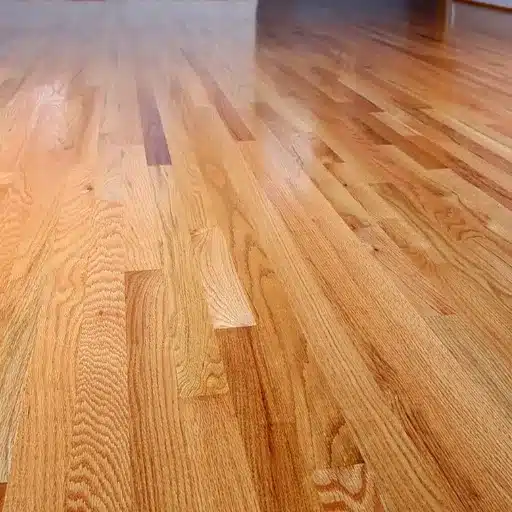
Can You Refinish Prefinished Engineered Hardwood Flooring?
Yes, you can refinish prefinished engineered hardwood, but only when two conditions are met: the real-wood wear layer is thick enough to survive sanding, and you’re ready to deal with the factory aluminum oxide coating on top of it. Miss either one and a $3,000 refresh becomes a full replacement.
Here’s the uncomfortable part. The floor that looks most worn out and the floor carrying the longest warranty are often the same floor you can’t fix. A 50-year finish warranty can sit on a 1.2 mm wear layer, because that number describes how long the factory coating resists abrasion, not how much wood you have left to sand.
If you already know prefinished was the right call and just want your options now, our guide to prefinished engineered wood flooring covers the full specification picture. This article answers the narrower question: can your specific floor come back?
Key Takeaways
- You can refinish prefinished engineered hardwood only if the wear layer is roughly 2.5 mm or thicker. NWFA sets a 2.5 mm minimum for factory-finished engineered products and 3.2 mm for unfinished ones.
- The factory aluminum oxide finish, not the wear layer, is usually what makes the job difficult. At Mohs 9, it glazes a rented sander and consumes far more abrasives than site finish.
- A screen-and-recoat frequently fails on aluminum oxide. The coating is too hard to key mechanically, and Teflon, Scotchgard or cleaner residue can block adhesion outright.
- Bevels decide your cost. Flattening them gives a seamless floor but removes extra veneer and adds about $1 to $2 per square foot in labor.
- Full refinishing runs $3 to $8 per square foot; replacement runs $8 to $25. Below a 1.2 mm wear layer, those two numbers stop being far apart.
Can You Refinish Prefinished Engineered Hardwood? The Two Tests
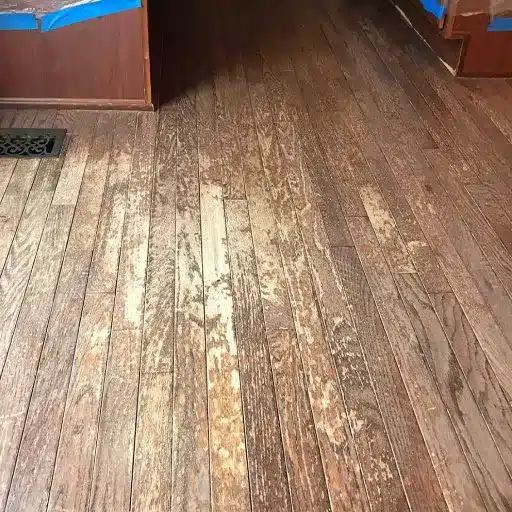
You can refinish prefinished engineered hardwood when the wear layer is at least 2.5 mm and the floor is structurally sound. Between 2 mm and 2.5 mm, one very careful professional pass may be possible, but a screen-and-recoat is the safer route. Below 2 mm, replacement becomes the realistic answer.
Two independent tests decide your outcome.
Test one is thickness. How much real hardwood sits above the core? That’s the hard limit on sanding, and it has nothing to do with the finish.
Test two is condition plus coating. Is the floor flat and dry, and can the aluminum oxide film be removed or bonded over? A floor can pass the first test comfortably and still fail this one.
Most published answers stop at test one, which is why so many homeowners discover the bevels, the recoat rejection and the abrasive bill only after they start.
How Much Wear Layer Do You Need to Refinish Prefinished Engineered Hardwood?
Wear layer is measured in millimeters, and it determines whether refinishing is available to you at all. Check the specification sheet first, then confirm it on the floor.
| Wear Layer | Can You Sand It? | Realistic Refinishing Cycles |
|---|---|---|
| 1.2 mm | No | Recoat only, or replace |
| 2 mm | Borderline | One careful professional pass |
| 2.5 to 3 mm | Yes | One to two cycles |
| 4 mm | Yes | Two to three cycles |
| 6 mm | Yes | Three or more, approaching solid wood |
The National Wood Flooring Association sets the floor at 2.5 mm for factory-finished engineered products and 3.2 mm for unfinished ones. That’s a published benchmark worth knowing before a contractor tells you something different.
NWFA’s trade guidance also warns that meeting the minimum doesn’t clear you to sand, because a standard pass removes roughly 1/32 inch and bevels consume more:
“Sometimes 3/32 inch is not enough if the beveled edges are so deep that sand through may occur by the time the bevels are sanded out.”
That sentence explains more failed refinishing jobs than any other factor: a 2.5 mm floor with shallow bevels can be restored, while a deep-beveled one may not have material to spare.
Three ways to check your own floor:
- Read the specification sheet. The product name, order record or a label inside a closet usually carries the wear layer.
- Look at a cut edge. Pull a floor vent or lift a threshold at a doorway. You’ll see the veneer and core in cross-section.
- Run the nickel test. A US nickel is about 1.95 mm thick. If the veneer looks thinner than the coin’s edge, don’t sand it.
Don’t pry up a good plank just to measure it. If the floor has already been sanded once, your margin is smaller than the specification suggests. Our article on how long prefinished engineered wood flooring lasts breaks lifespan into its finish, veneer and core components if you want to model the years left.
Why Refinishing Prefinished Engineered Hardwood Is Harder Than Solid
On a site-finished floor, the coating is applied in your home and stays soft enough to sand off predictably. On a prefinished floor, the coating is the product.
Factory finishes are UV-cured urethane with aluminum oxide in the top coats. That mineral sits at Mohs 9, second only to diamond, and finishing suppliers describe these systems as roughly 10 times more abrasion-resistant than conventional finishes. That durability is why prefinished floors hold up for a decade. It’s also why removing them is the hardest part of the job.
The first pass is the worst pass: most of the labor and nearly all the abrasive consumption happens while you cut through the factory coating. A lightweight orbital sander with a worn disc polishes the surface rather than removing it.
Professional shops use coarse 30 to 40 grit abrasives, and on some finishes diamond-embedded discs on a planetary sander, before stepping back down through a progressive grit sequence. Anything left behind becomes a bonding problem for the next coating.
Our explainer on aluminum oxide floor finish covers how the mineral is loaded into the coating, why “seven layers” often means aluminum oxide in only the top two, and why factory finishes out-wear site-applied polyurethane while resisting repair.
What Happens to the Bevels When You Sand?
Prefinished planks carry a micro-bevel, a small chamfer machined at each edge. It absorbs normal milling variance and hides overwood, the tiny height differences between adjacent planks that production speed makes impossible to eliminate.
When you refinish, you have to choose what happens to them. There’s no neutral option, because sanding either takes them down or it doesn’t. The generic sand-and-recoat workflow is covered in our refinishing engineered hardwood floors guide. What matters here is that a factory bevel changes the arithmetic.
Flatten the bevels and you get a smooth, continuous surface that looks site-finished. Dirt no longer collects in the grooves and cleaning gets easier. The cost is material: sanding bevels out removes noticeably more wear layer, and it can expose the plank height inconsistencies the bevels were hiding.
Keep the bevels and you sand less aggressively, preserve veneer for future cycles and retain the floor’s original character. The trade-off is that the grooves keep trapping grit, and they stay visible.
Removing bevels typically adds about $1 to $2 per square foot in labor, and a dime makes a useful gauge: if the remaining bevel depth is thicker than a dime, you either need more passes or you should leave them alone.
Never fill bevels with putty. Wood moves with the seasons and filler doesn’t. It cracks and peels within months, and NWFA guidance is consistent on this point.
Can You Screen and Recoat Prefinished Engineered Hardwood?
A screen-and-recoat is a light abrasion of the existing finish followed by a new protective coat, without sanding to bare wood. It restores sheen while removing almost no material, making it the obvious candidate for a thin wear layer.
On aluminum oxide, it frequently fails. The reason is mechanical and chemical at once. AO is hard enough that a fine screen under a buffer may barely scratch it, so a water-based finish has nothing to grip. Factory coatings can also carry high surface tension, plus additives such as Teflon or Scotchgard that actively repel a new coat.
Contamination makes it worse. Oil soaps, household cleaners and furniture polish leave residue that a buffer simply smears around, and the trade press documents how often those failures trace back to surface tension and cleaner residue rather than technique.
What actually works:
- A manufacturer recoat-adhesion or bonding system. These clean and condition the factory finish chemically so a compatible topcoat can bond. They’re specified for aluminum oxide and ceramic finishes.
- The finish manufacturer’s own approved topcoat. Adhesion systems are paired with specific finishes, not any finish on the shelf.
- A test patch, every time. Coat a small area in a closet, let it cure, then try to scratch it off with a fingernail. If it lifts, stop.
If the test patch fails, you have two options: sand properly, or replace. There’s no third path.
One more caution. Recoating isn’t viable on hand-scraped, distressed, cupped or overwood floors, because you can’t abrade the surface evenly enough for a reliable bond. If you want to keep a factory finish in service longer, routine care matters more than any repair technique, and our prefinished engineered flooring maintenance guide covers the products that protect it.
What It Costs to Refinish Prefinished Engineered Hardwood
| Approach | Typical Cost per Sq Ft | Best For |
|---|---|---|
| DIY screen-and-recoat | $0.50 to $1.50 | Thin veneers, confident DIYers |
| Professional screen-and-recoat | $2 to $4 | Thin veneers, occupied homes |
| Professional full refinish with AO removal | $3 to $8 | Wear layers of 2.5 mm and above |
| Full replacement | $8 to $25 | Core damage, spent veneer, layout changes |
On a prefinished floor, expect a bump at the top of any full-refinish quote. The aluminum oxide coat consumes more abrasives and slower machine time, so good bidders itemize it rather than hiding it. A quote far below the local range for a full sand is the shortcut, so ask what abrasives and equipment they plan to use.
A 500 square foot living room runs roughly $1,500 to $4,000 professionally, against $4,000 to $12,500 to replace. The return is real too: according to National Association of Realtors remodeling data, hardwood floor refinishing recovers about 147% of its cost at resale.
Where the math changes is on thin veneers. If your floor carries 1.2 mm and the finish has worn through, a full refinish isn’t available at any price, so the comparison is no longer $3,000 against $9,000. It’s $9,000 against nothing. For how material and format move pricing, see our engineered wood flooring cost breakdown.
Want the specification checked before you commit to a method? Send us your product details and our team will tell you what the wear layer and finish system realistically allow.
DIY Versus Professional on a Factory Finish
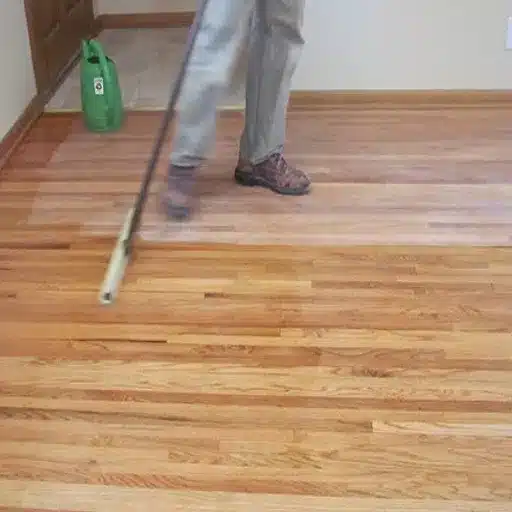
Refinishing solid hardwood is demanding but forgiving. Refinishing a factory-finished engineered floor is neither.
The difference is the margin for error. A solid 3/4 inch floor has decades of material behind the surface, so a heavy-handed pass costs you one future refinishing cycle.
On a 2.5 mm veneer, one over-sanded spot exposes the core permanently. There isn’t a repair for that. The board comes out.
Stay in DIY territory only when all four are true:
- You’re screening rather than sanding flat.
- The wear layer is 3 mm or thicker.
- You’ve run a successful test patch.
- You accept that a mistake is unrecoverable.
Hire a professional when any of these applies:
- The wear layer is 2.5 mm or less.
- The floor has been refinished before.
- You want the bevels flattened.
- You want a different stain color.
There’s also a warranty consideration. On prefinished flooring, sanding, screening or applying a third-party coating commonly voids the finish warranty outright. If your floor is inside its coverage window, find out before you take a machine to it. Our comparison of prefinished and unfinished flooring shows why that same limitation is the strongest argument for choosing unfinished when you know you’ll want to change the color later.
Priya learned this the expensive way. She screen-and-recoated her dark walnut aluminum oxide floor herself in the spring using a cleaner and a bonding product from a hardware store. It looked excellent through the summer.
By the following winter, the new coat had flaked along the bevel edges in every doorway. Feathering it out meant sanding the whole room, which her 2 mm veneer couldn’t afford. The recoat cost her the refinish. A $40 test patch in the closet would have shown her the adhesion problem before she committed the room.
When Refinishing Is Not the Answer
Sometimes the most sustainable choice is accepting the floor has reached the end of its service life. Refinishing is off the table in a specific set of conditions:
- The wear layer is 1.2 mm or less and the finish has worn through.
- Boards are cupping, crowning or delaminating.
- The core shows moisture damage or mold.
- Deep gouges reach the full depth of the wear layer.
- The floor has already been sanded once or twice.
- The surface is heavily hand-scraped, with low points below minimum thickness.
- You want a different species.
Ray is a flooring contractor who walks away from jobs like this. A client in 2025 asked him to flatten a hand-scraped engineered floor with a listed 2 mm wear layer. The scraping averaged more than a millimeter of relief, so sanding to the bottom of the texture would have cut clean through the veneer across the room.
He declined the work and specified a 4 mm replacement instead. The client was unhappy for a week. They’d have been unhappier still looking at exposed HDF in their living room.
If what you’re actually seeing is uneven gaps, overwood at butt joints or bevels that have widened with the seasons, that’s a different diagnosis with a different answer. Our article on prefinished engineered hardwood problems separates normal appearance from genuine defect, because the remedy isn’t refinishing.
When replacement is the answer, buy the wear layer you actually wanted the first time. Specify 3 mm or more, keep the spare boxes, and record the product details so a future refinish is a decision rather than a discovery.
Frequently Asked Questions
Can you refinish prefinished engineered hardwood?
Yes, if the wear layer is roughly 2.5 mm or thicker and the floor is structurally sound. Between 2 mm and 2.5 mm, one careful professional pass may work, but a screen-and-recoat is safer. The aluminum oxide finish slows the sanding down; it doesn’t change the wear-layer rule.
Can I refinish a floor with a 2 mm wear layer?
It’s borderline rather than impossible, which is why 2 mm generates the most disagreement. One very careful pass by an experienced professional can work. Full refinishing isn’t reliably available, and some manufacturers advise against sanding at all.
Why will a screen-and-recoat not stick to my aluminum oxide floor?
Because the coating is too hard to key mechanically and chemically hostile to new finishes. Aluminum oxide raises surface tension, and factory coatings often include additives such as Teflon or Scotchgard that repel water-based products. A manufacturer recoat-adhesion system plus an approved topcoat is the reliable route.
Do I have to sand the bevels out?
No. Keeping them is a valid choice that removes less veneer, preserves refinishing potential and keeps the floor’s original character. Flattening gives a seamless site-finished look but consumes extra wear layer and adds about 1to1to2 per square foot in labor.
How many times can prefinished engineered hardwood be refinished?
It depends entirely on wear layer. A 2 mm veneer allows one careful pass at most, a 2.5 to 3 mm veneer usually supports one to two cycles, and 4 mm supports two to three. Flattening bevels reduces the count.
Conclusion
You can refinish prefinished engineered hardwood when the wear layer gives you material to work with, and the honest threshold sits around 2.5 mm. Above it, the factory aluminum oxide coating is a difficulty rather than a barrier, because it must come off completely, it fights a screen-and-recoat, and it makes the first pass the most expensive hour of the job. Below it, a recoat is your refresh and replacement is your answer.
Three things decide which path you’re on. The wear layer sets the limit. The aluminum oxide film sets the effort. The bevels set the cost.
Getting this right isn’t only about money. Keeping a certified, sustainably sourced wood floor in service holds on to the carbon stored in that veneer and keeps a repairable floor out of a landfill. When the veneer genuinely is spent, replacing it with a thicker specification is the responsible choice, because the next owner will have the option you didn’t.
Ready to source flooring you can actually refinish later? Contact the VitalWood Global team for wear-layer specifications, finish-system guidance, samples and wholesale pricing.
If you’re still choosing your surface, our veneer finishing capabilities show how factory coatings are built and tested before they ship.